
What Does P0441 Mean? Causes, Symptoms, Diagnosis, and Fixes

Quick Answer
P0441 means your vehicle detected incorrect purge flow in the evaporative emission control, or EVAP, system. The problem often involves the purge valve, EVAP hoses, charcoal canister, vent system, or another component that controls fuel vapor flow. The code usually isn’t an immediate breakdown warning, but it should be diagnosed because the EVAP system helps prevent fuel vapors from escaping. You can also check general vehicle safety information through NHTSA.
Common reasons for P0441
- Faulty purge valve: The valve may stick open, remain closed, or fail to control vapor flow correctly.
- Damaged EVAP hose: Cracked, loose, kinked, or disconnected vapor lines can interfere with expected purge flow.
- Gas-cap problem: A damaged seal or improperly installed cap can affect some EVAP monitoring strategies.
- Charcoal-canister issue: A restricted, damaged, or fuel-saturated canister can disrupt vapor movement.
- Vent-system fault: A blocked vent valve or restricted fresh-air path can prevent the EVAP system from operating normally.
- Sensor or wiring fault: Electrical problems can make the engine computer detect purge flow incorrectly.
What should you do first?
- Scan for other EVAP codes, inspect the gas cap and visible hoses, then test the purge system before replacing parts.
If your scanner shows P0441, don’t start buying EVAP parts at random. I’ve seen purge-flow codes caused by everything from a loose hose to a purge valve that looked fine until it was tested under vacuum.
This guide explains what P0441 means, how the EVAP system works, what usually causes the code, and how to diagnose it logically.
In This Guide
What Does the P0441 Code Mean?
P0441 is a generic OBD-II diagnostic trouble code meaning Evaporative Emission Control System Incorrect Purge Flow. The vehicle’s computer expected a certain EVAP purge condition but detected something different.
This is primarily an emissions-system code rather than a key, immobilizer, transmission, or internal engine code.
What does the EVAP system do?
The evaporative emission control system captures gasoline vapors that would otherwise escape from the fuel system. Those vapors are temporarily stored and later sent into the engine to be burned.
A typical EVAP system can include:
- Fuel tank: Stores liquid fuel while containing fuel vapor.
- Charcoal canister: Stores fuel vapor using activated carbon.
- Purge valve or purge solenoid: Controls vapor flow toward the engine.
- Vent valve: Controls fresh-air entry and seals the system during certain self-tests.
- EVAP hoses: Carry vapor between the tank, canister, valves, and engine.
- Fuel-tank pressure sensor: On many vehicles, it helps the computer monitor pressure or vacuum changes.
- Fuel cap or capless filler: Helps maintain the system’s intended seal.
The purge valve normally opens under conditions chosen by the engine computer. Engine vacuum then draws stored fuel vapor from the charcoal canister toward the intake.
If the computer commands this process and doesn’t see the expected result, P0441 may be stored.
Does P0441 mean there is an EVAP leak?
Not necessarily. P0441 specifically points toward incorrect purge flow, while codes such as P0442, P0455, or P0456 more directly describe EVAP leak conditions.
However, the systems overlap. A leak, restriction, bad valve, or disconnected hose can sometimes interfere with the purge-flow test and contribute to P0441.
Locksmith’s note: An OBD-II scanner tells you what the computer detected, not which part has definitely failed. Treat P0441 as the start of diagnosis rather than a parts-replacement instruction.
Section Takeaway: P0441 means the vehicle detected incorrect EVAP purge flow. It does not automatically prove that the purge valve itself is bad.
What Causes a P0441 Code?
A failed purge valve is one common possibility, but it’s not the only one. The correct cause depends heavily on the vehicle’s EVAP design.
1. Purge valve stuck closed
If the purge valve cannot open, fuel vapor won’t flow toward the engine when the computer commands purge. The system may detect little or no expected vacuum change.
Carbon deposits, internal mechanical wear, or an electrical failure can prevent proper operation.
2. Purge valve stuck open
A purge valve can also fail in the open position. That allows vapor or intake vacuum to move through the system when the computer expects the valve to be closed.
This fault may cause rough starting or idle problems on some vehicles, especially after refueling.
3. Cracked, loose, or disconnected EVAP hose
EVAP hoses live around heat, fuel vapor, road debris, and age-related deterioration. A hose can split, collapse internally, disconnect, or develop a loose connection.
Any of those conditions may change the expected purge flow.
4. Restricted charcoal canister
The charcoal canister stores fuel vapors until the engine can consume them. If airflow through the canister becomes restricted, the purge valve may open without producing the expected vapor flow.
A canister can also become contaminated if liquid fuel repeatedly enters a part designed mainly for vapor.
5. Vent-valve or vent-path problem
The EVAP system needs controlled airflow. A blocked vent filter, stuck vent valve, or obstructed hose can change system pressure and interfere with purge monitoring.
Vehicles driven frequently on dusty roads deserve extra attention around vent filters and exposed EVAP components.
6. Fuel-cap or filler-neck issue
A loose or damaged gas cap is worth inspecting because it’s fast and free. Still, don’t assume every P0441 is a gas-cap problem.
Some vehicle strategies are more sensitive to cap sealing than others, and many newer vehicles use capless systems.
7. Electrical or sensor problem
A purge valve needs proper power, ground, wiring, and computer control. Damaged wiring or corroded connectors can stop an otherwise healthy valve from operating.
A misleading pressure-sensor signal can also affect how some vehicles evaluate EVAP operation.
| Possible Cause | What Goes Wrong | Useful Check |
|---|---|---|
| Purge valve | Sticks open, sticks closed, or responds incorrectly | Command test, vacuum test, and electrical check |
| EVAP hose | Leaks, collapses, kinks, or disconnects | Visual inspection and smoke test |
| Charcoal canister | Restricted, damaged, or contaminated | Check airflow and inspect for fuel saturation |
| Vent system | Can’t provide or control airflow correctly | Inspect vent valve, filter, and hoses |
| Fuel cap | Seal is damaged or cap isn’t installed correctly | Inspect seal and installation |
| Wiring or sensor | Valve isn’t controlled or feedback is misleading | Circuit testing and scan-tool live data |
Section Takeaway: Diagnose the entire purge path. A P0441 code can come from airflow, mechanical, sealing, electrical, or sensor faults.
What Are the Symptoms of P0441?
Many vehicles with P0441 drive normally. The check engine light may be the only obvious symptom.
Possible symptoms include:
- Check engine light: Usually the first indication that the EVAP monitor detected a fault.
- Fuel-vapor smell: Possible if a hose, canister, valve, or another EVAP component is leaking.
- Rough idle: A purge valve stuck open may create an unwanted intake-vacuum path.
- Hard starting: Some vehicles can be harder to start after refueling when excessive vapor enters the intake.
- Failed emissions inspection: An active emissions-related trouble code or incomplete readiness monitor can affect inspection eligibility.
- No noticeable drivability change: This is common with EVAP faults.
If you smell strong raw fuel, don’t treat that as a routine check-engine-light issue. Inspect the vehicle for an actual fuel leak before continuing normal use.
For general roadside and vehicle-care resources, AAA provides broad consumer automotive information.
How Do You Diagnose P0441?
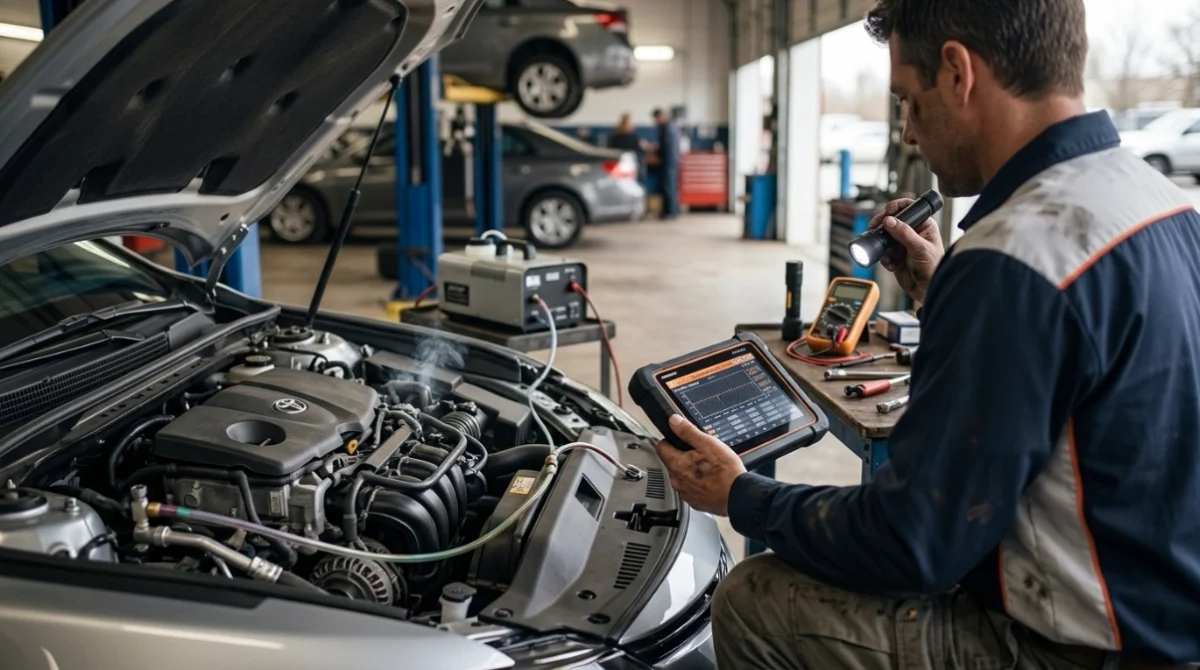
Good P0441 diagnosis starts with evidence. I prefer moving from the simplest checks toward active testing instead of replacing the purge valve immediately.
Step 1: Scan every stored code
Read stored, pending, and permanent codes if your scanner supports them. Related EVAP codes can change the diagnostic direction.
Also save freeze-frame data when available. It records operating conditions from around the time the computer detected the fault.
Step 2: Inspect the gas cap and filler area
Check whether the cap is installed correctly and inspect its seal for obvious cracking or damage. On a capless vehicle, look for debris or damage around the filler mechanism.
Don’t replace the cap solely because P0441 appears.
Step 3: Inspect visible EVAP hoses
Look for disconnected lines, split rubber sections, pinched hoses, and damaged connectors. Pay attention around the intake, purge valve, charcoal canister, and fuel-tank area.
Small hose problems are easy to miss when the engine bay is crowded.
Step 4: Check the purge valve
A technician can determine whether the purge valve seals when closed and allows flow when commanded. A bidirectional scan tool can make this much easier on supported vehicles.
The exact command strategy varies by manufacturer, model, and year.
Pro tip: Don’t apply battery power blindly to an unknown solenoid. Confirm the circuit design and manufacturer service information before electrical testing.
Step 5: Watch fuel-tank pressure data
Many vehicles provide fuel-tank pressure or similar EVAP data through an advanced scan tool. Watching that signal while commanding purge or vent functions can reveal whether the system responds.
Always compare the result with vehicle-specific service information rather than assuming one pressure value fits every car.
Step 6: Smoke-test the EVAP system
A smoke machine introduces low-pressure diagnostic smoke into the system. Escaping smoke can expose leaking hoses, fittings, valves, or seals.
Technicians must use EVAP-safe equipment and the vehicle manufacturer’s recommended procedure because fuel-vapor systems require special care.
Step 7: Test wiring before condemning parts
If the purge solenoid doesn’t respond, check its electrical circuit. A wiring problem can make a good valve look defective.
Connector damage matters too. Moisture, heat, broken locking tabs, or terminal corrosion can create intermittent faults.
Locksmith’s note: When I troubleshoot automotive electrical problems, I want proof at the connector before replacing a controlled component. The same discipline saves money with EVAP repairs.
Section Takeaway: Scan first, inspect second, then test flow, vacuum, wiring, and system sealing. Replacing parts without testing can turn a simple P0441 into an expensive guessing game.
Is P0441 Serious, and Can You Keep Driving?
P0441 usually isn’t as immediately dangerous as an overheating, oil-pressure, brake, or severe misfire warning. Many vehicles continue driving normally with this EVAP fault.
That doesn’t mean you should ignore it indefinitely.
You should address P0441 because:
- Fuel vapors may not be controlled as designed.
- The check engine light can hide a future problem until you scan again.
- The vehicle may fail an emissions inspection where OBD status is checked.
- A stuck-open purge valve can cause starting or idle complaints on some vehicles.
- A strong fuel odor could indicate a problem more serious than the code alone suggests.
If the check engine light starts flashing, that’s a different situation from a steady light. A flashing light commonly deserves prompt attention because it can accompany a severe misfire.
You can review broader crash and vehicle-safety research through the Insurance Institute for Highway Safety.
When should you stop driving?
Stop and investigate if you see liquid fuel, notice a powerful raw-fuel smell, experience severe stalling, or find another warning suggesting a safety-critical problem. P0441 by itself doesn’t tell you that liquid fuel is leaking.
Use the symptoms in front of you, not just the code number.
How Do You Fix Code P0441?
The correct repair is the one that fixes the failed test. There’s no universal P0441 part that should automatically be replaced.
Depending on diagnosis, repairs can include:
- Reinstalling or replacing a damaged fuel cap where applicable.
- Repairing cracked or disconnected EVAP hoses.
- Replacing a purge valve that fails mechanical or electrical testing.
- Repairing purge-valve wiring or connector damage.
- Cleaning or repairing a restricted vent path when manufacturer procedures allow it.
- Replacing a failed vent valve.
- Replacing a damaged or contaminated charcoal canister.
- Repairing a sensor circuit or replacing a sensor confirmed faulty by testing.
Can you clear P0441 with an OBD2 scanner?
Yes, most OBD-II scanners can clear the code after repairs. Clearing it doesn’t repair the underlying fault.
The computer must run its EVAP monitor again before you know whether the repair worked.
Why did P0441 come back after I cleared it?
If P0441 returns, the computer detected the fault again during another qualifying monitor test. That strongly suggests the root problem remains or the first repair didn’t address every fault.
EVAP monitors often require specific fuel level, temperature, driving, and soak conditions, so a code may not return immediately.
How much does it cost to fix P0441?
There isn’t one reliable price for a P0441 repair. Cost changes with the failed component, vehicle design, labor rate, location, and how much diagnosis is required.
A loose hose or cap issue may be inexpensive, while a difficult-to-access valve, wiring repair, or charcoal-canister replacement can cost considerably more.
Pro tip: Pay for diagnosis before authorizing expensive EVAP parts. A proper smoke test or bidirectional scan-tool test can be cheaper than replacing several good components.
Section Takeaway: Fix the confirmed cause, clear the code, and verify that the EVAP monitor can complete without P0441 returning.
P0441 FAQ
Can a loose gas cap cause P0441?
It can contribute on some vehicles, but P0441 specifically describes incorrect EVAP purge flow. Inspect the cap first because it’s easy, but don’t assume it is the cause without checking the rest of the purge system.
Is P0441 usually a bad purge valve?
A faulty purge valve is a common diagnostic possibility, but P0441 doesn’t prove the valve is bad. EVAP hoses, vent components, the charcoal canister, wiring, sensors, and sealing problems can create similar results.
Can P0441 cause a rough idle?
Yes, particularly if the purge valve is stuck open and creates an unwanted path into the intake. However, rough idle has many other possible causes, so verify the relationship before replacing EVAP parts.
Can P0441 cause poor gas mileage?
P0441 primarily indicates an EVAP purge-flow problem. You shouldn’t assume it is the cause of a major fuel-economy drop without checking other engine data, fuel trims, tire pressure, driving conditions, and related trouble codes.
Will P0441 clear itself?
The check engine light may turn off after enough successful monitor cycles if the fault no longer occurs. The code can remain stored in history, and permanent diagnostic codes follow separate clearing rules on supported vehicles.
Can I pass an emissions test with P0441?
An active check engine light or emissions-related trouble code can cause problems during an OBD-based inspection. Clearing codes immediately before testing can also reset readiness monitors, leaving the vehicle unready for inspection.
What is the difference between P0441 and P0442?
P0441 means the EVAP system detected incorrect purge flow. P0442 points more specifically to a small EVAP leak, although one underlying problem can sometimes contribute to multiple EVAP codes.
What Should You Do When You See P0441?
Start with a complete scan and a visual EVAP inspection. Then test the purge valve, hoses, vent path, electrical circuit, and system sealing as needed.
Most importantly, don’t replace parts just because their names appear on a generic code list. P0441 tells you that purge flow wasn’t what the computer expected; testing tells you why.
If you don’t have a smoke machine, bidirectional scanner, or wiring information for your vehicle, a qualified repair shop can test the system without turning the diagnosis into guesswork.
