What Is OBD2 and How Does It Work?

Quick Answer
OBD2, short for On-Board Diagnostics II, is a vehicle computer-based system that monitors engine operation and emissions-related components. An OBD2 scanner connects to the car’s diagnostic port, retrieves stored trouble codes, and helps identify systems that may need attention. It can narrow down a problem, but it doesn’t automatically identify the failed part or repair the vehicle.
What an OBD2 Scanner Can Tell You
- Stored trouble codes: Find diagnostic codes associated with detected engine or emissions-related problems.
- Check engine light: Help explain why the warning light has illuminated.
- Live data: On supported vehicles and scanners, view readings from selected sensors while the engine operates.
- Readiness status: Check whether certain onboard emissions self-tests have completed.
- Repair direction: Help a technician decide which components, wiring, or systems to test next.
One Important Limitation
- An OBD2 scanner is not the same as a car key programmer. It generally cannot program transponder keys, pair smart keys, or replace specialist immobilizer tools.
When a dashboard warning appears, it’s natural to wonder what’s wrong and whether you can check it yourself. In my automotive key and remote work, I consider an OBD2 scanner a useful diagnostic starting point, especially when someone wants to understand a warning before arranging repairs.
This guide explains how OBD2 works, what scanners can read, how to interpret their results, and where their capabilities stop. I’ll also explain the difference between engine diagnostics and the electronic systems responsible for recognizing your car key.
In This Guide
What Is OBD2?
OBD2 is a standardized onboard diagnostic system that helps a vehicle monitor selected operating conditions and detect certain faults. It allows compatible scan tools to communicate with the vehicle’s electronic control systems through a diagnostic connector.
OBD stands for On-Board Diagnostics, while the number 2 identifies the second generation of this diagnostic standard. In the United States, OBD2 became standard on most light-duty cars and trucks from the 1996 model year onward.
What Does OBD2 Monitor?
The system focuses heavily on emissions-related equipment, although the information available depends on the vehicle and diagnostic tool. Its monitoring can help identify faults before the driver notices a change in performance.
Common monitored systems and components include:
- Engine misfires: Detecting conditions in which cylinders fail to burn fuel properly.
- Oxygen sensors: Monitoring sensors that help the engine control fuel delivery and emissions.
- Catalytic converter: Checking for conditions that indicate reduced emissions-control performance.
- Fuel and air systems: Evaluating selected operating conditions related to combustion and fuel mixture.
- Evaporative emissions: Monitoring parts of the system designed to limit fuel vapor escaping into the atmosphere.
The exact monitoring capabilities vary by model, engine, software, and applicable requirements. Some vehicles also provide diagnostic access to additional systems through manufacturer-specific features or more advanced scan tools.
What Is the Difference Between OBD1 and OBD2?
OBD1 refers to earlier, manufacturer-dependent diagnostic systems, while OBD2 introduced more standardized diagnostic access and emissions-related fault reporting. That standardization made it easier to use compatible scanners across many different vehicle makes.
| Feature | OBD1 | OBD2 |
|---|---|---|
| Diagnostic standard | Varies more by manufacturer | More standardized diagnostic access |
| Connector | May vary by vehicle | Standardized 16-pin connector on compatible vehicles |
| Fault reporting | Often manufacturer-specific | Standardized emissions-related diagnostic codes |
| Scanner compatibility | May require vehicle-specific equipment | Compatible OBD2 scanners work across many supported vehicles |
For background on the system’s purpose and development, the U.S. Environmental Protection Agency’s vehicle inspection and maintenance resources explain how onboard diagnostics support emissions monitoring.
Section Takeaway: OBD2 provides standardized access to important diagnostic information, but compatibility still depends on the vehicle and the functions supported by the scanner.
How Does OBD2 Work?
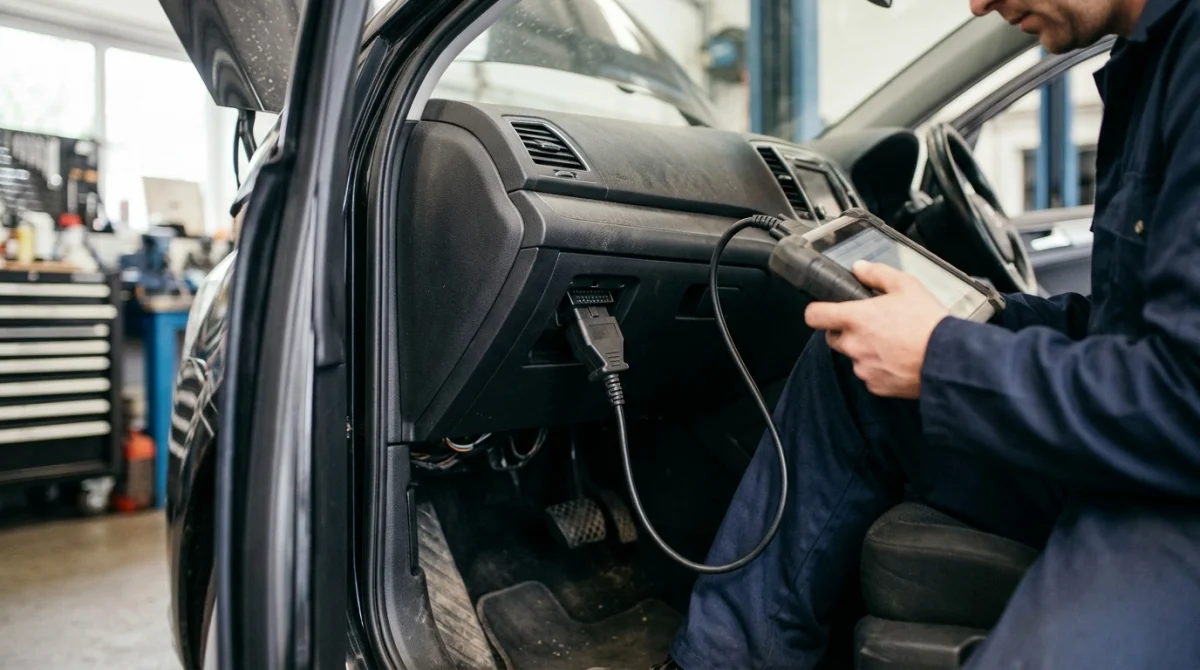
OBD2 works by collecting information from vehicle sensors, evaluating operating conditions through onboard computers, and recording diagnostic faults when certain criteria are met. A scanner retrieves available information through the diagnostic port so a driver or technician can investigate further.
The process involves several connected parts rather than one device working alone. Here’s how they fit together.
1. Sensors Collect Vehicle Information
Modern vehicles use sensors to measure conditions such as exhaust oxygen levels, engine temperature, air intake, and crankshaft position. Depending on the system, these readings help the engine computer regulate operation and check whether components behave as expected.
2. The Vehicle Computer Evaluates the Data
The engine control module (ECM) or powertrain control module (PCM) processes information from sensors and other inputs. Diagnostic software checks for conditions that fall outside expected limits or match a recognized fault pattern.
Some checks run continuously, while others require particular temperatures, speeds, or driving conditions. A fault may therefore appear immediately or only after the vehicle completes a relevant self-test.
3. The System Records a Diagnostic Trouble Code
When the computer detects a qualifying problem, it may store a diagnostic trouble code (DTC). The code identifies the general fault category or circuit involved, rather than always naming the exact failed component.
For example, a code associated with an oxygen sensor circuit can point toward a sensor, its wiring, a connector, or another underlying issue. Testing is needed before deciding which part, if any, should be replaced.
4. A Warning Light May Appear
If the system detects a fault that meets its warning criteria, it can illuminate the check engine light, also known as the malfunction indicator lamp. The light’s behavior matters: a flashing check engine light can indicate a serious active misfire that may damage the catalytic converter.
If the light flashes while the engine is running, reduce engine load and stop somewhere safe. Follow the vehicle manual and arrange prompt professional help rather than continuing to drive normally.
5. The Scanner Retrieves Diagnostic Information
An OBD2 scanner communicates with supported vehicle electronics through the diagnostic link connector, usually found beneath the dashboard. Depending on the tool, it can display stored codes, pending codes, freeze-frame information, live sensor data, and readiness-monitor status.
Freeze-frame data is a snapshot of selected operating conditions recorded when a fault was detected. It can help a technician understand what the vehicle was doing at the time, although it doesn’t always provide a complete picture.
Section Takeaway: OBD2 detects and reports certain faults; the scanner presents the information so the underlying cause can be investigated.
What Can an OBD2 Scanner Read?

A basic OBD2 scanner typically reads emissions-related diagnostic codes and selected engine data, while more advanced tools can access additional modules and functions on supported vehicles. The features depend on both the scanner and the vehicle’s diagnostic capabilities.
Diagnostic Trouble Codes
Codes commonly begin with a letter followed by four characters. The first letter indicates the broad system category.
- P: Powertrain, including engine and transmission-related diagnostics covered by the code.
- B: Body systems, where supported by the diagnostic tool.
- C: Chassis systems, where supported.
- U: Network communication faults between electronic modules.
Basic standardized scanners concentrate on emissions-related powertrain codes. They may not read every body, chassis, network, airbag, ABS, or manufacturer-specific code.
Live Data and Freeze-Frame Information
Live data shows selected readings as the vehicle operates. Depending on support, you may see engine speed, coolant temperature, fuel-trim values, throttle position, or oxygen-sensor readings.
Freeze-frame information provides context for certain stored faults. Both types of data are most useful when interpreted alongside the vehicle’s symptoms and service information.
Readiness Monitors
Readiness monitors indicate whether the vehicle’s onboard emissions tests have completed. A monitor marked incomplete doesn’t automatically mean a component has failed; it can mean the vehicle hasn’t yet met the conditions needed to run that test.
Disconnecting the battery or clearing diagnostic codes can reset some readiness information. If you’re preparing for an emissions inspection, check the local rules and avoid clearing codes simply to hide a warning.
Can a Scanner Tell You Exactly What to Replace?
No. A code is a diagnostic clue, not a guaranteed parts list.
Suppose a scanner reports an evaporative-emissions leak. The cause could involve a loose fuel cap, a damaged hose, a faulty valve, or another leak in the system, depending on the vehicle and code.
Use the code to guide the next test rather than buying a replacement component immediately. That approach can prevent unnecessary repairs.
Section Takeaway: Read codes alongside live data, symptoms, and proper testing; don’t treat a code description as proof that one specific part has failed.
