
How to Program a Chevy Key Fob (DIY, Dealer, or Locksmith)

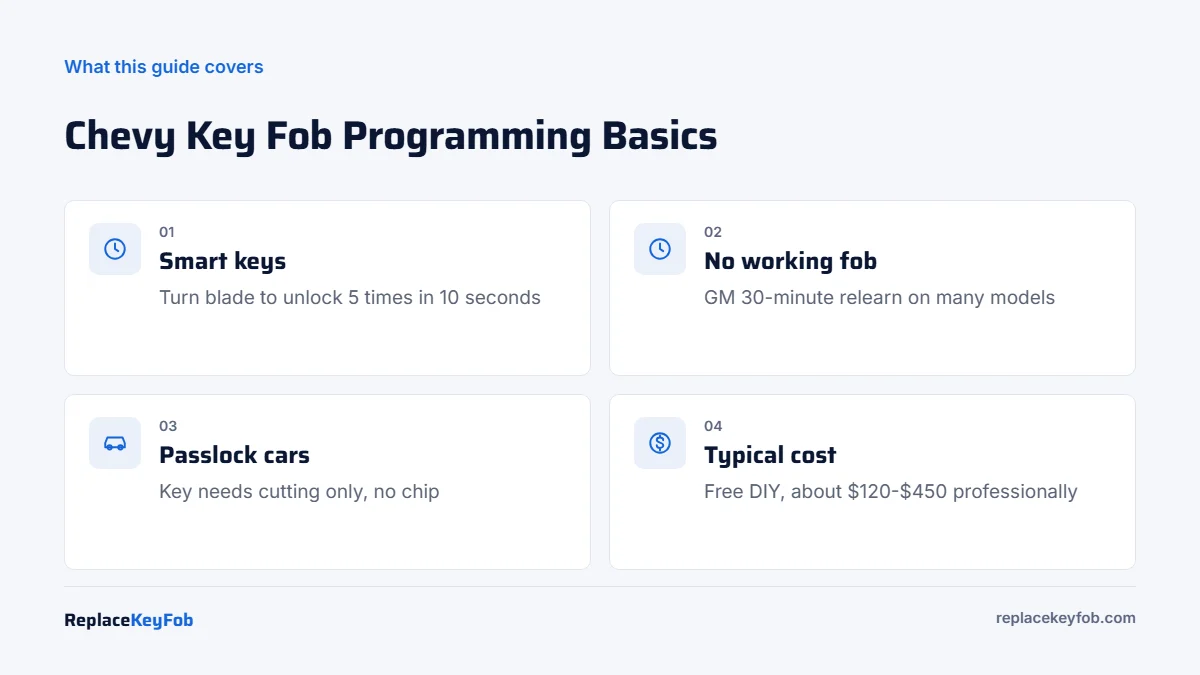
Many Chevrolets can add a remote or key without a dealer. Newer push-button models use the door lock cylinder sequence (turn the key to unlock five times within 10 seconds) when you have two working fobs, or a 30-minute relearn when you do not. Older Passlock and PASS-Key III cars use timed relearns. Some new models need a scan tool.
General Motors has always been unusual about key programming. Instead of locking everything behind dealer software, GM built timed relearn procedures into many Chevy immobilizer systems, so an owner with patience can often add a key or even recover from a lost key. The trade-off is that GM changed systems several times, and the right procedure depends on which one your Chevy has.
Below you will find each GM security system by era, the onboard methods that work on many Silverado, Impala, Traverse, Equinox, Malibu and Cruze models, and when a tool, locksmith or dealer is the better choice.
Chevy key types and immobilizer systems by era
| System | Typical years | How to recognize it | Owner-level programming |
|---|---|---|---|
| PASS-Key / PASS-Key II (resistor pellet) | Mid-1980s to early 2000s (Corvette, Camaro and some sedans) | A small resistor pellet is visible on the key blade | No programming; the key must match one of 15 resistor values |
| Passlock | Late 1990s to mid-2000s on many cars and trucks (some Impala, Malibu, Cobalt, HHR and truck years) | Plain metal key with no chip; the sensor is in the lock cylinder | Key needs cutting only; a 10-minute relearn fixes most security faults |
| PASS-Key III / PK3+ transponder | About 2000 onward, common on 2007-2018 models | Transponder chip in the key head or flip key | Often yes: add a key with an existing key, or a 30-minute relearn |
| Keyless access smart key | About 2010 onward (Traverse, Equinox, Malibu, Blazer, Silverado and more) | Push-button start | Often yes on 2010s models via the door lock sequence; newest models vary |
Separate keyless entry remotes were common through the late 2000s. From about 2010, most Chevys moved to a flip key with the remote and transponder in one unit, and later to push-button smart keys. A flip key needs both the remote and the chip programmed; a smart key handles both at once.
What you need before you start
- A replacement with the right FCC ID and part number. GM uses several frequencies and fob families even on one model, so match the label on the back of your original.
- A good coin cell. Most Chevy flip keys and smart keys take a CR2032. Our Chevrolet key fob battery guide lists exceptions.
- A cut key blade for flip keys and for the emergency blade in smart keys, which you need for the door lock method.
- Time. GM relearns use 10-minute timers. Keep the 12V battery healthy or connect a charger.
Replacement Chevy Flip Key or Smart Key Fob
Match the FCC ID, part number and button layout to your original, and buy a new, unused fob. GM smart keys that were registered to another vehicle often cannot be reused.
As an Amazon Associate, ReplaceKeyFob earns from qualifying purchases.
Chevy key fob programming instructions: push-button smart keys
Many 2010s Chevy owner’s manuals include a section called “Programming with Recognized Transmitters.” It needs two fobs the car already knows. The general flow is:
- Close all doors. Take the mechanical key blade out of a recognized fob.
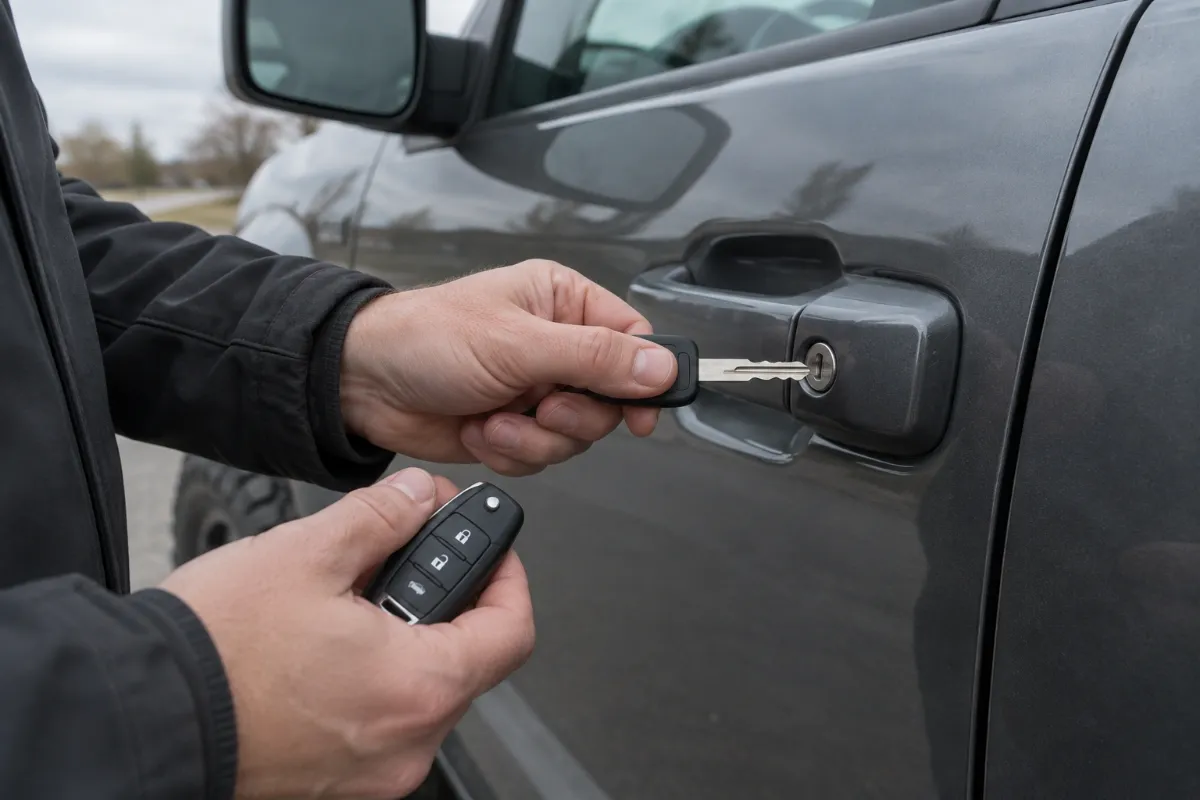
- Insert the blade into the driver door lock cylinder (you may need to remove a cap on the handle) and turn it to unlock five times within about 10 seconds.
- The Driver Information Center shows a message such as READY FOR REMOTE #3.
- Place the new fob in the transmitter pocket (often in the center console or a cupholder) and press the ENGINE START/STOP button. When the car learns it, the display moves to the next number.
- Repeat for any additional new fob, then exit by pressing and holding ENGINE START/STOP for several seconds, as described in your manual.
If you have fewer than two working fobs, the manual’s “Programming without Recognized Transmitters” procedure applies. It starts the same way, but the display shows REMOTE LEARN PENDING, PLEASE WAIT and you wait about 10 minutes, three times in a row, about 30 minutes total. All old fobs are erased and must be relearned in the same session.
Turn-key Chevys with a flip key or transponder key
For PASS-Key III and PK3+ vehicles, there are two common GM routes:
- Add a key with a working key: on many 2000s models, you insert a working key, turn it to ON, switch off, then insert the new key within a few seconds and turn it to ON. The security light goes out after about 10 seconds when the key is learned. Exact timing varies by model.
- 30-minute relearn: with the new key in the ignition, turn to ON and leave it until the security light stops flashing or goes out (about 10 minutes), turn off for about 5 seconds, and repeat for a total of three cycles. Then start the car. This erases other keys on many models, so relearn them afterward.
The remote buttons on flip keys are usually learned along with the key in these procedures or in a separate driver information center menu. On older Chevys with a separate remote, many manuals describe holding LOCK and UNLOCK on a working remote, or using a DIC “Relearn Remote Key” menu. Check your manual, because GM used several variations.
For Passlock cars, the key has no chip. A new key only needs to be cut. If the car will not start and the security light is on, a 10-minute relearn (key ON until the light stops flashing, then off, then start) clears most Passlock faults. Our guide on how to reset an immobilizer system goes into more detail.
Model notes: Silverado, Traverse, Impala, Trax, Blazer and Colorado
- Silverado: mid-2000s trucks may use Passlock or transponder keys depending on year; 2014-2018 trucks use a flip key or smart key; 2019 and newer trucks often accept the onboard smart-key methods above but can require a scan tool on some configurations.
- Traverse: 2009-2017 models use a separate remote or flip key on most trims, with smart keys on some later trims; the 2018 and newer Traverse is push-button on most trims.
- Impala: 2000-2013 cars use a separate remote and a Passlock or transponder key; 2014-2020 models use a smart key on most trims.
- Trax and Blazer: the 2015-2022 Trax uses a flip key; the 2019 and newer Blazer uses a smart key. Both often need a tool if the onboard method fails.
- Cobalt and HHR: many years use Passlock, so the key needs cutting only and the remote is separate.
- 2022 Colorado: flip key on most trims, with a transponder that can be added with the GM methods above or a tool.
If Chevy key fob programming is not working
- The door lock sequence does nothing: make sure all doors are closed, the blade turns fully, and you complete five turns inside the window.
- The new fob is not recognized in the pocket: confirm the FCC ID and that the fob is new. Used GM smart keys are often locked to their first vehicle.
- Security light stays on: let each 10-minute timer finish without touching the key. A weak 12V battery can interrupt the relearn.
- Remote works but no start: the transponder was not learned. Repeat the key relearn.
Our Chevy key fob not working guide covers receiver and battery faults that look like programming problems.
When to use a key programmer, locksmith or dealer
A tool or professional makes sense when the onboard method is not in your manual, when your Chevy is a newer model whose security will not accept onboard learning, or when you want the job done in minutes rather than 30. Look for a tool with GM IMMO coverage; our list of OBD2 scanners for Chevy is a good starting point.
| Job | Typical 2026 cost |
|---|---|
| Onboard relearn (DIY) | Free, plus the fob and key cutting |
| Locksmith: flip key cut and programmed | About $120-$250 |
| Locksmith: smart key | About $150-$350 |
| Dealer: fob plus programming | About $200-$450 |
| All keys lost | About $200-$500 |
If you have lost every key, see our guide on programming a key fob without a working key, and start with the main key fob programming guide for other makes.
Frequently Asked Questions
Often, yes. Many 2010s push-button Chevys use the door lock cylinder sequence, and many turn-key models accept a 10-minute or 30-minute relearn. Some newest models and some configurations need a scan tool or dealer.
It is a GM procedure that registers a key or fob when you do not have two working ones. You wait through three 10-minute security timers. It erases other keys, so relearn all of them in the same session.
Not always. Many models support onboard relearns. A programmer helps when your manual has no procedure, when the onboard method fails, or when you program keys often.
Turn-key trucks with a flip key usually use the GM key relearn. Push-button trucks use the door lock sequence with two recognized fobs or the 30-minute procedure. Check the owner’s manual for your model year.
Most Chevy flip keys and smart keys use a CR2032. Older separate remotes may differ, so check the cell in your fob.