
Battery Tender Junior Review: Best for Motorcycles and Storage?

We may earn a commission when you buy through links on this page, at no extra cost to you. How we pick products.
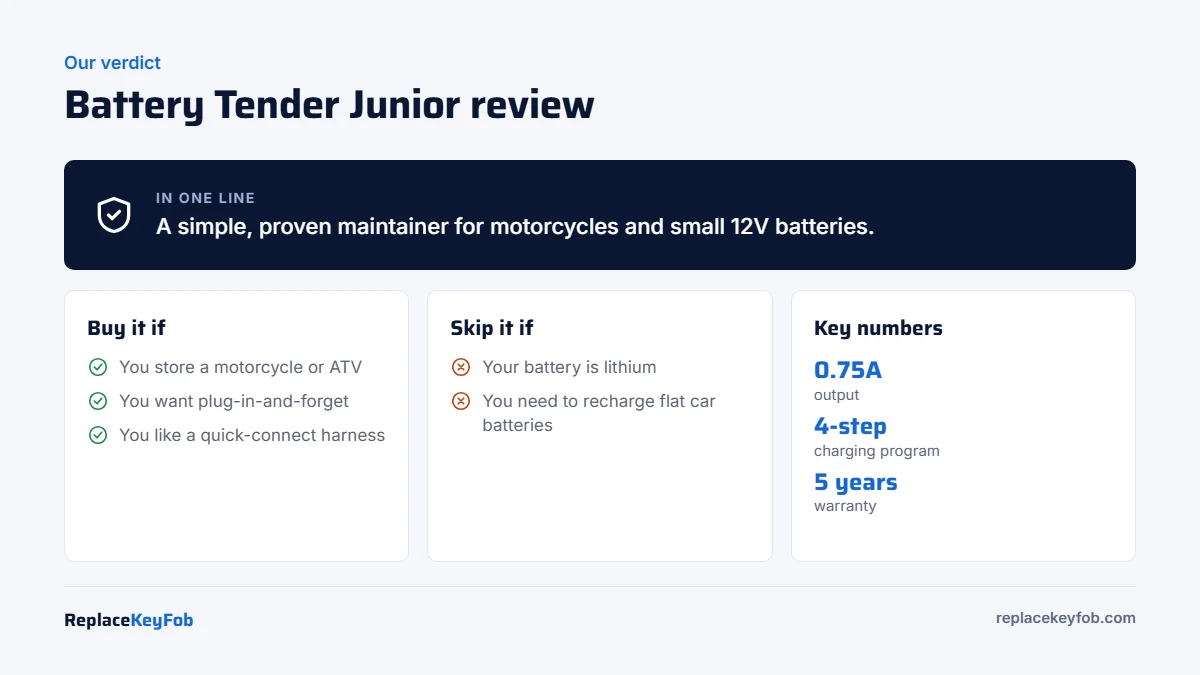
The Battery Tender Junior is an excellent maintainer for motorcycles, ATVs, lawn tractors and other small 12V batteries, and a decent one for keeping a healthy car battery topped up in storage. It is tiny, simple, safe to leave connected, and backed by a 5-year warranty. It is not a charger for flat car batteries: at 750mA it is far too slow. For cars, the NOCO Genius5 or the Battery Tender Plus is a better fit.
Few chargers are as well known as the Battery Tender Junior. Many motorcycle owners have one plugged in all winter, and the name “battery tender” has become shorthand for the whole category. This review explains what the Junior does well, why its low output is both a strength and a weakness, and which vehicles it suits. It draws on Battery Tender’s published specs and manual, long-term owner feedback, and comparison with the maintainers in our battery maintainer roundup.
Battery Tender Junior Specs at a Glance
| Spec | Battery Tender Junior |
|---|---|
| Output | 12V, 750mA (0.75A) |
| Battery types | 12V lead-acid: flooded, AGM, gel |
| Charging program | 4 steps: initialization, bulk, absorption, float |
| Safety | Spark-proof; reverse hook-up detection |
| Status light | Two-color LED |
| Output cord | 12 feet |
| Included leads | Fused ring-terminal harness, alligator clips |
| Size and weight | 3.3 x 1.3 x 2.4 inches, about 1 lb (charger only) |
| Warranty | 5 years |
Battery Tender Junior 12V 750mA Charger and Maintainer
12V, 750mA, 4-step charging, 5-year warranty
Check Price on AmazonDesign and Connections
The Junior is about the size of a deck of cards, with a wall-plug cord on one side and a 12-foot output cord on the other. The output ends in a quick-disconnect plug that connects to either of the two included leads: a fused ring-terminal harness or a pair of alligator clips.
The ring-terminal harness is the reason the Junior is so popular with riders. You bolt it to the battery terminals once and route the short pigtail somewhere easy to reach, often under the seat or near a side cover. From then on, plugging in for the night takes five seconds and you never have to remove bodywork. The 12-foot cord also means you rarely need an extension lead.
How It Charges
The Junior uses a 4-step program. Initialization checks the battery. Bulk charge delivers the full 750mA until the battery reaches a set voltage. Absorption tops off the last part of the charge at a controlled voltage. Float holds the battery at a safe maintenance voltage for as long as it stays connected. If the voltage drops under load, it returns to full output, then back to float.
That float stage is the point of a maintainer. Unlike an old trickle charger that keeps pushing current regardless, the Junior stops before overcharging. Our guide to battery maintainers vs trickle chargers explains why that matters.
Is 750mA Enough?
For what the Junior is designed for, yes. Motorcycle and powersports batteries are small, usually under 20Ah, and 750mA charges and maintains them gently. For maintaining a healthy car battery that is already near full, it also works: it just needs to replace the small parasitic draw of a parked car.
Where it falls short is recovering a flat car battery. A drained 60Ah car battery could take several days at 750mA, and a battery that sits flat that long is being damaged. If you often find your car’s battery already dead, use a 5A to 10A charger first, then switch to a maintainer. See our best car battery chargers.
Safety
The Junior is spark-proof and detects a reversed connection, so a mistake does not cause sparks or damage. The fused ring harness adds another layer of protection when it is permanently installed. The two-color LED shows whether it is charging or holding in float, which is enough information for a device you plug in and forget.
Junior vs Plus: Which Battery Tender?
| Battery Tender Junior | Battery Tender Plus | |
|---|---|---|
| Output | 0.75A | 1.25A |
| Best for | Motorcycles, powersports, small batteries | Cars, trucks, larger batteries in storage |
| Charging program | 4-step | 4-step |
| Quick-disconnect harness | Yes | Yes |
| Warranty | 5 years | 10 years |
If the battery you are maintaining is in a car, the Plus is the better match. If it is under a motorcycle seat, the Junior is all you need.
Installing the Ring Harness on a Motorcycle
- Remove the seat or side cover to reach the battery, and switch off the ignition.
- Loosen the negative (-) terminal bolt first, add the black ring terminal, and retighten.
- Loosen the positive (+) terminal bolt, add the red ring terminal (with the inline fuse), and retighten.
- Route the pigtail away from hot parts and moving parts such as the chain or suspension, and secure it with a cable tie.
- Leave the plug where you can reach it without tools, and fit its protective cap when you ride.
What Could Be Better
- Low output makes it slow for car batteries that are already flat.
- No lithium mode. Many newer motorcycles and powersports machines use lithium batteries, which need a compatible charger.
- 12V only, so it will not work on 6V vintage motorcycles or classic cars.
- Basic status light, with no detailed charge level.
Pros and Cons
Pros: tiny, very simple, quick-disconnect ring harness, 12-foot cord, spark-proof, 5-year warranty, long track record.
Cons: 750mA is slow for cars, no lithium mode, 12V only.
Who Should Buy the Battery Tender Junior?
Buy it if you own a motorcycle, scooter, ATV, UTV, jet ski, snowmobile or lawn tractor with a 12V lead-acid or AGM battery, or you want a simple maintainer for a healthy car battery during storage.
Skip it if your battery is lithium, you need to recharge flat car batteries, or you have 6V equipment.
Battery Tender Junior Alternatives
| If you want… | Consider | Why |
|---|---|---|
| The same simplicity with more output for cars | Battery Tender Plus | 1.25A, 10-year warranty |
| Lithium support in a small charger | NOCO Genius1 | 1A, 6V/12V, LiFePO4 mode |
| A charger that can recover a flat car battery | NOCO Genius5 | 5A, Force Mode, lithium support |
Comparing brands? Read NOCO Genius vs Battery Tender.
Quick Start: Using the Junior
- Install the ring-terminal harness on the battery (red to positive, black to negative), or use the alligator clips.
- Connect the Junior’s output plug to the harness.
- Plug the Junior into the wall outlet.
- Check the LED: it shows charging, then switches when the battery reaches float.
- Leave it connected for storage. To ride, unplug from the wall first, then disconnect the plug.
Related Guides
- Best battery maintainers for cars
- NOCO Genius5 review
- Best car battery chargers
- How long does a lithium car battery last?
FAQ
Can I use a Battery Tender Junior on a car battery?
Yes, to maintain a healthy car battery during storage. It is too slow to recharge a flat car battery in a reasonable time.
Can I leave the Battery Tender Junior on all winter?
Yes. That is what it is designed for. Its float mode holds the battery at a safe voltage without overcharging.
Does the Battery Tender Junior work on lithium batteries?
This model is for 12V lead-acid, AGM and gel batteries. For lithium, use a charger with a lithium mode.
How long does the Junior take to charge a motorcycle battery?
A partly drained motorcycle battery usually charges within a day. A deeply drained one can take longer.
Is the Battery Tender Junior a trickle charger?
It is a smart maintainer. Unlike a basic trickle charger, it switches to float mode when the battery is full, so it does not overcharge.
What do the lights mean on a Battery Tender Junior?
The two-color LED shows whether it is charging or has reached float. Check the manual for the exact light patterns on your unit.