
5 Best Car Battery Chargers (2026): Smart Picks for Cars and Trucks

We may earn a commission when you buy through links on this page, at no extra cost to you. How we pick products.
The NOCO Genius10 is the best car battery charger for most people: 10 amps is fast enough to recharge a car or truck battery overnight, it supports lead-acid, AGM and lithium batteries, and it can stay connected as a maintainer. If you want a charger that can also help crank the engine, the Schumacher SC1281 adds a 100A engine start. For faster charging of big batteries, the Schumacher SC1280 delivers 15 amps in a light package.
A good battery charger does more than bring a flat battery back. It tells you whether the battery is worth saving, protects the battery from overcharging, and keeps it healthy through winter or long trips. The market is full of chargers that look similar, but they differ a lot in charging speed, supported battery types and extras like engine start or testing. This guide compares five chargers for cars and trucks and explains which amperage and features you actually need.
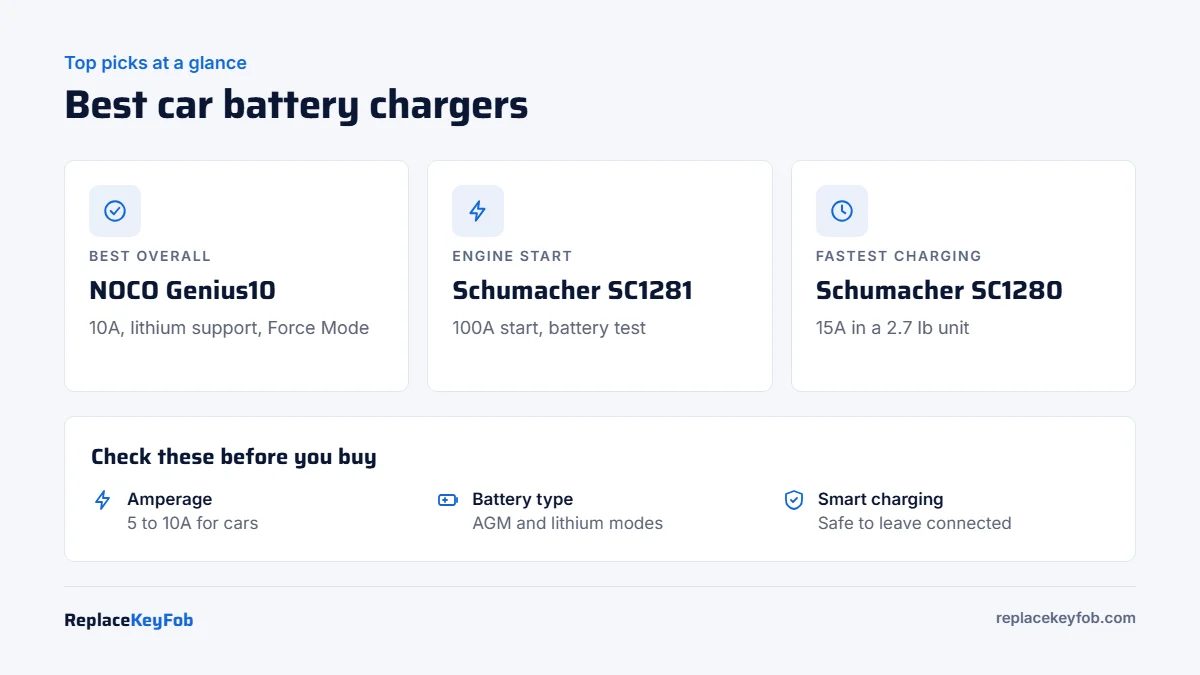
Our Top Picks at a Glance
| Charger | Best for | Charge rate | Stand-out feature |
|---|---|---|---|
| NOCO Genius10 | Best overall | 10A | Lithium support, Force Mode, thermal sensor |
| Schumacher SC1281 | Charger with engine start | 2A to 6A, 12A to 30A boost | 100A engine start, battery and alternator test |
| Schumacher SC1280 | Fast charging, big batteries | 15A, 3A maintain | Fast and light at about 2.7 lb |
| CTEK MXS 5.0 | Cold climates | 4.3A | 8-step charging, rugged housing |
| NOCO Genius5 | Compact charger and maintainer | 5A | Small, lithium support |
How We Chose These Chargers
- Charge rate matched to car batteries. 1A maintainers are too slow to recover a flat car battery; we focused on 4A and up.
- Smart, multi-stage charging that switches to maintenance automatically, so the charger can stay connected.
- Battery types: flooded, AGM (common in newer cars), gel and lithium.
- Recovery of deeply discharged batteries, since many smart chargers refuse to start below a few volts.
- Extras that solve real problems, like engine start and battery testing.
- Manufacturer specs, manuals and long-term owner feedback.
The Best Car Battery Chargers
1. NOCO Genius10: Best Overall
NOCO Genius10 10A Smart Battery Charger and Maintainer
10A, 6V/12V, lead-acid, AGM, gel and LiFePO4
Check Price on AmazonThe Genius10 hits the sweet spot for most owners. Ten amps recharges a typical car battery overnight and a large truck battery in a reasonable time, and once the battery is full it switches to maintenance and can stay connected indefinitely. It supports 6V and 12V lead-acid batteries (flooded, AGM, gel, SLA, VRLA) and 12V lithium LiFePO4, so it covers cars, trucks, boats, RVs and motorcycles.
Two features set it apart. An integrated thermal sensor adjusts charge voltage for hot and cold weather, and Force Mode lets you manually charge a battery that has dropped to zero volts, which many smart chargers refuse to touch. It also has a pulse repair function for sulfation. The box includes a 72-inch AC cable, an 80-inch DC cable with clamps, eyelet terminals, a mounting bracket and a 3-year warranty.
Pros: fast enough for trucks, lithium support, Force Mode, temperature compensation, compact for its power.
Cons: no engine-start function; modes take a minute to learn.
Best for: almost every car and truck owner.
Skip it if: you want a charger that can help start the car immediately.
2. Schumacher SC1281: Best Charger With Engine Start
Schumacher SC1281 6A Charger With 100A Engine Start
100A engine start, 12A to 30A boost, 6V/12V
Check Price on AmazonThe SC1281 is a classic home-garage charger: a 2A to 6A smart charger with a 12A to 30A boost charge and a 100-amp engine start. If you find the battery flat on a work morning, the boost and engine-start modes can get the car running in minutes instead of waiting hours for a full charge.
It also tests the battery and alternator, detects 6V and 12V automatically, has a desulfation mode and a smart trickle mode for long-term maintenance. The trade-off is weight (about 12.6 lb) and size; it is a garage tool, not something you carry in the car.
Pros: engine start and boost, built-in battery and alternator testing, maintains safely.
Cons: heavy; no lithium mode.
Best for: home garages where a quick start matters.
Skip it if: your car has a lithium battery.
3. Schumacher SC1280: Best for Fast Charging
Schumacher SC1280 15A Battery Charger and Maintainer
15A charge, 3A smart trickle, 6V/12V
Check Price on AmazonAt 15 amps, the SC1280 is the fastest charger in this guide, and it weighs only about 2.7 lb. It charges standard, AGM, gel and deep-cycle batteries, detects 6V and 12V automatically, and has a desulfation mode and a 3A smart trickle mode for maintenance. It is a strong match for truck batteries, dual-battery diesels and anyone who wants the battery charged before lunch rather than tomorrow.
The extra current is also useful as battery support during short key programming or coding sessions; see our guide to the best battery support for key and ECU programming.
Pros: fastest charge here, light, testing and desulfation modes.
Cons: no lithium mode; 15A is more than small batteries need.
Best for: trucks, large SUVs and impatient owners.
Skip it if: you mostly charge motorcycle or lawn tractor batteries.
4. CTEK MXS 5.0: Best for Cold Climates
CTEK MXS 5.0 4.3A Battery Charger and Maintainer
4.3A, 8-step, 12V lead-acid and AGM
Check Price on AmazonCTEK’s MXS 5.0 is a favorite in cold countries. Its 8-step program at up to 4.3 amps includes a reconditioning step and a float/pulse maintenance mode that can stay connected for months. It is splash, dust, spark and shock resistant, and CTEK designs it with cold-weather drivers in mind. It is slower than the 10A and 15A picks, so a deeply flat car battery takes longer, but it is gentle and thorough.
Pros: reliable in the cold, rugged, excellent long-term maintenance.
Cons: 12V lead-acid and AGM only; slower than 10A chargers.
Best for: unheated garages and cold winters.
Skip it if: you need lithium support or fast charging.
5. NOCO Genius5: Best Compact Charger and Maintainer
NOCO Genius5 5A Smart Battery Charger and Maintainer
5A, 6V/12V, lead-acid, AGM and LiFePO4
Check Price on AmazonThe Genius5 shares the Genius10’s features (lithium support, thermal sensor, Force Mode, repair mode) at half the current and about 1.6 lb. It is a little slow for big truck batteries, but it recharges a car battery overnight and doubles as a maintainer. See our best battery maintainers guide, where it is our top pick.
Pros: small and light, lithium support, 3-year warranty.
Cons: slower than the Genius10 on large batteries.
Best for: cars, motorcycles and small garages.
Skip it if: you charge large truck batteries often.
How Long Does It Take to Charge a Car Battery?
A rough rule: divide the amp-hours you need to replace by the charger’s amps, then add about 20% for charging losses and the slower final stage. A typical car battery is around 50 to 70Ah; a large truck battery can be 80Ah or more.
| Charger | Half-flat car battery (about 30Ah) | Fully flat car battery (about 60Ah) |
|---|---|---|
| 1A maintainer | About 1.5 days | About 3 days |
| 5A (Genius5) | About 7 hours | About 14 hours |
| 10A (Genius10) | About 4 hours | About 7 hours |
| 15A (SC1280) | About 2.5 hours | About 5 hours |
These are estimates. Battery age, temperature and the charger’s final absorption stage all affect the real time.
Charger Features Explained
| Feature | What it does | Do you need it? |
|---|---|---|
| Multi-stage charging | Charges at full rate, tapers, then switches to maintenance | Yes, on any charger you leave connected |
| AGM mode | Uses the slightly different voltage AGM batteries need | Yes, if your car has an AGM battery (common with start-stop) |
| Lithium mode | Charge profile for LiFePO4 batteries | Only if you own a lithium battery |
| Temperature compensation | Adjusts voltage for hot and cold conditions | Helpful in unheated garages |
| Force Mode or 0V charging | Starts charging a battery too flat to detect | Helpful for neglected batteries |
| Desulfation or repair mode | Pulse charging to reduce sulfation | Nice to have; cannot fix a failed cell |
| Engine start | High current to help crank the engine | Handy at home; not portable |
| Battery and alternator test | Checks battery health and charging output | Useful if you do your own diagnosis |
Charge It or Replace It?
A charger cannot save every battery. Signs the battery itself is the problem: it is more than four or five years old, it goes flat again within a few days of a full charge, it will not reach about 12.6V after charging and resting, it is swollen or leaking, or it fails a load test. In those cases, replace it. If the battery tests good but keeps going flat, the cause may be a parasitic draw or a weak alternator; our guide on testing an alternator with an OBD2 scanner is a good place to start.
How to Charge a Car Battery Safely
- Work in a ventilated area and keep sparks and flames away from the battery.
- Check the battery for cracks, bulging or leaks. Do not charge a damaged or frozen battery.
- Connect red to the positive (+) terminal and black to the negative (-) terminal or the chassis ground named in your manual.
- Plug the charger in and select the battery type (standard, AGM or lithium).
- Let the charger finish. Smart chargers switch to maintenance automatically.
- Unplug from the wall first, then remove the clamps.
Before blaming the battery, it is worth testing it. Our guide on how to test a car battery at home and checking battery voltage with an OBD2 scanner explain how.
Buying Guide: Choosing a Car Battery Charger
Choose the right amperage
For cars, 5A to 10A is the practical range. Trucks and dual-battery diesels benefit from 10A to 15A. Below 4A, think of it as a maintainer.
Match your battery type
AGM batteries need a slightly different charge profile, and lithium needs its own mode. Using the wrong setting can shorten battery life.
Engine start or not?
Engine-start chargers like the SC1281 are handy at home, but they do not replace a portable jump starter when you are away from an outlet.
Look for recovery features
Force Mode, desulfation and repair modes can bring back batteries that are deeply discharged, though they cannot fix a battery with a dead cell.
Replacing the battery? Remember registration
Many newer BMW, Audi, VW, Ford and other cars need the new battery registered with a scan tool so the charging system adapts to it. See how to register a car battery.
Related Guides
- Best battery maintainers for cars
- Best battery support for key and ECU programming
- 7 best portable jump starters
- Can a bad car battery cause key fob problems?
FAQ
What is the best amp setting to charge a car battery?
Around 10% of the battery’s amp-hour capacity is a gentle, efficient rate, so 5A to 10A suits most car batteries. Smart chargers manage the rate automatically.
Can I charge a car battery without disconnecting it?
Yes. Modern smart chargers are designed to charge with the battery in the car. Use the ground point recommended in your owner’s manual.
Can I leave a battery charger on overnight?
With a smart charger, yes. It switches to maintenance mode when the battery is full. Old manual chargers without automatic shutoff should not be left on.
Why won’t my charger charge a dead battery?
Many smart chargers need a minimum voltage to detect the battery. Chargers with Force Mode, like the NOCO Genius models, can start a deeply discharged battery. If it still will not hold a charge, the battery may be failed.
Is a 10 amp charger better than a 2 amp charger?
For recharging a car battery, yes, because it is much faster. For long-term maintenance, a low-amp charger is perfectly fine.
Can a weak car battery stop my key fob from working?
A weak car battery can cause locks, push-button start and key detection to act up. Charge or test the battery first; see can a bad car battery cause key fob problems.