
Best Battery Maintainers for Winter Car Storage

We may earn a commission when you buy through links on this page, at no extra cost to you. How we pick products.
The NOCO Genius2X2 is the best battery maintainer for winter car storage if you store more than one vehicle: it maintains two batteries at once, handles AGM, flooded and lithium, and adjusts for temperature. For a single car in an unheated garage, the CTEK MUS 4.3 Polar charges down to -22°F. If the car is stored outdoors with no outlet nearby, the OptiMate Solar Duo 20W keeps the battery topped up from a panel on the dashboard through the OBD port.
Winter storage is hard on batteries. A modern car draws a small current even when switched off, to power the clock, alarm, keyless entry receiver and computer memory, and over two or three months that can flatten a healthy battery. Cold makes it worse: a discharged lead-acid battery can freeze and crack at temperatures a full one would shrug off. A battery maintainer solves both problems by keeping the battery full all season. This guide picks six maintainers for different storage setups, from heated garages to outdoor parking, and ends with a simple storage checklist.
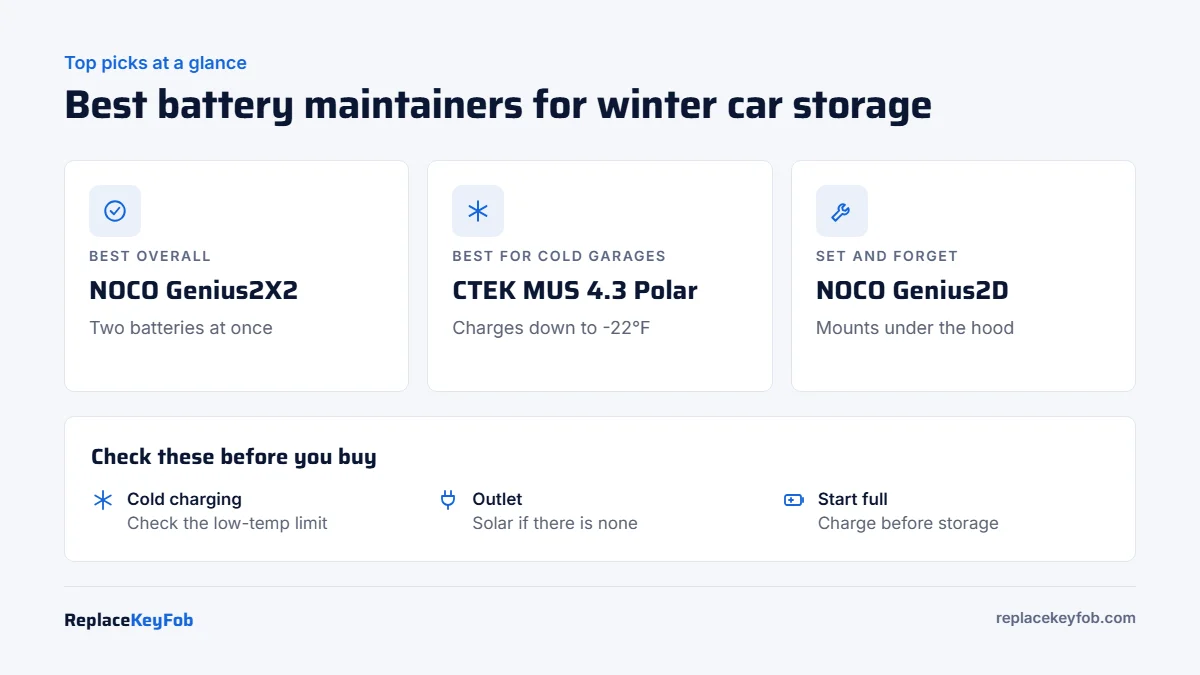
Our Top Picks at a Glance
| Maintainer | Best for | Output | Battery types |
|---|---|---|---|
| NOCO Genius2X2 | Best overall, two vehicles | 2 banks | Lead-acid (AGM, gel, flooded) and lithium |
| CTEK MUS 4.3 Polar | Unheated garages | 4.3A | 12V lead-acid incl. AGM |
| NOCO Genius2D | Permanent onboard install | 2A | 12V lead-acid incl. AGM |
| Battery Tender 800 | Rugged, sealed electronics | 800mA | 12V lead-acid |
| Battery Tender Junior 800mA (Lithium) | Cars plus lithium powersports | 800mA | Lead-acid and LiFePO4 (switchable) |
| OptiMate Solar Duo 20W Car Kit | Outdoor storage, no outlet | 20W solar | 12V lead-acid and 12.8V lithium |
How We Chose These Maintainers
We compared specs, manuals and retailer listings, plus long-term owner feedback from people who store cars, motorcycles and boats each winter. We did not run our own storage tests. For winter storage we focused on:
- Safe for months. True maintenance mode that holds the battery at the right voltage without overcharging.
- Cold performance. Temperature compensation or cold-rated designs for unheated garages.
- Connection options. Ring-terminal harnesses that stay on the battery all season, so you can plug in without opening the hood.
- Multi-vehicle needs. Many people store a car and a motorcycle or boat together.
- Durability and protection against moisture, sparks and reverse connection.
The Best Battery Maintainers for Winter Storage
1. NOCO Genius2X2: Best Overall for Two Vehicles
NOCO Genius2X2 2-Bank Battery Charger and Maintainer
Two batteries at once, AGM and lithium
Check Price on AmazonMost people who store a car for winter also store something else: a second car, a motorcycle, a boat or a lawn tractor. The Genius2X2 handles two batteries at the same time with independent banks, so each one gets its own correct charge. It supports 6V and 12V lead-acid batteries (AGM, gel, flooded, deep-cycle, marine) and lithium-ion (LiFePO4), which covers almost anything in a garage.
Each bank has NOCO’s thermal sensor that adjusts the charge for ambient temperature, a repair mode for sulfation and stratification, and Force Mode for batteries down to zero volts. It is designed to stay connected indefinitely. It is a larger unit than single chargers, but that is the trade-off for two outputs.
Pros: two independent banks, wide battery support, temperature compensation, repair mode.
Cons: bigger than single maintainers; you may need extension leads for vehicles parked apart.
Best for: households storing two vehicles.
Skip it if: you only store one car.
2. CTEK MUS 4.3 Polar: Best for Unheated Garages
CTEK MUS 4.3 Polar 12V Battery Charger
Charges down to -22°F
Check Price on AmazonIn an unheated garage, temperatures can sit well below freezing for weeks. The MUS 4.3 Polar is designed for that: CTEK rates it to charge down to -22°F, with cables built to stay flexible in the cold and a Snowflake mode for faster charging in extreme cold (also used for AGM batteries). Its 8-step program includes desulphation and a reconditioning mode.
It is spark-free, reverse-polarity protected, short-circuit proof and splash and dustproof, and CTEK says it is safe to leave connected to a car’s electronics without removing the battery. At 4.3A it can also recharge a low battery reasonably quickly before settling into maintenance.
Pros: cold-rated charging and cables, 4.3A output, recond mode, safe for electronics.
Cons: single bank; 12V lead-acid only.
Best for: one car in a cold garage or carport.
Skip it if: you need lithium support.
3. NOCO Genius2D: Best Permanent Onboard Maintainer
NOCO Genius2D 2A Onboard Battery Charger and Maintainer
Direct-mount under the hood
Check Price on AmazonIf you store the same car every winter, an onboard maintainer saves you opening the hood each season. The Genius2D mounts directly near the battery with a snap-fit bracket and self-tapping screws, and you simply plug its cord into an outlet when the car is parked. It supports 12V lead-acid batteries including AGM, gel, flooded, deep-cycle, marine and RV.
It has the same NOCO thermal sensor, Force Mode and indefinite maintenance as the other Genius models. It is especially popular on classic cars, boats and RVs that sit for months.
Pros: permanent mount, plug-in-and-go every season, AGM support, thermal sensor.
Cons: requires mounting; 12V lead-acid only.
Best for: classic and seasonal cars stored every year.
Skip it if: you do not want to drill or mount anything.
4. Battery Tender 800: Rugged and Moisture Resistant
Battery Tender 800 SuperSmart Battery Charger
Epoxy-encapsulated electronics, 800mA
Check Price on AmazonThe Battery Tender 800 has the same “SuperSmart” automatic charging and maintenance as the famous Battery Tender Junior, with spark-proof connection, reverse-polarity protection and short-circuit protection. What sets it apart is construction: the interior is fully encapsulated in an insulating, flame-retardant epoxy resin that protects against shock, vibration and moisture.
That makes it a good fit for damp garages, barns and boat storage. At 800mA it is a maintainer, not a fast charger, so start with a fully charged battery.
Pros: sealed electronics resist moisture, simple automatic operation, proven brand.
Cons: low output; no lithium mode.
Best for: damp storage spaces and long-term maintenance.
Skip it if: the battery is already low and needs recharging.
5. Battery Tender Junior 800mA (Lithium): Cars Plus Lithium Powersports
Battery Tender Junior 12V 800mA Lead-Acid and Lithium Charger
Push-button lead-acid or LiFePO4
Check Price on AmazonThis version of the Battery Tender Junior adds a button to switch between lead-acid (AGM, flooded, gel) and lithium (LiFePO4) charging. That is useful if you store a car with a lead-acid battery and a motorcycle with a lithium battery, and want one maintainer to move between them. Its ISM microcontroller constantly adjusts the charge, and it is spark-proof with automatic reverse-polarity detection.
Pros: lead-acid and lithium, compact, trusted brand.
Cons: low output for car batteries; one battery at a time.
Best for: mixed car and powersport storage.
Skip it if: you only maintain car batteries; the Battery Tender 800 or CTEK are better.
6. OptiMate Solar Duo 20W Car Kit: Best for Outdoor Storage
OptiMate Solar Duo 20W Car Kit
In-cabin solar, connects via OBD2 port
Check Price on AmazonNot every stored car has an outlet nearby. The OptiMate Solar Duo car kit uses a 20W panel placed inside the vehicle, behind the windshield, and connects to the battery through the OBD2 diagnostic port, so there is no need to open the hood or run cables outside. Its smart controller converts solar power into regulated pulses, brings the battery to full charge, and then maintains it.
It supports 12V lead-acid (AGM, gel, standard) and 12.8V lithium batteries and is rated for extreme temperatures. Solar output depends on sunlight, so in short, dark winter days in the north it maintains rather than recharges. Note that some cars cut power to the OBD port when switched off, so check your vehicle first.
Pros: no outlet needed, easy OBD connection, lead-acid and lithium support.
Cons: limited by winter sunlight; OBD port must stay powered with the ignition off.
Best for: cars stored outdoors or in a carport without power.
Skip it if: you have an outlet; a plug-in maintainer is more reliable. More options in our solar battery maintainer guide.
Which Setup Matches Your Storage?
| Storage situation | Best choice |
|---|---|
| Heated garage, one car | Any smart maintainer; Battery Tender 800 or NOCO Genius2 |
| Unheated garage, very cold winters | CTEK MUS 4.3 Polar |
| Two vehicles side by side | NOCO Genius2X2 |
| Same classic car every year | NOCO Genius2D onboard |
| Car plus lithium motorcycle | Battery Tender Junior lithium or Genius2X2 |
| Outdoors, no outlet | OptiMate Solar Duo 20W |
| Damp barn or boathouse | Battery Tender 800 |
Winter Car Storage Battery Checklist
- Start full. Charge the battery to 100% before storage. Maintainers are designed to hold a full battery, not recharge a dead one slowly.
- Clean the terminals and check for corrosion.
- Fit the ring-terminal harness that comes with most maintainers, so you can connect without opening the hood each time.
- Connect and plug in, and confirm the maintainer shows a charging or maintenance light.
- Keep key fobs away from the car or in a Faraday pouch, so keyless systems do not keep waking up.
- Check monthly. Make sure the light is normal and nothing has unplugged.
- In spring, unplug, start the car, and if it struggles, test the battery with a battery tester.
Buying Guide: Maintainers for Storage
Maintainer, not trickle charger
An old-style trickle charger supplies current constantly and can overcharge a battery over months. A smart maintainer switches to float mode. See battery maintainer vs trickle charger.
Disconnecting the battery is the backup plan
If you have no power at all, disconnecting the negative terminal reduces drain, but you may lose radio presets and some learned settings. A charged, disconnected battery can still self-discharge over a long winter.
Key fobs in storage
Fob batteries drain whether or not the car is used. Spring is a good time to check them; see why key fob batteries drain quickly.
Related Guides
- Best battery maintainers for cars
- Best battery maintainers for AGM batteries
- Best Battery Tenders for cars
- Best car batteries for cold weather
FAQ
Should I leave a battery maintainer on all winter?
Yes. A smart maintainer is designed to stay connected for months, holding the battery at the correct voltage without overcharging.
Is it better to disconnect the battery or use a maintainer?
A maintainer is better. It keeps the battery full and prevents freezing, while a disconnected battery still slowly self-discharges.
Can a car battery freeze in storage?
A discharged lead-acid battery can freeze at much warmer temperatures than a fully charged one. Keeping it full with a maintainer is the best protection.
Do I need to remove the battery from the car for winter?
Not if you use a maintainer. Leaving it in the car with a maintainer connected is simpler and keeps the car’s settings.
Will a solar maintainer work in winter?
It helps, but short days and low sun limit output. It can maintain a full battery, but it may not recharge a low one in northern winters.
How many amps do I need for storage?
For maintenance, 0.8 to 2A is enough. Charge the battery fully before storage, then let the maintainer hold it there.