
6 Best Car Battery Testers (2026): Know Before It Fails

We may earn a commission when you buy through links on this page, at no extra cost to you. How we pick products.
For most drivers, the TOPDON BT100 or ANCEL BA101 is all you need: clip it on, enter the battery’s CCA rating, and get a clear “good, recharge or replace” result plus cranking and charging tests. If you work on trucks or want a color screen and memory, the TOPDON BT200 adds 24V support. For one-person testing while cranking, the FOXWELL BT705 has a long 5.9 ft cable. If you already own an Autel scanner, the Autel MaxiBAS BT506 links to it.
A car battery rarely fails without warning, but the warning is easy to miss. A slightly slower crank, a dimmer interior light, a key fob that sometimes is not detected. A digital battery tester turns those hints into a clear answer in under a minute: is the battery healthy, does it just need charging, or is it time to replace it? It can also check whether the starter and alternator are doing their jobs. This guide compares six handheld conductance testers, from simple glove-box units to shop tools, and explains how to read the results.
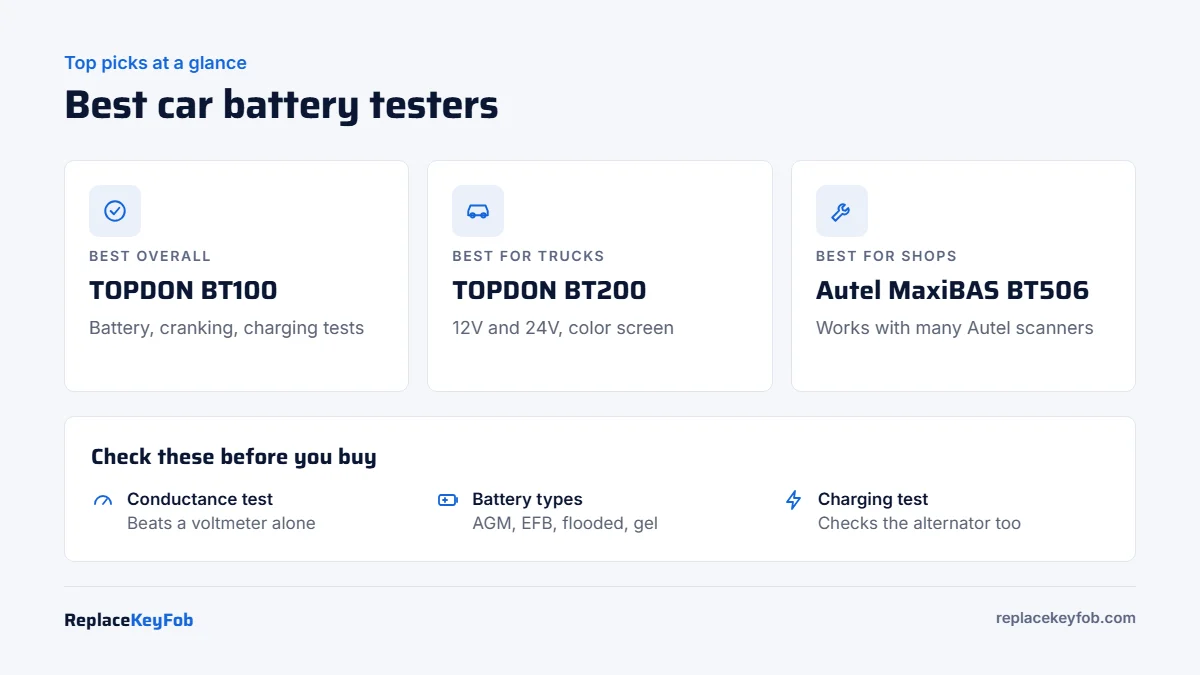
Our Top Picks at a Glance
| Tester | Best for | Voltage | Range |
|---|---|---|---|
| TOPDON BT100 | Best overall for most drivers | 12V | 100 to 2000 CCA |
| ANCEL BA101 | Simple, compact and widely used | 12V | 100 to 2000 CCA |
| TOPDON BT200 | Trucks, 24V and color screen | 12V and 24V | 100 to 2000 CCA |
| FOXWELL BT100 PRO | Clear results with temperature compensation | 12V | 100 to 1100 CCA |
| FOXWELL BT705 | One-person cranking tests | 12V and 24V | 100 to 2000 CCA |
| Autel MaxiBAS BT506 | Autel scanner owners and shops | 6V and 12V battery; 12V/24V system | 100 to 2000 CCA |
How a Digital Battery Tester Works
Old-style load testers put a heavy load on the battery for several seconds and watch the voltage fall. Modern handheld testers use conductance: they send a small signal through the battery and measure how easily current flows. From that, plus the CCA rating you enter, they estimate:
- State of health (SOH): how much of its original capability the battery still has.
- State of charge (SOC): how full it is right now.
- Measured CCA compared with the rated CCA.
- Internal resistance, which rises as a battery ages.
Most also run a cranking test (how far voltage drops while starting) and a charging test (whether the alternator puts out the right voltage at idle and under load). Conductance testing is quick, safe and does not drain the battery.
How We Chose These Testers
- Clear verdicts such as Good, Recharge or Replace, not just numbers.
- Battery types supported: flooded, AGM (flat and spiral), EFB and gel.
- Cranking and charging system tests.
- Screen readability in bright sun and in a dark garage.
- Clamp quality and protections against reverse polarity and short circuits.
- Manufacturer specs and long-term owner feedback. Some of these models also appear in independent YouTube comparisons, such as those by Project Farm, which their makers mention in their listings.
The Best Car Battery Testers
1. TOPDON BT100: Best Overall for Most Drivers
TOPDON BT100 12V Car Battery Tester
100 to 2000 CCA, battery, cranking and charging tests
Check Price on AmazonThe BT100 does everything a home mechanic needs in a glove-box-size tool. It tests 12V lead-acid batteries from 100 to 2000 CCA and reports state of health, state of charge, voltage, measured CCA and rating, plus three-color LEDs for a quick verdict. Its three tests cover the battery, the cranking system and the charging system, so it can tell you whether the problem is the battery, the starter side or the alternator.
It powers on only when correctly connected, which keeps it simple and safe. It is small enough to keep in the car and check the battery before a road trip or the first cold week.
Pros: complete 3-in-1 testing, compact, easy menus, LED verdict lights.
Cons: 12V only; monochrome screen.
Best for: car owners and DIYers.
Skip it if: you test 24V trucks.
2. ANCEL BA101: Simple, Compact and Widely Used
ANCEL BA101 12V Car Battery Tester
100 to 2000 CCA, flooded, AGM, gel and EFB
Check Price on AmazonThe BA101 is one of the best-known budget testers. It covers 12V batteries from 100 to 2000 CCA, supports test standards including SAE, BCI, EN, DIN, JIS and IEC, and works with flooded, AGM, gel and EFB batteries over 30Ah. ANCEL lists 4-in-1 protection against reverse polarity, short circuits, overcurrent and overvoltage, and the backlit black-and-white screen has adjustable contrast. It draws power directly from the battery, so there are no internal batteries to replace.
Pros: very small and light, wide standard support, protections for clamp slips.
Cons: basic screen; 12V only.
Best for: keeping in the glove box for quick checks.
Skip it if: you want saved test history or a color display.
3. TOPDON BT200: Best for Trucks and 24V
TOPDON BT200 12V/24V Battery and Alternator Tester
12V and 24V, 2.4-inch color screen
Check Price on AmazonThe BT200 is TOPDON’s step-up model. It tests both 12V and 24V systems from 100 to 2000 CCA, which covers cars, pickups, RVs and heavy trucks. It adds a 2.4-inch sunlight-readable color screen with Good/Replace prompts, copper clamps, a tougher housing and a memory that recalls your last test. TOPDON rates it for accurate operation from -4°F to 140°F and backs it with a one-year warranty and lifetime technical support.
Pros: 12V and 24V, color screen, last-test memory, wide temperature range.
Cons: larger than the BT100.
Best for: households with cars and trucks, and RV owners.
Skip it if: you only test one car.
4. FOXWELL BT100 PRO: Clear Results With Temperature Compensation
FOXWELL BT100 PRO 12V Battery Tester
100 to 1100 CCA, SOH, SOC, CCA and internal resistance
Check Price on AmazonFOXWELL’s BT100 PRO measures CCA, state of health, state of charge, voltage and internal resistance on 12V flooded, AGM, EFB and gel batteries, and gives clear results such as Good, Recharge or Replace. It has automatic temperature compensation for more consistent readings in summer and winter, a 2.4-inch backlit LCD, nine languages and a memory for the last test. Protections cover reverse polarity, overcurrent and short circuits.
Its range tops out at 1100 CCA, which covers almost all passenger car batteries but not the largest truck and commercial batteries.
Pros: temperature compensation, clear verdicts, saves last test.
Cons: 1100 CCA ceiling.
Best for: car owners who test in all seasons.
Skip it if: you test large commercial batteries.
5. FOXWELL BT705: Best for One-Person Cranking Tests
FOXWELL BT705 12V/24V Battery and Alternator Tester
12V and 24V, 5.9 ft cable, hard case
Check Price on AmazonCranking tests usually need two people: one to crank and one to watch the tester. The BT705 solves that with a 5.9-foot cable that reaches from the battery to the driver’s seat, so you can start the car and watch cranking voltage and cranking time yourself. It tests 12V and 24V systems from 100 to 2000 CCA, supports flooded, AGM, gel and EFB batteries, and comes with a hard carrying case. FOXWELL notes it was used in Project Farm’s 2026 battery comparison.
Pros: long cable for solo testing, 12V and 24V, guided prompts, durable case.
Cons: bulkier than glove-box testers.
Best for: DIY mechanics and small shops.
Skip it if: you want something pocket-size.
6. Autel MaxiBAS BT506: Best for Autel Scanner Owners
Autel MaxiBAS BT506 Battery and Electrical System Analyzer
6V and 12V batteries, works with many Autel scanners
Check Price on AmazonThe BT506 uses Autel’s adaptive conductance and supports 6V and 12V batteries from 100 to 2000 CCA, including flooded, AGM flat plate, AGM spiral, gel and EFB. It runs in-vehicle tests (battery, starter and generator) and out-of-vehicle tests, and it can identify abnormal cells. Its biggest advantage is that it works with many Autel scanners, so results appear on the tablet and can be saved, shared and printed as reports, along with battery location diagrams.
Pros: integrates with Autel scanners, detailed reports, in- and out-of-vehicle testing.
Cons: overkill if you do not own an Autel scanner.
Best for: shops and Autel owners.
Skip it if: you only need a quick yes or no.
How to Test a Car Battery
- Turn the engine and all accessories off. If the car was just driven, turn on the headlights for a minute to remove surface charge, then turn them off.
- Clean the terminals if they are corroded.
- Clip red to positive (+) and black to negative (-) directly on the battery posts.
- Select the battery type (flooded, AGM, EFB or gel) and the rating standard on the label (usually CCA/SAE in North America).
- Enter the rated CCA from the battery label.
- Read the result. Then run the cranking test (start the engine) and the charging test (engine idling, then with loads on).
Our guide on how to test a car battery at home covers multimeter checks as well.
How to Read the Results
| Result | What it means | What to do |
|---|---|---|
| Good | Battery healthy and charged | Nothing; test again before winter |
| Good, recharge | Healthy but low | Charge with a smart charger and retest |
| Charge and retest | Too low to judge | Fully charge, rest, then retest |
| Replace | Capacity or CCA too low | Replace the battery |
| Bad cell | Internal failure | Replace; do not keep jump starting |
Alternator readings matter too. With the engine running, a healthy charging system usually shows roughly 13.5 to 14.7V, depending on the vehicle. Much lower suggests a charging problem; see how to test an alternator with an OBD2 scanner.
Buying Guide
12V only or 12V and 24V?
Passenger cars are 12V. Choose a 24V-capable tester if you also work on heavy trucks or some RV and marine systems.
Check battery type support
Many newer cars use AGM or EFB. A tester that does not know the battery type can misjudge it.
Consider an OBD2 scanner with a tester
Some OBD2 scanners include a battery tester. They are convenient, but a dedicated tester is usually simpler and faster for battery checks. We review several combos, such as the OBD2 scanner with battery tester.
Battery Tester or Multimeter?
A basic multimeter measures voltage, which tells you the state of charge but not the battery’s health. A battery can show 12.6 volts at rest and still fail under load, because the voltage reading cannot see internal resistance or lost capacity. A digital battery tester uses conductance testing to estimate how much cranking power the battery can actually deliver, compares it with the rated CCA, and gives a clear result. For checking charging systems and wiring, a multimeter is useful. For deciding whether to replace a battery, a dedicated tester is much more reliable.
When to Test Your Battery
- Before winter and before a long road trip.
- When the engine cranks slowly or the lights dim at start-up.
- After the car has been parked for several weeks.
- Before key or module programming, when a stable voltage matters.
- Once a year after the battery is three years old.
Related Guides
- Best car batteries for cold weather
- Best AGM batteries for cars
- Check battery voltage with an OBD2 scanner
- Can a bad car battery cause key fob problems?
FAQ
Can a battery tester check the alternator?
Many digital testers include a charging system test that checks alternator output with the engine running. Check the features of the model you choose.
Do I need to disconnect the battery to test it?
No. Most digital testers work with the battery in the car. For the most accurate result, turn off the engine and accessories and let the car sit for a while first.
Are digital battery testers accurate?
Good conductance testers are reliable for deciding whether a battery is healthy, low or failing, as long as you enter the correct battery type and CCA rating. Testing a fully charged battery gives the clearest result.
Should I test a battery in the car or out of it?
Both work. Testing in the car is easier and lets you run cranking and charging tests too.
Why does my tester say charge and retest?
The battery is too discharged for an accurate health reading. Charge it fully, let it rest for a few hours, then test again.
How often should I test my car battery?
Before winter, before long trips, and any time you notice slow cranking or electrical glitches. Batteries older than three years deserve a check every few months.