
Audi Key Fob Battery Replacement: CR2032 for the Flip Key and the Newer Flat Key, Step by Step

Almost every Audi key takes a single CR2032 battery: the switchblade flip key used from about 2009 to 2016, the flat key with the pull-out emergency blade used from 2017 on, and most of the older flip keys before that. On the newer flat key, press the release and slide the emergency blade out, then push the back cover toward the end the blade came from and lift it off. On the flip key, extend the blade and pry the back cover off at the notch beside the hinge. Fit the new cell the same way round as the old one. No reprogramming is needed.
Audi makes the battery choice easy and the opening slightly awkward. The battery size has stayed at CR2032 across three generations of key, so the only real question is where the cover comes off, and that is different on the flip key and on the flat key that replaced it. Both covers are released by sliding rather than by prying along the seam, which is why a screwdriver pushed into the edge of an Audi key usually leaves a chewed-up corner and the cover still on. This guide shows the right spot for each key, then covers programming, the dead-key start method, costs and how long the new cell will last.

Which battery your Audi key fob takes
Find your key by shape and year. The FCC ID is printed on the back of the key or on a label under the battery cover, and the answer in the last column is a CR2032 almost every time.
| Key style | Typical FCC ID | Common on | Battery |
|---|---|---|---|
| Flat key with chrome trim and pull-out emergency blade (keyless) | IYZFBSB802, NBGFS12P71, NBGFS14P71 | A4 and allroad 2017 on, A5 2018 on, Q5 2018 on, Q7 2017 on, A6, A7 and A8 2019 on, Q3 2019 on, Q8, e-tron, Q4 e-tron | CR2032 |
| Switchblade flip key, rounded body, three or four buttons | IYZFBSB802, NBG009272T, NBGFS14P71 | A4 2009 to 2016, Q5 2009 to 2017, A6 and A7 2012 to 2018, Q7 2007 to 2015, A3 2015 to 2020, TT 2016 on, R8 | CR2032 |
| Older flip key, squarer body, round release button | NBG92596263, MYT8Z0837231 | A4 2002 to 2008, A6 2005 to 2011, A3 2006 to 2013, TT 2000 to 2014, Q7 2007 to 2009, A8 2004 to 2010 | CR2032 (a few early ones CR2025) |
| Small square remote on a key ring, pre-2002 | Various | A4, A6 and TT from the late 1990s | CR2032 or CR1620, read the cell |
If you open an Audi key and find a CR2025 in it, look at the holder before assuming that is right. On nearly all of them the holder is cut for the 3.2 mm thick CR2032, and a thinner cell fitted by a previous owner is the usual reason for a key that works one day and not the next. Only a few early-2000s flip keys were made for the CR2025. The code on the old cell plus a glance at the depth of the holder settles it.
The code tells you the size: the first two digits are the diameter in millimetres and the last two are the thickness in tenths of a millimetre, so a CR2032 is 20 mm wide and 3.2 mm thick while a CR2025 is the same width but thinner. A thinner cell in the same holder makes poor contact and causes the random dropouts people blame on the car. Our key fob battery size chart lists every size by brand.
What you need
- One new battery of the exact code printed on the old one (Panasonic, Energizer, Duracell, Murata or dealer branded all work)
- A small flat-blade screwdriver or a plastic pry tool for the flip key; the emergency blade is enough for the flat key
- A clean table and good light, so a dropped battery or the small cover does not vanish
Avoid rechargeable cells such as LIR2032. They have the right shape but a higher voltage, and they are not what the key is designed for. A branded 3 V lithium cell with a date well into the future is all you need.
Changing the battery in the newer Audi flat key
This is the key fitted from 2017 on, with the chrome trim around the edge and an emergency blade that slides out of the end. The cover is on the back and releases toward the blade end.
Press the small release button on the side of the key and pull the metal blade straight out. You will not need it as a tool, but the cover cannot move until it is out of the way.
Turn the key over. The back cover is the section with the four rings on it. Put your thumb on it and push firmly toward the end the blade came out of; it slides a few millimetres and then lifts away. If it will not move, push the tip of the blade into the small slot inside the blade opening to release the catch while you push.
The CR2032 sits with its + side and printed code facing up, toward the cover. Take a photo so there is no guessing later.
Use a plastic tool or a fingernail at the cut-out beside the cell and lift it out by the edge. Do not scrape a metal tool across the circuit board.
Hold the new cell by its edges and press it in the same way round as the old one. It should sit flat under the small retaining clip without rocking.
Lay the cover on, slide it back until it clicks, push the emergency blade home and press lock and unlock near the car. The LED on the key should flash with each press.
The cover only goes on one way and only clicks when it is fully home. If it sits slightly raised, the battery is standing proud, which usually means it is not under the clip or it is the wrong thickness.
Changing the battery in an Audi flip key
This covers the switchblade keys from about 2002 to 2016 (and the A3, TT and R8 keys that kept the flip design later). The whole back of the key is the battery cover.
- Press the round button so the blade flips out and stays extended; it gives you something to hold.
- Turn the key over. At the end nearest the blade hinge, on the seam, there is a small notch. Put a flat screwdriver or a plastic tool in the notch and twist gently. The back cover lifts at that end; work it free along the sides rather than levering one corner hard.
- Note which way the battery faces (normally + up, toward the cover), then lever it out from the cut-out at its edge.
- Press in the new CR2032 the same way round, check the rubber button pad is seated in the front half, and snap the cover back on until the seam is flush all the way round.
The transponder chip that lets the car start is sealed inside the key and does not use the battery. A flip key with a dead cell still turns in the ignition and starts the engine on cars with a key slot; you only lose the remote buttons.
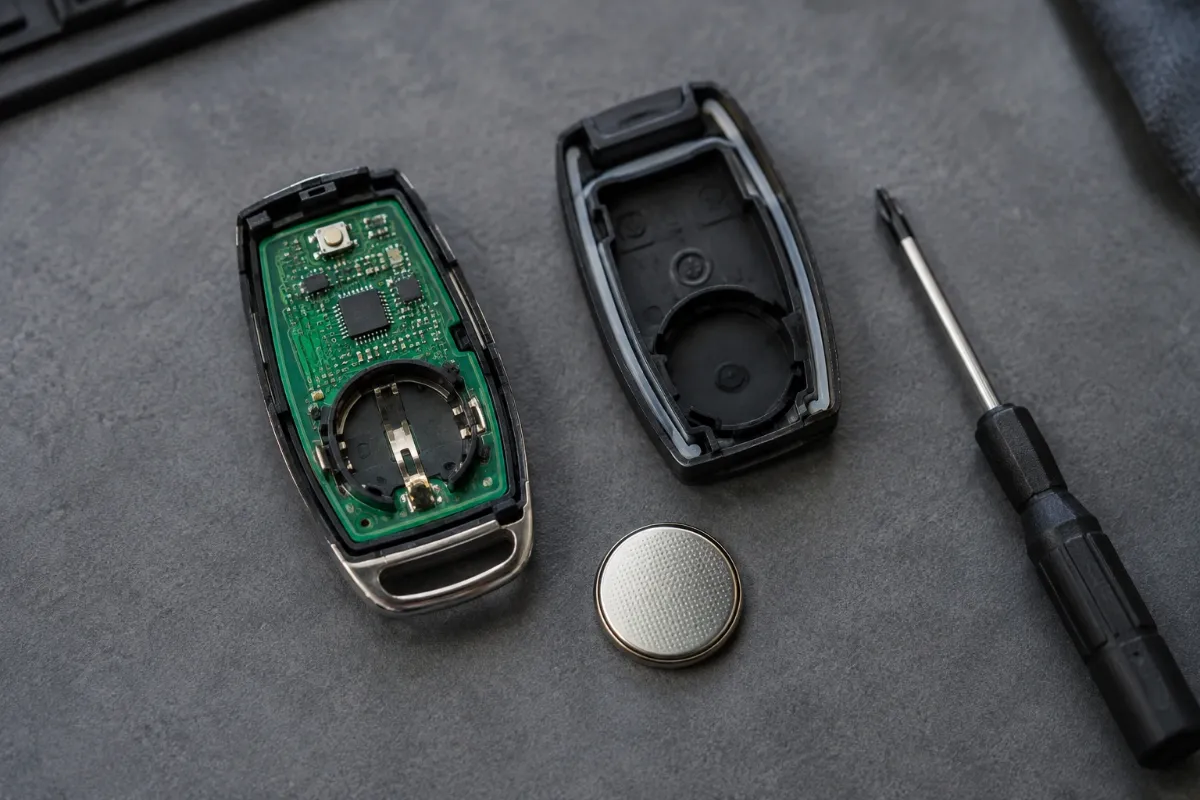
3V lithium CR2032 coin cell
Every Audi key from the last twenty years takes a CR2032. Buy a name brand in a small multi-pack and keep the spares in the glove box, not loose in the fob.
As an Amazon Associate, ReplaceKeyFob earns from qualifying purchases.
Do you need to reprogram an Audi key after a battery change?
No. The key’s pairing with the car is stored in memory that does not depend on the battery, so an Audi key works as soon as a fresh cell goes in. If the dash showed Key battery weak, please replace or Change key battery, it clears the next time you start the car, or after a drive on some models. If the key has been out of range or dead for a long time, press lock or unlock once near the car to resync it; that is the only step an owner can do. Pairing a new key is dealer or specialist work because it needs the car’s immobiliser data.
If the car still does not see the key
First, get moving. On an Audi with a key slot in the dash (most 2009 to 2016 models), push the flip key into the slot and press it in, or turn it, as normal; the slot powers the chip, so a dead remote battery does not matter. On a keyless Audi without a slot, hold the key against the marked spot on the steering column trim below the wheel, or in the cup holder on some models, while you press the Start button with your foot on the brake. The emergency blade unlocks the driver’s door; on the flat key the lock is under a small cap at the end of the handle that the blade tip pops off.
Then work through the usual causes, in order of how often they turn out to be the problem:
- Wrong size. A CR2025 or CR2016 in a CR2032 holder makes patchy contact and the key works one day and not the next. Compare the code on the new cell with the old one.
- Upside down. If the key does nothing at all and the LED does not flash, open it and turn the battery over.
- Bent or dirty contact. The spring contact can be flattened by prying. Lift it gently with a plastic tool and clean it with a dry cotton bud. See how to clean key fob battery contacts.
- Tired new battery. Cells that sat in a drawer or came from an unbranded multi-pack can be flat out of the packet. Try a second one from a fresh pack.
- The car’s 12 V battery. If the car was also slow to crank or threw warnings on start-up, the problem is the car, not the key. See can a bad car battery cause key fob problems.
- Damage inside the key. A fob that has been dropped hard, through a wash, or left in a hot car can have a cracked solder joint or corroded board. A locksmith can test whether it still transmits.
The general checklist for a key that still does not respond is in key fob not working after a battery replacement.
What it costs
An Audi dealer parts counter will usually fit a battery while you wait for little more than the price of the cell. The larger figures only apply if the key itself has to be replaced. Audi keys for 2009 and newer cars need the car’s immobiliser data to be matched, which most dealers order against the VIN with a short wait, and only a minority of independent locksmiths can do, so keeping the second key alive is worth far more than the battery costs.
How long the new battery will last
A flip key only transmits when you press a button, so a CR2032 in one typically lasts three to five years. The keyless flat key listens for the car and answers whenever you touch a door handle, so one to two years is normal, and less if the key lives within a few feet of the car overnight. Cold weather and carrying the key loose with things that press the buttons both shorten that. More detail is in how long key fob batteries last.
Safety: keep coin batteries away from children and pets
A swallowed coin cell can cause serious internal burns within hours. Keep spares and the old cell out of reach, and dispose of old batteries at a drop-off point rather than in household waste. If you think a child has swallowed a battery, go to the emergency room straight away and call the National Battery Ingestion Hotline at 1-800-498-8666, or Poison Help at 1-800-222-1222.
Frequently Asked Questions
A single CR2032 3 V lithium coin cell on nearly every Audi key: the 2017-on flat key, the 2009 to 2016 flip key and most older flip keys. A few early-2000s keys take a CR2025. Confirm with the code on the old battery.
Press the release and slide the emergency blade out, then push the back cover (the part with the four rings) toward the end the blade came from and lift it off. The battery sits underneath with the + side up.
No. The key keeps its pairing without battery power and works as soon as the new cell is in. The Key battery weak message clears after the next start. Press lock or unlock once near the car if the key has been dead for a long time.
On cars with a dash slot, push the key into the slot as normal. On keyless models, hold the key against the marked spot on the steering column trim, or in the cup holder on some models, while pressing Start with your foot on the brake.
It will fit the holder and may work for a while, but it is thinner than the CR2032 the holder is designed for, so the contact is poor and the key becomes unreliable. Use a CR2032 unless the old cell was a CR2025.
The car usually needs a start cycle or a short drive to update. If it stays on, check that the new cell is a CR2032 from a fresh pack, the right way up, and that the spring contact in the key is not flattened.