
How to Unfreeze Frozen Car Door Handles

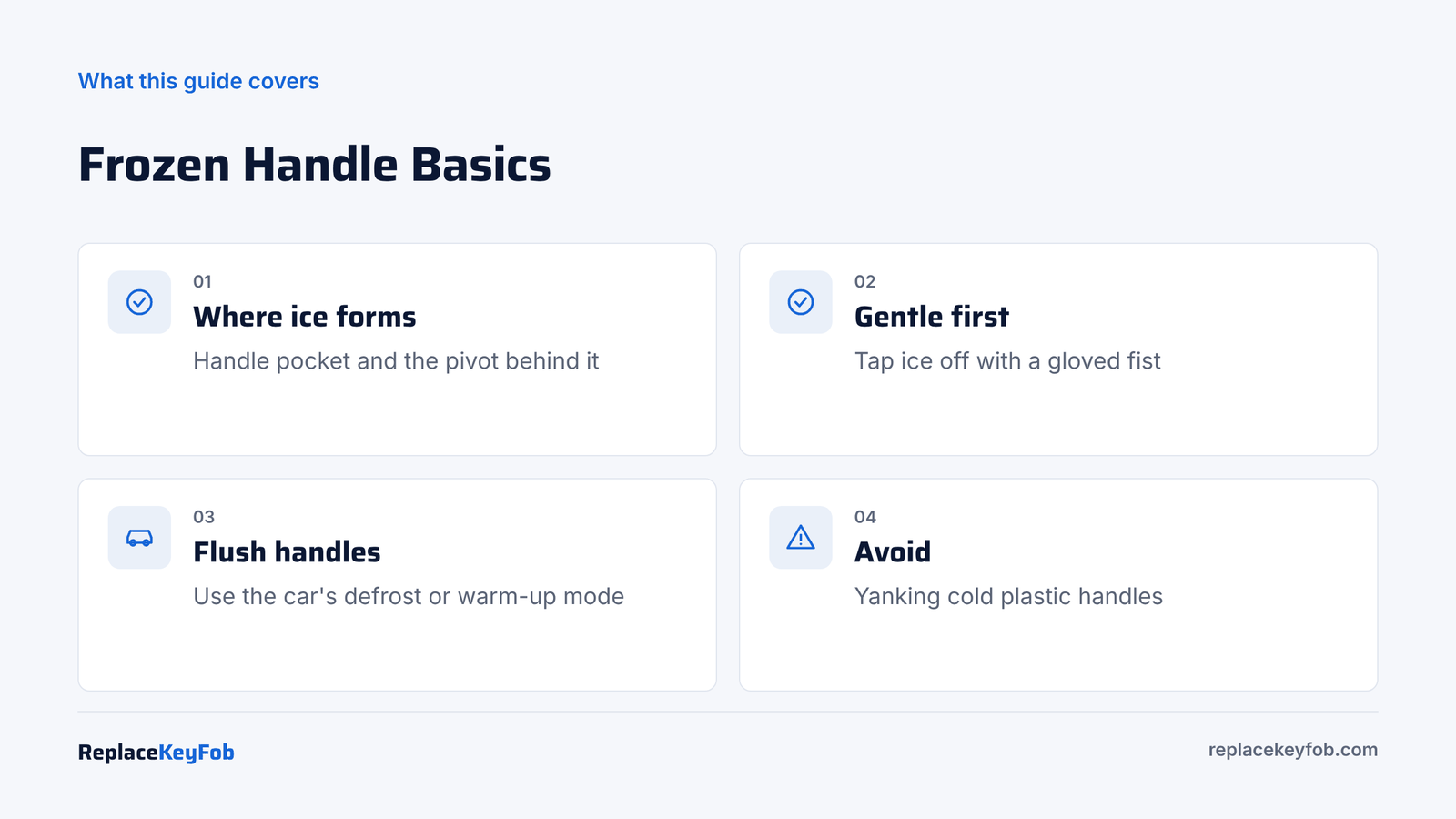
To unfreeze frozen car door handles, tap the ice off with a gloved fist, chip ice from the handle pocket with a plastic scraper, and spray de-icer behind the handle. A hair dryer or 10 to 15 minutes of cabin heat finishes the job. Lift the handle gently, because cold plastic snaps.
A frozen door handle is different from a frozen door or a frozen lock. Here the handle itself will not lift or pull out, because ice has filled the pocket behind it or frozen the pivot and spring. Sometimes the handle moves, but only part way, because the rod or cable behind it is iced up inside the door.
The risk with handles is breakage. Exterior handles on most cars are plastic or painted plastic over a metal frame, and they become brittle well below freezing. A broken handle in January can leave you climbing in through the passenger side for weeks, so take the slow route.
Know Your Handle Type
The method depends on the handle on your car.
| Handle type | How it opens | Where ice causes trouble |
|---|---|---|
| Pull-up flap | Lift from below | Pocket under the flap, pivot pins |
| Pull-out grab handle | Pull outward | Gap behind the handle, rear pivot |
| Flush or pop-out handle | Extends by motor or press | Ice sheet over the handle, motor cannot push it out |
| Pivot flush handle | Press one end, pull the other | Ice locks the pivoting end in place |
| Electronic push-button latch | Press a button or pad | Ice over the button; door seal also frozen |
Flush and electronic handles appear on many EVs and newer luxury models. They look clean but they cannot break ice by themselves, so they need heat more than force.
What You Need
- Gloves and a plastic ice scraper
- Alcohol-based de-icer spray with a nozzle
- Hair dryer and outdoor extension cord, if available
- Microfiber towel
- Silicone spray for prevention
Car de-icer spray for handles and seals
Look for an alcohol-based de-icer with a nozzle or trigger that can reach behind the handle, and check that it is safe for paint, rubber and plastic.
As an Amazon Associate, ReplaceKeyFob earns from qualifying purchases.
How to Unfreeze a Car Door Handle
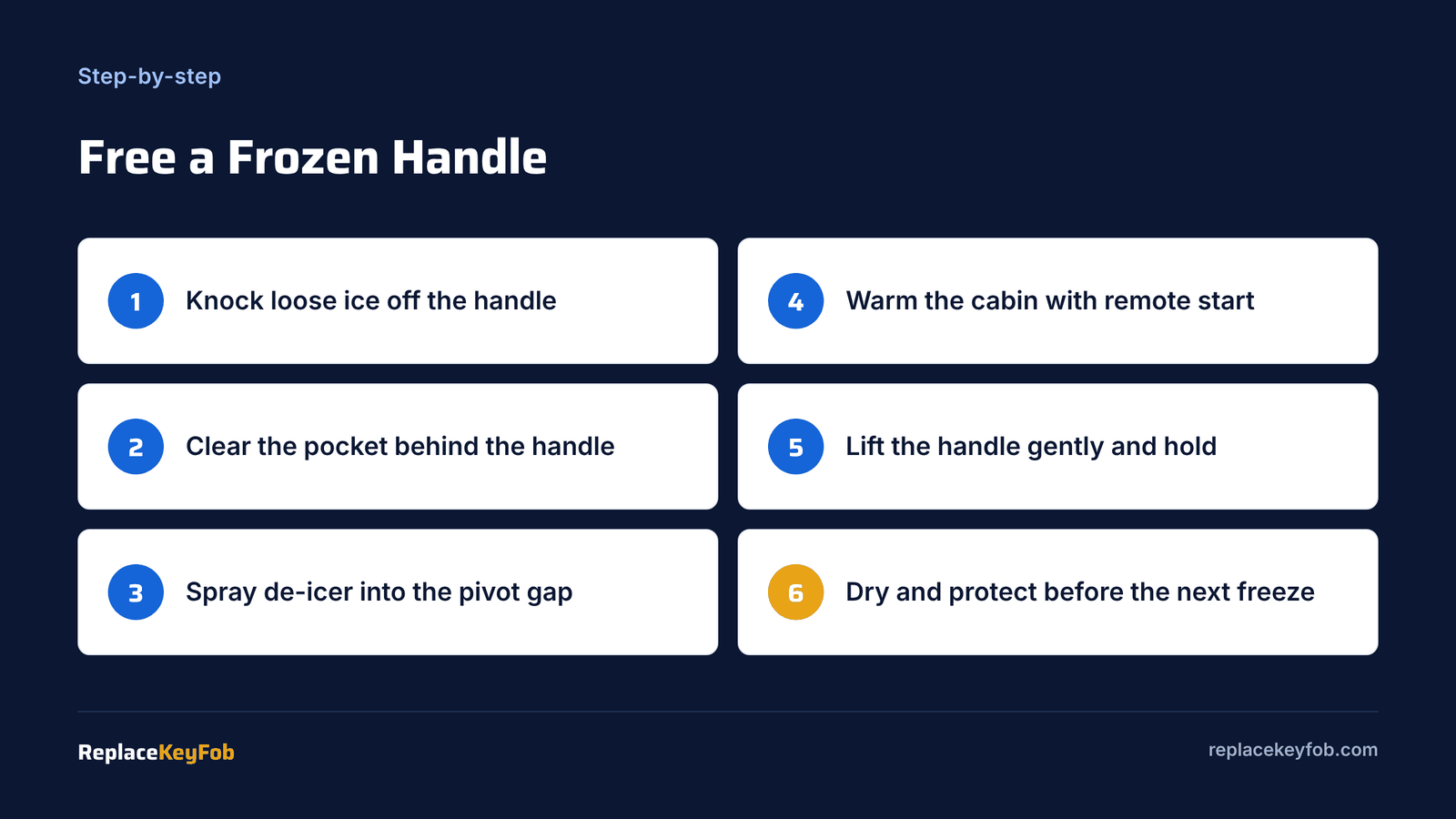
- Break the surface ice. Tap around the handle with the side of a gloved fist. Light, firm taps crack the ice shell without denting the door. Do not hit the handle itself hard.
- Clear the pocket. Use the corner of a plastic scraper to chip ice out of the recess behind or below the handle. This is where most of the holding ice sits. Work around the edges, not under the handle with force.
- Spray de-icer behind the handle. Aim the nozzle into the gap between the handle and the door skin, especially at the pivot ends. Wait one to two minutes.
- Use your hands as heaters. If you have no de-icer, take off your gloves and hold your palms over the handle for a minute or two at a time. Slow, but it works on a thin layer.
- Add heat if you can. A hair dryer on medium, held 4 to 6 inches away and moving, thaws the handle and its pivot in a few minutes.
- Start the car if possible. If another door opens, or you have remote start, run the engine with the heater on high. Heat from the cabin reaches the handle linkage inside the door within about 10 to 20 minutes.
- Lift gently and hold. Pull the handle slowly to its full travel and hold it for a few seconds. If it stops part way, do not force it. Let go, apply more de-icer or heat, and try again.
Why hold the handle out
The handle pulls a rod or cable that releases the latch. If that linkage is still stiff, a quick tug may not release the latch fully, and the door stays shut. Holding the handle gives the latch time to release while you pull the door slowly. If the handle moves but the door does not open, the seal is frozen; see how to unfreeze a car door for that step.
Flush and Electronic Door Handles
Motorized pop-out handles
Cars with handles that present themselves when you approach rely on a small motor. A layer of ice can stop the handle extending. Most of these cars have a winter feature: preconditioning or a defrost mode in the app or on the touchscreen that warms the cabin and, on some models, the handle area. Start it 15 to 30 minutes before you leave. You can also break thin ice by pressing firmly on the handle a few times. Check your owner’s manual, because some models let you press one end of the handle to push it out manually.
Pivot flush handles
On handles where you press the wide end so the narrow end swings out, ice can lock the pivot. Clear ice off the full handle outline, press the wide end firmly several times to crack the ice, then de-ice the gap. On Tesla models, the app’s defrost function helps on many model years.
Touch sensors and passive entry
Smart key cars unlock when you touch a sensor on the handle. Ice and thick gloves can stop the sensor reading your touch. Clear ice off the sensor area and touch it with a bare finger, or press the unlock button on the fob instead. If passive entry keeps failing in cold weather, see how passive keyless entry works and does cold weather affect key fobs.
If the Handle Still Won’t Work
| What happens | Likely cause | Next step |
|---|---|---|
| Handle will not move at all | Ice in the pocket and pivot | More de-icer, more heat, then retry |
| Handle moves, door stays shut | Linkage stiff or seal frozen | Hold the handle out, push the door, de-ice seam |
| Handle feels loose, no resistance | Rod or cable popped off, or handle broken | Open from inside; repair needed |
| Flush handle will not extend | Ice over handle or weak 12V battery | Run defrost mode; check the 12V battery |
| Key will not turn in the handle keyhole | Lock cylinder frozen | Use lock de-icer in the keyhole |
If the keyhole in the handle is also frozen, follow how to unfreeze car door locks. If the handle went loose after a hard pull, the clip that holds the rod to the handle has probably snapped or come off. That is a common winter repair and usually needs the door panel removed.
How Long Each Method Takes
Knowing what to expect helps you stop forcing the handle when a method simply needs more time.
| Method | Typical time | Works best for |
|---|---|---|
| Tapping and clearing the pocket | 1 to 3 minutes | Thin ice after a light freeze |
| De-icer spray | 2 to 5 minutes | Ice behind the handle and pivots |
| Bare hands | 3 to 10 minutes | Thin film, no tools on hand |
| Hair dryer | 3 to 8 minutes | Thick ice, car parked near an outlet |
| Cabin heat or remote start | 10 to 20 minutes | Linkage frozen inside the door |
| Defrost or preconditioning mode | 15 to 30 minutes | Flush and motorized handles |
In freezing rain, the ice can be a solid glaze over the whole door. In that case, combine methods: start the car remotely if you can, clear the handle while the cabin warms, then use de-icer on the pivot gaps. Trying one method at a time in a hard glaze wastes more time than running two together.
Mistakes to Avoid
- Yanking. Cold plastic cracks. Pull slowly and hold.
- Prying behind the handle with metal. A screwdriver will scratch paint and can bend the handle frame.
- Hot water. It refreezes in the pocket and pivot, often worse than before, and can crack cold glass if it splashes.
- Hitting the handle directly. Tap the door skin around it instead.
- Ignoring a loose handle. Driving around with a disconnected handle rod can let it rattle loose further, and the door may not open from outside in an emergency.
Keep Door Handles From Freezing
- Wipe handles and pockets dry after car washes in winter.
- Spray a light coat of silicone into the handle pocket and pivots before a freeze.
- Park with the car facing away from wind-driven sleet when possible.
- Use remote start or the app’s preconditioning before cold mornings.
- On EVs, keep the 12V battery healthy, because weak 12V power slows door motors.
When to Get It Repaired
If a handle broke or disconnected during a freeze, an exterior door handle replacement typically costs about $150 to $400 at a shop in 2026, and more on luxury flush handles, which can run about $400 to $900 or higher per door. If the handle works but the door will not unlock, the problem may be the lock actuator; see why a key fob unlocks the passenger door only for how a failed actuator behaves.
Frequently Asked Questions
Water from rain, snow or a car wash settles in the pocket behind the handle and around its pivot, then freezes overnight. The ice holds the handle in place even though the latch is free.
Lukewarm water can work in an emergency, but dry the handle immediately or it will refreeze worse. De-icer spray or a hair dryer is safer.
Use the app’s climate or defrost function for 15 to 30 minutes, clear ice off the handle and press firmly on the handle to break the ice. Steps vary by model year; check your owner’s manual.
The handle released the latch but the rubber seal is frozen to the frame. Push the door inward to crack the ice, de-ice the seam and pull slowly while holding the handle out.
Yes. Cold plastic and the clips that connect the handle rod are brittle in freezing weather, and a hard pull is the most common way handles break in winter.