
How to Fix a Sticky Car Door Key Lock

To fix a sticky car door key lock, clean the key, spray lock cleaner into the keyhole, then add dry graphite and work the key in and out 20 times. If your spare key turns smoothly, the main key is worn and needs a new one cut by code. If both stick, call a locksmith.
A sticky door lock feels like the key drags going in, catches half way, or needs a jiggle before it will turn. On many modern cars it gets worse over time because nobody uses the keyhole: the remote does all the work, and the cylinder sits there collecting dust and water until the day the fob dies.
The good news is that most sticky locks are caused by dirt and dried lubricant, and you can fix them in 15 minutes with a can of lock cleaner and a tube of graphite. The trick is knowing when the problem is the key and when it is the lock, so you do not keep lubricating a lock that actually needs a new key.
Why Car Door Key Locks Get Sticky
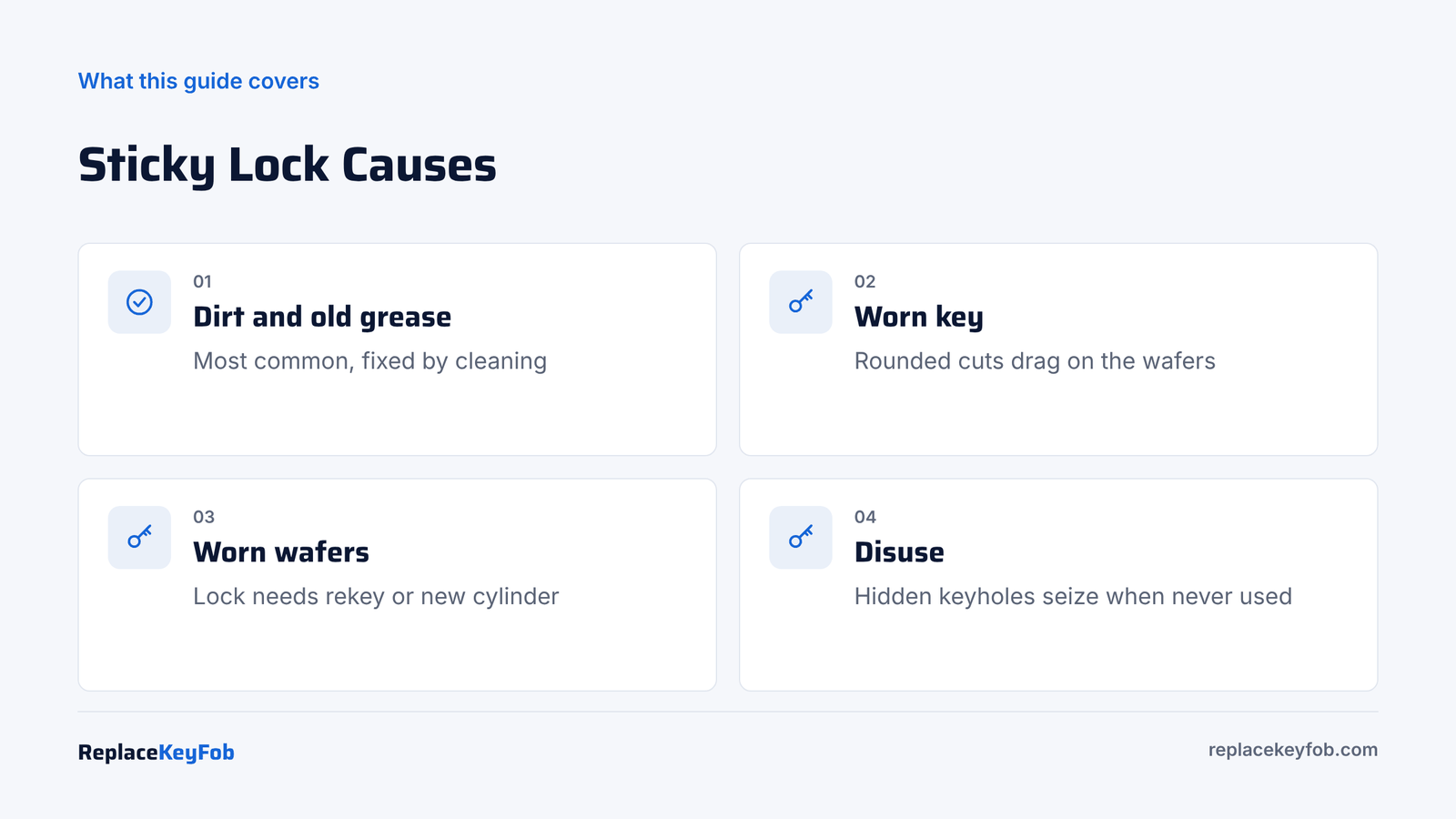
| Cause | What you notice | Fix |
|---|---|---|
| Dirt, grit, old grease | Key drags, feels gritty, worse in cold | Clean and dry-lube the cylinder |
| Worn key | Spare works better than main key | Cut a new key by code |
| Bent or twisted key | Key goes in at an angle or binds | Replace the key |
| Worn wafers or springs | Both keys stick, lock feels loose or random | Rekey or replace cylinder |
| Corrosion from salt and water | Rust on keyhole face, stiff shutter | Clean, lube; replace if pitted |
| Disuse | Key will not turn at all on a hidden keyhole | Penetrating lock cleaner, then graphite |
| Bent lock rod inside the door | Key turns but lock does not move | Door panel off, reconnect rod |
Tools and Supplies
- Lock cleaner or plastic-safe electrical contact cleaner
- Dry graphite lock lubricant or dry PTFE lock spray
- Old toothbrush and a cloth
- Your spare key
- Magnifying glass or phone camera for inspecting the key
Dry graphite lock lubricant
Choose a powdered graphite or dry PTFE lock lube in a squeeze tube with a fine nozzle that fits the keyhole shutter. Dry lubes do not gum up in cold weather.
As an Amazon Associate, ReplaceKeyFob earns from qualifying purchases.
Step-by-Step: Fix a Sticky Door Key Lock
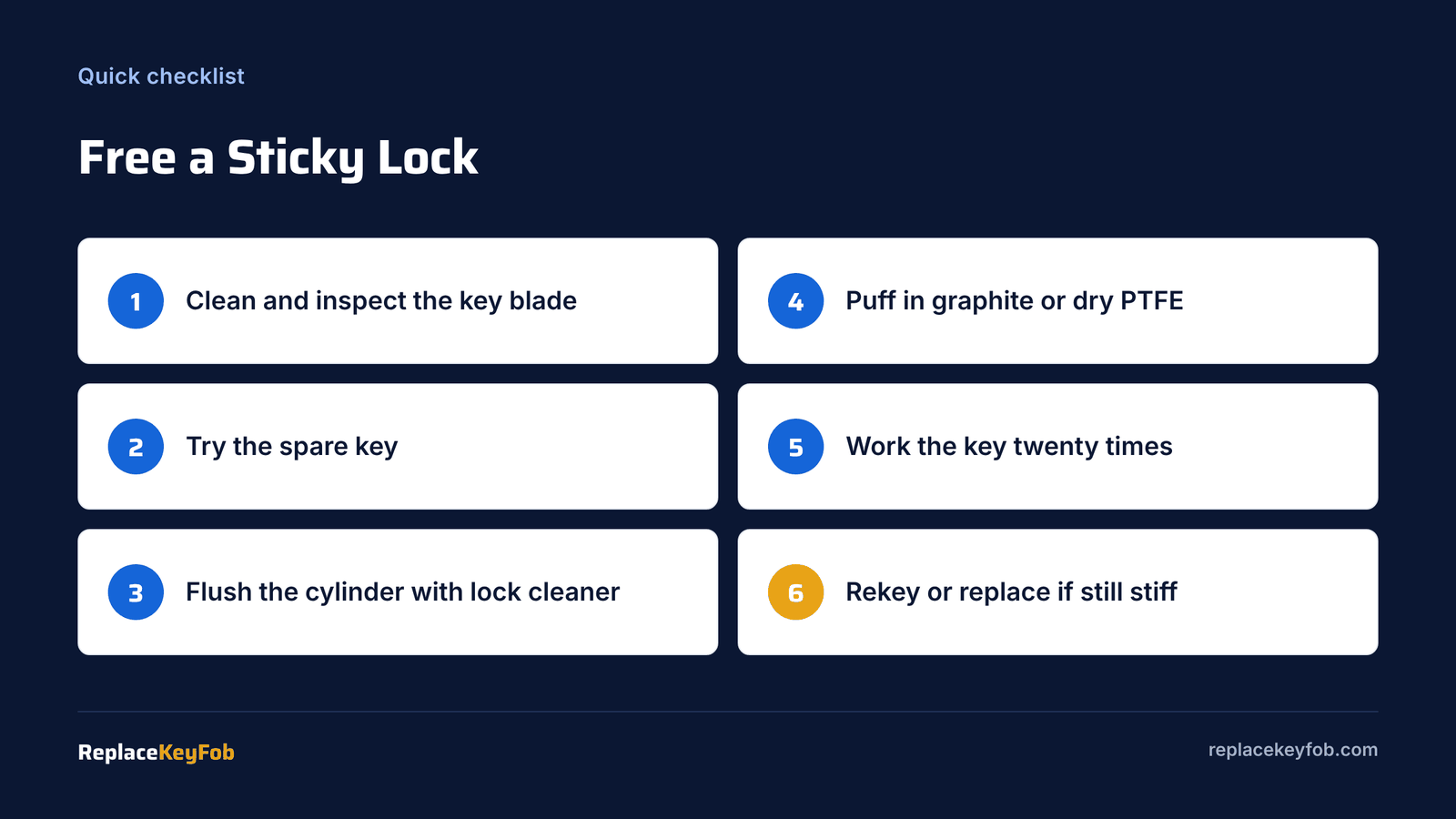
1. Inspect and clean the key
Look at the key blade under good light. The cuts should have crisp edges and flat tops. If the peaks look rounded or polished smooth, the key is worn. Check for bending by laying it on a flat table. Scrub the blade with a toothbrush and a little cleaner, then dry it. A dirty key pushes grit straight into the lock each time you use it.
2. Test with the spare key
Try the spare. This single step tells you more than any other.
- Spare turns smoothly: your everyday key is worn. Keep using the spare and have a new key cut.
- Spare also sticks: the problem is in the lock cylinder. Continue with the cleaning steps.
3. Flush the cylinder
Spray lock cleaner into the keyhole for two to three seconds. Insert the key and move it in and out ten times, then pull it out and wipe it. Repeat until the key comes out clean. This removes dust, dried grease and grit from between the wafers.
4. Dry-lube the cylinder
Once the cleaner has evaporated (about five minutes), puff dry graphite or spray dry PTFE into the keyhole. Insert the key, turn it to lock and unlock, and remove it. Do this about 20 times. The graphite coats each wafer and the cylinder wall.
5. Free a lock that will not turn at all
On a keyhole that has not been used in years, the cylinder may be seized. Spray lock cleaner, wait ten minutes, then turn the key gently in both directions in small movements. Do not use pliers on the key. If it will not move after two or three rounds, stop; forcing it will snap the key.
How to Remove a Key Stuck in a Car Door Lock
A key that goes in but will not come out is usually held by a wafer that did not drop back into place, or by a bent blade.
- Turn the key back to the exact straight-up position where it went in. Most door locks only release the key in that position.
- Push the key fully in, then pull straight out while wiggling it gently up and down, not side to side.
- Spray lock cleaner or a dry lube along the blade where it enters the lock, wait a minute and try again.
- Lift up slightly on the key as you pull. This helps wafers clear the cuts.
- If the key is bent, do not straighten it while it is in the lock. Pull it out first.
If the key snaps, see our guide on removing a broken key from a car door lock. A locksmith can usually extract it without damage.
Read the Symptom Before You Fix It
How the key feels tells you where the problem sits:
- Gritty drag all the way in: dirt in the cylinder. Cleaning fixes it.
- Smooth in, stiff to turn: dried grease or corrosion on the cylinder body. Clean, then dry-lube.
- Catches at the same point every time: one wafer is sticking, or one cut on the key is worn. Try the spare to tell which.
- Turns only if you pull the key out slightly: classic worn key or worn wafers. The key is not lifting the wafers to the right height.
- Worse in cold or wet weather: water inside the lock. Dry it out and switch to graphite.
- Key turns, door does not lock or unlock: the lock is fine; the rod or clip behind it inside the door has come loose.
Matching the symptom first stops you from spending money on a new key when the cylinder only needed cleaning, or the other way around.
Fixing a Worn Key
Copying a worn key copies the wear. The better option is cutting a new key to the original factory code.
- Dealer: many dealers can cut a key by VIN with proof of ownership. If the key has a chip or remote, it may also need programming for the ignition.
- Locksmith: an automotive locksmith can decode your lock or look up the code and cut a fresh key.
- Fob emergency blade: on smart key cars, the hidden mechanical blade can be replaced or cut separately from the fob.
For a full spare key, see how to get a spare key fob. Typical costs in 2026: a plain metal blade cut by code costs about $10 to $50, a laser-cut emergency blade about $30 to $90, and a transponder key or remote key about $90 to $300 including programming.
Model and Age Differences
- Older cars (pre-2000s): often have keyholes on both front doors and the trunk. More keyholes mean more wear and more water entry.
- 2000s to mid-2010s: usually driver door plus trunk, with standard edge-cut keys.
- Newer cars: often a single driver-side keyhole, sometimes hidden behind a cap, and laser-cut (sidewinder) keys. These locks fail from disuse more than wear.
- Trucks and work vehicles: more dust and mud exposure, so they need cleaning more often.
Mistakes to Avoid
- Spraying grease or heavy oil into the lock. It turns into paste with dust.
- Using pliers on the key. It bends or snaps the blade.
- Copying a worn key. You get a new key with the same rounded cuts.
- Forcing a seized lock in freezing weather. Thaw it first; see how to unfreeze car door locks.
- Ignoring a lock that turns but does nothing. The rod or clip inside the door may have come off. That needs the panel removed.
Prevention
Use the keyhole once a month, even if you normally use the fob. Lubricate it with graphite twice a year, as explained in how to lubricate car door locks. Keep your key clean and off rough surfaces, and do not hang heavy keychains on a key that also goes into the ignition.
When to Call a Locksmith
Call a pro if both keys stick after cleaning, if the key is stuck and will not come out, or if the lock spins without locking. An automotive locksmith typically charges about $100 to $250 to service or rekey a door lock cylinder in 2026, and about $150 to $350 to replace one with parts. For help finding one, see our locksmith guide.
Frequently Asked Questions
The most common causes are dirt and dried grease inside the cylinder or a worn key. Test with your spare: if it works smoothly, your main key is worn.
Flush it with lock cleaner, let it dry, then lube with dry graphite or dry PTFE and work the key in and out about 20 times.
Return the key to the straight insertion position, push it fully in, then pull straight out while wiggling up and down. A little dry lube along the blade helps.
No. Copying keeps the worn cuts. Have a new key cut to the factory code by a dealer or locksmith instead.
Most sticky locks only need cleaning and lubrication. If both keys still stick, a locksmith can rekey the cylinder with new wafers or replace it.