
How to Change a Car Battery at Home (Remove and Install)

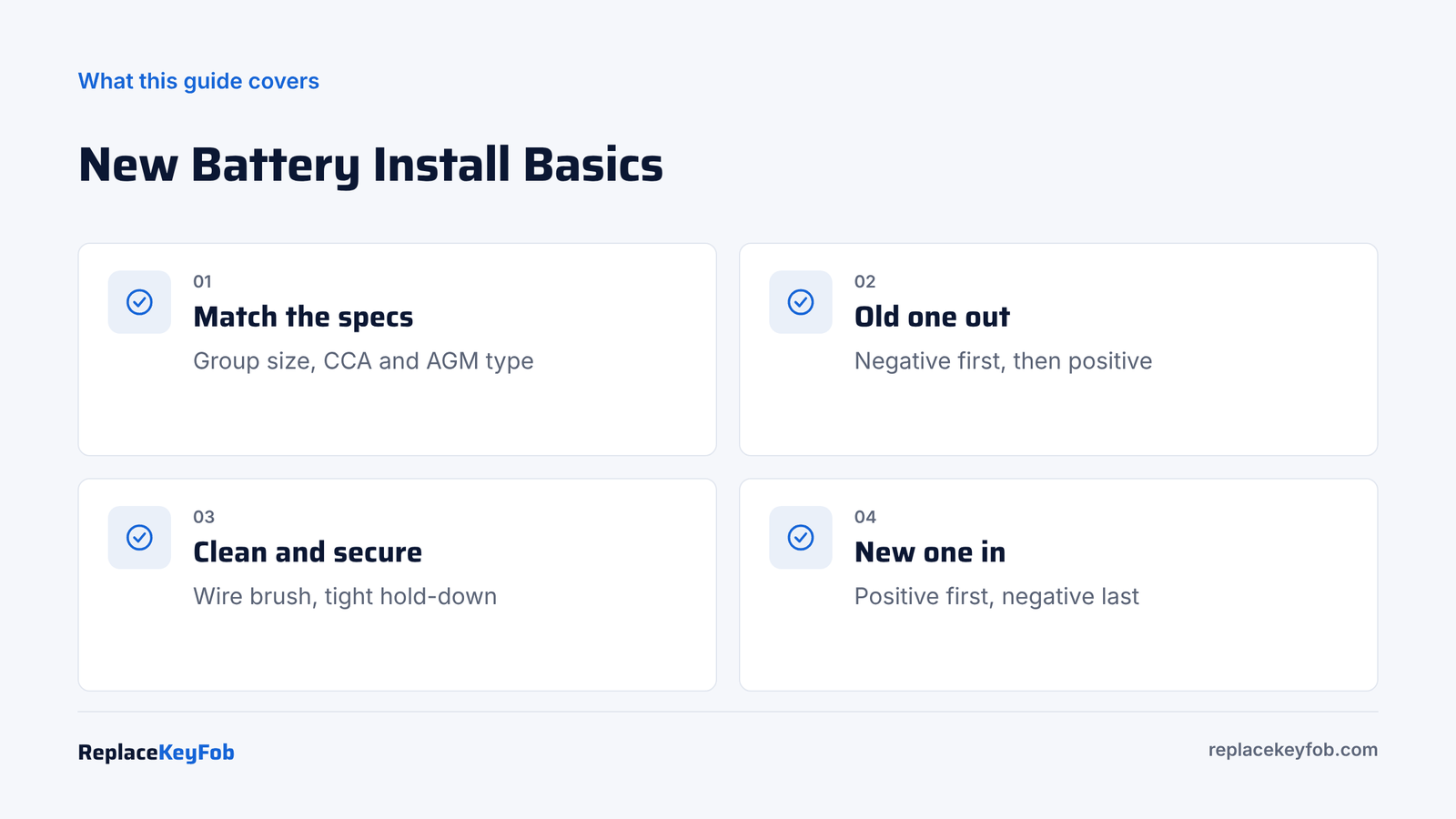
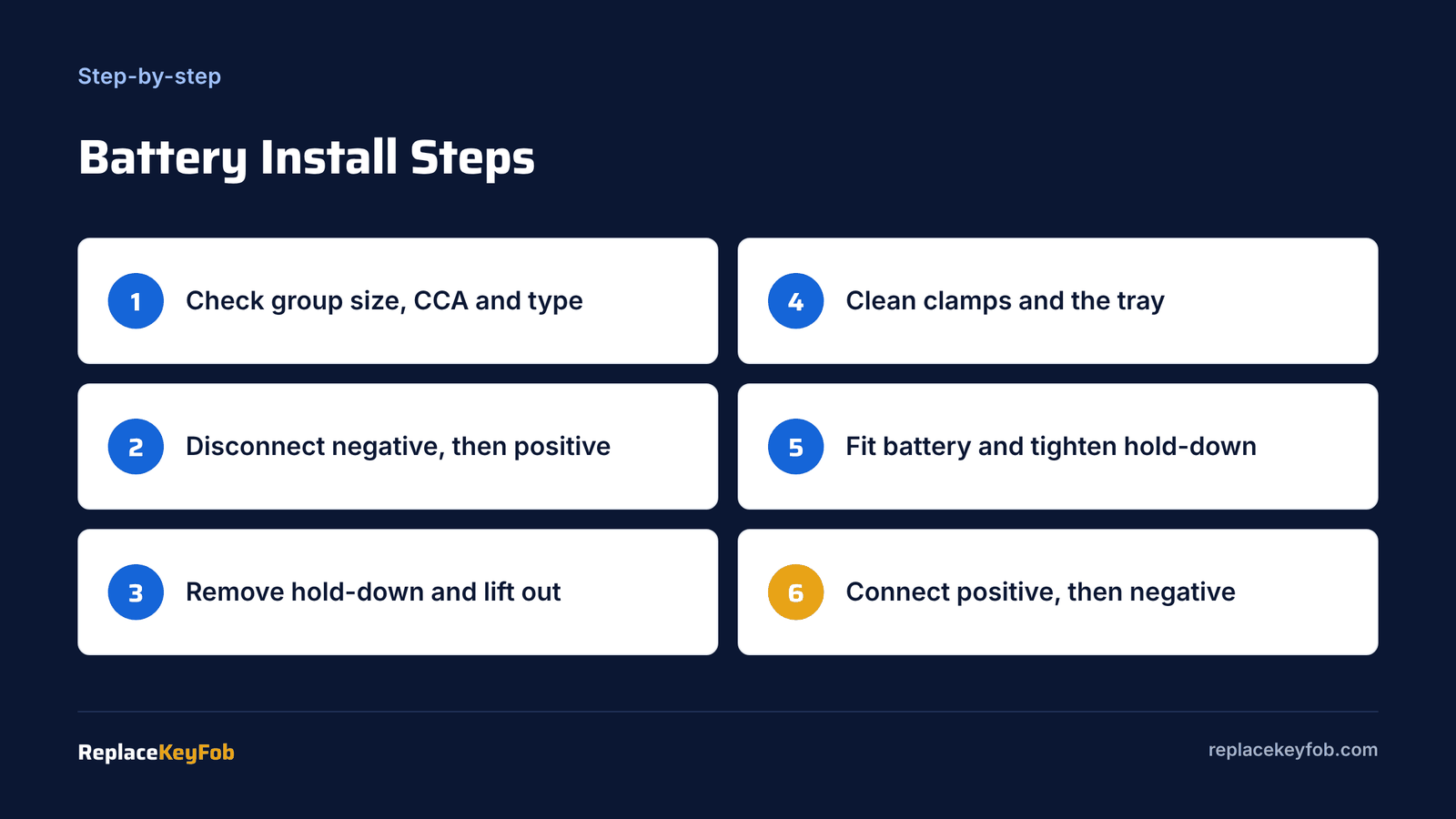
To install a new car battery, buy one with the same group size, equal or higher cold cranking amps and the same type (flooded, EFB or AGM). Turn the car off, remove the negative cable, then the positive, unbolt the hold-down and lift the old battery out. Clean the clamps, set the new battery in, secure it, then connect positive first and negative last.
Replacing a battery yourself saves labor and a wait at the shop, and on most cars it needs only a wrench, a brush and about 30 minutes. The job is simple, but a few details decide whether the new battery lasts five years or fails early: the right specs, clean tight clamps, a secure hold-down, and on some cars, telling the computer a new battery is installed.
This guide is the full hands-on process. For prices and whether a shop install is worth it, see car battery replacement cost. For warranty questions, see car battery warranty.
Step 0: Make Sure You Need a Battery
A dead battery is not always a bad battery. Before buying, check:
- Resting voltage: about 12.6 volts is fully charged; 12.4 is about 75 percent; below 12.0 means deeply discharged. See how to test a car battery with a multimeter.
- Load test: most parts stores test batteries for free. A battery that passes after charging may not need replacing.
- Charging system: with the engine running, voltage should be about 13.7 to 14.7 volts. Lower means the alternator may be the problem.
- Age: check the date code; see car battery date code. Most batteries last about 3 to 5 years.
Choosing the Right Replacement
| Spec | What to match | Why |
|---|---|---|
| Group size (e.g. 24F, 35, 48/H6, 65) | Exact match | Fits the tray, hold-down and cable reach |
| Cold cranking amps (CCA) | Same or higher | Starting power in cold weather |
| Type: flooded, EFB or AGM | Same type as original | Start-stop cars need EFB or AGM |
| Terminal layout | Same positive side | Cables must reach without stretching |
| Reserve capacity | Same or higher | Powers electronics if alternator fails |
If your car came with an AGM battery, use AGM again. Our guide to AGM vs flooded batteries explains why.
Tools and Supplies
- 10 mm wrench or socket for most terminal clamps
- 10 mm to 13 mm socket and extension for the hold-down
- Terminal brush or wire brush
- Safety glasses and gloves
- Baking soda and water for corrosion
- Anti-corrosion spray or felt washers
- Optional: memory saver, battery carrying strap, terminal puller
Battery Carrier Strap
A battery strap clamps onto the posts or case so you can lift a heavy battery straight up without dropping it. Check that it fits top-post batteries and has a sturdy grip.
As an Amazon Associate, ReplaceKeyFob earns from qualifying purchases.
Step 1: Prepare the Car
- Park on flat ground, set the parking brake, and turn off the engine, lights and accessories.
- Remove the key, or keep the smart key away from the car.
- Open the hood and find the battery. If it is not there, check the trunk, under the rear seat or under the floor.
- Note the radio code if your car uses one, and connect a memory saver if you want to keep settings.
- Put on glasses and gloves.
Step 2: Disconnect the Old Battery
- Negative first. Loosen the black clamp nut and lift the clamp off the minus post. Tuck it away so it cannot touch the post.
- Then positive. Lift the red cover, loosen the nut and remove the clamp.
- Vent tube: some batteries, especially in trunks, have a vent hose. Pull it off and keep it.
The reason for this order is detailed in how to disconnect a car battery safely.
Step 3: Remove the Hold-Down and Battery
- Remove the hold-down clamp or bracket. It may be a bar across the top held by two long J-bolts, or a small wedge at the base held by one bolt.
- Lift the battery straight up, keeping it level. Most car batteries weigh about 30 to 50 pounds. Use the handle if it has one, or a carrier strap. Lift with your legs.
- Set it on the ground, upright, away from children and pets.
Step 4: Clean the Tray and Clamps
This is the step most people skip, and it is the one that makes the biggest difference.
- Check the tray for acid stains, corrosion or debris. Scrub with a solution of baking soda and water, then rinse with a little water and dry.
- Scrub the inside of each cable clamp with a terminal brush until the metal is bright.
- Look at the cables. Swollen, green or crumbling cable ends should be replaced; corrosion can travel inside the insulation.
- Check the hold-down for rust and the bolts for stripped threads.
For heavy corrosion, see battery terminal corrosion.
Step 5: Fit the New Battery
- Remove any plastic caps from the new battery’s posts.
- Set it into the tray in the same orientation as the old one, with the positive post on the same side.
- Make sure it sits flat and fully down in the tray.
- Refit the hold-down and tighten it until the battery cannot move when you push it. Do not overtighten; you can crack the case.
- Reconnect the vent tube if your car has one.
A loose battery vibrates, which damages its plates and can rub through the case or short the positive post on the hood.
Step 6: Connect the New Battery
- Positive first. Push the red clamp fully onto the plus post. Tighten until it cannot twist by hand, then close the red cover.
- Negative last. Fit the black clamp to the minus post and tighten. A small spark when it touches is normal.
- Apply anti-corrosion spray or fit felt washers to both posts.
- Wiggle each clamp. If it moves at all, tighten a little more.
Step 7: Start and Check
- Start the car. It should crank briskly.
- Check for warning lights. Some may clear after a short drive.
- With the engine running, measure voltage across the posts: about 13.7 to 14.7 volts means the alternator is charging.
- Reset the clock and radio presets. Reset auto-up windows if needed; see how to reset auto-up windows after a battery change.
- Return the old battery to the store for your core refund.
Variations: Hidden Batteries and Hybrids
- Trunk or spare-wheel well (many BMW, Mercedes, Audi, some Chrysler and Dodge models): remove the floor panel and any cover. Reconnect the vent tube, which carries gas outside the car, before closing up.
- Under a seat or floor (some SUVs and minivans): the seat may need to slide fully forward or be unbolted. A shop is often faster.
- Behind a wheel-well liner (some GM, Chrysler and Nissan models): remove the front wheel and liner clips for access. Budget an hour.
- Hybrids: only replace the 12V auxiliary battery, never touch orange high-voltage cables, and use the exact type listed in the manual, often AGM.
Cars That Need Battery Registration
Many BMW, Mini, Audi, Volkswagen, Mercedes and Volvo models, plus some Ford, GM and other newer vehicles, use a battery management system. After replacement, the system should be told a new battery is in, or it may keep charging as if the old one were still there. That can shorten the new battery’s life. You can do it with a capable scan tool; see how to register a car battery with a scan tool.
Mistakes to Avoid
- Wrong order. Always negative off first, positive on first.
- Skipping the hold-down. A loose battery fails early and can short.
- Dirty clamps. New battery, old corrosion, same problems.
- Wrong type. A flooded battery in an AGM car wears out fast.
- Tossing the old battery. It is hazardous waste and worth a core refund.
- Overtightening clamps. It can crack lead posts or strip side-post threads.
When to Let a Shop Do It
Pay for installation if the battery is under a seat, behind a wheel-well liner or in a tight trunk well, or if your car needs registration and you have no scan tool. Typical 2026 US labor is about $40 to $150 at independent shops, and free at many parts stores on easy-access cars when you buy the battery there.
Frequently Asked Questions
Positive first, then negative. When removing the old battery, take off the negative first.
About 20 to 30 minutes on most cars with the battery under the hood. Hidden batteries can take an hour or more.
Usually not. New batteries are sold charged. If it has sat on the shelf for months, check voltage; under about 12.4 volts, charge it first.
Often the clock, radio presets and auto-up windows. Some cars also need battery registration with a scan tool.
Yes. Higher CCA is fine as long as the group size and type match. The car only draws what it needs.
Return it to the store where you bought the new one for the core refund, or to a recycling center. Never put it in household trash.