
How to Disconnect a Car Battery Safely (Which Terminal First)

To disconnect a car battery safely, turn off the ignition and all accessories, wear safety glasses, and remove the negative (black, minus) cable first using a wrench, usually 10 mm. Then remove the positive (red, plus) cable. When reconnecting, attach the positive first and the negative last. This order keeps the wrench from creating a short circuit.
Disconnecting a battery takes five minutes, but the order matters. A car battery can deliver hundreds of amps in a short circuit. If your wrench touches the positive post and the car body at the same time, it can arc, weld itself, burn your hand, or even crack the battery and spray acid. Removing the negative first makes that nearly impossible.
You might disconnect the battery to replace it, to work on the electrical system, to store the car, or to stop a drain. This guide covers the safe way for all of those, plus the special cases on modern cars.
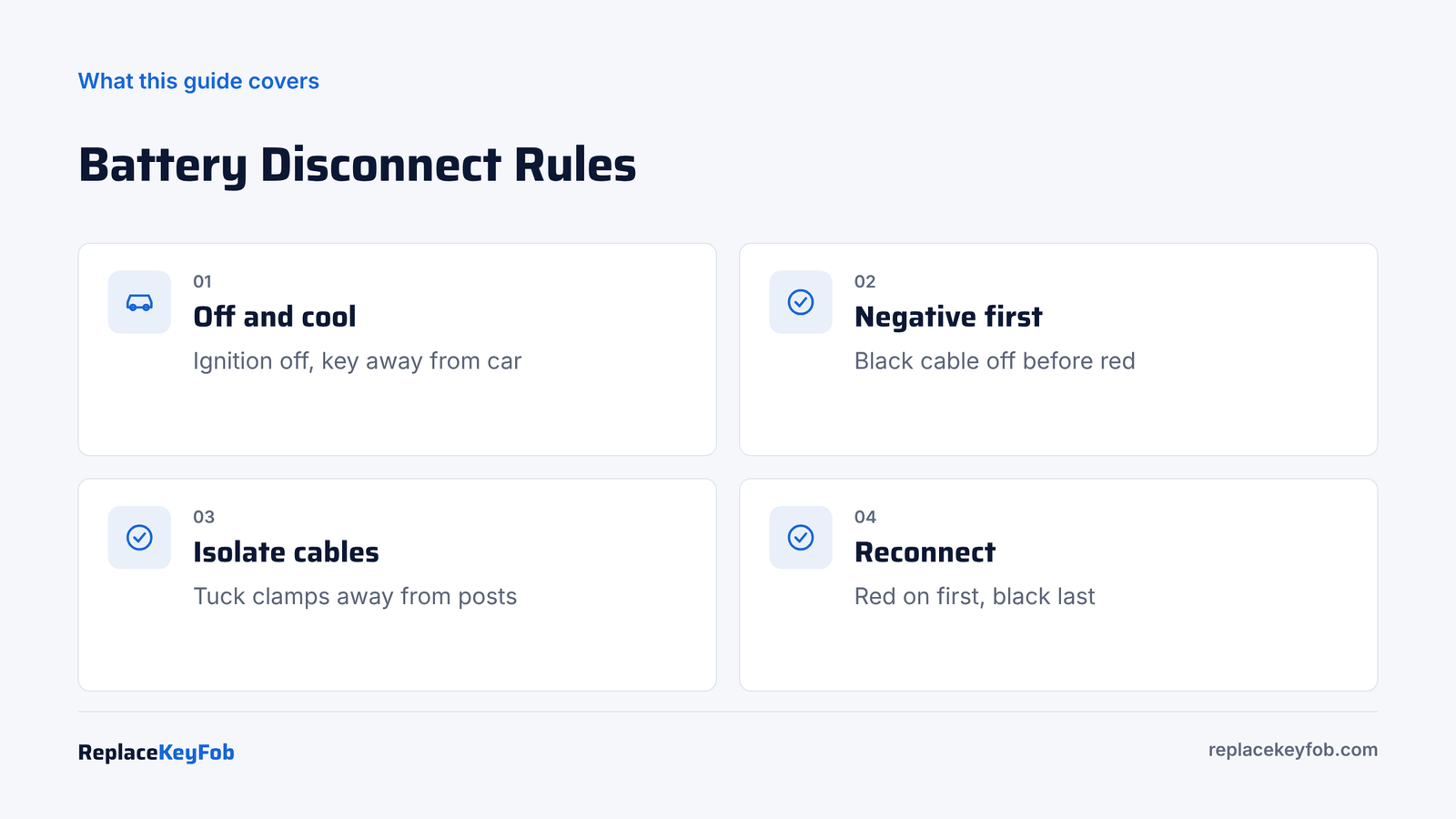
Why Negative First?
In nearly all modern cars, the negative battery terminal is connected to the car’s metal body and engine. This is called the ground.
- Removing the negative first: once it is off, the circuit is broken. If your wrench later touches the positive post and the body, nothing happens because there is no path back to the battery.
- Removing the positive first: while the negative is still connected, the whole car body is part of the circuit. If the wrench on the positive post touches any metal, it creates a dead short.
Reconnecting in reverse (positive first, negative last) follows the same logic. The final connection, which may make a small spark, is on the ground side and away from the risky positive post.
What You Need
- Wrench or socket, usually 10 mm for top-post terminals; some side-post GM batteries use 8 mm or 5/16 inch
- Safety glasses and gloves
- Terminal puller (helpful for stuck clamps)
- Wire brush or terminal cleaner
- A rag or insulated cover to keep cables away from posts
- Optional: memory saver to keep radio and settings
Battery Terminal Puller and Brush Set
A terminal puller removes stuck clamps without prying on the battery post, and the brush cleans both post and clamp. Look for a set with a two-jaw puller and a post-and-clamp brush.
As an Amazon Associate, ReplaceKeyFob earns from qualifying purchases.
Step-by-Step: Disconnecting the Battery
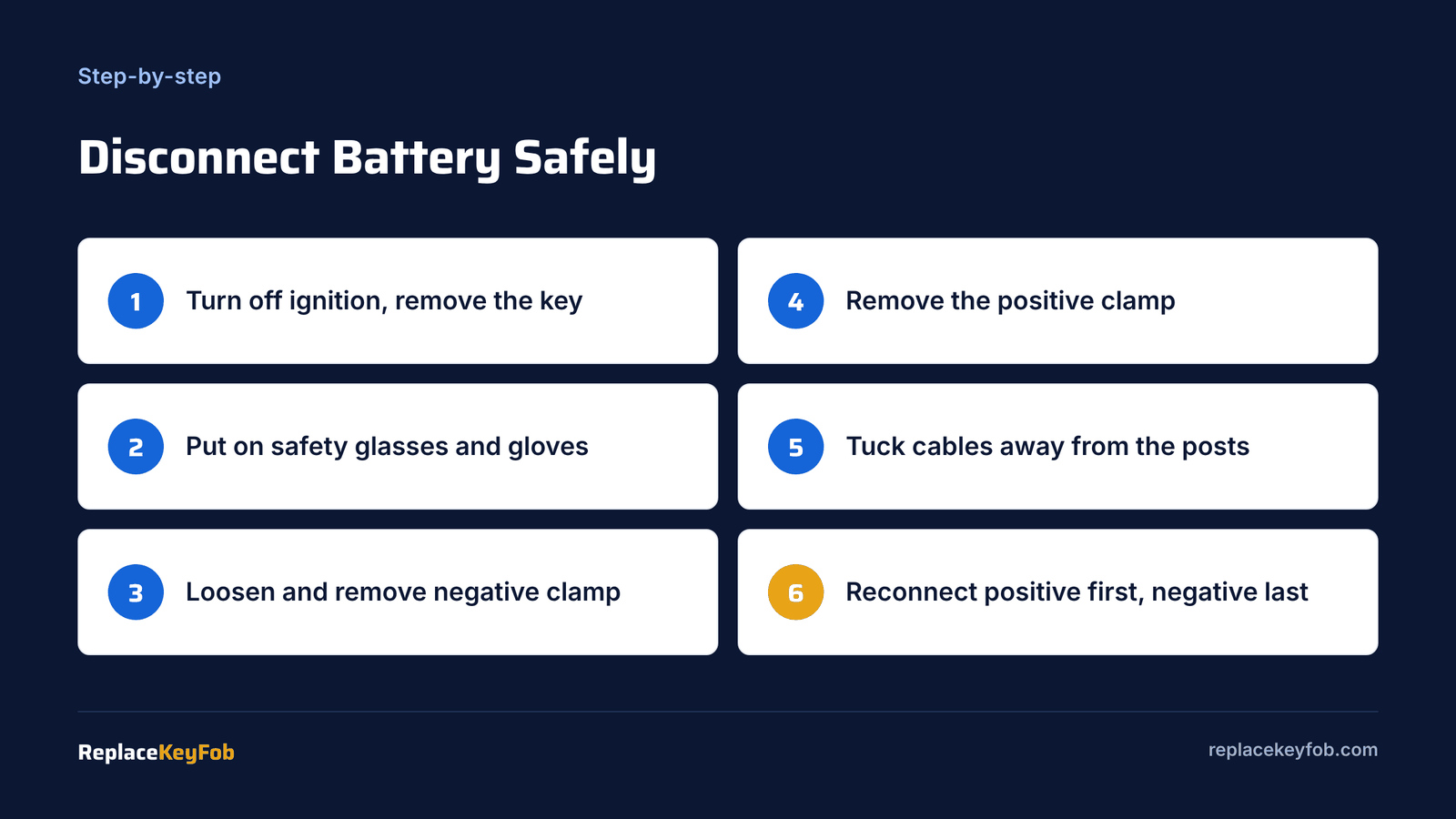
- Park and switch everything off. Turn off the engine, lights, radio and climate control. Remove the key, or move the smart key well away from the car so it does not wake up.
- Wait a few minutes. Many modern cars keep modules awake briefly after shutdown. Some makers recommend waiting several minutes before disconnecting. Check your owner’s manual.
- Put on glasses and gloves. Batteries can vent hydrogen gas and contain sulfuric acid.
- Find the negative terminal. It is marked with a minus sign (-) and usually has a black cable or cover. The positive has a plus sign (+) and a red cover.
- Loosen the negative clamp nut. Turn the 10 mm nut counterclockwise a few turns. You do not need to remove it.
- Lift the clamp off the post. Twist it gently while pulling up. If it is stuck, use a terminal puller. Do not pry against the battery case.
- Move the negative cable away. Tuck it to the side or wrap the clamp with a rag so it cannot spring back onto the post.
- Remove the positive clamp. Flip open the red cover, loosen the nut and lift the clamp off.
The battery is now disconnected. If you are removing it, take off the hold-down bracket next.
Special Cases on Modern Cars
Start-stop cars with a battery sensor
Many start-stop and newer cars have an intelligent battery sensor (IBS) on the negative terminal. It is a small electronic box between the post and the cable. Do not unbolt the sensor from the cable. Loosen the clamp at the post and remove the whole sensor and cable together, or follow the manual’s instructions, which sometimes say to disconnect at a separate ground point.
Battery in the trunk or under a seat
BMW, Mercedes, Audi and some other models have the battery in the trunk or under the floor. The same rule applies: negative first. Some models have a separate ground cable bolted to the body near the battery; the manual may tell you to disconnect there instead.
Hybrids and EVs
Hybrids and EVs have a 12V battery and a high-voltage traction battery. Only work on the 12V battery. Never touch orange cables or high-voltage components. Turn the vehicle fully off before disconnecting the 12V battery, and follow the owner’s manual. On many hybrids the 12V battery is in the trunk or under a rear seat.
Side-post terminals
Some GM vehicles use side-post batteries. The bolt goes into the side of the battery. Use an 8 mm or 5/16 inch wrench, and take care not to overtighten when reconnecting, since the threads are in the battery.
How to Reconnect the Battery
- Clean the posts and clamps with a wire brush if there is any white, blue or green crust. See battery terminal corrosion for safe cleaning.
- Connect positive first. Push the red clamp fully down onto the positive post and tighten until it cannot twist by hand. Close the red cover.
- Connect negative last. Fit the black clamp to the negative post and tighten. A small spark when it touches is normal.
- Check both clamps are tight. Loose terminals cause no-start, flickering lights and charging faults.
What to Expect After Reconnecting
Disconnecting the battery resets some systems. Common after-effects:
- Clock, radio presets and trip data may be lost.
- Power window auto-up may stop working until reset. See how to reset auto-up windows after a battery change.
- Radio code: some older cars ask for an anti-theft code. See radio code after battery change.
- Idle relearn: the engine may idle unevenly for a few drives.
- Key fob: a few cars need the remote resynced. See key fob not working after disconnecting the car battery.
- Warning lights: steering, stability or start-stop lights may come on until you drive a short distance.
Troubleshooting Table
| Problem | Likely cause | What to do |
|---|---|---|
| Clamp will not come off | Corrosion or tight fit | Use a terminal puller, not a screwdriver |
| Big spark on the negative | Something left on, or a drain | Check lights, doors and accessories are off |
| Car will not start after reconnecting | Loose clamp or immobilizer reset | Retighten, then try the key or fob again |
| Warning lights stay on | Systems need relearning | Drive a few miles; reset steering if asked |
| Nut spins but clamp stays tight | Clamp stretched or corroded | Spread the clamp gently, clean, or replace it |
Battery Disconnect Switches
If you disconnect the battery often, for example on a classic car, boat trailer or a car that sits all winter, a battery disconnect switch makes it easy. It fits on the negative post and has a knob or lever that breaks the circuit without tools. Use one rated for your battery’s cranking current, and do not use it on modern cars that need constant power for security or telematics unless you accept losing those settings each time.
How Long Should You Leave It Disconnected?
For most repairs, only as long as the job takes. For a full reset of learned values, 15 to 30 minutes is plenty. If you are storing the car, leaving the negative off prevents drain, though the battery still self-discharges slowly; check it every few weeks.
Mistakes to Avoid
- Removing positive first. The most common and most dangerous mistake.
- Letting a clamp spring back. A disconnected negative cable touching the post reconnects the circuit.
- Prying the clamp with a screwdriver. It can crack the post or the case.
- Smoking or making sparks nearby. Batteries can vent hydrogen.
- Touching high-voltage parts on hybrids or EVs.
When to Call a Pro
If the clamps are badly corroded, the post is damaged, or your car’s manual says to use a special procedure, a shop can do it quickly. Typical 2026 US costs are about $25 to $75 for labor alone, or free at many parts stores with a battery purchase. If you are disconnecting because you suspect a drain, test the battery first with how to test a car battery with a multimeter.
Frequently Asked Questions
The negative (black, minus) terminal first, then the positive. When reconnecting, attach the positive first and the negative last.
The negative is connected to the car body. Removing it first breaks the circuit, so a wrench touching the positive post and metal cannot short the battery.
Yes, for most work, removing only the negative is enough to isolate the electrical system. Remove both when taking the battery out.
Usually 10 mm for top-post terminals. Some GM side-post batteries use 8 mm or 5/16 inch.
It clears learned values such as idle and fuel trims on many cars, plus radio and clock settings. Stored trouble codes are usually cleared too.