
How to Keep a Car Battery Charged When You Don’t Drive

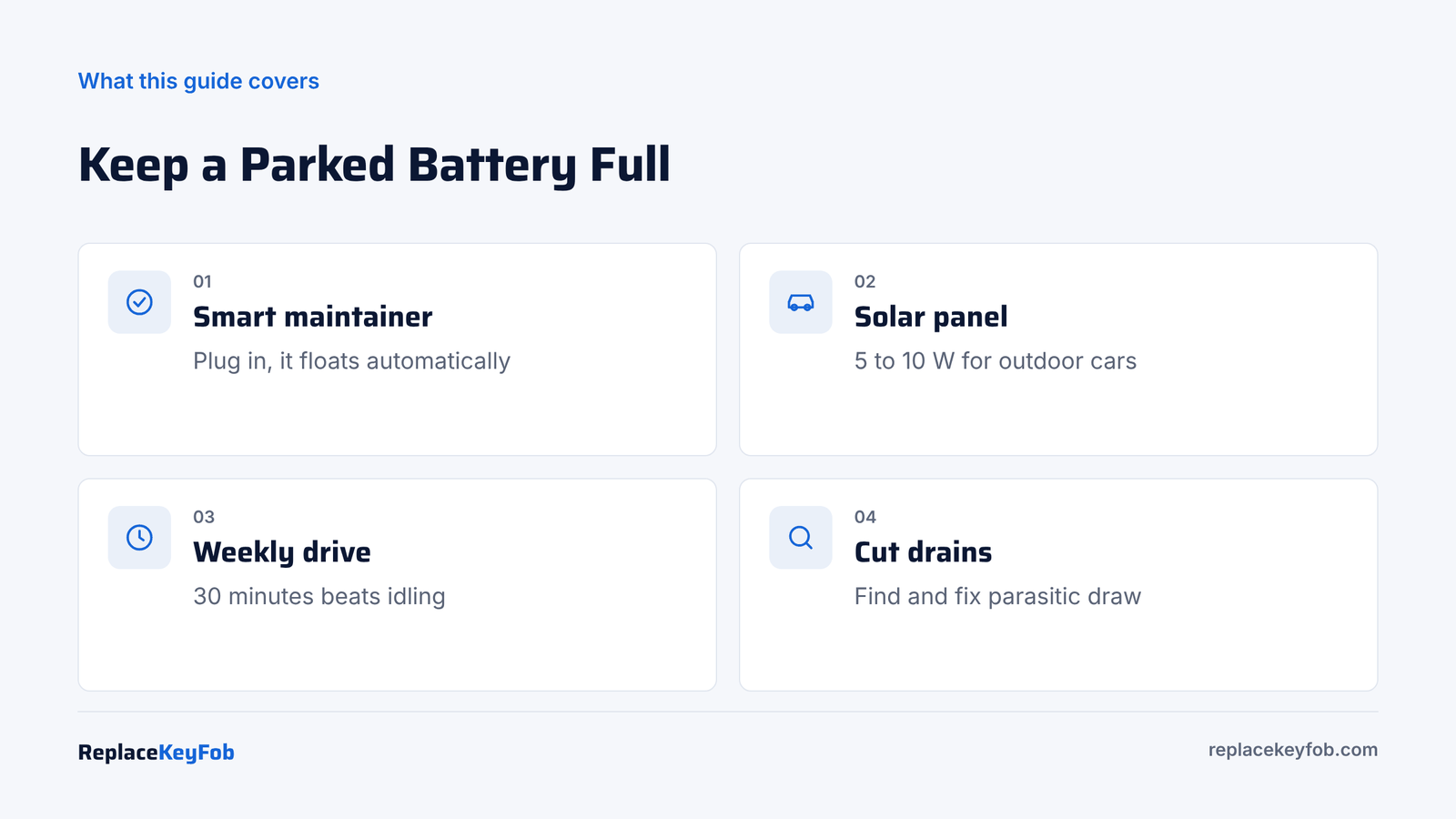
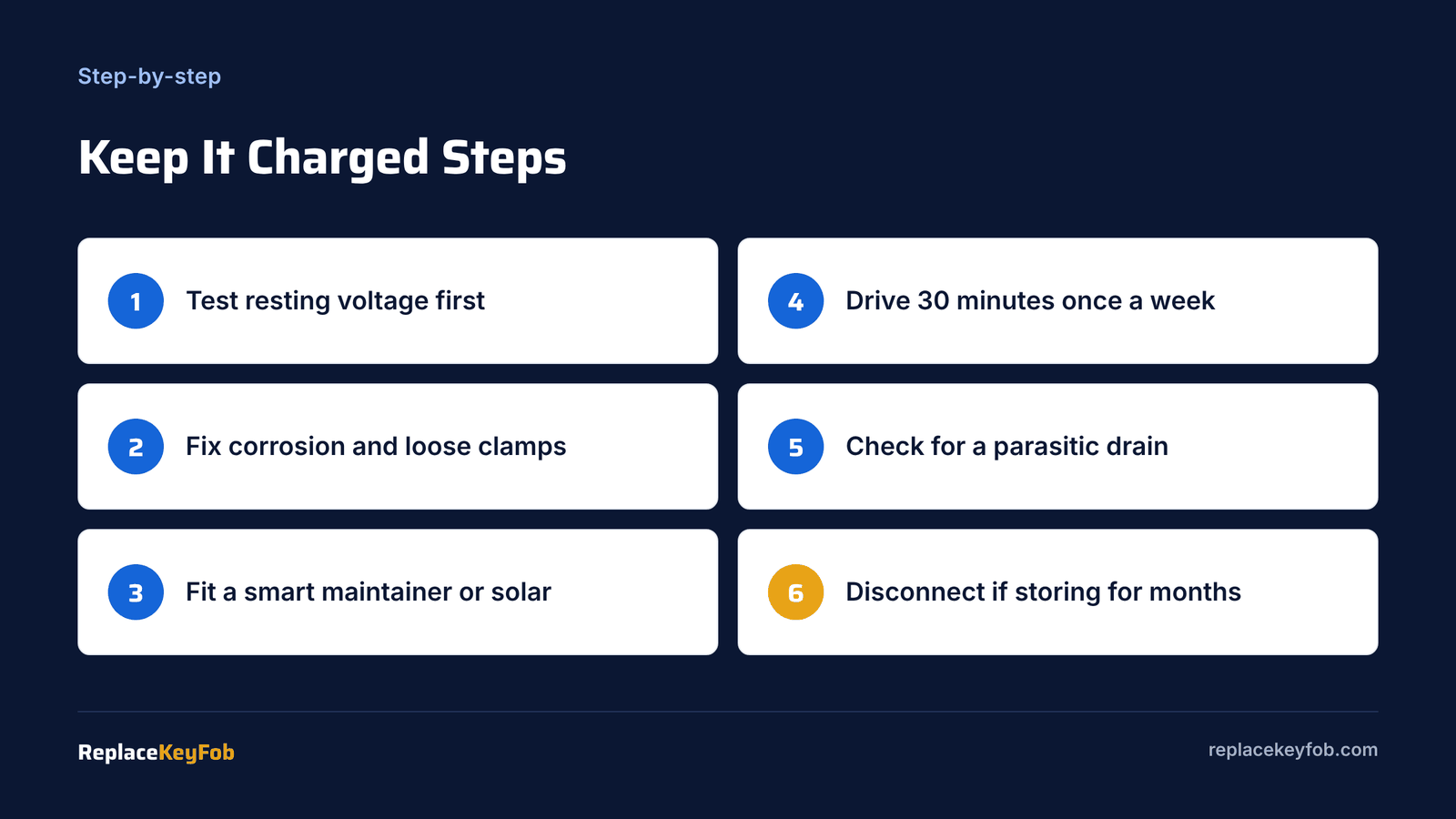
To keep a car battery charged when you do not drive much, connect a smart battery maintainer that charges and then holds the battery at a safe float voltage. If there is no outlet, use a small solar maintainer of about 5 to 10 watts. Otherwise, drive at least 20 to 30 minutes once a week rather than idling, and fix any parasitic drain.
Batteries are built to be recharged by driving. When a car sits, the charge leaks out two ways: self-discharge inside the battery, and current drawn by the car’s own electronics while parked. Modern cars have many modules that stay partly awake for keyless entry, alarms and connected services. Over a few weeks, that adds up to a no-start.
Different situations call for different fixes. A car that sits in a garage all week needs a different plan from one parked outdoors for months. This guide covers each method, how well it works and how to choose. For the opposite problem, a battery that keeps dying even with regular driving, the drain section below is the place to start.
Why Batteries Go Flat in Parked Cars
- Self-discharge: a flooded battery loses about 3 to 5 percent per month on its own, faster in heat. AGM loses less.
- Parasitic draw: a healthy modern car typically draws about 20 to 50 milliamps once its modules sleep. At 40 mA, a car uses about 1 amp-hour a day, or about 30 amp-hours a month, which is half of a typical 60 Ah battery.
- Short trips: a five-minute trip may not replace the energy the starter used. Repeated short trips slowly drain the battery even if you drive daily.
- Age: older batteries hold less charge and lose it faster.
A battery that sits below about 12.4 volts for long periods sulfates and loses capacity. Keeping it near full is what makes it last.
Method 1: Smart Battery Maintainer
This is the best method for any car that sits more than a week at a time near an outlet.
- Choose a smart maintainer with modes for your battery type. AGM batteries need an AGM mode; lithium batteries need a lithium mode.
- Connect red to positive and black to negative or a ground point. Many maintainers include a ring-terminal lead you can leave bolted to the battery, so you just plug in.
- Plug it in. The maintainer charges the battery, then switches to a float or pulse mode.
- Leave it connected as long as the car sits.
Do not use a basic trickle charger for long periods; it keeps charging and can overcharge. Our comparison battery maintainer vs trickle charger explains the difference, and best battery maintainers for cars lists good options.
Smart Battery Maintainer With Ring Leads
A small maintainer with permanent ring-terminal leads makes plugging in a 5-second job. Check that it supports your battery type and has automatic float mode.
As an Amazon Associate, ReplaceKeyFob earns from qualifying purchases.
Method 2: Solar Battery Maintainer
For cars parked outdoors or in a garage without power, a solar maintainer offsets drain.
- Size: about 5 to 10 watts is a common range for cars with normal drain. Larger vehicles or high-drain cars may need more.
- Charge controller: choose a panel with a built-in controller, or add one, so it cannot overcharge.
- Placement: on the dash facing the sun, or outside on the roof or windshield. Tinted glass reduces output.
- Connection: through the battery clamps or ring leads. Many 12V sockets switch off with the ignition, so a socket plug may not work.
A solar panel will not recharge a flat battery quickly. It keeps a charged battery from dropping. See best solar battery maintainers for picks.
Method 3: Drive It Properly
If you prefer not to use a maintainer, regular driving works, but it has to be real driving.
- Drive 20 to 30 minutes, once a week, at steady speeds, ideally some highway.
- Avoid only idling. At idle, many alternators produce little extra current, and the fans, lights and blower use much of it.
- Turn off extra loads such as seat heaters and rear defrost toward the end of the trip so more current goes to the battery.
- Know the limits. Driving tops up a healthy battery but does not fully recharge a deeply flat one.
A battery that is already weak may need a charger first, then regular drives to stay topped up. If starts are getting slower week by week, put it on a charger overnight and test it.
Method 4: Find and Fix Parasitic Drains
If a battery dies after only a few days, something is drawing too much.
- Check the obvious. Glove box, trunk and vanity mirror lights, a door not fully shut, a phone charger or dash cam plugged in.
- Watch for modules staying awake. If the dash lights or infotainment stay on long after you lock the car, a module may not be sleeping.
- Measure the draw. With a multimeter set to amps, in series with the negative cable, after the car has been locked and left for the time the manual specifies (often 30 to 60 minutes), the draw should usually be under about 50 milliamps.
- Pull fuses one at a time while watching the meter. The fuse that drops the reading is the circuit with the drain.
- Common culprits: aftermarket alarms and remote starters, dash cams wired to constant power, stuck relays, trunk or hood switches that tell the car it is open.
A trunk or hood ajar switch that fails can keep modules awake all night. If your trunk will not latch, see how to fix a trunk latch that won’t close.
Method 5: Disconnect or Use a Battery Switch
For storage of more than a month without power or sun, disconnect the negative cable. See how to disconnect a car battery safely. A battery disconnect switch on the negative post makes it a tool-free job, which suits classic cars and seasonal vehicles.
You will lose some settings, and the battery still self-discharges slowly, so check voltage monthly.
Hybrids and EVs
Hybrids and EVs still have a 12V battery that powers the computers and locks. It is charged by the high-voltage system only when the car is on or, on many EVs, periodically while parked. If a hybrid sits for weeks, its small 12V battery can go flat. Turn the car to Ready for about an hour every couple of weeks, or use a maintainer on the 12V battery or jump terminals. Some EVs have a storage or transport mode; check the owner’s manual.
Connected Services and Higher Drains
Many newer cars have built-in telematics modems for app control, remote start, tracking and over-the-air updates. These wake up from time to time to check in, and some keep a higher standby draw than older cars. A car that uses its app often, or that receives software updates while parked, can drain faster than the typical figures above.
- Limit app checks while the car is stored, because each remote request can wake several modules.
- Check the manual for a storage or deep-sleep mode, which some makers include to reduce standby draw.
- Expect warnings. Some cars switch off remote features to protect the battery and show a message in the app. That is a sign the battery needs a charge.
- Aftermarket devices such as GPS trackers, dash cams with parking mode and remote starters add their own draw. Wire them to a low-voltage cutoff, or unplug them during storage.
Which Method Should You Use?
| Situation | Best choice |
|---|---|
| Garage with outlet, car sits 1 week or more | Smart maintainer |
| Outdoors, no outlet | Solar maintainer plus monthly check |
| Driven once a week | 30-minute drive, maintainer if starts weaken |
| Stored for months, no power | Disconnect negative or remove battery |
| Dies in 2 to 3 days | Find the parasitic drain first |
Mistakes to Avoid
- Idling in the driveway to charge. It wastes fuel and charges slowly.
- Leaving an unregulated trickle charger on for months.
- Ignoring a fast drain. A maintainer hides the problem; fix it.
- Using the wrong charger mode for AGM or lithium batteries.
When the Battery Is the Problem
If the battery will not hold above about 12.4 volts a day after a full charge, it is likely worn out. Test it with how to test a car battery with a multimeter or at a parts store. A key fob that also seems weak is a separate issue; see why does my key fob battery keep dying.
Frequently Asked Questions
Use a smart battery maintainer plugged into an outlet, or a small solar maintainer if parked outdoors. Both keep the battery near full without overcharging.
A little, but slowly. A 20 to 30 minute drive at steady speed charges much better than idling.
Yes, a smart maintainer is designed for that. It switches to float mode once the battery is full.
Many modern cars start fine after 2 to 3 weeks, but cars with high drain or older batteries may fail in under a week.
A 5 to 10 watt solar maintainer can offset normal parasitic drain on most cars in decent sun. It will not quickly recharge a flat battery.