
How to Charge a Lithium (LiFePO4) Car Battery

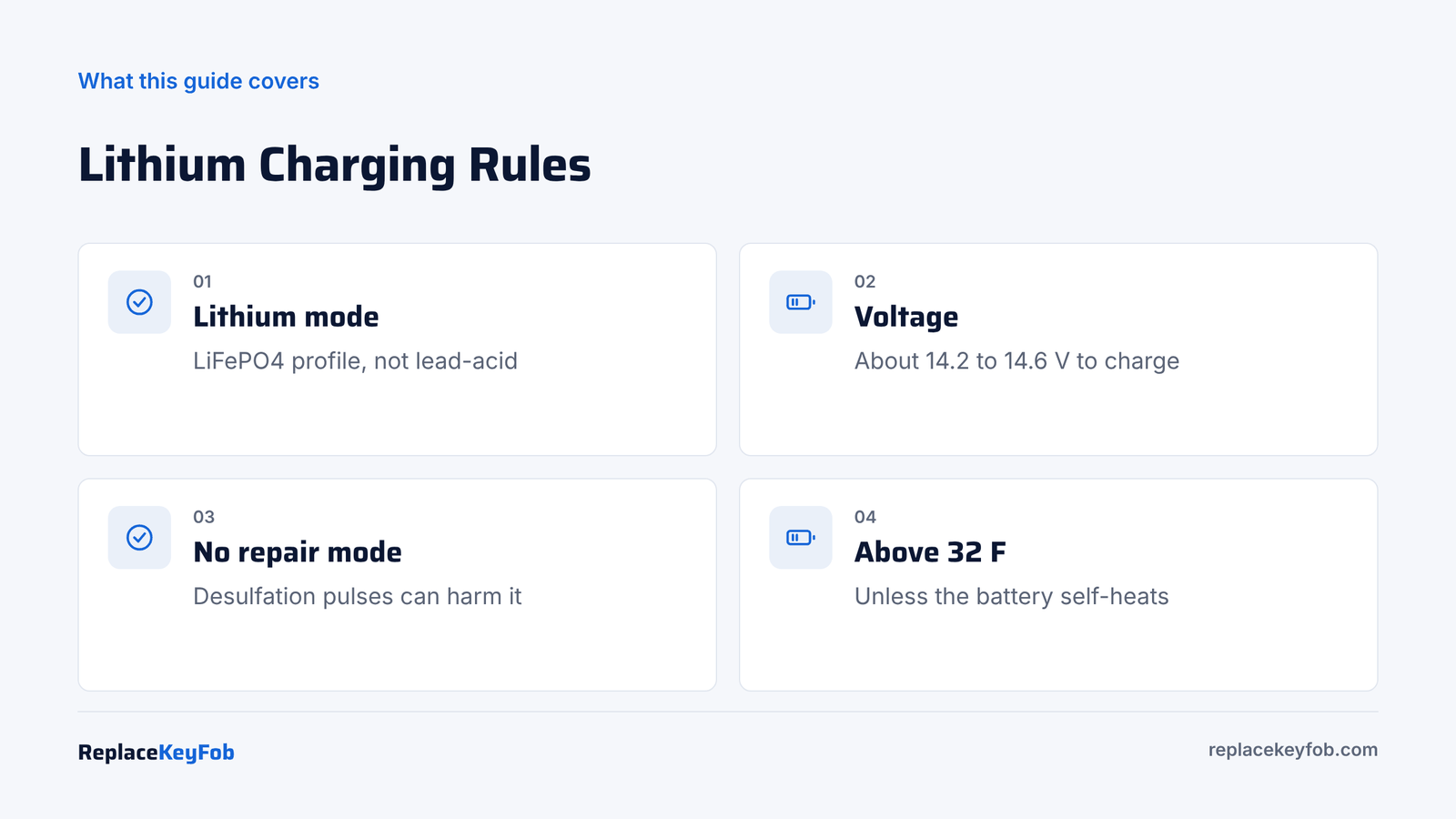
To charge a lithium car battery (LiFePO4), use a charger with a dedicated lithium or LiFePO4 mode. It charges to about 14.2 to 14.6 volts and then stops or holds a low float. Do not use lead-acid desulfation or repair modes, and do not charge below 32 F unless the battery has built-in heating or low-temperature protection. A charger with a wake mode can revive a battery whose BMS has shut off.
Lithium iron phosphate (LiFePO4) batteries are increasingly used as 12V starter batteries in performance cars, as aftermarket upgrades, and especially in RVs, boats and campers. They weigh about half as much as lead-acid, hold their voltage well, and last far more cycles. They also charge differently. A charger set up for lead-acid can confuse the battery’s management system or, in repair modes, push voltages that damage it.
This guide is about 12V LiFePO4 batteries in cars and RVs, not phone or laptop batteries. It covers the charge profile, step-by-step charging at home, what to do when the battery seems dead, and how RV systems charge lithium. For how long these batteries last, see how long does a lithium car battery last.
How Lithium Differs From Lead-Acid
| Feature | LiFePO4 12V | Lead-acid (flooded or AGM) |
|---|---|---|
| Nominal voltage | About 12.8 V | About 12.6 V |
| Full charge voltage | About 14.2 to 14.6 V | About 14.4 to 14.8 V |
| Float needed | Often no, or low float about 13.4 to 13.6 V | Yes, about 13.5 to 13.8 V |
| Resting full voltage | About 13.3 to 13.6 V | About 12.6 to 12.9 V |
| Desulfation mode | Not needed, can harm | Sometimes helpful |
| Cold charging | Not below 32 F without protection | Possible, slower |
| Built-in BMS | Yes, cuts off on faults | No |
The battery management system (BMS) inside a lithium battery protects it from overcharge, deep discharge, short circuits and cold charging. It can also shut the battery off completely, which looks like a dead battery.
What You Need
- A smart charger with a lithium or LiFePO4 mode, or a dedicated lithium charger
- Safety glasses
- A multimeter
- The battery maker’s charging specs (on the label or website)
LiFePO4 Battery Charger 12V
A charger with a true LiFePO4 profile charges to the right voltage, avoids lead-acid desulfation pulses and often includes a BMS wake function. Check that it lists LiFePO4 and 12V, and the amp rate suits your battery size.
As an Amazon Associate, ReplaceKeyFob earns from qualifying purchases.
Step-by-Step: Charging a Lithium Car Battery
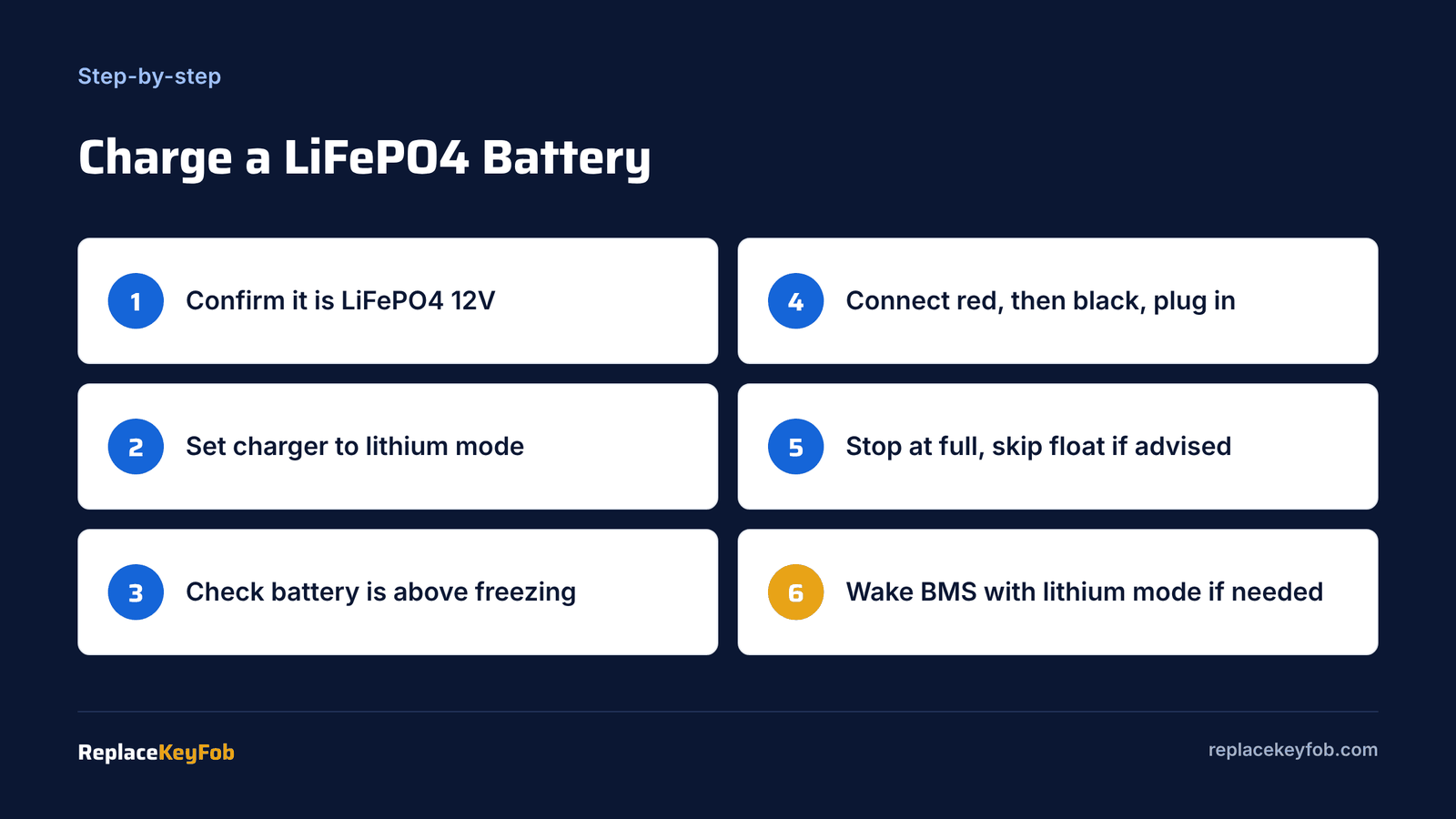
- Confirm the chemistry. The label should say LiFePO4 or lithium iron phosphate, 12V or 12.8V. Do not use these steps for other lithium chemistries unless the maker says so.
- Check the temperature. The battery should be above 32 F (0 C). If it has been in a cold car, bring it inside or warm the car first, unless the battery has self-heating or low-temperature charge protection.
- Select lithium mode on the charger with the charger unplugged.
- Connect red to positive and black to negative. In the car, a ground point works as well, though many lithium makers prefer direct connection to the negative post.
- Choose the rate. Lithium batteries accept high current, but follow the maker’s limit. For a car starter battery, a 5 to 10 amp charger is fine; RV house batteries often take 20 amps or more.
- Plug in and charge. Lithium charges quickly and evenly until close to full.
- Stop at full. A lithium mode stops or holds a low float. Many makers say a lithium battery does not need to sit on float.
- Unplug, then remove clamps.
- Check resting voltage after an hour: about 13.3 to 13.6 volts means full on most LiFePO4 batteries.
Why Lead-Acid Modes Are a Problem
- Desulfation or repair modes apply high-voltage pulses, sometimes 15.5 volts or more. A lithium BMS may disconnect, or cells may be stressed.
- Equalization modes for flooded batteries push even higher voltages. Never use them on lithium.
- Constant float at lead-acid levels keeps lithium cells near full all the time, which some makers say shortens life.
- AGM mode may be close enough on some chargers to work in a pinch, but only if the battery maker says so and the charger has no automatic desulfation step.
Lithium Battery Seems Dead? The BMS May Have Shut Off
If the battery reads 0 volts or very low, the BMS may have cut it off after a deep discharge. The cells are often fine.
- Use a charger with a lithium wake or reactivation mode. It applies a small current to wake the BMS.
- If you do not have one, some battery makers sell a reset cable or describe a wake method in their manual. Follow it exactly.
- Charge normally once the battery shows voltage again.
- Find out why it happened. A parasitic drain or a long storage period without a disconnect usually causes it.
Do not try to wake a lithium battery by connecting it in parallel with a lead-acid battery unless the maker allows it. Large current can flow between them.
How to Charge a Lithium Battery in an RV
RVs often use LiFePO4 house batteries. They charge from several sources, and each needs a lithium setting.
- Converter or charger: the shore-power converter must have a lithium profile. Many older RV converters do not; upgrade it or add a lithium charger.
- Alternator: lithium batteries accept very high current, which can overheat a standard alternator. A DC-DC charger between the starter battery and the house battery limits current and gives the right charge profile.
- Solar: set the charge controller to the LiFePO4 profile, with absorption and float set to the battery maker’s values.
- Generator: charges through the converter, so the converter profile matters.
OEM Lithium 12V Batteries
Some newer cars, including certain Porsche models and recent Teslas, use factory lithium 12V batteries. These often have their own charging rules and may be monitored by the car. Do not connect a lead-acid charger in a repair mode. Follow the owner’s manual for charging or jump-starting, and use the car’s designated jump terminals where they exist.
Lithium as a Car Starter Battery: What to Check
Swapping a lead-acid starter battery for lithium is popular on track cars and motorcycles, but check these points first:
- Cold cranking: lithium starter batteries can lose cranking power in deep cold. Some include a pre-heat feature that warms the cells when you turn on the headlights for a minute.
- Charging system: most car alternators charge at about 13.8 to 14.7 volts, which suits many lithium starter batteries, but smart-charging and battery-registration systems on modern cars may expect lead-acid behavior. Check that the battery maker lists your car or charging system as compatible.
- Size and terminals: lithium batteries often come in smaller cases with adapters. Make sure the hold-down secures them firmly.
- Jump starting: some lithium starter batteries should not be used to jump another car. Read the battery’s instructions.
Storage and Maintenance
- Store at partial charge if the maker recommends it, often around 50 to 70 percent for long storage.
- Disconnect the battery or use the car’s disconnect switch to stop parasitic drain. Lithium self-discharges slowly, but the car’s drain does not stop.
- Keep it above freezing for charging, though most LiFePO4 batteries can be stored in cold if not charged.
- Check every 2 to 3 months during storage.
For general storage advice, see how to store a car battery for winter, and for cars that sit often, how to keep a car battery charged.
Troubleshooting Table
| Problem | Cause | Fix |
|---|---|---|
| Charger will not start | BMS shut off or voltage too low | Use lithium wake mode |
| Charger stops early | Battery too cold, BMS blocking | Warm battery above 32 F |
| Battery full but car cranks weakly | Undersized battery for engine | Check CCA rating, size up |
| Dies after sitting | Parasitic drain triggered BMS cutoff | Disconnect or use a maintainer with lithium mode |
| Voltage seems high at rest | Normal for lithium | About 13.3 to 13.6 V is full |
Mistakes to Avoid
- Using lead-acid repair or equalize modes.
- Charging below freezing without built-in protection.
- Assuming a 0 V reading means the battery is ruined. Check the BMS first.
- Using an old RV converter without a lithium profile.
- Jump starting from a lithium starter battery without checking the maker allows it.
When to Get Help
If a lithium battery will not wake, swells, or gets hot while charging, stop and contact the battery maker. Lithium batteries often carry long warranties, typically 3 to 10 years, so a failed unit may be replaced. A professional RV or battery shop can test the cells and BMS. For general battery tests, see how to test a car battery with a multimeter.
Frequently Asked Questions
Only if it has a lithium or LiFePO4 mode. Lead-acid modes, especially desulfation and equalize, can trip the BMS or stress the cells.
Typically about 14.2 to 14.6 volts. Many makers recommend no float, or a low float of about 13.4 to 13.6 volts.
Not below 32 F unless it has a self-heating or low-temperature protection feature. Warm it first.
Use a LiFePO4 charger or a smart charger in lithium mode, check the battery is above freezing, connect red then black, plug in and let it stop at full.
Make sure the converter, solar controller and any DC-DC charger are set to the LiFePO4 profile. A DC-DC charger protects the alternator.
The BMS has likely shut it off after a deep discharge. A charger with a lithium wake mode can usually reactivate it.