
How to Store a Car Battery for Winter or Vacation

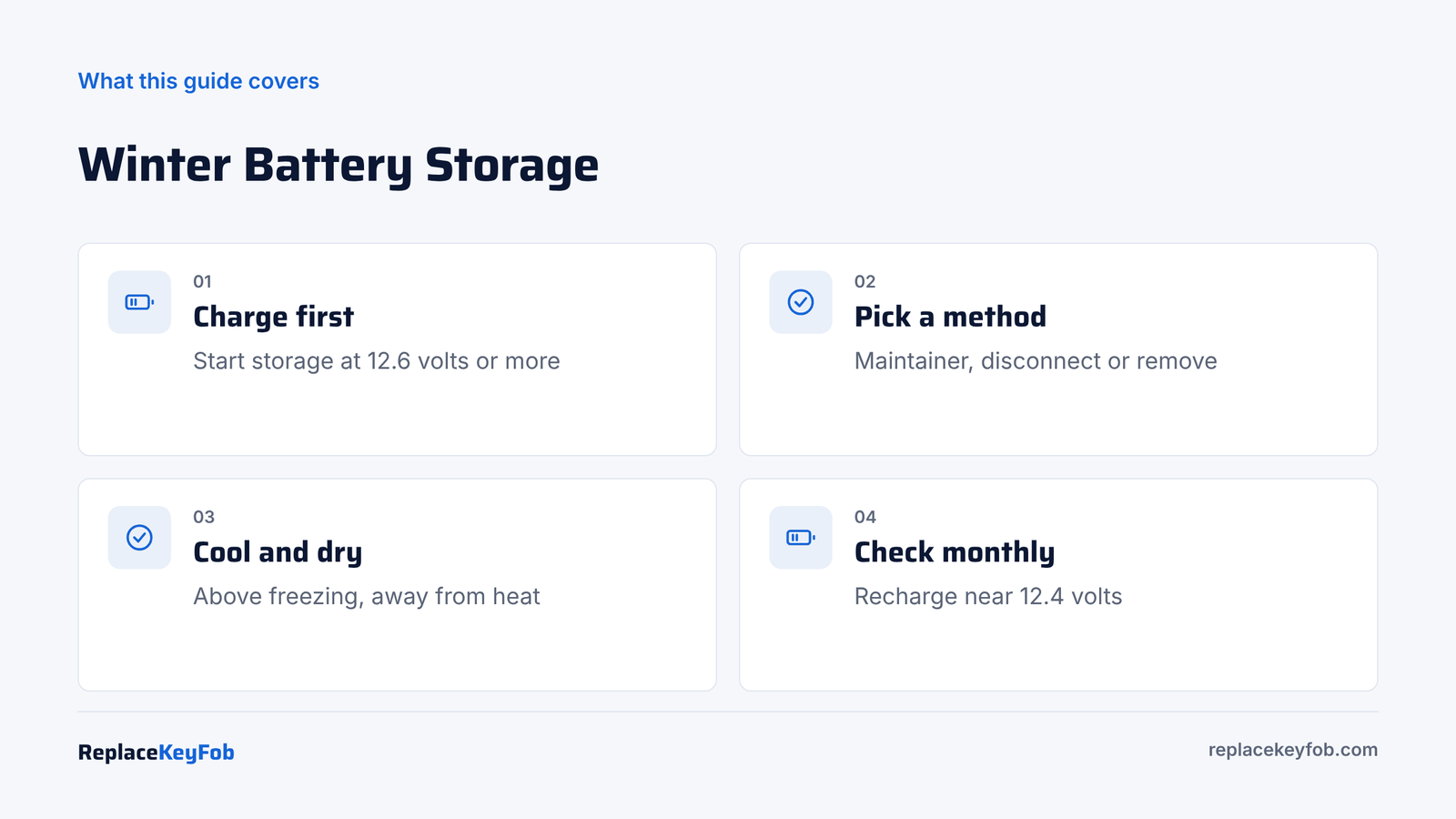
To store a car battery for winter, charge it fully first. Then either leave it in the car on a smart battery maintainer, or remove it and keep it in a cool, dry place above freezing. Check the voltage every 4 to 6 weeks and recharge when it falls toward 12.4 volts. A fully charged battery resists freezing; a flat one can freeze and crack.
Winter storage kills more batteries than winter driving. A battery that sits for three months slowly discharges, and a partly discharged lead-acid battery forms hard sulfate crystals on its plates that may never fully reverse. Add freezing temperatures, and a flat battery can freeze, bulge and crack.
The fix is not complicated. Start full, keep it full, and keep it out of extreme cold and heat. This guide covers three ways to do that, depending on whether the car stays in a heated garage, an unheated shed or outdoors.
Why Charge Level Matters in Cold Weather
Battery acid is mostly water when the battery is discharged and stronger acid when it is charged. Stronger acid freezes at a much lower temperature.
| State of charge | Approximate resting voltage | Approximate freezing point |
|---|---|---|
| 100% | About 12.6 to 12.7 V | About -70 F or lower |
| 75% | About 12.4 V | About -35 F |
| 50% | About 12.2 V | About -10 F |
| 25% | About 12.0 V | About +5 F |
| Fully discharged | Under 11.9 V | About +20 F to +30 F |
These are approximate figures for flooded batteries, but the lesson holds for AGM too: a full battery is very hard to freeze, and a flat one can freeze in an ordinary northern winter.
How Fast a Stored Battery Discharges
Even disconnected, a battery loses charge on its own. Typical rates:
- Flooded lead-acid: about 3 to 5 percent per month at room temperature, faster when warm.
- AGM: about 1 to 3 percent per month.
- In the car and connected: much faster, because modules, alarms and telematics draw current. A healthy car may draw about 20 to 50 milliamps after it sleeps, which can flatten a battery in a few weeks.
So a battery left connected in a car for a winter almost always ends up flat unless it is on a maintainer.
Choose Your Storage Method
| Method | Best for | Effort |
|---|---|---|
| Leave in car on a smart maintainer | Garage with an outlet | Lowest |
| Disconnect negative, leave in car | No outlet, a few weeks to 2 months | Low, check monthly |
| Remove and store indoors | Unheated storage, long storage, very cold climates | Moderate |
| Solar maintainer in the car | Outdoor parking, no outlet | Low, sun needed |
Smart Battery Maintainer
A smart maintainer charges the battery, then holds it at a safe float voltage for months without overcharging. Check that it has modes for your battery type (AGM, flooded or lithium) and a weather-resistant case.
As an Amazon Associate, ReplaceKeyFob earns from qualifying purchases.
For more options, see our guide to best battery maintainers for winter car storage.
Method 1: Leave It in the Car on a Maintainer
This is the easiest and keeps the car’s settings intact.
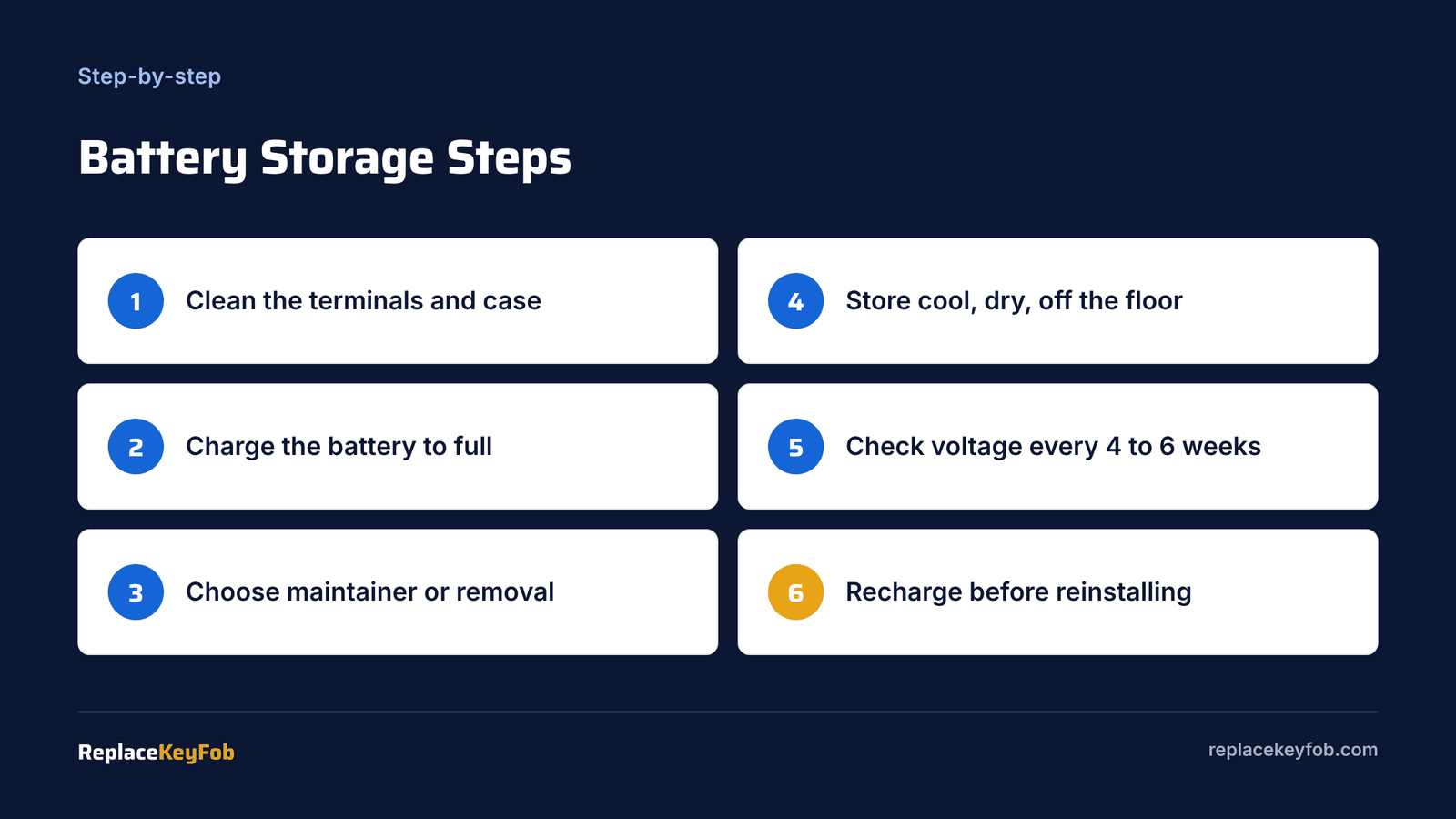
- Clean the terminals. Corrosion increases drain. See battery terminal corrosion.
- Charge fully. Run a full charge cycle with the maintainer or a charger first.
- Connect the maintainer. Red clip to positive, black clip to negative or a ground point, or use the ring-terminal leads many maintainers include so you can connect without opening the hood.
- Select the right mode. AGM batteries need the AGM setting.
- Plug in and leave it. A smart maintainer switches to float automatically.
- Check monthly. Make sure the status light shows it is maintaining.
Avoid old manual trickle chargers for long storage. They keep pushing current and can overcharge the battery. See battery maintainer vs trickle charger.
Method 2: Disconnect the Negative Cable
If you have no outlet, cutting the car’s drain is the next best thing.
- Charge the battery fully.
- Disconnect the negative cable and tuck it away from the post. See how to disconnect a car battery safely.
- Check the voltage every 4 to 6 weeks with a multimeter. Recharge if it falls toward 12.4 volts.
You will lose clock and radio settings, and some cars need a few relearns afterward.
Method 3: Remove the Battery and Store It Indoors
For long storage, very cold climates or a car parked outdoors, take the battery inside.
- Charge it fully while still in the car, or after removal with a charger.
- Remove it. Negative cable first, then positive, then the hold-down. Lift it straight up and keep it level.
- Clean it. Wipe the case with a baking soda solution to remove acid residue and dirt, which can create a slow leakage path between the posts.
- Pick the spot. Cool, dry and well ventilated, ideally around 40 to 60 F. A basement, garage shelf or utility room works. Avoid furnace rooms, direct sun and anywhere a child can reach.
- Set it on a shelf or a piece of wood. The old concrete-floor myth comes from early hard-rubber cases; modern plastic cases do not discharge on concrete. A shelf still keeps it away from cold, damp floors and accidental kicks.
- Cover the posts with plastic caps or tape so nothing metal can bridge them.
- Check and recharge. Measure voltage every 4 to 6 weeks, or leave it on a maintainer.
Storing it on a maintainer indoors
The best combination is a removed battery on a smart maintainer, on a shelf, in a cool room. It stays fully charged with no drain from the car.
Storage Plan by Climate
| Where the car spends winter | Recommended plan |
|---|---|
| Heated garage | Leave battery in, smart maintainer connected |
| Unheated garage, mild winter (rarely below 20 F) | Maintainer in car, or disconnect and check monthly |
| Unheated garage, harsh winter | Maintainer in car, or remove battery to a heated space |
| Outdoors, snow belt | Remove battery and store indoors on a maintainer |
| Outdoors, hot southern winter | Maintainer or solar panel; heat speeds discharge |
Heat matters as much as cold. A battery stored in a hot attic or a sunny shed loses charge faster and ages faster, so cool storage is better than warm.
Before You Reinstall in Spring
- Charge fully and let it rest an hour. A resting voltage of about 12.6 volts or more is good.
- Inspect for bulging, cracks or leaks. A battery that froze often shows a swollen case. Do not charge or install a bulged or cracked battery.
- Clean the posts and clamps.
- Reinstall: positive first, negative last.
- Have it load tested, free at most parts stores. See how to test a car battery with a multimeter for home checks.
Special Cases
- AGM batteries: store the same way, but use a maintainer with an AGM mode.
- Lithium (LiFePO4) batteries: they self-discharge very slowly and many makers recommend storing them partly charged rather than full. Follow the battery maker’s storage guidance and never charge below freezing unless the battery has built-in low-temperature protection.
- Motorcycles, boats and lawn tractors: the same rules apply; small batteries discharge faster in proportion, so a maintainer matters even more.
- Vacation of 2 to 4 weeks: a healthy battery in a modern car usually survives, but a car with an aftermarket alarm or remote start may not. Use a maintainer or disconnect if in doubt.
Mistakes to Avoid
- Storing a half-charged battery. It sulfates and can freeze.
- Using a basic trickle charger for months. It can overcharge and dry out the battery.
- Charging a frozen battery. Let it thaw indoors first; charging ice-filled cells can cause them to rupture.
- Storing near sparks or flames. Batteries can vent hydrogen, especially when charging.
- Forgetting it exists. Put a calendar reminder for monthly checks.
When to Replace Instead of Store
If a battery is over about 4 to 5 years old, fails a load test, or will not hold above 12.4 volts a day after charging, storage will not save it. Replace it in spring and recycle the old one. See car battery replacement cost for typical 2026 prices.
Related guides: How to Disconnect a Car Battery Safely (Which Terminal First); How to Change a Car Battery at Home (Remove and Install); 6 Best Battery Maintainers for Cars (2026): Storage and Winter Picks.
Frequently Asked Questions
Charge it fully, then keep it on a smart maintainer, either in the car or on a shelf indoors. If you have no maintainer, check voltage monthly and recharge near 12.4 volts.
Remove it if the car is stored outdoors in a cold climate or for many months without an outlet. In a garage with an outlet, a maintainer in the car works well.
Yes. A fully discharged battery can freeze at around 20 to 30 F, while a fully charged one resists freezing to about -70 F.
Not for modern plastic-case batteries. A shelf is still better because it keeps the battery away from cold, damp floors and accidents.
Connected in a modern car, often 2 to 4 weeks before starting gets weak. Disconnected and fully charged, several months, with monthly checks.