
How to Use a Car Battery Tester and Read the Results

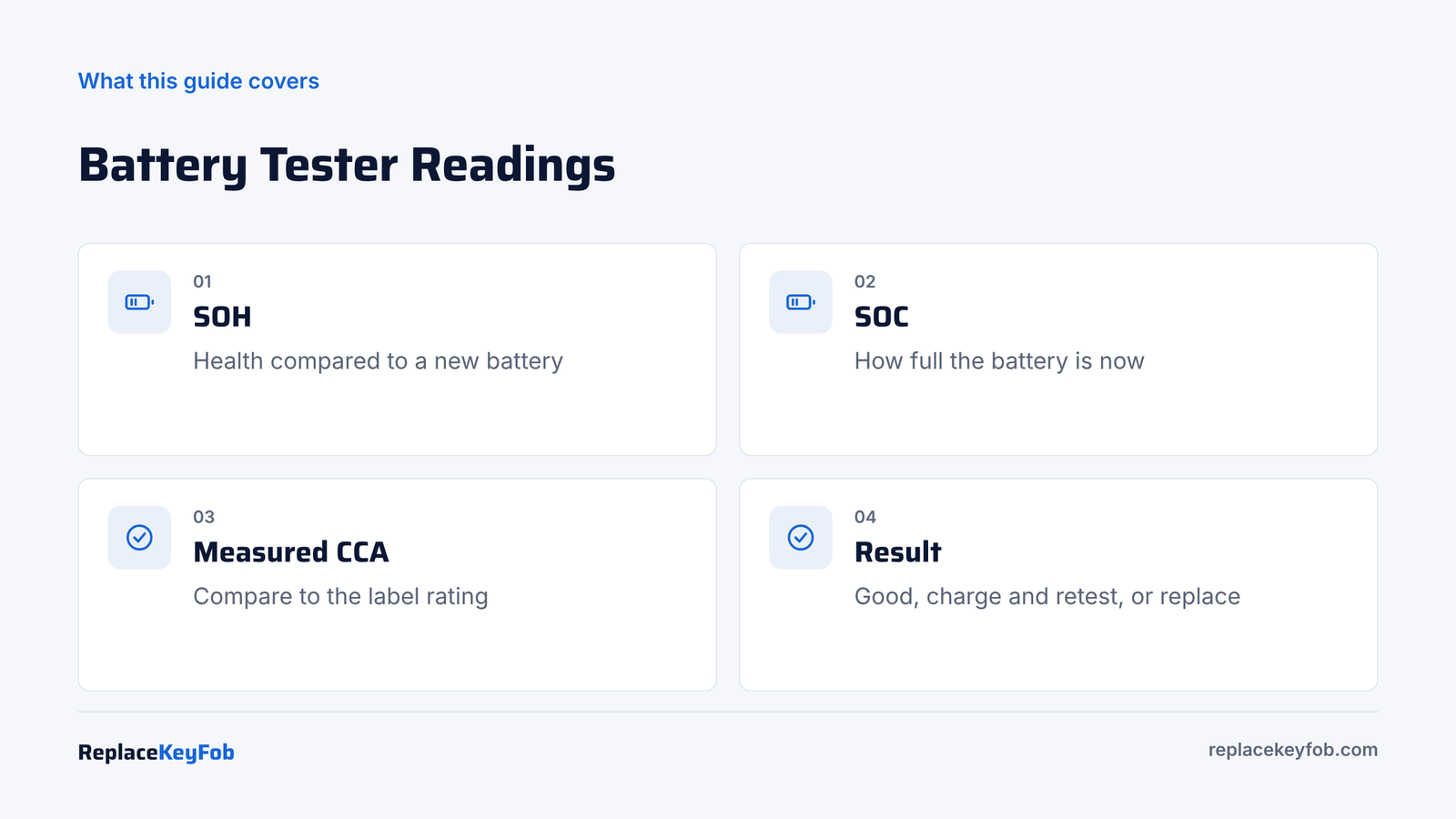
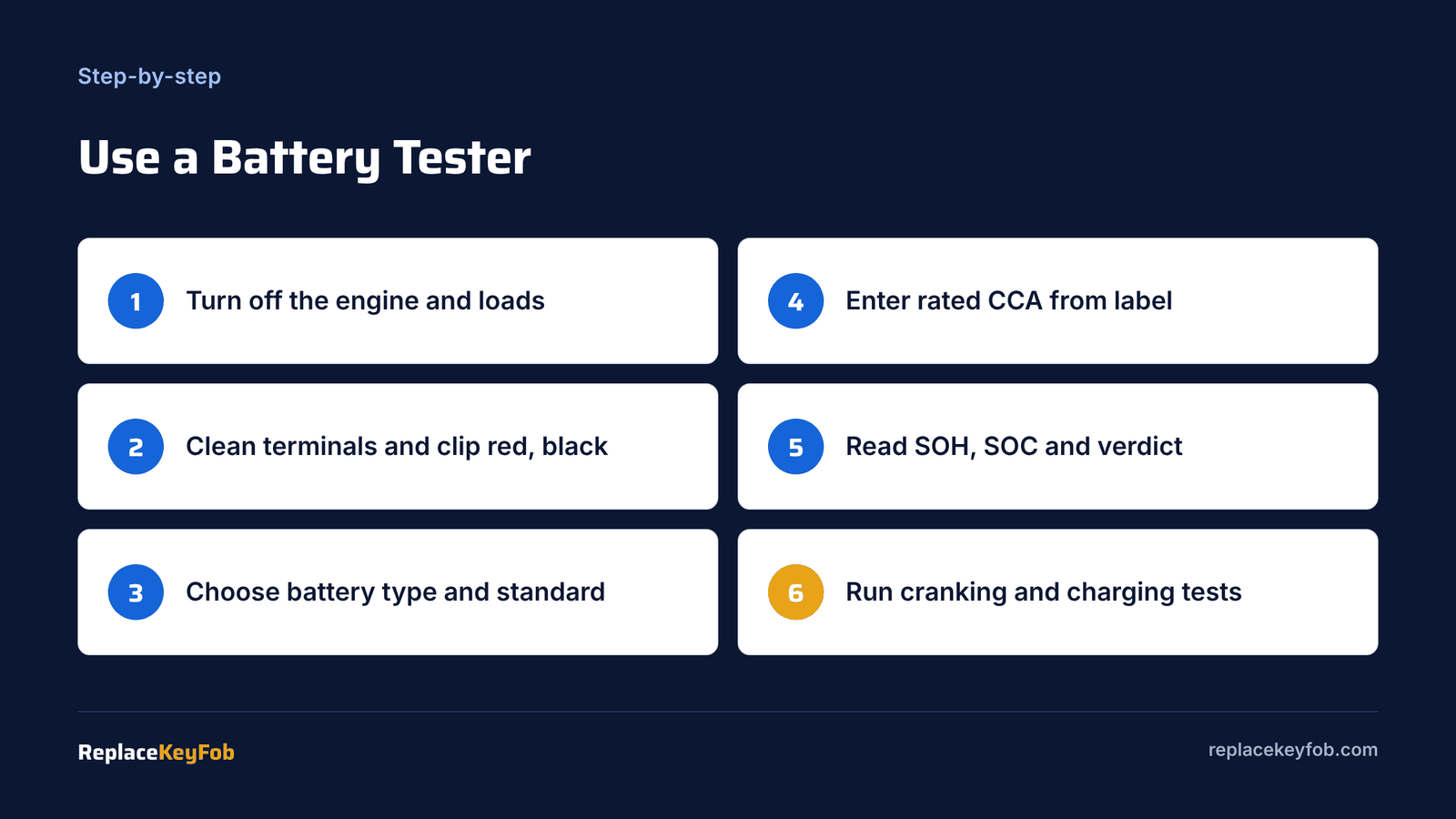
To use a car battery tester, switch the engine off, clip the red lead to the battery positive and the black lead to the negative. Choose the battery type (flooded, AGM, EFB or gel), the rating standard (usually CCA in the US), and enter the CCA printed on the label. The tester shows health (SOH), charge (SOC), measured CCA and a verdict.
Digital battery testers have replaced the old carbon-pile load tester for most quick checks. Instead of draining hundreds of amps, they send a small signal through the battery and measure its internal response. From that, they estimate how many cold cranking amps the battery can still deliver and how healthy it is. A test takes under a minute and does not heat or drain the battery.
The results are only as good as the information you enter. If you choose the wrong battery type or type in the wrong rating, a good battery can fail or a weak one can pass. This guide walks through setup, each reading, and the cranking and charging tests most testers also include. If you are shopping for a tester, see our roundup of the best car battery testers.
Before You Test
- Let the battery rest. If the car just ran, the surface charge can make the battery look stronger. Wait at least 30 minutes, or switch the headlights on for about a minute and then off.
- Turn everything off. Doors closed, lights off, key out. Many cars keep modules awake for a few minutes after locking.
- Clean the terminals. Corrosion between the clip and post causes false “bad battery” results. See battery terminal corrosion.
- Find the battery label. You need the battery type and the rated CCA. If the label is worn, check the receipt or the brand’s website.
- Know the battery age. A date code helps you judge a borderline result; see how to read a car battery date code.
12V Digital Battery Tester
Look for support for flooded, AGM, EFB and gel batteries, multiple rating standards (CCA, EN, IEC, DIN, JIS), and cranking and charging tests.
As an Amazon Associate, ReplaceKeyFob earns from qualifying purchases.
How to Use a Car Battery Tester Step by Step
- Connect the clamps. Red to positive (+), black to negative (-). Clip directly on the lead posts, not the bolts, for the best reading. Most testers power on from the battery.
- Choose in-vehicle or out-of-vehicle if the tester asks. In-vehicle tests allow for small loads from the car.
- Select the battery type. Flooded (sometimes “regular” or “SLI”), AGM flat plate, AGM spiral (like some Optima batteries), EFB or gel. Picking AGM for a flooded battery, or the reverse, skews the result.
- Select the rating standard. In the US this is almost always CCA. European batteries may list EN; Japanese batteries may show JIS codes like 55B24R, and the tester will look up the rating.
- Enter the rated value. Type the CCA from the label, for example 650 CCA.
- Start the test. Results usually appear in a few seconds.
- Read the result and any advice it shows.
- Run the cranking test if offered. The tester asks you to start the engine and records the lowest voltage during cranking.
- Run the charging test. With the engine running, the tester checks alternator output at idle and with loads on.
Why rest time matters
Right after driving or charging, the battery has a surface charge that raises voltage briefly. Testers use voltage to estimate charge level, so testing too soon makes a weak battery look fuller. A short rest, or a minute of headlight load, removes it.
How to Read the Results
| Reading | What it means | Typical healthy range |
|---|---|---|
| Voltage | Battery voltage at rest | About 12.4 to 12.7 V |
| SOC (state of charge) | How full the battery is right now | 75 to 100 percent |
| SOH (state of health) | Capacity left compared to new | Above about 70 to 80 percent is usually fine |
| Measured CCA | Cold cranking amps it can deliver now | Close to or above the rated CCA |
| Internal resistance | Lower is better | Varies by battery size; compare over time |
The verdict screens
- Good battery: no action needed. Test again in six months.
- Good, recharge: the battery is healthy but low. Charge it fully and retest.
- Charge and retest: the tester cannot judge health because charge is too low. Charge, rest, then test again.
- Replace battery: health or CCA is too low.
- Bad cell: one cell has failed. Replace the battery.
A low SOC with a “replace” result does not always mean the battery is dead. Testers are less accurate on deeply discharged batteries. Charge it fully first; see how to charge a car battery at home. If it still fails, it is time for a new one.
Cranking and Charging Tests
| Test | Good result | Problem result |
|---|---|---|
| Cranking voltage | Stays above about 9.6 to 10 V | Drops below about 9.6 V |
| Charging voltage, idle | About 13.6 to 14.7 V | Under about 13.2 V or over about 14.8 V |
| Charging with loads on | Stays above about 13.2 V | Drops low, battery not charging |
| Ripple test | Low ripple | High ripple can mean a bad alternator diode |
Some smart charging systems and start-stop cars deliberately vary alternator voltage, so a reading near 12.8 to 13 V can be normal at times. Check the car’s specifications. You can also check charging with a scan tool; see how to test an alternator with an OBD2 scanner.
Using Testers With Printers or Apps
Some testers print a slip or send results to a phone app. These help you track a battery over time and show proof of a failed test for a warranty claim. Our car battery warranty guide explains how to use a tester printout when claiming.
Tester Walkthrough: Typical Menu Flow
Popular handheld testers, including the Ancel BA101 and similar models, follow a very similar flow, though menu names vary:
- Clip on and wait for the start screen.
- Pick Battery Test, then In Vehicle or Out of Vehicle.
- Pick the battery type with the arrow keys and press enter.
- Pick the standard (CCA, BCI, CA, MCA, JIS, DIN, IEC, EN, SAE).
- Set the rating with the arrow keys. Holding the key usually scrolls faster.
- Read the result, then use the menu for Cranking Test and Charging Test.
Check your model’s manual for the exact names and any extra modes, such as a 24-volt setting for heavy trucks. Some testers include a printer or Bluetooth link so you can save or share the result.
How Often to Test
- Twice a year, ideally before winter and before summer heat
- Any time cranking sounds slow or a battery warning appears
- Before long trips if the battery is over three years old
- After the car sits for more than a few weeks
Keeping a simple log of measured CCA and SOH shows you the trend. A battery losing a large chunk of CCA between tests is near the end even if it still shows “good.”
Capacity Testers vs Conductance Testers
Most handheld testers are conductance testers. They estimate health quickly but do not measure true amp-hour capacity. A capacity tester discharges the battery at a set rate and measures how long it lasts, which takes hours. Capacity testing is more common for deep-cycle, RV and solar batteries. For a car starting battery, a conductance tester plus a load test is usually enough.
Common Mistakes
- Choosing the wrong battery type. This is the biggest source of wrong results.
- Entering the wrong CCA. Do not use the marine cranking amps (MCA) or the CA number by mistake.
- Testing right after driving. Surface charge inflates the reading.
- Clipping onto bolts instead of posts. The test includes the clamp joint and can read low.
- Ignoring a “charge and retest” result. Charge first; it is not a pass or fail.
When to Get a Second Opinion
If your tester says “replace” but the battery is under three years old, ask a parts store to retest it. Most test for free. A new battery typically costs about $150 to $400 installed; see car battery replacement cost.
Frequently Asked Questions
Look at SOH (health), SOC (charge level), measured CCA and the verdict. A healthy battery shows high SOH, measured CCA near the rating, and a “good” result.
Yes. Most testers work with the battery installed. Turn everything off and let the battery rest before testing.
The battery is too low for an accurate health reading. Charge it fully, let it rest, and test again.
Enter the cold cranking amps printed on the battery label. Do not use CA or MCA values.
They are good enough to tell a strong battery from a weak one, as long as you enter the right type and rating. For borderline results, confirm with a load test or a free parts store test.