
How to Charge a Car Battery at Home (Settings and Time)

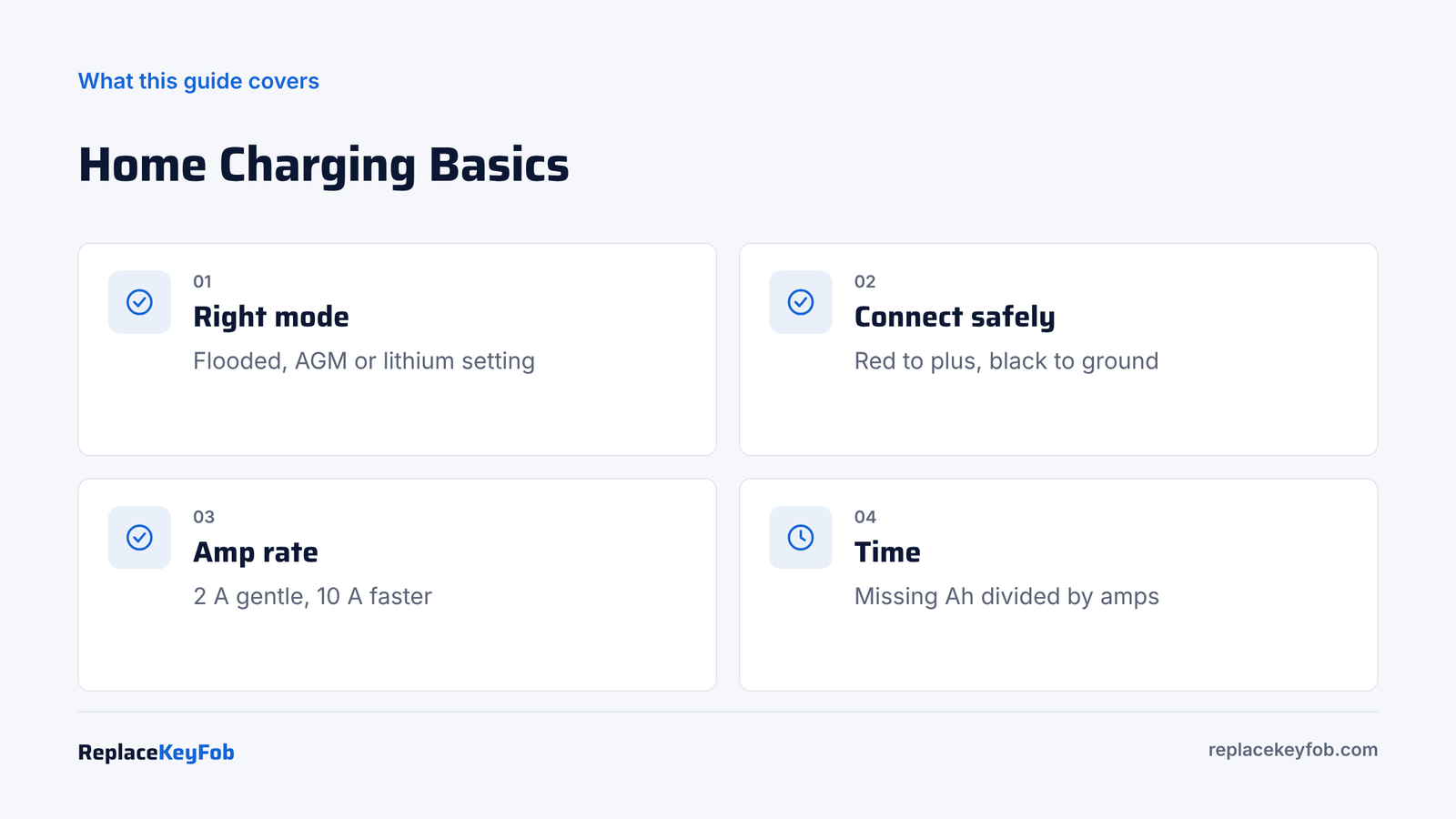
To charge a car battery at home, use a smart charger set to your battery type (standard, AGM or lithium). With the charger unplugged, connect the red clamp to the positive post and the black clamp to the negative post or a bare metal ground. Plug in and choose a rate of about 2 to 10 amps. Most batteries take about 4 to 12 hours to charge fully.
A home charger is the best way to bring a drained battery back. It is gentler and more complete than driving, and modern smart chargers are close to foolproof: they test the battery, charge in stages and stop at full. The steps are simple, but getting the mode, connection order and amp rate right protects both you and the battery.
This guide covers charger types, a step-by-step process, how long it takes, and the special cases: deeply dead batteries, AGM and lithium, and hybrids. If the car will not start and you need to go now, see how to jump start a car instead.
Charger Types
| Charger type | What it does | Best for |
|---|---|---|
| Smart (multi-stage) charger | Tests, charges in stages, then maintains | Most home charging |
| Battery maintainer | Low current, keeps a charged battery full | Storage, not flat batteries |
| Trickle charger (manual) | Constant low current, no auto shutoff | Short use only, watch it |
| Jump starter or charger combo | Boost to start, plus charging | Garage use with occasional jumps |
| Old manual charger | Fixed high output, no regulation | Not recommended for AGM or modern cars |
A smart charger in the 4 to 10 amp range suits most car owners. See best car battery chargers and jump starter vs battery charger for help choosing.
Smart Multi-Stage Battery Charger
A smart charger with AGM and lithium modes, a 2 A and 10 A rate and automatic float covers almost every car battery. Check that it has reverse-polarity protection and a clear charge-level display.
As an Amazon Associate, ReplaceKeyFob earns from qualifying purchases.
Before You Start: Safety
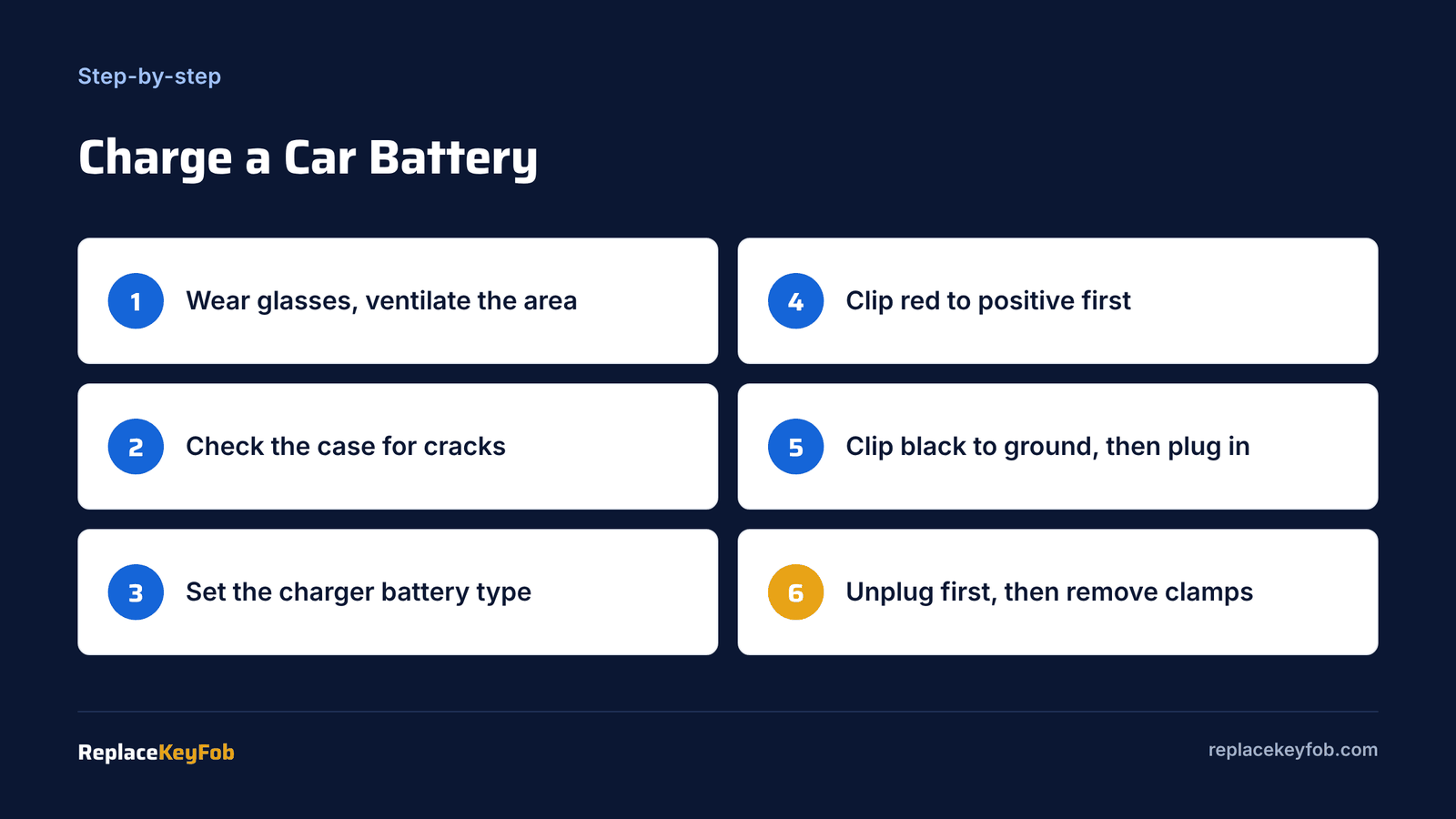
- Wear safety glasses. Batteries contain sulfuric acid.
- Ventilate. Charging can release hydrogen gas. Charge in an open garage or outdoors, never in a closed room.
- No sparks or flames near the battery.
- Inspect the battery. Do not charge a battery that is cracked, bulging, leaking or frozen. A frozen battery must thaw indoors before charging.
- Keep the charger off the battery top and away from where gas collects.
Step-by-Step: Charging the Battery
You can charge with the battery in the car or out. In the car is fine with a smart charger, and it keeps your settings.
- Turn the car off and remove the key. Switch off all lights and accessories.
- Clean the terminals if there is visible corrosion. See battery terminal corrosion.
- Make sure the charger is unplugged and switched off.
- Connect the red clamp to the positive (+) post.
- Connect the black clamp. In the car, connect it to the negative post or to bare, unpainted metal on the engine or body away from the battery. Out of the car, connect it to the negative post.
- Select the battery type on the charger: standard or flooded, AGM, or lithium. Using the wrong mode can undercharge or overcharge the battery.
- Select the charge rate. 2 amps for small batteries or overnight; about 4 to 10 amps for a typical car battery.
- Plug in and turn on. The charger should show it is charging.
- Wait for full. Smart chargers show a full or float indicator.
- Unplug first, then remove the clamps: black first, then red.
How Long Does It Take?
A simple estimate: hours equals the amp-hours to replace, divided by the charger’s amps, plus about 20 percent for losses and the slow final stage.
| Battery state | 2 A charger | 4 A charger | 10 A charger |
|---|---|---|---|
| 75% charged (about 15 Ah missing) | About 8 to 9 hours | About 4 to 5 hours | About 2 hours |
| 50% charged (about 30 Ah missing) | About 18 hours | About 9 hours | About 4 hours |
| Flat (about 50 to 60 Ah missing) | About 30+ hours | About 15 to 18 hours | About 6 to 8 hours |
These are approximate for a 60 Ah battery. Larger truck batteries take longer. A smart charger slows down near full, so the last part takes the longest.
Choosing the Right Charger Size
- Small cars and sedans (about 40 to 60 Ah): a 4 to 8 amp smart charger handles an overnight recharge.
- Trucks and large SUVs (about 70 to 100 Ah or dual batteries): a 10 to 15 amp charger saves hours. On diesel trucks with two batteries, charge each one, or charge them together only if the charger maker allows it.
- Motorcycles and lawn tractors: use a 1 to 2 amp setting; high rates overheat small batteries.
- Storage only: a maintainer of about 1 amp is enough, but it is too slow to recover a flat battery.
Charging With the Battery Out of the Car
Removing the battery is useful if the car is outdoors, the battery is in a hard-to-reach spot under a seat, or you want to charge it on a bench.
- Disconnect negative first, then positive, and lift the battery out level. See how to disconnect a car battery safely.
- Set it on a workbench or a sheet of plywood in a ventilated space.
- Connect red to positive and black directly to the negative post.
- Charge as above, then let it rest an hour and check voltage before reinstalling.
How to Tell When It Is Charged
- The charger shows full, float or a green light.
- After unplugging and resting for an hour or more, the battery reads about 12.6 volts or higher on a multimeter. See how to test a car battery with a multimeter.
- The car cranks briskly.
Charging a Dead Battery That the Charger Will Not Recognize
Some smart chargers will not start if the battery is below a minimum voltage, often around 2 to 3 volts or more, depending on the model. The charger may show an error or nothing at all.
- Use a charger with a manual or force mode designed for very low batteries, following its instructions carefully.
- Check the connections. A corroded clamp can make the charger read zero.
- Consider the battery’s condition. A battery that has sat flat for weeks may be sulfated beyond recovery. Charge it, then load test it before trusting it.
AGM and Lithium Batteries
- AGM: use the AGM mode. AGM batteries need a slightly higher, tightly controlled absorption voltage, and old unregulated chargers can overheat and dry them out. The AGM mode on any quality smart charger is the safe choice. See AGM vs flooded batteries if you are not sure which type you have.
- Lithium (LiFePO4): use only a charger with a lithium mode. Do not use desulfation or repair modes on lithium. Do not charge below freezing unless the battery has low-temperature protection.
How to Charge a Hybrid Car Battery at Home
Hybrids have two batteries, and “charging” means different things:
- 12V auxiliary battery: this is the one that goes flat if the car sits. Charge it with a normal smart charger, using AGM mode if it is AGM. On many hybrids it is in the trunk or under a rear seat, and the maker provides a jump or charging terminal in the under-hood fuse box. Connect red to that terminal and black to a ground point.
- High-voltage traction battery: on a regular hybrid it charges itself while you drive. You cannot and should not charge it at home. On a plug-in hybrid (PHEV), you charge it with the supplied cord from a standard outlet (Level 1) or a home charger (Level 2).
Never connect a 12V charger to any high-voltage component or orange cable.
Mistakes to Avoid
- Connecting with the charger plugged in. It can spark at the clamps.
- Wrong battery mode.
- Charging in a closed room.
- Charging a frozen or cracked battery.
- Leaving a manual trickle charger on for days.
When to Replace Instead
If a fully charged battery drops below about 12.4 volts within a day, or fails a load test, it is worn out. Replacement typically costs about $110 to $380 for the battery in 2026. See car battery replacement cost.
Frequently Asked Questions
About 4 to 8 hours with a 10 amp charger for a half to fully drained battery, and much longer at 2 amps. Smart chargers stop at full.
Yes, with a smart charger. Connect red to positive and black to the negative post or a ground point, and keep the car off.
About 2 amps for slow overnight charging or small batteries, and about 4 to 10 amps for a typical car battery.
Often yes, with a charger that has a low-voltage or force mode. Load test it afterward, since a long-dead battery may not hold charge.
Charge the 12V auxiliary battery with a smart charger at the battery or the under-hood jump terminal. The high-voltage battery charges itself, or with the plug-in cord on a PHEV.