
How to Test a Starter Solenoid (Cars, Mowers and Tractors)

To test a starter solenoid, check that the small terminal gets about 12V when the key is in Start. Then measure across the two large terminals while cranking: near 0V means the contacts closed; near battery voltage means the contacts are bad. A click with no crank and good signal usually means worn solenoid contacts or a bad starter.
The starter solenoid is a heavy-duty switch. A small current from the ignition switch energizes its coil, which closes big copper contacts and sends battery current to the starter motor. On most cars, the solenoid is mounted on the starter itself. On riding mowers, garden tractors, older Ford vehicles and many farm tractors, it is a separate cylinder mounted on the frame or fender.
When the solenoid’s contacts burn or its coil fails, you get the classic single click, or nothing at all. This guide covers both styles.
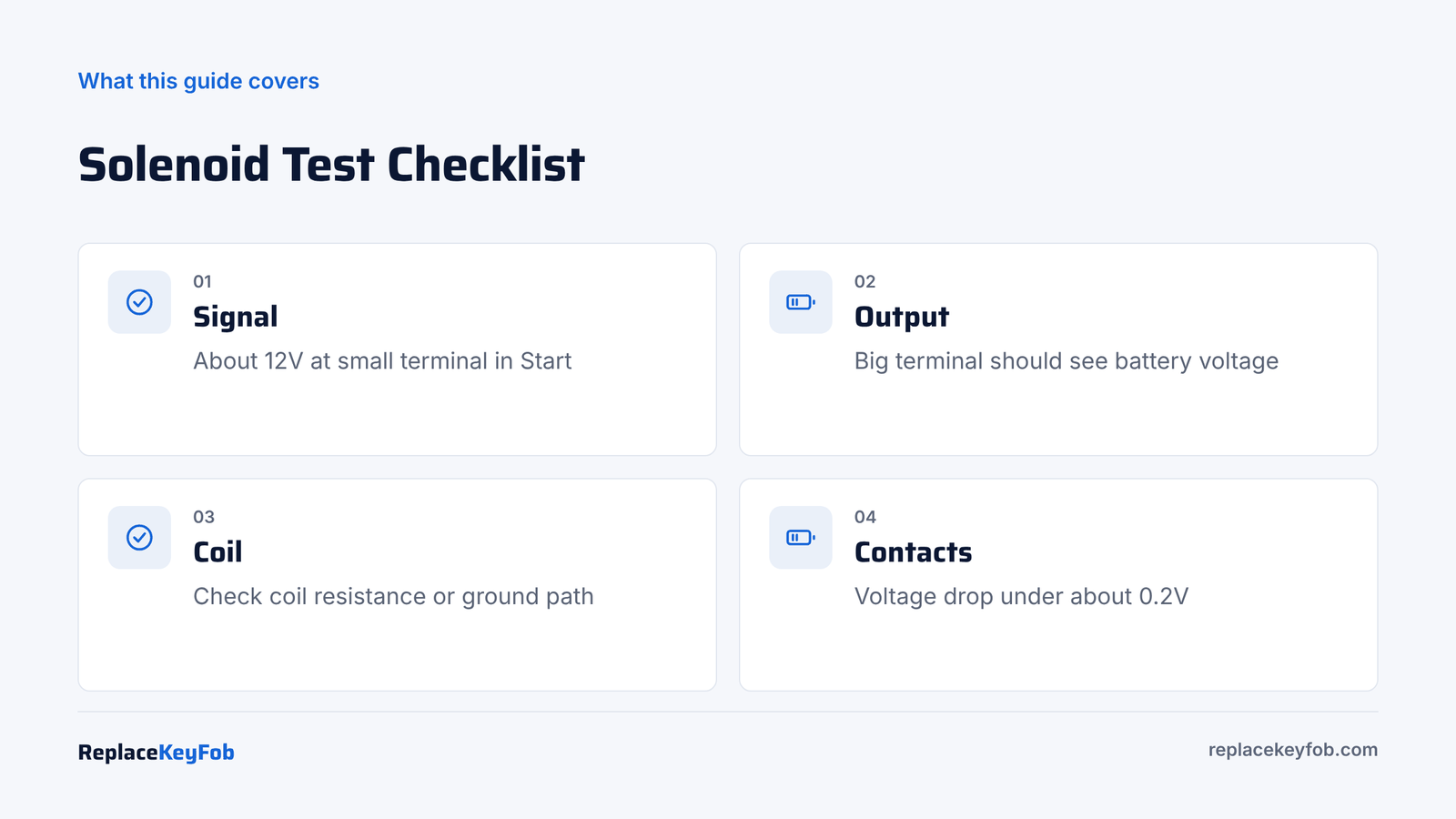
How a Solenoid Is Wired
| Terminal | What connects there |
|---|---|
| Large terminal 1 | Battery positive cable (always live) |
| Large terminal 2 | Cable to the starter motor |
| Small S terminal | Start signal from the key switch or relay |
| Small I or R terminal (some) | Ignition bypass for older coils |
| Ground | The solenoid body (3-terminal style) or a separate ground terminal (4-terminal style) |
On a 3-terminal remote solenoid, the body must be grounded through its mounting bolts. On a 4-terminal solenoid, one small terminal is the signal and the other is a dedicated ground wire. This matters on mowers, where a rusty mount is a common failure on 3-terminal types.
What You Need
- A digital multimeter.
- Safety glasses and gloves.
- A wire brush for terminals.
- A helper or a remote starter switch.
- For bench testing: a good 12V battery and jumper wires.
Universal 12V starter solenoid
If testing shows the remote solenoid has failed, match the terminal count (3 or 4) and mounting style to the original before buying a replacement.
As an Amazon Associate, ReplaceKeyFob earns from qualifying purchases.
Before You Test
- Charge the battery. It should read about 12.4V or more at rest. A weak battery causes clicking that looks like a bad solenoid. See how to test a car battery with a multimeter.
- Clean the terminals at the battery and the solenoid. Corrosion causes many solenoid complaints.
- Put the vehicle in Park or Neutral with the parking brake set. On mowers and tractors, set the brake and turn the PTO off.
Test 1: Check the Start Signal
- Set the meter to DC volts.
- Put the red probe on the small S terminal and the black probe on a good ground (engine block or frame).
- Have a helper turn the key to Start.
- You should see about 10 to 12V.
No voltage means the problem is upstream: the key switch, neutral or clutch switch, seat switch on a mower, the starter relay or a fuse. The solenoid itself may be fine.
Test 2: Check the Battery Feed
Put the red probe on the large battery-side terminal and black on ground. You should see full battery voltage at all times. If not, the battery cable or its connection is bad.
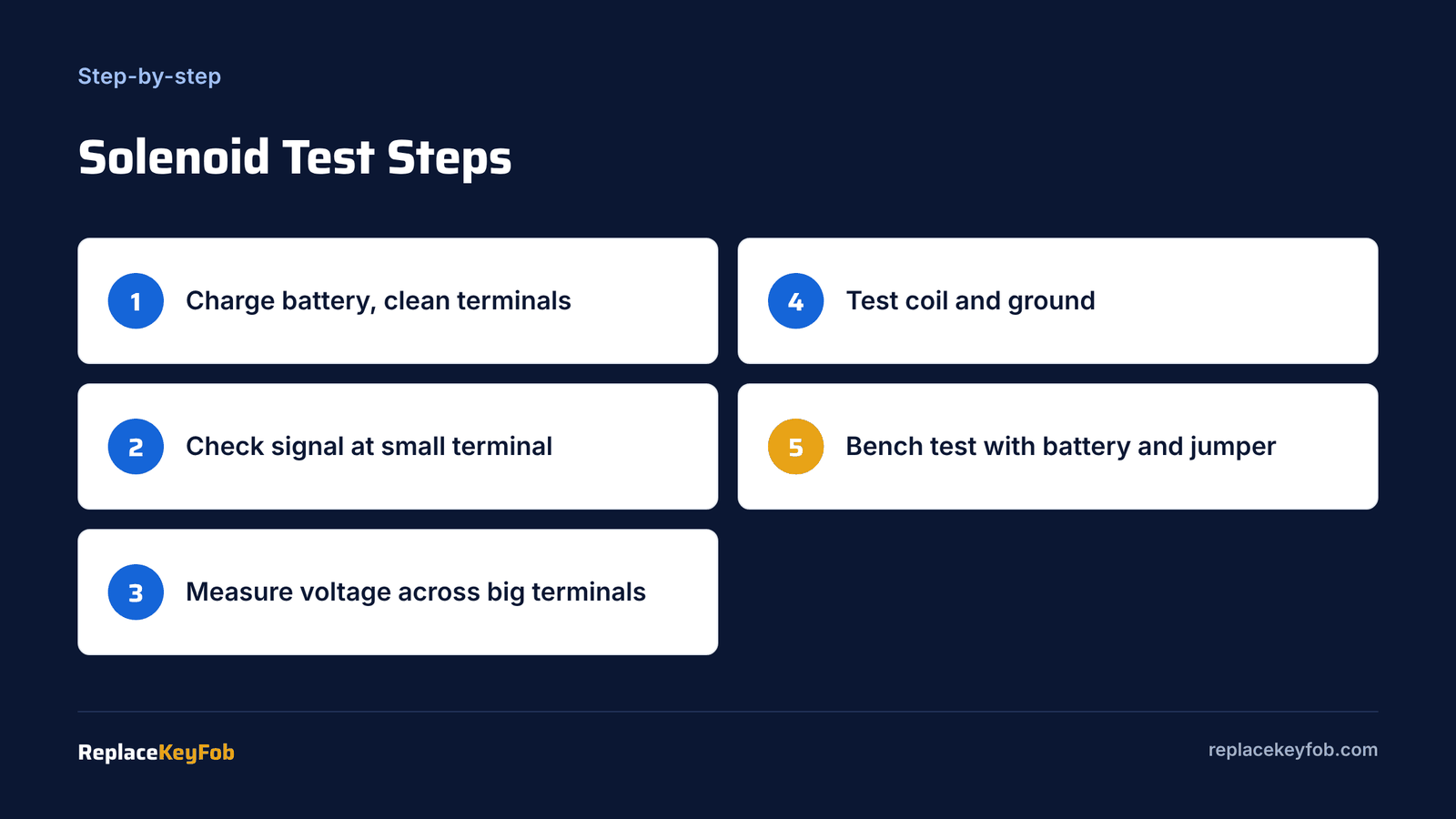
Test 3: Voltage Across the Large Terminals (Contacts Test)
This is the most useful solenoid test. It shows whether the contacts actually close and carry current.
- Put the red probe on the large battery-side terminal and the black probe on the large starter-side terminal.
- With the key off, you will see about battery voltage (the starter motor provides a path to ground). That is normal.
- Have a helper crank the engine.
| Reading while cranking | What it means |
|---|---|
| Under about 0.2V | Contacts closing well; solenoid OK |
| About 0.2 to 0.5V | Worn or pitted contacts; marginal |
| Near battery voltage | Contacts not closing; solenoid bad (if signal is good) |
If the contacts close well but the starter still does not turn, the starter motor is the problem. See how to test a starter motor.
Test 4: Coil and Ground Check
On a 4-terminal solenoid
- Disconnect the battery.
- Remove the wires from the two small terminals.
- Set the meter to ohms and measure across the two small terminals. A low but not zero reading (a few ohms) shows the coil is intact. An open circuit (OL) means the coil has failed. Very close to zero can mean a shorted coil.
On a 3-terminal solenoid
- Measure between the small S terminal and the solenoid body. You should see continuity (a few ohms).
- Then check the ground: with the battery connected, put the red probe on the battery negative and the black on the solenoid body, crank, and read voltage drop. It should be very low. A high reading means the mount is rusty and the coil cannot ground. Clean the mounting surface.
How to Test a Starter Solenoid on a Riding Mower
Riding mowers almost always use a separate solenoid, usually near the battery or under the dash panel.
- Set the brake, turn the PTO off and sit on the seat (or bypass the seat switch only for testing, then restore it).
- Check the small terminal for 12V when the key is in Start. No voltage often means a safety switch (seat, brake, PTO) or the key switch is the issue.
- If the signal is good and you hear a click but no crank, do the contacts test across the large terminals.
- On a 3-terminal solenoid, clean the mounting bolts and frame contact, since rust here is very common on mowers.
If the mower clicks every time, also check the battery; mower batteries are small and often weak after winter. Our guide on how to jump start a riding mower with a car can rule that out quickly.
How to Test a Starter Solenoid on a Tractor
Compact and older farm tractors use the same tests. Watch for:
- Neutral safety switch: many tractors will not send a start signal unless the gear lever or hydrostatic pedal is in neutral and the PTO is off.
- Long cable runs: voltage drop on old cables can be high. Do the battery feed test.
- 6V systems: some older tractors are 6V. Use a meter, not a 12V test lamp, and never jump them with 12V.
Bench Test a Remote Solenoid
A separate solenoid is easy to test off the vehicle:
- Disconnect the battery and remove the solenoid, noting which wire goes where.
- Set the meter to continuity (beep) and touch the two large terminals. It should show open (no beep).
- Connect a 12V battery: negative to the solenoid body (3-terminal) or the ground terminal (4-terminal), and briefly touch a positive jumper to the small S terminal.
- You should hear a firm click, and the meter should now beep across the large terminals.
- Remove the jumper. The meter should go back to open.
A solenoid that clicks but shows no continuity, or one that stays closed after the jumper is removed, is bad. A stuck-closed solenoid is dangerous on a mower, because the starter keeps running.
The Bypass Test (Use Extreme Care)
Mechanics sometimes bridge the two large terminals with an insulated screwdriver to see if the starter spins. If it does, the starter is fine and the solenoid or its signal is the problem. This bypasses every safety switch and creates a large spark, so only do it with the transmission in Park or Neutral, the parking brake set, the PTO off on mowers, hands clear of belts and blades, and eye protection on. Never do it near fuel vapor.
Troubleshooting Summary
| Symptom | Likely cause | Next step |
|---|---|---|
| No click, no crank | No signal, bad coil or ground | Test S terminal and coil |
| Single click, no crank | Burned contacts or bad starter | Contacts test across large terminals |
| Rapid clicking | Battery low | Charge and test battery |
| Starter keeps running after key release | Solenoid stuck closed | Disconnect battery, replace solenoid |
| Works only when tapped | Worn contacts | Replace solenoid |
Mistakes to Avoid
- Replacing the solenoid before checking the battery and the start signal.
- Forgetting that 3-terminal solenoids ground through their mounts.
- Reversing the large cables on a replacement solenoid that is marked for battery and starter sides.
- Working on the large terminals with the battery connected and a metal tool that can touch the frame.
Cost
A separate remote solenoid for a mower or tractor typically costs about $15 to $50 in 2026. On most cars the solenoid is part of the starter, and a replacement starter typically costs about $300 to $800 installed. A shop diagnosis for a no-crank is usually about $100 to $180.
Frequently Asked Questions
If the small terminal gets about 12V in Start, but the voltage across the large terminals stays near battery voltage while cranking, the contacts are not closing and the solenoid is bad.
Check for voltage at the small S terminal in Start, then measure across the two large terminals while cranking. Near zero is good; near battery voltage means a bad solenoid.
Confirm the safety switches are satisfied, check for 12V at the small terminal in Start, then test across the large terminals. Clean the mount on 3-terminal solenoids, which ground through the body.
You can jump the two large terminals with an insulated tool to see if the starter spins, but it bypasses all safety switches and can spark heavily. Only do it with the vehicle in Park or Neutral, wheels chocked, and nobody near moving parts.
On most modern cars, yes; the solenoid sits on top of the starter and is usually replaced with it. On mowers, tractors and some older vehicles, it is a separate part.