
How to Test a Starter Motor (In the Car and on the Bench)

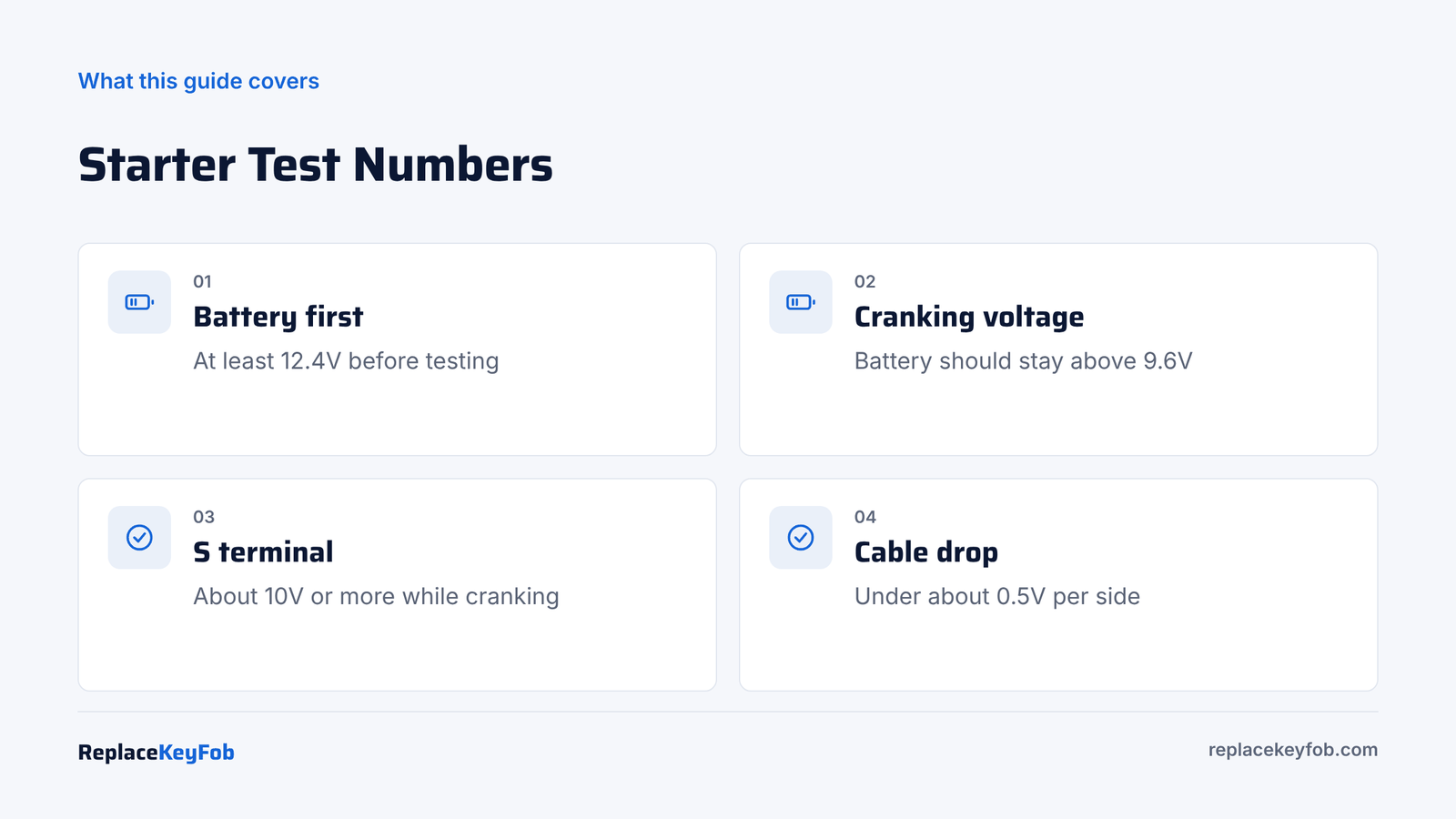
To test a starter motor, first make sure the battery reads at least 12.4V. Then measure battery voltage while cranking: it should stay above about 9.6V. Check that the starter’s small S terminal gets about 10V or more when the key is turned, and that cable voltage drop is under about 0.5V. If all pass and it still will not crank, the starter is likely bad.
A starter that clicks, grinds, or does nothing at all is often blamed too quickly. A weak battery, a corroded cable, a bad ground or a faulty start signal can all look exactly like a failed starter. Replacing a starter that is fine wastes a few hundred dollars and an afternoon.
This guide shows how to test the starter while it is in the car with a multimeter, and how to bench test it once it is out. If your main symptom is a click, our guide on car clicks but won’t start is a useful companion.
Symptoms of a Bad Starter
- A single loud click and no crank, with bright dash lights.
- Grinding or whirring without the engine turning (a worn drive gear or bad solenoid engagement).
- The starter works sometimes, especially after tapping it.
- Slow cranking with a fully charged battery.
- Smoke or a burning smell from under the car after trying to start.
Rapid clicking is different: that usually means the battery is too low, not that the starter is bad.
What You Need
- A digital multimeter.
- Safety glasses and gloves.
- A helper to turn the key, or a remote starter switch.
- Jack and jack stands if the starter is under the car.
- For bench testing: a good 12V battery, heavy jumper cables and a short jumper wire.
Remote starter switch
A remote starter switch clips to the starter or relay so you can crank the engine from under the hood while reading the meter, without a helper.
As an Amazon Associate, ReplaceKeyFob earns from qualifying purchases.
Before Testing the Starter: Check the Battery
All starter tests assume a good battery. Measure it with the engine off: 12.4V or more is acceptable, 12.6V is full. If it is lower, charge it first. A battery that reads well at rest but collapses under load needs a load test; see how to load test a car battery.
Also clean and tighten the battery terminals. Corrosion is a common cause of “dead starter” complaints. See battery terminal corrosion.
Test 1: Battery Voltage While Cranking
- Connect the meter to the battery terminals (DC volts).
- Disable the engine from starting if possible (for example by removing the fuel pump fuse or relay) so you can crank for a few seconds. On some cars this is not practical; short cranks are fine.
- Crank for a few seconds and watch the reading.
| Cranking voltage | What it suggests |
|---|---|
| Above about 10V, engine cranks normally | Battery and starter fine |
| About 9.6 to 10V | Acceptable, especially in cold weather |
| Below about 9.6V | Weak battery, or starter drawing too much current |
| Stays near 12V, no crank | Current is not reaching the starter: cable, solenoid, signal |
A big voltage drop with slow cranking and a good battery suggests a starter that is dragging (worn bushings or a shorted armature). Voltage that barely moves with no crank points to the circuit, not the motor.
Test 2: Voltage at the Starter
The starter has a large main terminal (the battery cable connects here) and a small S terminal (the start signal wire from the ignition switch or relay).
- Put the red probe on the starter’s large terminal and the black on the starter case or engine block.
- With the key off, you should see battery voltage.
- Crank the engine. The reading should stay within about 0.5V of the battery reading taken in Test 1.
If voltage at the starter is much lower than at the battery while cranking, the cable or a connection between them has high resistance.
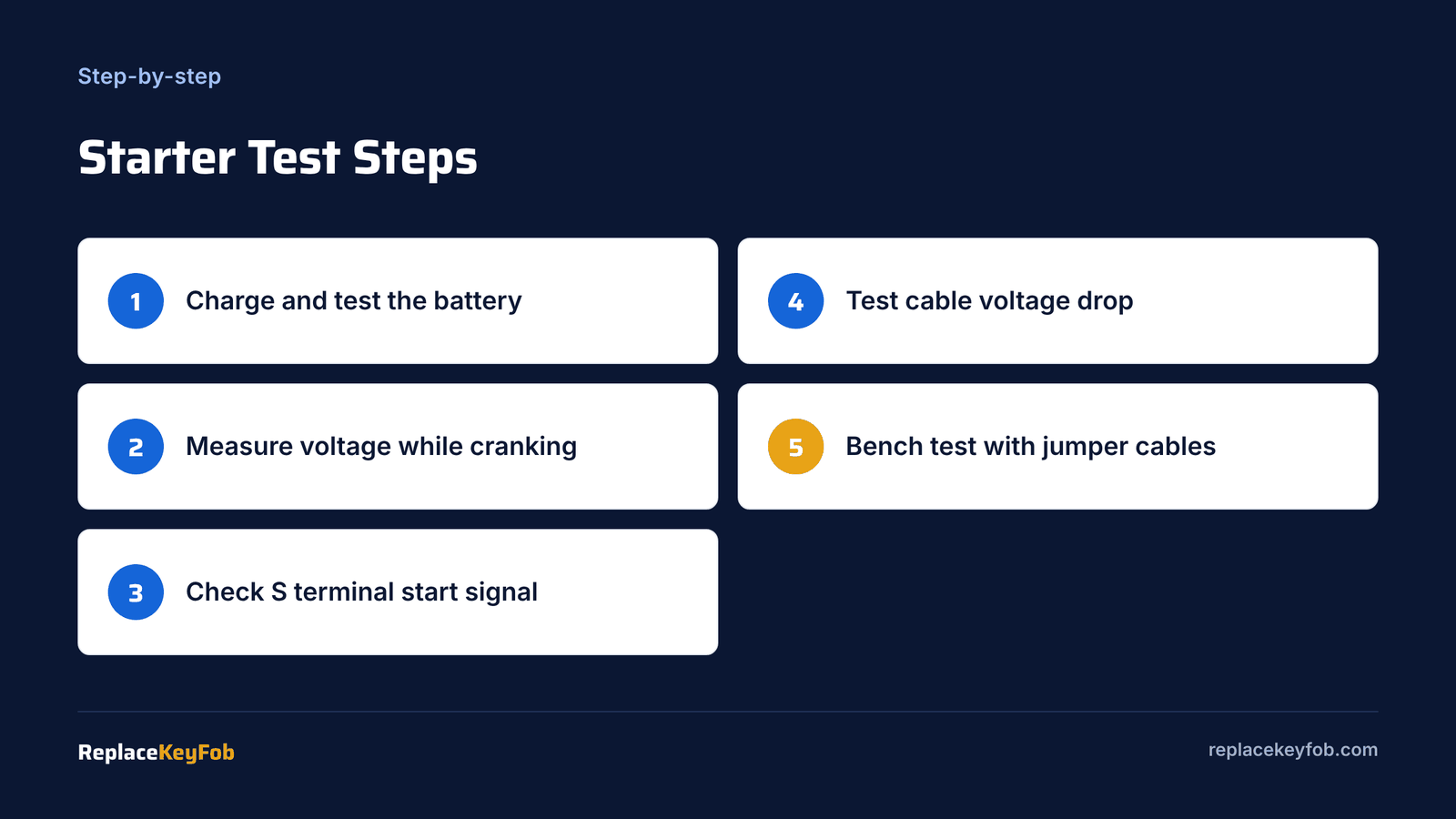
Test 3: The Start Signal (S Terminal)
- Put the red probe on the small S terminal and the black on the engine block.
- Have a helper turn the key to Start (or press the start button with the brake down).
- You should see about 10V or more while the key is held in Start.
| S terminal reading | What it means |
|---|---|
| 10V or more, starter clicks but no crank | Starter or solenoid contacts likely bad |
| 10V or more, starter does nothing | Starter solenoid or motor bad, or poor ground |
| 0V or very low | Problem upstream: ignition switch, neutral safety or clutch switch, starter relay, immobilizer |
No signal at the S terminal means the starter is not the problem yet. Check the starter relay, the park/neutral switch (automatic) or clutch switch (manual) and the immobilizer. A flashing security light with no crank points to an immobilizer issue; see how an engine immobilizer works.
Test 4: Voltage Drop on Cables and Ground
This catches hidden resistance in the circuit.
Positive cable
- Red probe on the battery positive post (on the post itself, not the clamp).
- Black probe on the starter’s large terminal.
- Crank. A reading under about 0.5V is acceptable. More means a bad cable or connection.
Ground side
- Red probe on the starter case or engine block.
- Black probe on the battery negative post.
- Crank. A reading under about 0.3V is good. Higher means a poor engine ground strap.
Our guide on how to test battery cables shows how to find and fix the bad spot.
Test 5: Bench Test the Starter
If the in-car tests point to the starter, remove it (disconnect the battery negative first) and bench test it to confirm.
- Secure the starter in a vise or clamp it to a solid bench. It will jump when energized.
- Connect the negative jumper cable from a good 12V battery’s negative terminal to the starter case.
- Connect the positive jumper cable from the battery positive to the starter’s large main terminal.
- Use a short jumper wire to briefly connect the large terminal (or battery positive) to the small S terminal.
- Watch the result. The pinion gear should shoot forward and the motor should spin quickly and smoothly.
| Bench result | Diagnosis |
|---|---|
| Pinion extends, spins fast and smooth | Starter is good |
| Click, no spin | Solenoid contacts or motor brushes worn |
| Spins, pinion does not extend | Solenoid or drive fork fault |
| Spins slowly, grinds or sparks | Worn bushings, brushes or armature |
| Nothing at all | Open solenoid coil or motor winding |
Many parts stores can bench test a starter for free on a test machine, which also measures current draw.
How to Test Starter Motor With a Voltmeter Only
If you only have a basic voltmeter, Tests 1 to 4 still work. The key comparisons are:
- Battery voltage at rest versus while cranking.
- Battery voltage versus starter terminal voltage while cranking.
- Whether the S terminal sees voltage in Start.
Those three readings tell you whether the problem is the battery, the wiring, the signal or the starter itself.
The Old Tap Trick
Tapping the starter body with a hammer handle while someone turns the key sometimes gets a worn starter to work once more. It can get you home, but it confirms the starter is failing. Replace it soon.
Mistakes to Avoid
- Testing with a weak battery.
- Skipping the ground test. Bad engine grounds are common.
- Cranking for long periods. Starters overheat; crank no more than about 10 seconds, then rest.
- Working on the starter without disconnecting the battery. The main terminal is always live.
- Bench testing without securing the starter. It can jump off the bench.
When to Replace and Cost
If the starter fails the bench test or the in-car tests point clearly to it, replace it. In 2026, a remanufactured starter typically costs about $120 to $350, and replacement at a shop typically totals about $300 to $800, more on V6 and V8 engines where the starter is under the intake manifold or hard to reach.
Frequently Asked Questions
Measure battery voltage at rest and while cranking, check voltage at the starter’s main terminal and S terminal while cranking, and check cable voltage drop. If voltage and signal are good but the starter will not turn, it is bad.
The battery should stay above about 9.6V, and the starter’s main terminal should be within about 0.5V of battery voltage. The S terminal should see about 10V or more in Start.
Clamp it securely, connect negative to the case and positive to the main terminal, then briefly jumper positive to the S terminal. A good starter extends the pinion and spins fast and smoothly.
Yes. A corroded or loose engine ground strap can stop the starter from cranking even with a good battery and starter. Do a ground-side voltage drop test.
Rapid clicking and dim lights usually point to the battery. A single click with bright lights, or no crank with good voltage at the starter, points to the starter or solenoid.