
How to Reset the TPMS Light (Tire Pressure Warning)

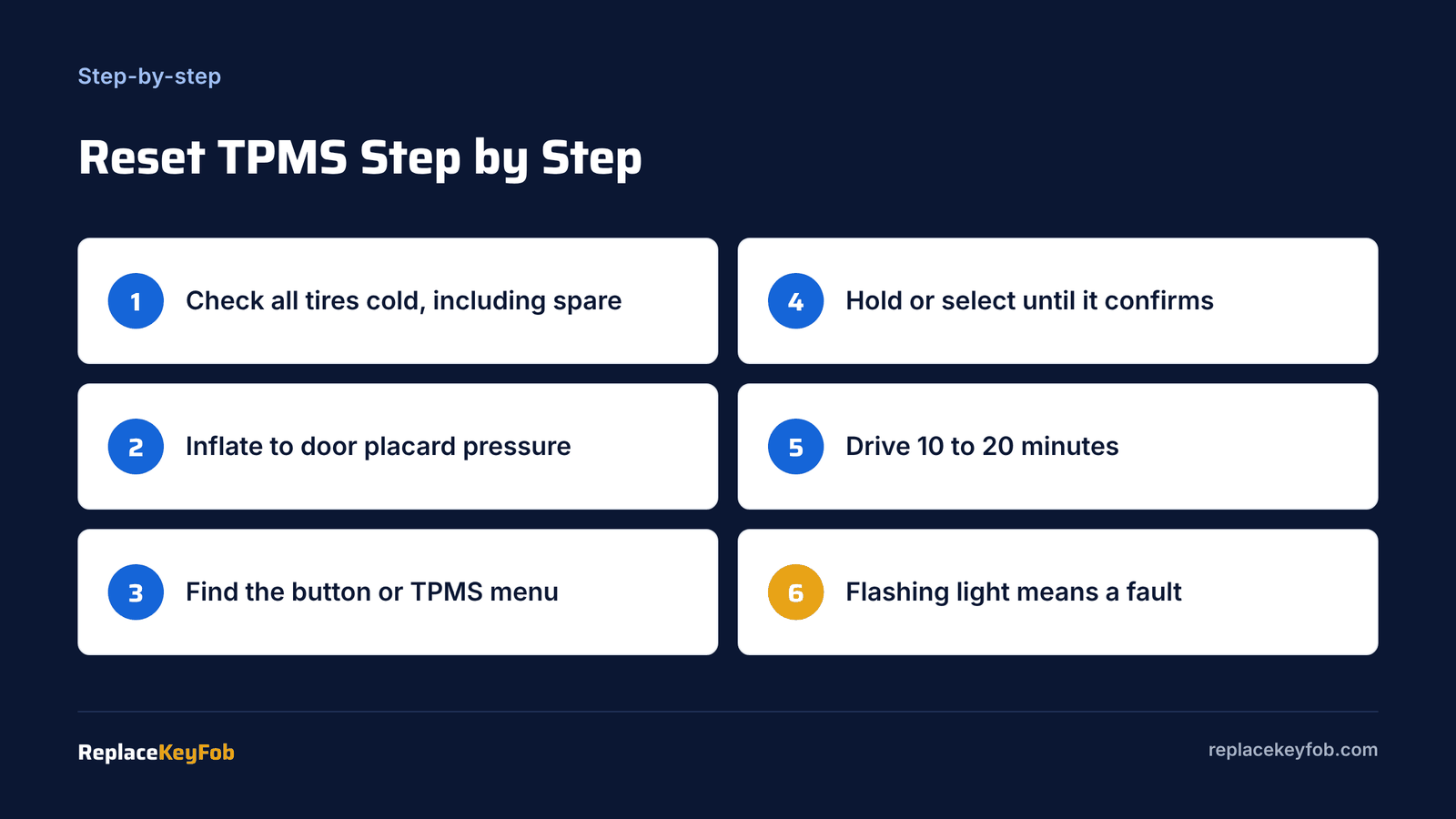
To reset the TPMS light, check all four tires cold and inflate them to the pressure on the driver door placard. On many cars the light then goes off after 10 to 20 minutes of driving. If it stays on, hold the TPMS reset button until the light blinks, or run the TPMS calibration in the dash settings menu.
A tire pressure warning light is one of the most common dash lights, and also one of the most misunderstood. It is not a reminder that resets on a timer. It is a sensor reading, and on most cars it turns off by itself once the pressure is right. When it does not, the reset method depends on whether your car uses direct sensors in each wheel or an indirect system that watches wheel speed.
This guide covers both, with the button, menu and drive methods for the most common brands. If you want to know when a scan tool is needed, our related guide on whether an OBD2 scanner can reset the TPMS light explains the tool side.
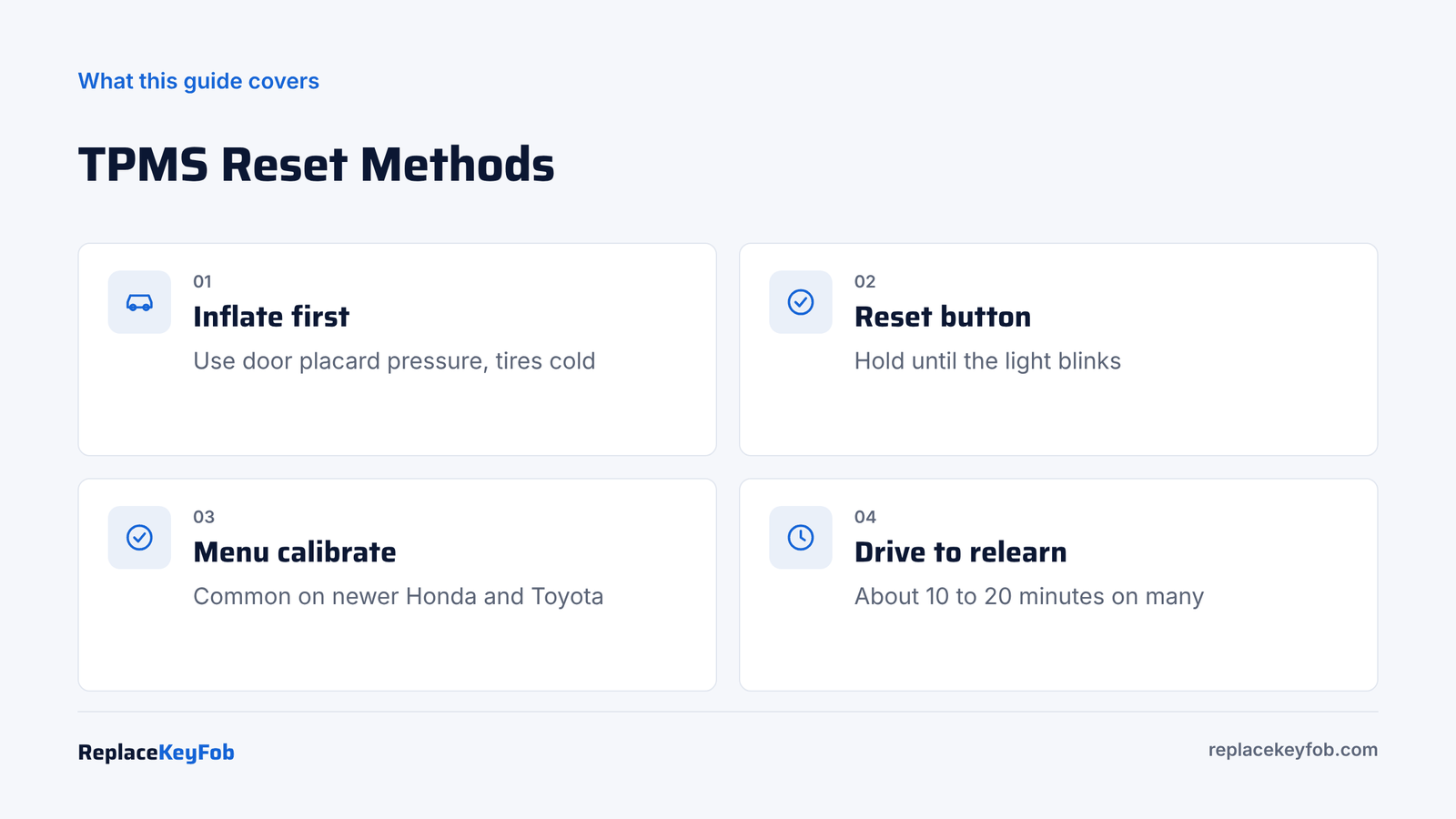
Solid vs Flashing TPMS Light
Before resetting anything, look at how the light behaves when you start the car.
| What the light does | What it means | What to do |
|---|---|---|
| Solid from startup | One or more tires low (often 25% or more below spec) | Check and inflate all tires, then drive |
| Comes on in cold mornings, goes off later | Pressure is borderline; cold air lowers it | Add 2 to 3 psi up to placard spec |
| Flashes for about 60 to 90 seconds, then stays solid | System fault: dead sensor battery, missing sensor, or spare without a sensor | Sensor diagnosis, not a reset |
| Comes on after a tire rotation or new wheels | Sensors need to be relearned to new positions | Relearn procedure or TPMS tool |
Tire pressure drops about 1 psi for every 10°F drop in temperature, which is why the light often appears on the first cold morning of fall.
What You Need
- A good tire pressure gauge (do not trust the gas station hose gauge)
- An air compressor or access to an air pump
- Your door jamb placard showing the recommended cold pressure
- The owner’s manual for your car’s TPMS steps
- For sensor relearns on some cars: a TPMS relearn tool
Digital tire pressure gauge
Pick a gauge that reads in 0.5 psi steps and has a lit display. Checking tires cold with your own gauge prevents most TPMS warnings.
As an Amazon Associate, ReplaceKeyFob earns from qualifying purchases.
Step 1: Set the Right Pressure
- Check the tires cold, before driving or after the car has sat for three hours.
- Read the placard on the driver door jamb. Use that number, not the “max pressure” molded on the tire sidewall.
- Inflate every tire to the placard pressure. Some cars list different front and rear numbers.
- Check the spare too, if your car monitors it. Many full-size trucks and some SUVs do.
Why this matters: a reset only works when the car sees normal pressure. On indirect systems, calibrating at the wrong pressure teaches the car the wrong baseline.
Step 2: Drive
On most cars with direct sensors, the light turns off on its own. Drive above about 15 to 20 mph for 10 to 20 minutes so the sensors wake up and send new readings. Many trucks, including the 2019 and newer Ram 1500, work this way: there is no reset button, and the sensors relearn automatically once pressure is correct and the truck is driven.
If the light is still on after a 20-minute drive with all tires correct, move to the button or menu method.
How to Reset TPMS Light With the Button
Many Toyota, Lexus, Subaru and some older Honda and Mazda models have a physical TPMS reset button.
- Inflate all tires to the placard pressure.
- Turn the ignition to ON with the engine off, or start the engine (follow your manual).
- Find the button. On many older Toyota models it is under the steering column, below the dash on the driver side, or inside or below the glove box. It is marked “SET” or with the TPMS symbol, a horseshoe with an exclamation point.
- Press and hold the button until the TPMS light blinks slowly about three times.
- Wait a few minutes with the key on, then drive about 20 minutes to let the system store the new values.
Reset Through the Dash Menu
Newer cars often moved the reset into the instrument cluster or touchscreen menu.
Honda and Acura (indirect TPMS)
Many 2014 and newer Honda models, including many Civic, Accord, CR-V and Pilot years, use an indirect system that compares wheel speeds.
- Set all tires to placard pressure.
- With the vehicle in Park and ignition on, open the display menu: often Settings > Vehicle > TPMS Calibration > Calibrate. On models with a steering-wheel display, use the arrow buttons to find “TPMS Calibration”.
- Confirm “Calibrate”. The light may stay on briefly.
- Drive normally. Calibration completes during about 30 minutes of cumulative driving on many models.
Some 2013 to 2015 Honda models used a TPMS button low on the dash to the left of the steering wheel instead.
Toyota and Lexus with newer displays
On many recent models with a multi-information display, the TPMS initialization is in the gear-icon menu, often under Settings > Vehicle Settings > TPMS, where you select set or initialize after inflating the tires. Hold the option until the confirmation appears.
GM, Ford and Stellantis
These brands mostly use direct sensors that clear automatically once pressure is correct and the car is driven. After tire rotation or new sensors, many require a relearn with a TPMS tool or a specific procedure in the instrument cluster. Check the manual, because the steps vary by model and year.
How to Reset TPMS Light on a 2019 Ram 1500
The 2019 and newer Ram 1500 uses direct sensors with automatic learning. Set all tires to the pressure on the door placard (light-duty trims often list different front and rear values), then drive for about 20 minutes above roughly 15 mph. The cluster tire screen should update each wheel. If one position shows dashes, that sensor is not reporting, which usually means a dead sensor battery or a damaged sensor.
If the TPMS Light Will Not Go Off
| Problem | Likely cause | Fix |
|---|---|---|
| Light stays on, tires correct | One tire was set at the wrong pressure, or spare is low | Recheck all five with your gauge |
| Light flashes then stays on | Sensor battery dead (common after 7 to 10 years) | Replace the sensor |
| Light after new tires | Sensor damaged during mounting, or not relearned | Ask the tire shop to scan sensors |
| Light after rotation | Positions not relearned on cars that track position | Relearn with a TPMS tool |
| Winter wheels on | No sensors in the winter set | Fit sensors or accept the warning |
| Reading shows dashes for one tire | Sensor not transmitting | Sensor diagnosis |
A dedicated TPMS tool can wake each sensor and read its ID and battery status. See the difference between a TPMS tool and an OBD2 scanner and our guide to the best OBD2 scanner for TPMS reset.
Mistakes to Avoid
- Using the tire sidewall maximum: the max pressure is not the recommended pressure, and over-inflation reduces grip.
- Calibrating an indirect system on low tires: the car learns the wrong baseline and will not warn you correctly.
- Ignoring a flashing light: a flashing light means the system is not working, so a real leak may not be reported.
- Disconnecting the battery to “reset” it: this does not reset TPMS on most cars and can reset other settings, such as auto-up windows.
When to Call a Pro and What It Costs
A tire shop can scan and relearn TPMS sensors in minutes. Typical 2026 US costs:
| Service | Typical cost |
|---|---|
| TPMS check or relearn | Free to about $50 |
| One TPMS sensor replaced | About $60 to $150 per wheel installed |
| Full set of four sensors | About $250 to $600 |
| Dealer TPMS diagnosis | About $100 to $180 |
Many tire shops include a TPMS relearn free when you buy tires from them.
Frequently Asked Questions
Inflate all tires to the door placard pressure, turn the ignition on, then press and hold the TPMS reset button until the light blinks about three times. Drive for about 20 minutes so the system stores the new pressures.
On many 2014 and newer Hondas, set all tires to the placard pressure, then go to the display settings and choose TPMS Calibration, then Calibrate. The system finishes learning after about 30 minutes of normal driving.
Yes, on most cars with direct sensors. Once all tires are at the correct pressure, the light usually turns off after 10 to 20 minutes of driving. A flashing light will not go off by itself because it means a sensor fault.
Tire pressure drops about 1 psi for every 10°F. A tire set at the minimum on a warm day can fall below the warning threshold on a cold morning. Top it up to placard pressure when the tire is cold.
There is no reset button. Inflate all tires to the door placard pressure and drive for about 20 minutes above roughly 15 mph. The sensors relearn automatically and the light should turn off.
You can drive carefully to check and inflate your tires, but do not ignore it. A low tire overheats, wears faster and can fail. If a tire looks visibly flat, change to the spare.