
How to Reset the TPMS Light on a Hyundai

This post contains affiliate links. As an Amazon Associate, ReplaceKeyFob earns from qualifying purchases, at no extra cost to you.
To reset the TPMS light on a Hyundai, let the tires cool, inflate all four to the pressure on the driver door placard, and drive at more than about 15 mph for 10 to 20 minutes. The light turns off on its own once each sensor reports correct pressure. If the light flashes before staying on, a sensor or the system has a fault and needs a TPMS tool.
Hyundai’s tire pressure monitoring is simple from the driver’s seat: one yellow light, and on many newer models a screen that shows each tire’s pressure. Most Hyundais do not have a reset button or a calibration menu. The sensors inside each wheel read actual pressure, so as soon as the pressure is right and the sensors transmit, the light should clear.
Most of the time, then, a Hyundai TPMS reset is really a pressure fix plus a short drive. The rest of this guide covers the cases where it is not that simple: flashing lights, new sensors, new wheels and lights that keep coming back. If you drive more than one brand, our general guide on how to reset the TPMS light covers the other common systems.
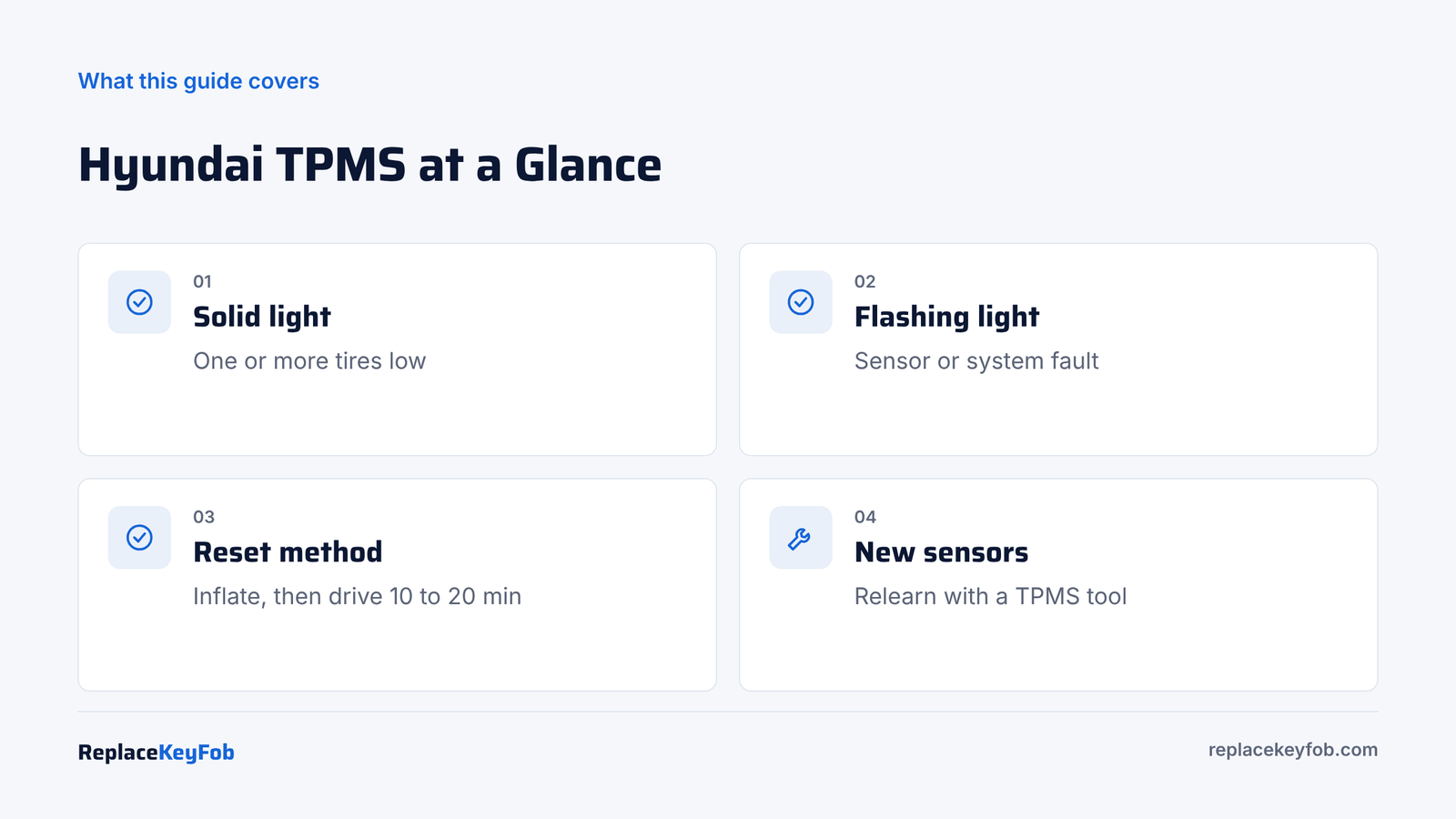
Solid vs Flashing: Read the Light First
| Light behavior | What it means | What to do |
|---|---|---|
| Solid from the start | One or more tires below the warning threshold | Inflate and drive |
| Flashes about a minute, then solid | System fault, sensor not reporting | Diagnose with a TPMS tool |
| Comes on in cold weather only | Pressure drops with temperature | Top up cold |
| Turns off after driving, returns next day | Slow leak | Inspect that tire |
| Message on cluster naming one tire | That tire is low | Check for a puncture |
Knowing which one you have saves time. A flashing light means more air will not help.
What You Need
- An accurate tire pressure gauge
- An air source
- The door jamb placard (front and rear pressures may differ)
- A TPMS tool only for new sensors or a system fault
12V portable tire inflator with digital preset
A preset inflator stops at the exact PSI you set, which makes it easy to bring all four tires to the Hyundai placard pressure cold before driving to clear the light.
As an Amazon Associate, ReplaceKeyFob earns from qualifying purchases.
How to Reset the Hyundai TPMS Light
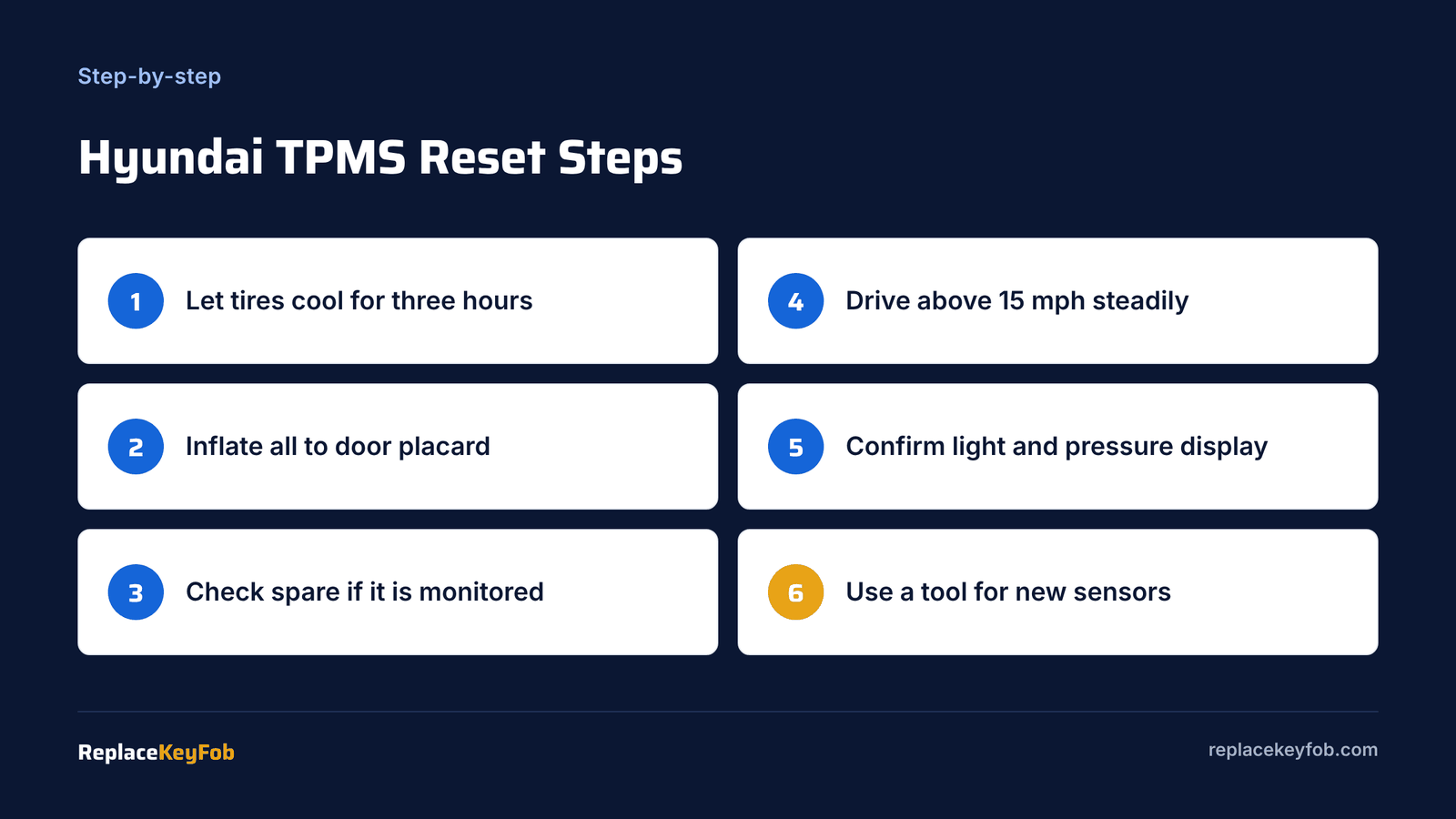
- Start with cold tires. Check before driving, or after the car has sat for three hours. A warm tire can read 3 or 4 PSI high and fool you.
- Find the placard on the driver side door jamb or B-pillar.
- Inflate each tire to that pressure. Do not go by the number on the tire sidewall.
- Check the spare if your model monitors it. Most Hyundai cars and many SUVs use a compact spare without a sensor, but check your manual.
- Drive at more than about 15 mph for 10 to 20 minutes. Steady driving helps the sensors send frequent updates.
- Look at the cluster. On models with a tire pressure screen, each tire should now show the updated number and the light should be off.
The reason the drive matters is that sensors save battery by transmitting less often when the car is parked. Once the wheels turn, the readings come faster and the system can confirm that all four are good.
When You Need a TPMS Relearn on a Hyundai
The drive-to-reset method only works with sensors the car already knows. You need a relearn when:
- A sensor was replaced after damage or a dead battery
- You fitted a second set of wheels with their own sensors
- The light flashes and a sensor is not being heard
On many newer Hyundai models, new sensors can learn automatically after a drive of about 10 to 20 minutes. On many others, the sensor IDs must be written to the car with a TPMS tool through the OBD2 port. A tire shop or dealer can do this quickly. If you prefer to do it yourself, look for a TPMS tool that lists your model and year, or see our guide to the best OBD2 scanners for Hyundai.
Typical tool relearn steps
- Inflate all tires to placard pressure.
- Use the TPMS tool to trigger and read each sensor, usually starting at the left front.
- Connect the tool to the OBD2 port and write the sensor IDs to the car.
- Turn the ignition off, wait, then drive to confirm.
Model Notes From Common Searches
Hyundai Elantra TPMS light reset
Many Elantras use the standard inflate and drive method. Newer Elantras show individual tire pressures on the cluster, which makes it easy to see which tire is low. If the light returns every few days on one corner, look for a slow leak at the valve stem or a nail in the tread.
2008 Hyundai Sonata TPMS light reset
Many 2008 Sonatas use direct sensors that are now well past the typical 7 to 10 year sensor battery life. If the light flashes and then stays on, a dead sensor is the most likely cause. Adding air will not clear it. Replace the faulty sensor and have it registered.
Santa Fe, Tucson and Palisade
Many years show pressure by tire. They use the same inflate and drive method. Larger SUVs may have different front and rear pressures and a higher load pressure for towing.
Ioniq and other EVs
Hyundai EVs often run higher placard pressures for range. Follow the placard exactly, and expect the light to be sensitive to small drops.
How Hyundai Shows Tire Pressure on the Cluster
Many newer Hyundais let you check each tire’s pressure without a gauge:
- With the ignition ON, use the steering wheel buttons to scroll through the cluster pages.
- Find the Tire Pressure or Utility page, depending on the model.
- Read each corner. Some models need a few minutes of driving before numbers appear, and show dashes until then.
This display reads the same sensors as the warning light, so it is the quickest way to find the low tire. Use it after inflating to confirm every corner matches the placard. If one corner shows dashes long after a drive, that sensor may not be reporting.
Seasonal Problems
Tire pressure falls about 1 PSI for every 10°F drop in air temperature. That is why the TPMS light shows up on the first cold morning of fall. The fix is the same: inflate to placard cold and drive. In winter, some owners set tires 1 to 2 PSI above placard to avoid repeat warnings, but never exceed the tire’s maximum.
Troubleshooting a Hyundai TPMS Light
| What you see | Likely cause | Fix |
|---|---|---|
| Light stays on after adding air | One tire still low, or drive too short | Recheck cold, drive 20 minutes |
| Light flashes then stays on | Dead, damaged or missing sensor | Scan sensors with a TPMS tool |
| Light after new tires | Sensor damaged during mounting | Have the shop test it |
| Light after new wheels | Wheels without sensors or IDs not learned | Fit sensors, relearn |
| Pressure screen shows dashes | Sensor not reporting | Drive a few minutes; if it stays, diagnose |
| One tire keeps dropping | Puncture, valve leak, bead leak | Tire inspection and repair |
Mistakes to Avoid
- Filling hot tires to placard. They will be under-inflated when cold.
- Assuming a flashing light is low pressure. It is a fault.
- Using a generic code reader to reset TPMS. Most cannot write sensor IDs. See can an OBD2 scanner reset the TPMS light.
- Ignoring a repeat warning. It usually means a slow leak.
- Over-inflating to make the light go away. It reduces grip and makes the ride harsh. Stick to placard pressure, or at most 1 to 2 PSI above it in cold weather.
When to Call a Pro and What It Costs
Visit a tire shop or Hyundai dealer if the light flashes, if you need new sensors, or if a tire keeps losing air. In 2026 typical US costs are about $25 to $75 for a relearn, about $60 to $150 per installed sensor, and about $20 to $40 for a simple puncture repair.
Frequently Asked Questions
Most Hyundai models do not. The light clears on its own after you inflate the tires to the placard pressure and drive about 10 to 20 minutes above 15 mph.
A flashing light that stays on after about a minute means the system has a fault, such as a dead or missing sensor. It is not a low pressure warning.
Usually 10 to 20 minutes of driving after the tires are set to the correct pressure.
On many models, yes, with a TPMS tool. Some newer models learn new sensors automatically after a drive.
You can drive carefully to a place to check and add air, but do not ignore it. Low tires wear faster, hurt handling and can overheat.