
P0106 Repair Cost: What You’ll Pay and What Fixes It

P0106 repair cost usually ranges from about $120 to $450, depending on the real cause. A simple MAP sensor replacement often costs around $178–$229, while check engine light diagnosis can add $122–$233 before parts. Vacuum leaks, wiring damage, or model-specific parts can raise the total. :contentReference[oaicite:1]{index=1}
Quick cost guide:
- Diagnosis: $122–$233
- MAP sensor replacement: $178–$229 average
- Vacuum hose repair: often lower cost
- Wiring repair: depends on damage
- Dealer repair: often higher than independent shops
You searched for P0106 repair cost because your check engine light is on, and you want to know if this is a small repair or a painful bill.
The frustrating part is that P0106 does not always mean “replace the MAP sensor.” It means the engine computer sees a manifold pressure signal that does not match expected engine conditions. This takes about 8 minutes to read.
Before paying for parts, you need to know which repair path fits your vehicle.
P0106 Code Meaning and Why Cost Changes
P0106 means the manifold absolute pressure or barometric pressure circuit has a range or performance problem. The MAP sensor helps the engine control module calculate air pressure, engine load, fuel delivery, and ignition timing. :contentReference[oaicite:2]{index=2}
That sounds like a sensor problem, but the sensor is only one part of the system. The same code can come from a vacuum leak, damaged connector, wiring fault, dirty throttle body area, or incorrect pressure reading.
The repair cost changes because P0106 identifies the bad signal, not the failed part.
Warning: Replacing the MAP sensor without testing can waste money. A cracked vacuum hose can trigger the same code and cost less to fix.
Kelley Blue Book notes that P0106-related codes can involve the MAP sensor circuit, intake leaks, wiring issues, throttle position problems, mass airflow sensor faults, EGR issues, and other engine control parts. :contentReference[oaicite:3]{index=3}
That is why diagnosis comes first. The next section shows where the money goes.
P0106 Repair Cost Breakdown
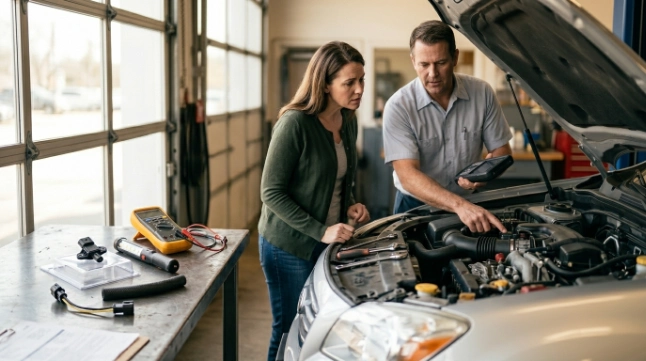
P0106 repair cost has two parts: diagnosis and the repair itself. Most drivers pay for testing before the shop replaces parts.
RepairPal lists check engine light diagnosis and testing at $122–$233 on average. RepairPal also lists average MAP sensor replacement at $178–$229, with parts around $124–$150 and labor around $54–$79. :contentReference[oaicite:4]{index=4}
This table shows the common price paths.
| P0106 Cause | Common Repair | Likely Cost Pattern |
|---|---|---|
| Bad MAP sensor | Replace sensor | Often $178–$229 average |
| Vacuum leak | Repair hose or intake leak | Low to moderate |
| Corroded connector | Clean or repair connector | Depends on labor time |
| Damaged wiring | Trace and repair circuit | Moderate to high |
| Software or ECM issue | Update, reflash, or deeper testing | Higher and model-specific |
The key point is simple: a cheap part can become expensive when the fault takes time to find.
For a deeper cost reference, see the RepairPal MAP sensor replacement estimate.
Why P0106 Diagnosis Matters Before Replacing Parts
P0106 diagnosis matters because the engine computer compares MAP sensor data against throttle position, RPM, engine load, and barometric pressure. A good technician checks whether those signals agree.
Edmunds describes normal diagnosis as scanning codes, inspecting vacuum hoses, testing sensor voltage, and comparing live MAP data with other engine readings. :contentReference[oaicite:5]{index=5}
That process saves money because it separates a failed sensor from a false reading. A sensor can report bad data because the intake manifold has unmetered air, not because the sensor died.
Tip: Ask the shop whether the estimate includes live data testing, vacuum leak inspection, and connector checks. A code scan alone is not full diagnosis.
Official Mitsubishi diagnostic information shows how specific manufacturer testing can be. One P0106 test checks MAP sensor voltage against pressure values, engine speed, throttle position, and coolant temperature conditions. :contentReference[oaicite:6]{index=6}
For technical readers, the Mitsubishi P0106 diagnostic procedure shows why a vehicle-specific test plan matters.
Most Common P0106 Fixes
The most common P0106 fixes are MAP sensor replacement, vacuum leak repair, connector repair, wiring repair, and air intake inspection. The right fix depends on test results.
A shop will usually begin with the cheapest visible checks. That includes cracked vacuum lines, loose intake clamps, damaged connectors, oil contamination, and related codes.
- Replace a failed MAP sensor.
- Repair cracked vacuum hoses.
- Clean or secure electrical connectors.
- Repair damaged MAP sensor wiring.
- Check air intake restrictions.
- Clear codes and road test.
Edmunds lists cleaning or replacing clogged air filters, repairing wiring, fixing vacuum leaks, replacing the MAP sensor, and updating engine control module software as possible P0106 repairs. :contentReference[oaicite:7]{index=7}
The cheapest correct repair is always better than the fastest guessed repair.
What Most People Get Wrong About P0106 Repair Cost
Most people get P0106 wrong because they treat the code as a parts order. The code gives a diagnostic direction, not a final invoice.
Misconception 1: P0106 Always Means a Bad MAP Sensor
P0106 often points toward the MAP sensor circuit, but other intake and engine control problems can trigger the same code. Kelley Blue Book lists vacuum leaks, wiring concerns, clogged catalytic converter, misfires, throttle position sensor issues, mass airflow sensor faults, EGR problems, and idle air control faults among possible causes. :contentReference[oaicite:8]{index=8}
That means a new MAP sensor will not fix every vehicle. Testing protects your budget.
Misconception 2: A Free Code Scan Is Full Diagnosis
A free scan tells you the stored code. It does not prove which part failed.
Full diagnosis checks live data, vacuum leaks, wiring, connector condition, and related codes. RepairPal separates check engine light diagnosis cost from actual repair cost for this reason. :contentReference[oaicite:9]{index=9}
Misconception 3: Driving With P0106 Is Harmless
A steady check engine light does not always mean emergency, but P0106 can affect power, fuel economy, idle quality, and stalling. Edmunds warns that hesitation, reduced power, and stalling can create safety concerns during traffic or acceleration. :contentReference[oaicite:10]{index=10}
The next question is whether you can drive before the appointment.
Can You Drive With a P0106 Code?
You can drive a short distance with some P0106 cases, but you should not ignore the code. Poor MAP sensor data can make the engine run too rich, too lean, or unstable.
If the car idles smoothly and the check engine light stays steady, drive gently to a repair shop. If the vehicle stalls, hesitates hard, smells rich, loses power, or shows a flashing check engine light, avoid driving.
Warning: A flashing check engine light points to a serious fault. Pull over safely and arrange repair before driving again.
Kelley Blue Book states that flashing check engine lights require immediate attention, while steady lights still need proper diagnosis. :contentReference[oaicite:11]{index=11}
Now decide which repair path fits your situation.
P0106 Repair Decision Guide
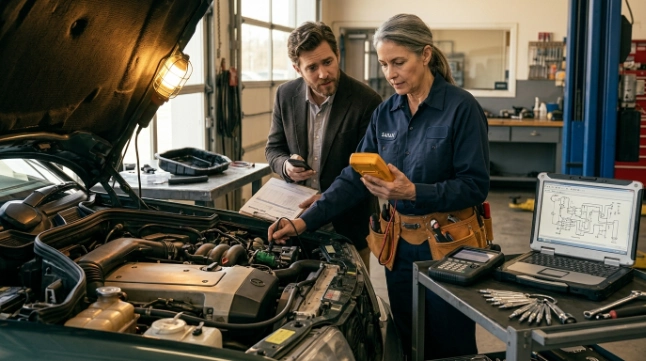
The best P0106 repair decision depends on symptoms, budget, and proof from testing. Use this guide before approving work.
- If the shop only scanned the code, ask for testing.
- If live MAP data is wrong, test the sensor circuit.
- If vacuum readings look abnormal, inspect hoses first.
- If the connector is corroded, repair that before replacement.
- If parts vary by model, request the part number.
- If the estimate exceeds $450, ask what caused the higher cost.
What most people do not think to ask is whether the diagnostic fee applies toward the repair. Some shops credit diagnosis when you approve the work, while others bill it separately.
Ask one clear question: “What test proves this part caused the P0106 code?”
That question keeps the conversation factual. It also helps you avoid paying for a sensor when the fault sits in a hose, connector, or wiring harness.
For a plain-language overview of symptoms and causes, see the Kelley Blue Book P0106 guide.
IMAGE SUGGESTION: A mechanic holding an OBD-II scanner beside an engine bay, with a highlighted MAP sensor area.
ALT TEXT: P0106 repair cost diagnosis with OBD-II scanner and MAP sensor inspection.
P0106 repair cost depends on the failed system, not the code alone.
As vehicles add more sensor logic, live data testing will matter more than quick part replacement.
Before approving repair, ask the shop to show the test result that proves the failed part.
Frequently Asked Questions
How much does it cost to fix P0106?
P0106 repair usually costs about $120–$450, depending on diagnosis, parts, labor, and the real cause. A MAP sensor replacement averages $178–$229, while check engine light diagnosis often adds $122–$233 before repair. :contentReference[oaicite:12]{index=12}
Will replacing the MAP sensor fix P0106?
Replacing the MAP sensor will fix P0106 only when testing proves the sensor has failed. Vacuum leaks, wiring faults, connector corrosion, throttle issues, and related intake problems can trigger the same code. Always confirm the cause before buying parts.
Is P0106 expensive to diagnose?
P0106 diagnosis can cost more than a simple scan because the technician must compare live MAP readings with other engine data. RepairPal lists check engine light diagnosis and testing at $122–$233 on average, before repair work begins. :contentReference[oaicite:13]{index=13}
Can a vacuum leak cause P0106?
Yes, a vacuum leak can cause P0106 because it changes intake manifold pressure. The MAP sensor can then report a pressure value that does not match throttle position, RPM, or engine load. Cracked hoses and loose intake connections deserve inspection before sensor replacement.
Can I clear P0106 and keep driving?
You can clear the code, but the light will return if the fault remains. Clearing P0106 without repair also erases useful diagnostic data. If the engine runs poorly, stalls, or shows a flashing check engine light, stop driving and repair the fault.
