
P0118 Symptoms: What This Coolant Sensor Code Feels Like

P0118 symptoms usually include a check engine light, hard starting, poor fuel economy, rough idle, black exhaust smoke, cooling fan problems, or no obvious drivability issue at all. P0118 means the engine computer sees a high-voltage signal from the engine coolant temperature sensor circuit.
You searched for P0118 symptoms because your scanner found the code, and now you want to know what the car will do next.
The confusing part is simple. A P0118 code does not always feel dramatic while driving.
Sometimes the only sign is a check engine light. Other times, the engine starts poorly, runs rich, smells like fuel, or turns the cooling fans on at the wrong time.
This takes about 8 minutes to read. You’ll know which symptoms matter, what causes them, and what to check before replacing parts.
Quick check: If your scan tool shows an engine coolant temperature reading far below outside temperature on a cold engine, suspect the ECT sensor circuit before blaming the thermostat.
P0118 Code Meaning and Why Symptoms Happen
P0118 means the engine coolant temperature sensor circuit is sending a high-voltage signal to the engine control module.
The engine computer reads that high signal as an engine that is colder than it is.
The coolant temperature sensor is a negative temperature coefficient resistor. As coolant temperature rises, sensor resistance drops and signal voltage drops.
When the signal stays too high, the computer loses trust in the coolant temperature reading.
- Cold reading tells the computer to add fuel.
- Wrong temperature affects ignition timing.
- Cooling fan control can become inaccurate.
- Idle speed can change.
- Emission control strategy can change.
The key insight: P0118 symptoms come from a false cold-engine signal, not always from a hot engine.
You may think a coolant temperature code means the engine is overheating. With P0118, the computer often believes the opposite.
That false reading explains why fuel-related symptoms show up before temperature gauge symptoms.
Common P0118 Symptoms You May Notice
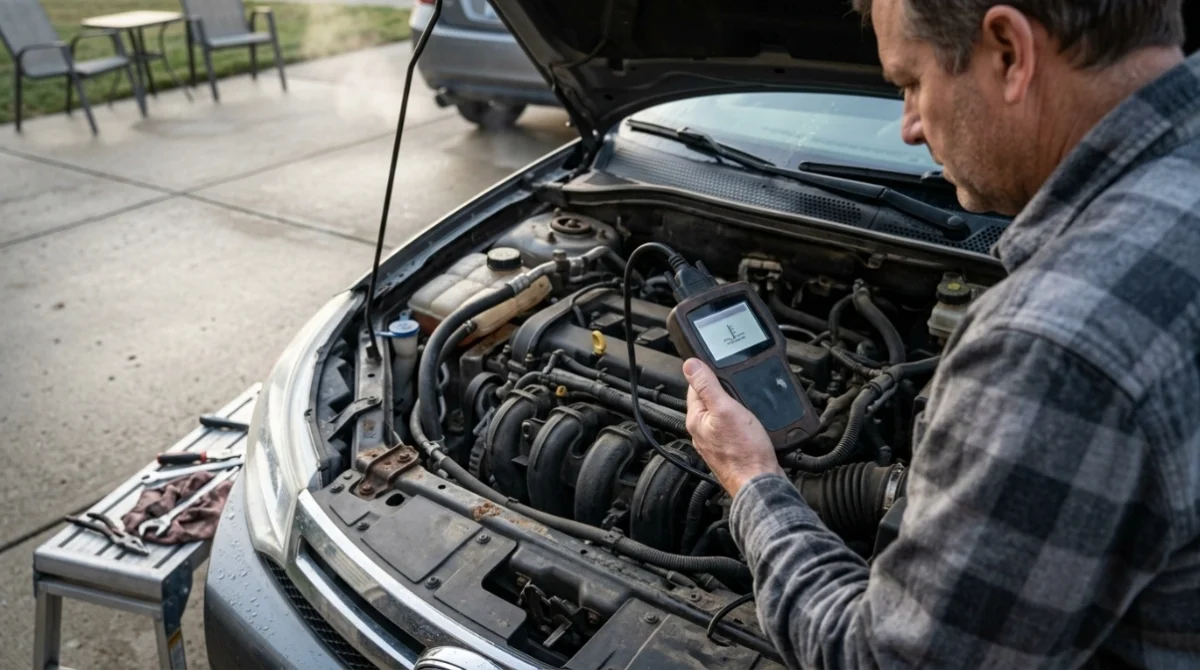
The most common P0118 symptom is an illuminated check engine light.
After that, symptoms depend on how your vehicle handles a failed coolant temperature signal.
Some vehicles enter a backup mode and keep running with a default temperature value. Others show clear drivability problems.
| Symptom | Why It Happens | What It Means |
|---|---|---|
| Check engine light | The ECM detects an abnormal coolant sensor voltage. | Scan the code before driving far. |
| Hard starting | The fuel mixture becomes too rich. | Cold-start data is unreliable. |
| Poor fuel economy | The computer adds extra fuel. | The engine runs richer than needed. |
| Rough idle | Fuel and timing corrections become inaccurate. | The code affects drivability. |
| Black smoke | Too much fuel enters the cylinders. | Do not ignore the code. |
| Fan runs nonstop | The ECM uses a safety strategy. | The temperature signal is not trusted. |
The strongest clue is a coolant temperature reading that does not match real engine temperature.
On a cold engine, coolant temperature and intake air temperature should sit close to the outside air temperature.
Why P0118 Can Show No Symptoms
P0118 can appear with no obvious driving symptoms because the computer uses backup values.
This protects the engine from stalling, but it does not fix the signal problem.
That is why some drivers see only the check engine light. The car starts, idles, and drives, but the engine computer still stores the fault.
Warning: Do not clear P0118 and call it fixed. If the circuit fault returns, the engine computer will keep using incorrect temperature data.
You might think no symptom means no repair is needed. That belief creates bigger problems during emissions testing and cold starts.
A steady check engine light means the PCM stored a diagnostic trouble code. State inspection programs also treat active emission-related codes as repair issues.
P0118 Symptoms vs Bad Thermostat Symptoms
P0118 symptoms come from an electrical sensor circuit problem.
A bad thermostat symptom comes from a mechanical coolant flow problem.
The two can feel similar because both affect temperature behavior. The scan data separates them.
| Clue | P0118 Sensor Circuit | Bad Thermostat |
|---|---|---|
| Scan tool temperature | Reads unrealistically cold | Changes slowly or stays low |
| Voltage issue | High signal voltage | No sensor circuit fault required |
| Common cause | Sensor, connector, open wire | Stuck open or stuck closed thermostat |
| First test | Compare ECT and IAT on cold engine | Watch warm-up behavior |
The fastest split is simple. Check live ECT data before replacing a thermostat.
For a broader OBD context, the U.S. EPA explains that onboard diagnostics monitor emission-related components and engine data through vehicle software in its OBD regulations overview.
What Most People Get Wrong About P0118 Symptoms
The biggest mistake is replacing the coolant temperature sensor without checking the connector and wiring.
P0118 often points to the circuit, not only the sensor.
Mistake 1: Thinking P0118 Always Means Overheating
P0118 does not always mean the engine is overheating.
The code means the computer sees a high-voltage coolant temperature signal.
That signal can make the computer think the engine is colder than real temperature. This is why rich running and hard starting show up.
Mistake 2: Replacing Parts Before Reading Live Data
Live scan data gives the clearest first answer.
A cold engine should show coolant temperature close to ambient temperature.
If the scan tool shows an extreme cold value, the sensor circuit needs testing before any cooling system part gets replaced.
Mistake 3: Ignoring Coolant and Connector Condition
Corrosion around the coolant sensor connector can create an unstable signal.
Low coolant can also expose the sensor to air instead of liquid coolant.
That changes the reading and makes the diagnosis harder. Start with the simple checks first.
How to Check P0118 Symptoms Before Repair
Start with scan data, then inspect the coolant sensor area.
This order prevents wasted money and wrong parts.
Use the steps below when the engine is cool and safe to touch.
- Read all stored and pending codes.
- Check freeze-frame coolant temperature.
- Compare cold ECT and IAT readings.
- Inspect coolant level and coolant condition.
- Check the ECT connector for corrosion.
- Inspect wiring for breaks or rubbing.
- Test sensor resistance or circuit voltage.
OEM technical information for Mitsubishi describes P0118 as an engine coolant temperature circuit high input and shows that the ECM checks whether the sensor voltage stays within range. The reference also lists an open circuit, connector damage, sensor failure, and ECM failure as possible causes in its P0118 diagnostic procedure.
Best first action: compare the scanner’s coolant temperature reading with outside temperature before buying a sensor.
IMAGE SUGGESTION: Close-up photo of a mechanic reading coolant temperature live data on an OBD-II scan tool.
ALT TEXT: P0118 symptoms scan tool coolant temperature reading
Can You Drive With P0118 Symptoms?
You can drive a short distance with mild P0118 symptoms if the engine is not overheating and the check engine light is steady.
You should not keep driving if the temperature gauge rises, the engine runs rough, black smoke appears, or the check engine light flashes.
A steady light means the car detected a stored fault. A flashing light signals a more serious running condition.
New York’s vehicle inspection program explains that a steady check engine light points to an emissions-related fault, while a flashing light requires immediate attention because serious engine or catalytic converter damage can occur.
- If the light is steady, scan and repair soon.
- If the light flashes, stop driving.
- If the engine overheats, shut it off.
- If fuel smell is strong, avoid long trips.
- If fans run nonstop, check live data.
For check engine light behavior, see the NYVIP OBD-II check engine light guide.
P0118 Causes Behind the Symptoms
The main P0118 causes are a failed engine coolant temperature sensor, damaged wiring, poor connector contact, low coolant, or an ECM input problem.
The sensor gets blamed first, but the harness deserves equal attention.
A coolant temperature sensor lives near heat, vibration, coolant residue, and plastic connectors. That location makes wiring faults common.
- Failed ECT sensor
- Open signal wire
- Damaged ground circuit
- Loose or corroded connector
- Low or contaminated coolant
- ECM input fault
What most people do not think to ask is this: did the code appear after recent work?
If someone replaced a thermostat, intake part, radiator hose, or coolant outlet, the sensor connector can be left loose. That creates a P0118 symptom pattern right after repair.
Pro tip: If P0118 appeared right after coolant service, check the connector before replacing the sensor.
Best Repair Path for P0118 Symptoms

The best repair path starts with proof, not guesses.
Replace the sensor only after scan data, connector inspection, and circuit checks point to sensor failure.
If you are in situation A, where the connector is loose or corroded, clean or repair the connector first.
If you are in situation B, where live data shows an extreme cold reading and wiring checks pass, replace the ECT sensor.
If you are in situation C, where the engine overheats or coolant is low, fix the cooling system issue before clearing codes.
| Situation | Likely Fix |
|---|---|
| Loose connector after repair | Reconnect and secure the plug |
| Corrosion at sensor plug | Repair connector terminals |
| Bad sensor resistance reading | Replace ECT sensor |
| Open circuit in harness | Repair wiring |
| Low coolant with overheating | Repair leak and refill coolant |
The repair is complete only when the live coolant temperature reading matches real engine behavior and the code does not return after a drive cycle.
IMAGE SUGGESTION: Engine bay image showing the coolant temperature sensor connector near the coolant outlet.
ALT TEXT: P0118 symptoms engine coolant temperature sensor connector location
P0118 symptoms happen because the engine computer receives a high-voltage coolant temperature signal and trusts the wrong temperature data.
As vehicles rely more on live sensor strategy in 2026, one bad temperature signal can affect fuel, idle, cooling fan logic, and emissions readiness.
Before replacing anything, plug in a scanner and compare cold ECT temperature with outside air temperature.
Frequently Asked Questions
What is the first symptom of P0118?
The first symptom of P0118 is usually the check engine light. Some vehicles also show hard starting, poor fuel economy, or rough idle because the ECM receives the wrong coolant temperature signal and changes fuel delivery.
Does P0118 mean my coolant temperature sensor is bad?
P0118 can mean the coolant temperature sensor is bad, but it can also mean the connector, wiring, ground circuit, or coolant condition is causing a bad signal. Test live data and wiring before replacing the sensor.
Can low coolant cause P0118 symptoms?
Low coolant can contribute to poor coolant temperature readings when the sensor is not surrounded by liquid coolant. P0118 is still an electrical circuit high code, so the connector and sensor circuit need testing after coolant level is corrected.
Will P0118 cause poor gas mileage?
P0118 can cause poor gas mileage because the ECM can read the engine as colder than it is. That false cold reading can make the engine run rich, which wastes fuel and can create black smoke.
How do I know if P0118 is fixed?
P0118 is fixed when live coolant temperature data matches real engine temperature and the code does not return after the repair. Clear the code only after checking the sensor, wiring, connector, coolant level, and drive-cycle behavior.
