
What Does P0172 Mean?

P0172 means “Fuel System Too Rich Bank 1.” Your engine computer sees too much fuel or not enough air in the air-fuel mixture on Bank 1. The check engine light turns on because fuel trim has moved beyond the normal correction range.
- Main meaning: rich fuel mixture
- Area affected: Bank 1
- Common causes: MAF sensor, fuel pressure, injectors, air restriction
- First step: scan live fuel trim data
You searched this because a scanner showed P0172 and the check engine light is on.
The code sounds technical, but the core problem is simple: the engine is getting a fuel mixture that the computer cannot correct enough. This takes about 8 minutes to read.
The wrong move is replacing the oxygen sensor first. P0172 often means the oxygen sensor is reporting a rich condition, not causing it. AutoZone notes that P0172 points to a rich mixture on Bank 1, while P0175 points to the same condition on Bank 2. :contentReference[oaicite:0]{index=0}
Look at short-term and long-term fuel trim before buying parts. Negative fuel trim means the computer is subtracting fuel because the engine is running rich.
P0172 Code Meaning in Plain English
P0172 means your engine computer has detected a rich air-fuel mixture on Bank 1.
“Rich” means the combustion chamber has too much fuel compared with air. CarParts.com defines P0172 as “Fuel System Too Rich Bank 1” and explains that the vehicle computer sets the code when it sees too much fuel or too little oxygen in the mixture. :contentReference[oaicite:1]{index=1}
Bank 1 means the side of the engine that contains cylinder number 1. On most inline 4-cylinder engines, there is only one bank, so Bank 1 means the whole engine.
| Code part | Meaning | Why it matters |
|---|---|---|
| P | Powertrain | The issue relates to engine or transmission control. |
| 0172 | System too rich | The computer is subtracting fuel to correct the mixture. |
| Bank 1 | Cylinder 1 side | Diagnosis starts on that side of the engine. |
The key point is not “replace one part.” The key point is “find why the engine is adding too much fuel or losing measured air.”
Why P0172 Happens Inside the Engine
P0172 happens when the engine control module sees fuel trim values that show a rich condition.
The ECM watches oxygen sensor feedback, air measurement, coolant temperature, throttle position, and fuel trim. Mitsubishi technical information for DTC P0172 says the ECM checks whether the fuel trim value stays within a set range, and the code appears when long-term and short-term fuel trim move too rich. :contentReference[oaicite:2]{index=2}
Think of fuel trim as the computer’s correction number. A small correction is normal. A large negative correction means the computer is pulling fuel away because the engine already has too much.
Do not assume the oxygen sensor failed because P0172 mentions mixture feedback. The oxygen sensor often exposes the problem. The cause can sit in the intake, fuel, sensor, or exhaust system.
The engine can become rich in two broad ways. Too much fuel enters the cylinders, or too little air reaches the cylinders.
A leaking injector adds fuel after the computer has already calculated the correct amount. A restricted air filter, dirty mass airflow sensor, or inaccurate temperature reading can push the computer toward the wrong fuel calculation.
P0172 Symptoms You Can Notice
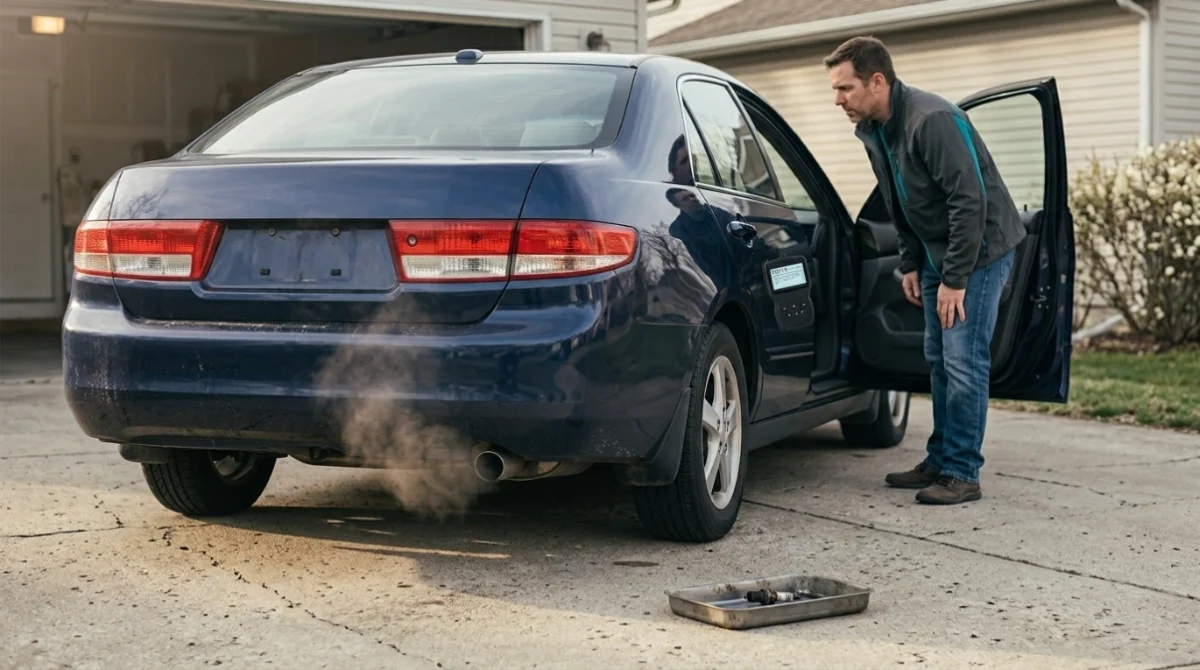
P0172 can appear with no obvious drivability issue, but most rich conditions leave clues.
AutoZone lists symptoms such as strong exhaust smell, black smoke, higher fuel use, lower power, rough idle, and fuel dilution in engine oil. These symptoms happen because extra fuel does not burn cleanly inside the cylinder. :contentReference[oaicite:3]{index=3}
- Check engine light stays on
- Fuel economy drops
- Exhaust smells rich or gassy
- Idle feels rough after warm-up
- Black smoke appears from the tailpipe
- Spark plugs foul faster
- Oil smells like fuel
The fuel smell matters most. Fuel dilution can reduce oil protection, and soot can coat spark plugs, oxygen sensors, and the catalytic converter.
If the vehicle runs smoothly, you still need diagnosis. A smooth idle only means the engine still compensates enough to run, not that the rich condition is harmless.
Most Common P0172 Causes
The most common P0172 causes come from air measurement errors, excess fuel delivery, or bad sensor data.
Edmunds lists diagnostic checks for P0172 that include intake and vacuum inspection, fuel pressure testing, oxygen sensor testing, MAF sensor testing, and injector testing. That order matters because P0172 has several causes with similar symptoms. :contentReference[oaicite:4]{index=4}
| Cause | What happens | Best first check |
|---|---|---|
| Dirty MAF sensor | Airflow reading becomes inaccurate. | Compare MAF grams per second to engine size. |
| Leaking fuel injector | Fuel enters one cylinder after command. | Check fuel pressure drop and plug color. |
| High fuel pressure | Injectors deliver more fuel than expected. | Test pressure against factory spec. |
| Restricted air intake | The engine gets less air than needed. | Inspect air filter and intake duct. |
| Bad coolant temperature data | The computer thinks the engine is colder. | Compare scan data to real temperature. |
| Exhaust leak before sensor | Sensor readings become misleading. | Inspect manifold and upstream pipe. |
Mitsubishi’s DTC P0172 service data also lists likely causes such as air-fuel ratio sensor failure, MAF sensor failure, injector failure, fuel pressure issues, coolant temperature sensor failure, MAP sensor failure, exhaust leak, and throttle valve dirtiness. :contentReference[oaicite:5]{index=5}
How to Diagnose P0172 Without Guessing

The best P0172 diagnosis starts with live data, not parts replacement.
Start with the scanner. Record short-term fuel trim, long-term fuel trim, MAF reading, coolant temperature, oxygen sensor activity, and any other stored codes.
- Read all codes, not only P0172.
- Check freeze-frame data for load and temperature.
- Inspect the air filter and intake duct.
- Check MAF sensor data at idle and revs.
- Test fuel pressure against factory spec.
- Inspect spark plugs for one rich cylinder.
- Clear codes only after the repair test.
This order prevents wasted money. A P0172 code with a MAF code points toward air measurement. A P0172 code with one wet spark plug points toward one injector or cylinder issue.
If both short-term and long-term fuel trims are negative at idle and cruise, suspect fuel pressure, MAF data, or sensor input. If the issue changes sharply by RPM, inspect air leaks, intake restriction, and exhaust leaks.
The EPA describes onboard diagnostics as software that monitors emission-related components and turns on the malfunction indicator light when a problem is detected. For background on how OBD systems support emissions checks, see the EPA onboard diagnostics requirements. :contentReference[oaicite:6]{index=6}
What Most People Get Wrong About P0172
The biggest mistake is treating P0172 as a single-part failure.
P0172 is a result code. It tells you the mixture is rich. It does not prove the oxygen sensor, MAF sensor, injector, or fuel pump failed.
P0172 does not always mean a bad oxygen sensor
The upstream oxygen sensor reports exhaust oxygen content. If the engine has too much fuel, the sensor will report a rich condition.
Replacing that sensor without checking fuel trim, fuel pressure, and intake data turns diagnosis into guessing. The new sensor will report the same rich mixture when the root cause remains.
P0172 does not always mean the car is unsafe
A mild rich condition can let the vehicle drive normally for a short time.
That does not make it safe to ignore. A strong fuel smell, black smoke, misfire, flashing check engine light, or fuel-contaminated oil means stop driving and diagnose the issue.
P0172 does not always come from too much fuel
The engine can run rich because it gets too little air.
A collapsed intake hose, clogged air filter, or dirty throttle area can reduce airflow. The computer then sees a mixture that needs fuel removed.
P0172 vs P0175 and Bank 1 Explained
P0172 refers to Bank 1. P0175 refers to Bank 2.
Bank 1 is the side with cylinder number 1. Bank 2 is the opposite side on V-style, flat, or multi-bank engines. AutoZone explains that Bank 1 is the same side as cylinder 1, while Bank 2 is the opposite side. :contentReference[oaicite:7]{index=7}
If only P0172 appears, focus on Bank 1 first. Look for one-bank issues such as a leaking injector, exhaust leak, or sensor fault on that side.
If P0172 and P0175 appear together, look for system-wide causes. A dirty MAF sensor, high fuel pressure, restricted intake, or wrong coolant temperature data can affect both banks.
One-bank rich codes point toward bank-specific parts. Both-bank rich codes point toward shared air, fuel, or sensor inputs.
Can You Drive With P0172?
You can drive a short distance with P0172 if the engine runs smoothly, oil does not smell like fuel, and no warning light flashes.
Do not keep driving for days without checking the cause. AutoZone warns that rich fuel conditions can dilute engine oil, build carbon, foul spark plugs, damage the catalytic converter, and coat oxygen sensors with soot. :contentReference[oaicite:8]{index=8}
The decision is simple:
- If the check engine light is steady, schedule diagnosis soon.
- If the engine misfires, avoid driving.
- If black smoke appears, stop and inspect fuel delivery.
- If oil smells like fuel, change oil after repair.
- If the vehicle fails emissions, check warranty coverage.
The EPA says specified major emissions components such as catalytic converters, the ECU, and the OBD device or computer have longer federal emissions warranty coverage than many other parts. Read the EPA emissions warranty FAQ before paying for a costly emissions-related repair. :contentReference[oaicite:9]{index=9}
Best Fix for P0172
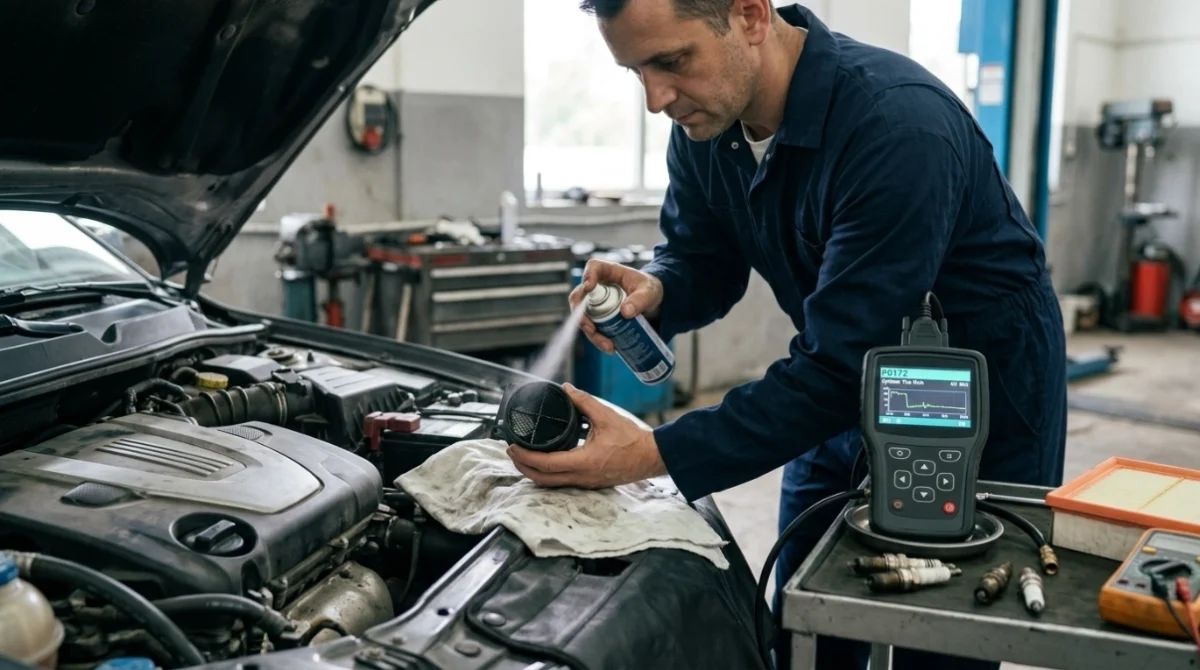
The best fix for P0172 is the repair that matches the data.
If MAF data is wrong, clean or replace the mass airflow sensor. If fuel pressure is high, test the regulator, return line, pump control, or rail pressure sensor. If one plug looks wet or sooty, inspect the injector on that cylinder.
For deeper technical confirmation, compare your scan data with manufacturer logic. Mitsubishi’s official P0172 page shows how fuel trim thresholds trigger the code under closed-loop conditions, which proves why live trim data beats guesswork. See the Mitsubishi DTC P0172 fuel system data. :contentReference[oaicite:10]{index=10}
Use this decision block:
- If fuel trim is negative on both banks, check MAF and fuel pressure.
- If only Bank 1 is rich, check Bank 1 injector and exhaust leaks.
- If coolant data reads cold on a warm engine, test the temperature sensor.
- If the air filter is dirty, replace it and retest trim.
- If oil smells like gasoline, repair the cause and change oil.
Clear the code after repair and drive through warm idle, steady cruise, and light acceleration. The repair works when fuel trims return close to normal and P0172 does not reset.
IMAGE SUGGESTION: OBD scanner showing negative fuel trim values beside a simple engine airflow diagram.
ALT TEXT: what does P0172 mean fuel trim scanner example
P0172 means the engine is running rich on Bank 1, and the smart fix starts with fuel trim data.
Modern OBD systems give enough clues to separate air measurement faults, fuel delivery faults, and sensor input faults before you buy parts.
Open your scanner now and write down short-term fuel trim, long-term fuel trim, MAF data, and coolant temperature.
Frequently Asked Questions
Is P0172 a serious code?
Yes, P0172 is serious when the rich condition causes black smoke, fuel smell, misfires, or fuel dilution in the oil. A mild rich code can let the vehicle drive, but delayed diagnosis can damage spark plugs, oxygen sensors, and the catalytic converter.
What is the most common fix for P0172?
The most common fix depends on live scan data, but dirty MAF sensors, leaking injectors, high fuel pressure, and restricted air intake are frequent causes. Clean inspection comes first, then fuel pressure testing, then sensor and injector checks.
Can a dirty air filter cause P0172?
Yes, a dirty or restricted air filter can contribute to P0172 because the engine receives less air than expected. The computer then sees a rich mixture and pulls fuel through negative fuel trim. Replace the filter and retest before buying sensors.
Does P0172 mean Bank 1 oxygen sensor is bad?
No, P0172 does not prove the Bank 1 oxygen sensor is bad. The oxygen sensor often reports the rich condition correctly. Test fuel trim, fuel pressure, intake airflow, coolant temperature, and injector behavior before replacing the sensor.
Will P0172 clear itself after repair?
P0172 can clear after several successful drive cycles, but clearing the code with a scanner confirms the repair faster. After clearing, drive until the engine warms up and reaches closed loop. If fuel trims stay normal, the fix worked.
