
P0174 Symptoms: What Bank 2 Running Lean Feels Like and What to Do

Your check engine light comes on, you connect an OBD2 scanner, and code P0174 appears. The car may still run, but it might idle roughly, hesitate during acceleration, or feel weaker than normal.
Understanding the common P0174 symptoms can help you decide whether the vehicle is safe to drive and what should be inspected first. This guide explains what the code means, how a lean condition affects engine performance, which problems commonly trigger it, and when professional diagnosis is the smarter choice.
Quick Answer
P0174 means the engine computer has detected a lean air-fuel mixture on Bank 2. Common P0174 symptoms include a check engine light, rough idle, hesitation, weak acceleration, hard starting, surging, misfires, and reduced fuel economy. Some vehicles may show no noticeable symptoms beyond the warning light.
What Does Code P0174 Mean?
P0174 is an OBD2 diagnostic trouble code that means:
System Too Lean — Bank 2
A gasoline engine needs a controlled mixture of air and fuel. A “lean” condition means the engine computer believes Bank 2 is receiving too much air, too little fuel, or inaccurate sensor information that makes the mixture appear lean.
Bank 2 is the side of a V-shaped or horizontally opposed engine that does not contain cylinder number one. Cylinder placement varies by manufacturer, so do not guess which side is Bank 2 based only on the driver or passenger side.
The official Ford OBD system operation summary lists P0174 as “System Too Lean, Bank 2” and shows that fuel-trim monitoring relies on several engine inputs. This is why the code should be treated as a starting point, not proof that one specific sensor has failed. (Ford Service Content)
P0174 does not automatically mean the oxygen sensor is bad. It means the engine computer has reached or approached the limit of how much extra fuel it can add to correct the reported lean condition.
Most Common P0174 Symptoms
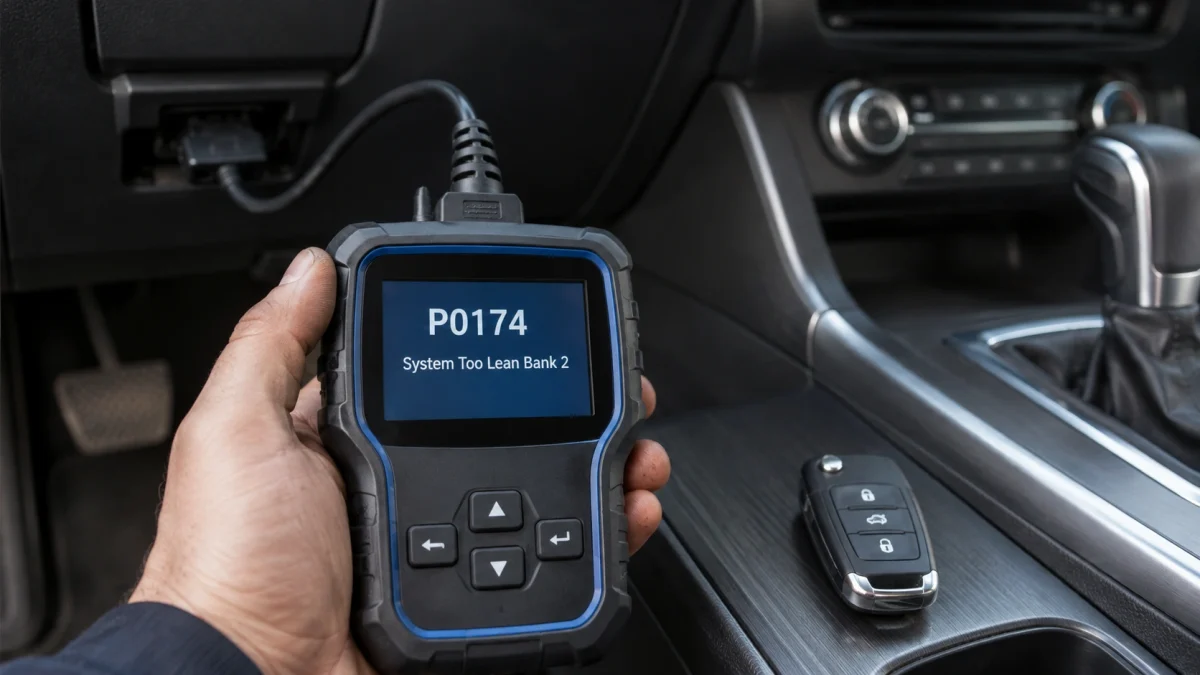
P0174 symptoms depend on the severity of the lean condition and whether the engine computer can temporarily compensate for it.
| Symptom | What the driver may notice | Recommended response |
|---|---|---|
| Check engine light | Solid or flashing warning light | Scan the vehicle and save all codes |
| Rough idle | Shaking, uneven RPM, or vibration at stops | Arrange diagnosis soon |
| Hesitation | Delay or stumbling when pressing the accelerator | Avoid heavy acceleration |
| Reduced power | Vehicle feels slower or struggles under load | Check for fuel or air-delivery problems |
| Hard starting | Longer cranking before the engine starts | Test fuel pressure and intake leaks |
| Surging | RPM rises and falls without steady pedal input | Inspect for vacuum leaks |
| Misfiring | Shaking, popping, or flashing check engine light | Stop driving if severe |
| Poor fuel economy | More fuel used than expected | Inspect fuel trims and sensor readings |
| No obvious symptoms | Only the check engine light is present | Do not ignore the code |
Check Engine Light
The most common symptom is an illuminated malfunction indicator lamp, usually called the check engine light.
A solid light may appear while the vehicle still seems normal. The engine computer may be adding extra fuel successfully enough to hide other symptoms.
A flashing check engine light is more serious. It commonly indicates active misfiring that can overheat and damage the catalytic converter.
Rough or Unstable Idle
A vacuum leak often has its strongest effect at idle. You might feel the engine shaking through the steering wheel, seat, or floor while stopped.
The RPM may move up and down. In more serious cases, the engine may stall when you stop at an intersection or shift into gear.
Hesitation During Acceleration
The vehicle may stumble when you press the accelerator, especially when merging, climbing a hill, or carrying a heavy load.
This can happen when the engine needs more fuel but cannot receive it quickly enough. Low fuel pressure, a restricted injector, or incorrect airflow information may cause this behavior.
Reduced Engine Power
A lean-running Bank 2 may not produce the same power as the other side of the engine. The vehicle can feel sluggish even though the accelerator is pressed normally.
Some vehicles may enter a reduced-power mode when additional throttle, fuel-pressure, or misfire codes are present.
Hard Starting or Extended Cranking
A weak fuel pump or loss of fuel pressure may cause the engine to crank longer than usual before starting. Toyota service information, for example, documents certain vehicles where P0171 or P0174 appeared with hard starting and low fuel pressure.
This symptom is sometimes mistaken for a key fob or immobilizer problem. The difference is that a fuel-related problem usually allows the starter to crank normally, while a key-recognition problem may produce a security warning, no-crank condition, or immediate shutdown.
Engine Surging
Surging feels as though the vehicle is accelerating and slowing slightly even though your foot remains steady.
Unmetered air entering through a split hose, intake boot, gasket, or PCV connection can make engine speed difficult for the computer to control.
Misfires, Shaking, or Popping
A severe lean condition can cause incomplete combustion. You may notice:
- Strong engine shaking
- Popping through the intake or exhaust
- Misfire codes such as P0300 or a cylinder-specific P0301–P0308
- A flashing check engine light
- Loss of power
Do not continue driving normally when the engine is shaking badly or the warning light is flashing.
Reduced Fuel Economy
A lean condition sounds as though it should use less fuel, but that is not always what happens.
When the computer detects excess oxygen, it responds by adding fuel. If the condition continues, fuel consumption may increase. Misfires and repeated acceleration to compensate for weak performance can make mileage worse.
No Noticeable Driving Symptoms
Some vehicles show only a check engine light. The engine computer may still be compensating successfully during normal driving.
A lack of symptoms does not mean the problem has repaired itself. The condition can worsen, affect emissions, or prevent the vehicle from passing an OBD-based inspection.
Why P0174 Symptoms Can Be Different Between Vehicles
P0174 identifies a result, not a failed component. Several different problems can create the same code.
Symptoms change depending on:
- Whether the air leak affects only Bank 2 or both banks
- Whether the problem occurs mainly at idle or under load
- How far the fuel trims have moved
- Whether the engine is misfiring
- Whether additional codes are stored
- The engine design and manufacturer’s control strategy
- Temperature, altitude, and driving conditions
A small intake gasket leak may cause rough idle but normal highway performance. A weak fuel pump may cause hard starting and power loss during acceleration. An inaccurate sensor may create a warning light with few noticeable symptoms.
Common Causes of P0174
Vacuum or Intake-Air Leak
Unmetered air entering after the mass airflow sensor is one of the most common possibilities.
Potential leak points include:
- Cracked air-intake boots
- Loose intake clamps
- Damaged vacuum hoses
- PCV hoses and fittings
- Intake manifold gaskets
- Brake-booster vacuum lines
- Oil filler caps or dipstick seals on certain engines
A General Motors service bulletin documents P0171 and P0174 caused by a cracked or failed rubber intake boot on certain vehicles. Another GM bulletin lists loose PCV connections, a loose oil cap, sealing concerns, and software calibration as possible causes. These examples show why visual inspection and model-specific information matter. (NHTSA)
Low Fuel Pressure
A weak fuel pump, restricted fuel filter, faulty pressure regulator, electrical supply problem, or damaged fuel line can reduce fuel delivery.
Low pressure often affects both banks, so P0171 and P0174 may appear together. However, engine design and operating conditions can sometimes cause one code to appear first.
Fuel-pressure testing requires the correct procedure and safety equipment. Gasoline is highly flammable, and some direct-injection systems operate at extremely high pressure.
Restricted or Faulty Fuel Injector
A restricted injector on Bank 2 may deliver less fuel than commanded. Possible symptoms include roughness, hesitation, misfire codes, and unusual fuel-trim readings.
Professional shops may perform injector balance, electrical, or flow testing before recommending replacement.
Dirty or Inaccurate Mass Airflow Sensor
The mass airflow sensor, or MAF sensor, tells the engine computer how much air is entering the engine.
If it underreports airflow, the computer may deliver too little fuel. A MAF-related problem usually affects both banks, although one bank may reach the fault limit before the other.
Use only a cleaner specifically labeled for mass airflow sensors. Do not touch the sensing element or clean it with brake cleaner, carburetor cleaner, or compressed air.
Exhaust Leak Before the Bank 2 Sensor
An exhaust leak ahead of the upstream oxygen or air-fuel ratio sensor can draw outside oxygen into the exhaust stream.
The sensor may then report a lean condition even when the combustion mixture is not truly lean. A technician may inspect for soot marks, loose fasteners, cracked manifolds, or leaking gaskets.
Oxygen or Air-Fuel Ratio Sensor Problem
A biased Bank 2 sensor can falsely report excess oxygen. Wiring damage, connector corrosion, heater-circuit problems, or sensor contamination may also affect the signal.
However, replacing the sensor without testing is a common and expensive mistake. A sensor may be reporting a real lean condition caused elsewhere.
EVAP Purge-System Problem
A purge valve that remains open can allow too much vapor or air into the intake, especially at idle.
This may create unstable fuel trims, rough starting after refueling, or a lean code. EVAP-related codes may also be stored.
Engine Software or Calibration
Certain manufacturer bulletins identify engine-control software as a possible cause of recurring lean codes.
Software updates normally require approved programming equipment, stable battery support, and vehicle-specific procedures. This is generally dealership or properly equipped repair-shop work, not a basic DIY scanner task. (NHTSA)
Mechanical Engine Problem
Less common causes include:
- Low compression
- Burned or leaking valve
- Incorrect valve timing
- Worn camshaft components
- Intake manifold damage
- Cylinder-specific mechanical failure
These possibilities become more important when P0174 appears with persistent misfire codes or compression-related symptoms.
Expert Tip: Record all codes, freeze-frame information, and fuel-trim readings before clearing P0174. That information can show whether the problem happened at idle, during acceleration, or under heavy load and may save significant diagnostic time.
Is It Safe to Drive With P0174?
A vehicle with a solid check engine light and no noticeable drivability problems may usually be driven a limited distance to a repair facility.
Keep the trip brief and avoid:
- Hard acceleration
- High engine speeds
- Heavy towing
- Steep hills
- Long highway trips
Stop driving and arrange assistance when:
- The check engine light is flashing
- The vehicle shakes or misfires badly
- The engine stalls
- Acceleration becomes unsafe
- You smell strong raw fuel
- The engine overheats
- The vehicle loses significant power
Official Ford owner’s manual warning-light guidance warns that a steadily flashing malfunction light requires immediate service because increased exhaust temperature can damage the catalytic converter or other components. Always follow the instructions for your own make and model.
How to Diagnose P0174 With an OBD2 Scanner
An entry-level scanner can retrieve the code, but a scan tool with live data is more useful.
1. Save Every Stored and Pending Code
Do not focus only on P0174. Look for related codes involving:
- Bank 1 lean operation
- Misfires
- Mass airflow
- Fuel pressure
- Oxygen sensors
- EVAP purge
- Intake temperature
- Engine coolant temperature
Related codes can narrow the search.
2. Review Freeze-Frame Data
Freeze-frame data records operating conditions when the code was detected.
Check:
- Engine RPM
- Vehicle speed
- Engine load
- Coolant temperature
- Short-term fuel trim
- Long-term fuel trim
- Mass airflow
- Fuel pressure, when supported
A code that appears mainly at idle points more strongly toward a vacuum leak. A code that appears under heavy load may support a fuel-volume or pressure problem.
3. Compare Bank 1 and Bank 2 Fuel Trims
Fuel trim shows how much fuel the computer is adding or subtracting.
- Positive fuel trim: The computer is adding fuel.
- Negative fuel trim: The computer is removing fuel.
- Bank 2 much higher than Bank 1: Look for a Bank 2-specific leak, injector, sensor, exhaust, or mechanical issue.
- Both banks similarly high: Consider a shared vacuum leak, MAF error, low fuel pressure, or purge problem.
Exact acceptable values vary by vehicle. Use manufacturer service information rather than one universal cutoff.
4. Inspect the Intake System
With the engine off and cool, look for:
- Split rubber ducts
- Loose clamps
- Disconnected hoses
- Collapsed or brittle PCV lines
- Damaged electrical connectors
- Loose oil cap
- Poorly seated dipstick
- Signs of previous incorrect repair
Flex rubber hoses gently because cracks may hide underneath folds.
5. Listen for Air Leaks
A hissing or whistling noise can point toward a vacuum leak.
Do not place your hands near belts, fans, pulleys, or hot exhaust parts while the engine is running.
6. Use a Smoke Test When Needed
A professional smoke machine introduces controlled diagnostic vapor into the intake system. Escaping smoke reveals small leaks that may be invisible during visual inspection.
Avoid spraying flammable chemicals around a running engine to search for leaks. This creates fire and injury risks and can damage sensors or painted surfaces.
7. Test Fuel Pressure and Sensor Data
If no air leak is found, a qualified technician may test:
- Low-side and high-side fuel pressure
- Fuel-pressure drop after shutdown
- Injector balance
- MAF readings
- Bank 2 oxygen-sensor response
- Exhaust leaks
- Compression
- Manufacturer software level
8. Verify the Repair
After correcting the cause:
- Clear the code with a scanner.
- Start the vehicle and watch fuel trims.
- Allow the engine to reach operating temperature.
- Test at idle and under safe driving conditions.
- Confirm that P0174 does not return.
- Complete the required drive cycle before an emissions inspection.
P0174 Symptoms Versus a Key Fob or Immobilizer Problem
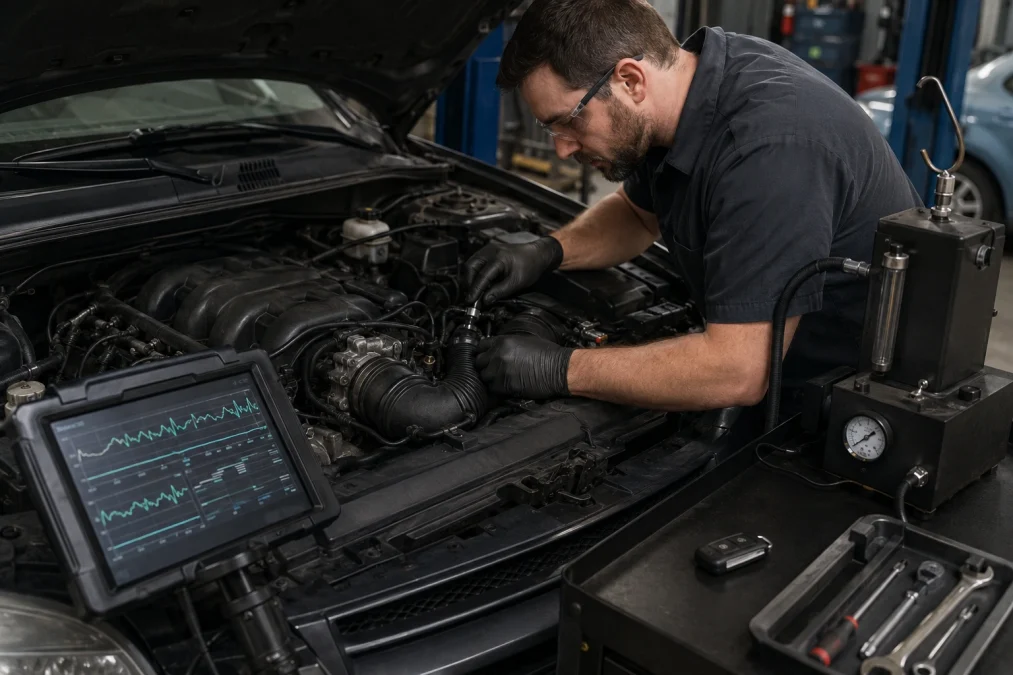
Because P0174 can cause hard starting, some drivers assume the key fob or transponder key is responsible. These problems usually behave differently.
| Sign | P0174 lean condition | Key fob or immobilizer issue |
|---|---|---|
| Starter operation | Usually cranks normally | May not crank on some vehicles |
| Engine after starting | May idle roughly or hesitate | May start and shut off immediately |
| Security warning | Usually absent | Often illuminated or flashing |
| Check engine code | P0174 and possibly related engine codes | May show immobilizer or body-system codes |
| Driving symptoms | Hesitation, surging, weak power | Usually no lean-running symptoms |
| Key fob battery effect | Does not cause P0174 | Can reduce remote or passive-entry operation |
A weak key fob battery can affect locking, unlocking, passive entry, or push-button key detection. It cannot directly change the engine’s air-fuel mixture or create a true P0174 condition.
Some vehicles will still start with a weak fob battery when the fob is placed against a designated emergency-start location. Check the owner’s manual before replacing or programming a key.
Repair Decisions, Cost, Quality, and Durability
The final repair cost depends on the cause. A loose clamp or split vacuum hose may be inexpensive. Fuel-pump, injector, intake-manifold, or mechanical engine repairs can cost substantially more.
| Possible cause | Best first action | General cost level | Typical service provider |
|---|---|---|---|
| Loose hose or clamp | Inspect and reseat | Low | DIY or repair shop |
| Cracked intake boot | Confirm leak and replace duct | Low to moderate | Repair shop |
| Intake gasket leak | Smoke-test before replacement | Moderate | Repair shop |
| Dirty MAF sensor | Inspect data and clean correctly | Low | DIY or repair shop |
| Faulty MAF or oxygen sensor | Test signal before replacement | Moderate | Repair shop |
| Restricted injector | Perform injector testing | Moderate to high | Diagnostic repair shop |
| Weak fuel pump | Verify pressure and electrical supply | High | Repair shop or dealership |
| ECM software update | Check applicable manufacturer bulletin | Moderate | Dealership or equipped shop |
| Mechanical engine fault | Compression or leak-down testing | High | Engine specialist |
Choose hoses, gaskets, sensors, and fuel-system parts that meet OEM specifications. Very cheap sensors may provide inaccurate signals or have shorter service life.
The most cost-effective approach is usually to pay for proper testing before buying parts. Replacing several possible components without confirming the cause can cost more than a professional diagnosis.
When to Call a Professional Locksmith or Dealership
P0174 is primarily an engine-management problem, not a key fob problem.
Contact a qualified repair shop or dealership when:
- P0174 returns after a basic intake inspection
- The check engine light flashes
- The engine misfires, stalls, or loses power
- Fuel-pressure testing is required
- Direct-injection components must be serviced
- Smoke testing or advanced live-data analysis is needed
- An engine-control software update may apply
- The repair could be covered by warranty or an emissions warranty
Manufacturer technical service bulletins can identify model-specific causes and repair procedures. Car owners can review NHTSA’s manufacturer communications resources to learn how bulletins and other manufacturer notices are made available. (NHTSA)
It is also wise to check the vehicle through the official NHTSA recall lookup before paying for a major repair. A recall is different from a technical service bulletin, but an open recall may qualify for a manufacturer-paid remedy. (NHTSA)
Contact an automotive locksmith when the vehicle will not recognize the key, the security light is active, the transponder key is damaged, or the push-button system reports “key not detected.” Most locksmiths do not diagnose lean fuel-mixture codes unless they also operate a full automotive repair service.
Common Mistakes Car Owners Should Avoid
- Replacing the Bank 2 oxygen sensor immediately. The sensor may be accurately reporting an air or fuel problem.
- Clearing the code before saving data. Freeze-frame and fuel-trim information can be extremely valuable.
- Assuming a key fob battery caused the code. A fob battery does not control the engine’s air-fuel ratio.
- Replacing parts based only on an inexpensive code reader. A code reader identifies the system, not the failed component.
- Ignoring companion codes. Misfire, fuel-pressure, MAF, or EVAP codes may reveal the real cause.
- Using the wrong cleaner on a MAF sensor. Harsh solvents can permanently damage the sensing element.
- Searching for vacuum leaks with flammable spray. A professional smoke test is safer and more reliable.
- Continuing to drive with a flashing warning light. Active misfires can damage the catalytic converter.
- Installing the cheapest available sensor. Poor-quality sensors may create inaccurate readings or recurring codes.
- Assuming every P0174 repair is the same. Causes and test procedures vary by engine, model year, and manufacturer.
FAQs
Can a weak key fob battery cause P0174?
No. A weak key fob battery can cause remote-entry or key-detection problems, but it cannot directly make Bank 2 run lean.
Does P0174 always mean a bad oxygen sensor?
No. Vacuum leaks, intake damage, low fuel pressure, injector problems, exhaust leaks, MAF errors, or software issues can all trigger P0174. Test the sensor before replacing it.
Which side of the engine is Bank 2?
Bank 2 is the engine bank that does not contain cylinder number one. It may be on either side depending on the engine. Check manufacturer service information for the correct cylinder layout.
Can a dirty mass airflow sensor cause P0174?
Yes. An inaccurate MAF sensor can cause the computer to underestimate incoming air and deliver too little fuel. MAF problems commonly affect both banks, although only P0174 may appear initially.
Can I clear P0174 and keep driving?
You can clear the code, but clearing it does not repair the cause. Save the codes and freeze-frame data first. If the code returns, diagnose the vehicle rather than repeatedly erasing it.
Will P0174 cause an emissions-test failure?
A stored emissions-related code and illuminated check engine light can cause an OBD-based inspection failure. Clearing the code immediately before testing may also leave readiness monitors incomplete.
How serious is code P0174?
The severity ranges from a small air leak to a fuel-delivery or mechanical problem. Mild cases may show only a warning light, while severe cases can cause misfires, stalling, power loss, or catalytic-converter damage.
Conclusion
The most common P0174 symptoms are a check engine light, rough idle, hesitation, reduced power, hard starting, surging, misfires, and poor fuel economy. Some cars may continue to drive normally while the engine computer compensates for the lean condition.
Start by saving the scan data, checking for related codes, comparing Bank 1 and Bank 2 fuel trims, and inspecting intake hoses and connections. Do not assume the oxygen sensor or key fob is responsible without testing.
When the light flashes, the engine shakes, or advanced fuel-pressure, smoke, software, or mechanical testing is required, schedule a professional diagnosis. Finding the actual cause before replacing parts is the safest and most cost-effective next step.
