
P0202 Symptoms: What Cylinder 2 Injector Circuit Problems Feel Like

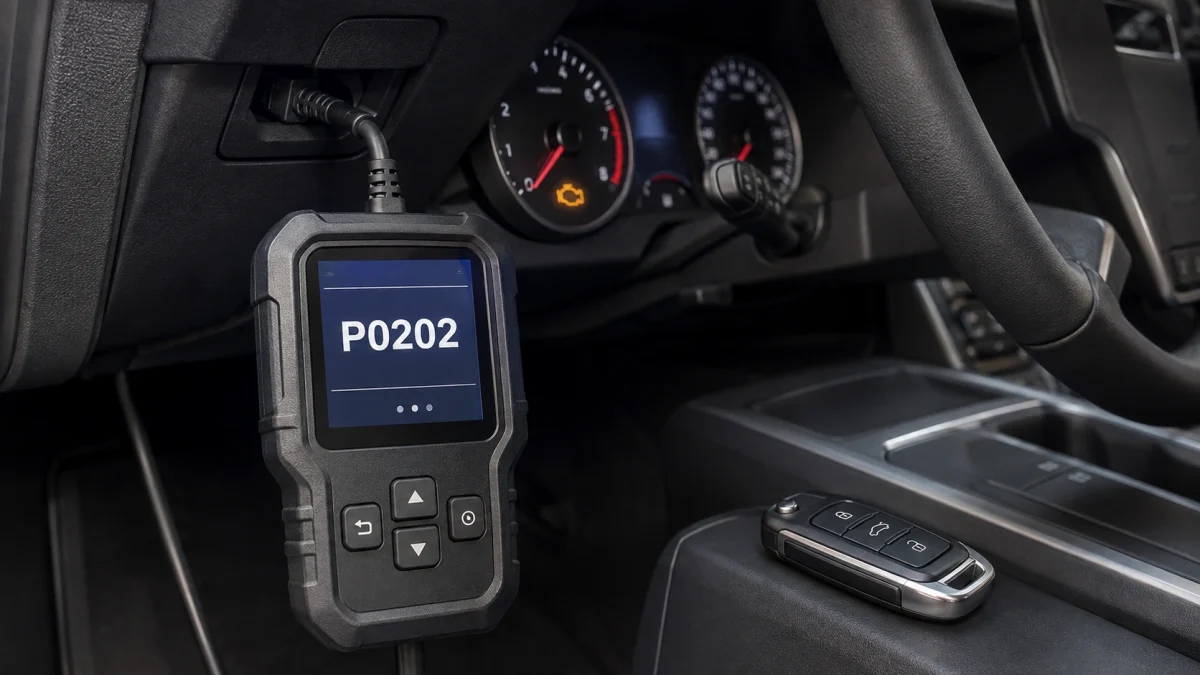
Your check engine light is on, your engine feels rough, and an OBD2 scanner shows code P0202. That combination can be worrying, especially when you do not know whether the problem is a fuel injector, damaged wiring, or a failing engine computer.
The most common P0202 symptoms include rough idling, hesitation, reduced power, poor fuel economy, difficult starting, and engine misfires. Some vehicles may still drive almost normally, while others may shake badly or enter reduced-power mode.
This guide explains what P0202 means, the symptoms you may notice, how serious the code is, and when professional diagnosis is the smarter choice.
Quick Answer
P0202 symptoms commonly include a check engine light, rough idle, engine shaking, hesitation, reduced acceleration, poor fuel economy, hard starting, or stalling. The code means the engine computer detected an electrical problem in the cylinder 2 fuel-injector circuit. It does not automatically mean the injector itself has failed.
What Does Code P0202 Mean?
P0202 is a diagnostic trouble code related to the electrical circuit controlling the fuel injector for cylinder 2.
A manufacturer’s OBD system operation summary from Ford identifies P0202 as an injector circuit or open-circuit fault for cylinder 2. An “open circuit” means electricity is not traveling through the circuit as the engine computer expects. (Ford Service Content)
The circuit normally includes:
- The cylinder 2 fuel injector
- The injector electrical connector
- Wiring between the injector and engine computer
- Power and ground circuits
- The powertrain control module, or PCM
The PCM controls when the injector opens and how long it stays open. If the computer detects an unexpected voltage or missing electrical response, it may store P0202 and turn on the check engine light.
P0202 identifies a circuit problem. It does not prove that the fuel injector needs replacement.
Most Common P0202 Symptoms
The exact symptoms depend on whether the circuit failure is constant or intermittent. Engine design, driving conditions, and other stored codes can also affect what you experience.
Check Engine Light
The check engine light is often the first sign of P0202.
It may stay on continuously even when the vehicle appears to run normally. This can happen when the electrical connection fails only occasionally or when the PCM has stored the code after detecting a brief fault.
Do not assume the problem has fixed itself just because the engine feels normal. An intermittent connector or damaged wire can fail again when the engine moves, heats up, or travels over a rough road.
Rough or Unstable Idle
A cylinder that does not receive the correct amount of fuel cannot contribute normally to engine power.
At idle, you may notice:
- Shaking through the steering wheel
- Vibration in the seat or floor
- An uneven engine sound
- Engine speed moving up and down
- A feeling that the engine may stall
Roughness may become more noticeable when the air conditioner is running or the transmission is placed in Drive.
Engine Misfire
P0202 can cause cylinder 2 to misfire if the injector does not open.
A misfire means the air-and-fuel mixture in that cylinder is not burning correctly. The engine may feel as though it is skipping, stumbling, or briefly losing power.
The misfire may be constant or appear only during:
- Cold starts
- Hard acceleration
- Highway merging
- Uphill driving
- Wet or humid weather
- Engine vibration
The Environmental Protection Agency explains that an onboard diagnostic system may detect problems ranging from minor faults to a severe misfire capable of causing engine damage. Follow the EPA’s check engine light guidance rather than ignoring a warning light that appears with severe shaking or poor performance. (EPA NEEPA)
Hesitation During Acceleration
The vehicle may hesitate when you press the accelerator.
This often feels like a pause before the engine responds. You may also experience surging, jerking, or uneven acceleration.
The problem can become more obvious when the engine needs additional fuel, such as when passing another vehicle or climbing a hill.
Reduced Engine Power
When one cylinder is not operating correctly, the engine may produce noticeably less power.
A four-cylinder engine can feel especially weak because one affected cylinder represents a large portion of its total power. Larger engines may hide the problem better, but performance can still suffer.
Some vehicles may activate a reduced-power or fail-safe mode to protect the engine and emissions system.
Poor Fuel Economy
Fuel economy may decrease because the engine is no longer operating efficiently.
The PCM may adjust fuel delivery in response to the imbalance. The driver may also press the accelerator harder to compensate for the loss of power.
A sudden drop in miles per gallon is not enough to diagnose P0202 by itself, but it supports the diagnosis when combined with rough running and a stored injector-circuit code.
Hard Starting
An injector circuit problem can make the engine take longer to start.
You may need to crank the engine several times before it runs. Once started, it may shake or struggle to maintain idle speed.
However, hard starting can also come from a weak battery, low fuel pressure, ignition problems, or a key-recognition issue. Proper testing is necessary before replacing anything.
Engine Stalling
A vehicle with P0202 may stall at idle, when slowing down, or shortly after starting.
Stalling is more likely when the engine is already under extra load. For example, it may stall when:
- The air conditioner turns on
- The steering wheel is turned at low speed
- The transmission is shifted into gear
- The vehicle stops at an intersection
Do not continue driving if the engine repeatedly stalls in traffic. Loss of engine power can make the vehicle unsafe to control.
Fuel Smell or Unusual Exhaust Odor
Some injector faults can create an unusual exhaust smell.
An injector that remains closed may cause a lean condition in the affected cylinder. A mechanically leaking injector may produce a rich fuel smell, although a leaking injector is not the same as an open electrical circuit.
A strong raw-fuel smell requires immediate attention. Shut off the engine, avoid sparks or flames, and have the vehicle inspected.
Failed Emissions Inspection
P0202 may cause the vehicle to fail an emissions or OBD inspection.
Clearing the code immediately before an inspection usually does not solve the problem. It also resets the vehicle’s readiness monitors, which may result in an incomplete or failed test until the monitors run again.
P0202 Warning Signs and Urgency
| Warning sign | What it may indicate | Recommended action |
|---|---|---|
| Check engine light with normal driving | Intermittent circuit fault or stored history code | Arrange diagnosis soon |
| Rough idle or mild hesitation | Cylinder 2 may not be receiving consistent fuel | Limit driving and schedule testing |
| Strong shaking or major power loss | Active injector failure or severe misfire | Stop driving when safe |
| Flashing check engine light | Serious active fault requiring immediate attention | Shut off the engine and consider towing |
| Repeated stalling | Unreliable engine operation and safety risk | Do not continue normal driving |
| Raw-fuel smell or visible fuel | Possible fuel leak or injector problem | Turn off the vehicle and seek emergency service |
Why P0202 Symptoms Can Come and Go
Electrical problems are often intermittent.
The engine may run normally when the vehicle is cold but begin misfiring after the engine warms up. Heat can expand connector terminals or increase resistance in damaged wiring.
Symptoms may also appear after:
- Driving over bumps
- Heavy rain or engine-bay moisture
- Recent engine repairs
- Battery replacement
- Rodent damage
- Movement of the injector harness
- Oil or coolant entering a connector
An intermittent P0202 code should still be diagnosed. Wiring faults rarely become more dependable over time.
Common Causes Behind P0202 Symptoms
Failed Cylinder 2 Fuel Injector
The injector contains an internal electrical coil. If that coil develops an open circuit or abnormal resistance, the PCM may no longer be able to operate it.
A failed injector is possible, but it should be confirmed with testing before replacement.
Loose or Damaged Injector Connector
The connector may be loose, cracked, contaminated, or partially disconnected.
Connector terminals can also become spread, corroded, pushed backward, or damaged during previous repairs.
Broken or Chafed Wiring
Injector wiring lives in a hot, vibrating area of the engine compartment.
Over time, insulation can rub against brackets, covers, or other components. A wire may break internally even when the outer insulation looks acceptable.
Corrosion or Moisture
Water, road salt, engine-cleaning chemicals, oil, or coolant can enter an electrical connector.
Corrosion increases electrical resistance and may create an intermittent loss of injector control.
Power or Ground Problem
Some engines share injector power supplies. A blown fuse, damaged power wire, poor ground, or relay problem can affect injector operation.
When several injector codes appear together, a shared electrical problem becomes more likely.
PCM or Injector Driver Failure
The PCM contains electronic drivers that control the injectors. A failed driver can cause P0202, but PCM failure is less common than connector, wiring, or injector problems.
A PCM should not be replaced until the injector and complete circuit have been tested. A replacement module may also require vehicle-specific programming and security-system relearning.
Can You Drive With P0202?
Driving a short distance may be possible when the check engine light is steady and the engine runs almost normally. However, continued driving is not recommended until the problem has been evaluated.
Stop driving and arrange a tow when:
- The check engine light flashes
- The engine shakes heavily
- Acceleration becomes unsafe
- The vehicle repeatedly stalls
- You smell raw fuel
- Engine temperature rises
- Other serious warning lights appear
Driving with an active misfire can create additional engine or emissions-system damage. It can also leave you stranded if the electrical connection fails completely.
How P0202 Should Be Diagnosed
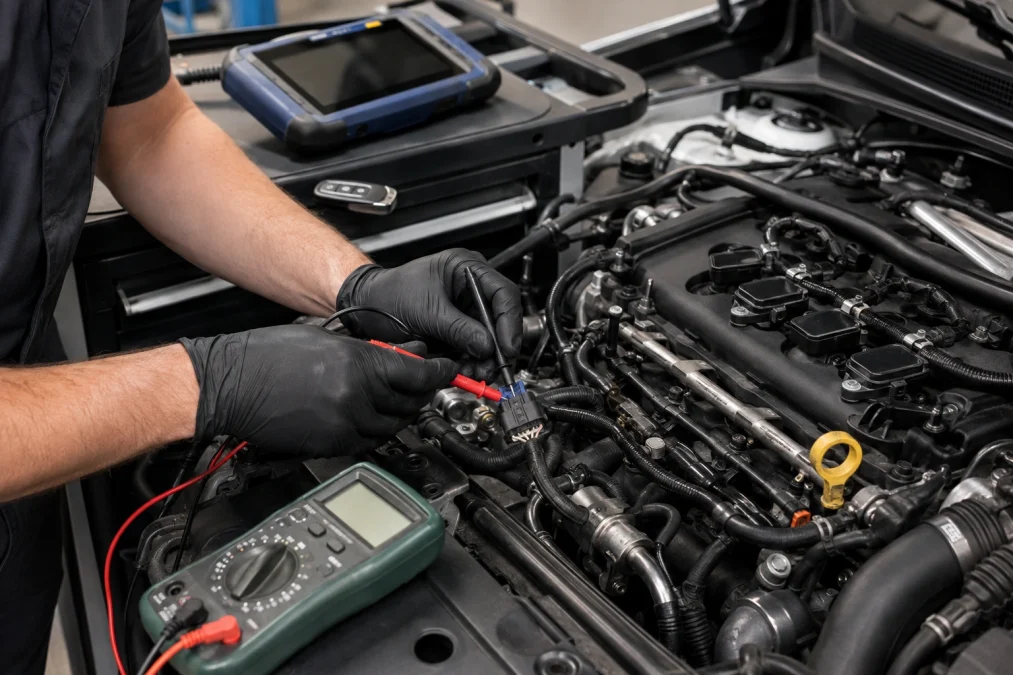
An OBD2 scanner provides a starting point, not a complete diagnosis.
A careful diagnostic process usually includes these steps:
- Read all stored and pending codes. Related codes can show whether the problem affects only cylinder 2 or a shared circuit.
- Record freeze-frame data. This shows engine conditions when the code was stored, such as speed, temperature, and engine load.
- Inspect the injector connector. Look for loose locks, corrosion, damaged pins, oil, water, or broken plastic.
- Inspect the wiring harness. Pay close attention to areas touching engine covers, brackets, and hot exhaust components.
- Test the injector electrically. Resistance and circuit tests must follow the vehicle manufacturer’s specifications.
- Verify injector control. A technician may use a scan tool, test light designed for injector circuits, oscilloscope, or other professional equipment.
- Test the PCM circuit only after other causes are eliminated. Computer replacement should be the last conclusion, not the first.
Do not probe injector terminals randomly. Applying the wrong voltage can damage the injector driver inside the PCM.
Diesel common-rail systems require additional caution. Their injectors may use high electrical voltage and extremely high fuel pressure. Leave live-circuit and fuel-system testing to a qualified technician.
Expert Tip: Ask the technician to show whether the failed part is the injector, connector, wiring, or PCM driver before approving injector replacement. P0202 describes a circuit, not one guaranteed failed component.
Does P0202 Have Anything to Do With the Key Fob?
Normally, no.
P0202 is an engine fuel-injector circuit code. It is not a key fob, immobilizer, or transponder-key code.
However, drivers sometimes confuse the symptoms because both problems can cause starting trouble.
Signs the problem is more likely P0202
- The engine cranks but runs roughly
- The engine starts and misfires
- The check engine light is on
- The scanner shows P0202
- The engine lacks power after starting
Signs the problem may involve the key or immobilizer
- The engine does not crank
- A security or key warning light flashes
- The dashboard says “Key Not Detected”
- The vehicle starts and immediately shuts off
- A spare key works but the main key does not
- Lock and unlock buttons also fail
A weak key-fob battery may prevent passive key detection on some vehicles, but it cannot repair an injector circuit.
Before paying for key programming, confirm whether the engine is cranking and whether security-system warnings are present. The ALOA guidance for automotive key-fob problems also recommends checking basic fob issues before arranging specialized automotive locksmith service. (Aloa)
Repair Options, Cost Level, and Durability
Actual repair prices depend on the vehicle, engine design, labor time, parts availability, and diagnostic difficulty.
| Confirmed problem | Likely repair | Relative cost | Durability consideration |
|---|---|---|---|
| Loose connector | Secure and clean connection | Low | Reliable only if terminals still grip correctly |
| Damaged terminal | Replace terminal or connector pigtail | Low to moderate | Use sealed, automotive-grade parts |
| Chafed wire | Repair or replace harness section | Low to moderate | Protect repaired wiring from heat and rubbing |
| Failed injector | Replace cylinder 2 injector | Moderate to high | Correct part number and seals are essential |
| Shared fuse or relay fault | Repair power-supply problem | Low to moderate | Diagnose the cause before replacing a fuse |
| PCM driver failure | Repair or replace and program PCM | High | Requires correct programming and relearning |
A cheap connector repair can be durable when proper terminals, seals, wire gauge, and heat protection are used. Twisting wires together and covering them with household tape is not a dependable engine-bay repair.
Injector quality also matters. Incorrect or low-quality injectors may create poor fuel control, repeat misfires, leaks, or calibration problems.
When to Call a Professional Locksmith or Dealership
P0202 is generally a job for an automotive repair technician, diagnostic specialist, or dealership service department—not a standard lockout locksmith.
Call an automotive repair professional when:
- The engine runs roughly or misfires
- The check engine light flashes
- Wiring needs electrical testing
- You smell fuel
- The vehicle has a high-pressure diesel system
- Injector replacement requires intake-system removal
- You cannot safely identify cylinder 2
Consider a dealership when:
- The vehicle is under warranty
- A manufacturer-specific service bulletin may apply
- The PCM needs programming
- The injector requires coding or calibration
- Specialized factory diagnostic equipment is necessary
It is also worth checking your VIN with the official NHTSA recall lookup tool. If a related defect is covered by a safety recall, an authorized dealership normally performs the recall repair without charging the owner. (NHTSA)
Call an automotive locksmith when:
- The security light is flashing
- The vehicle says “Key Not Detected”
- The key fob is lost or damaged
- The transponder key will not authorize starting
- A replacement key needs cutting or programming
- The engine problem began after a key or immobilizer service
In some situations, you may have two separate problems: an injector-circuit code and a weak or damaged key fob. Do not approve key programming as a repair for P0202 unless separate immobilizer testing supports it.
When comparing service providers, request a written diagnosis and estimate. The FTC’s auto repair guidance recommends comparing repair shops and reviewing warranty policies before authorizing work. (Consumer Advice)
Common Mistakes Car Owners Should Avoid
- Replacing the injector based only on the code. P0202 can come from wiring, a connector, power supply, or PCM driver.
- Adding fuel-injector cleaner as the main repair. Cleaner may help some deposits, but it cannot reconnect an open electrical circuit.
- Clearing the code before recording data. Freeze-frame information can help identify when the failure occurs.
- Continuing to drive with severe shaking. An active misfire can create additional damage and unsafe acceleration.
- Assuming cylinder 2 is in the same location on every engine. Cylinder numbering differs by manufacturer and engine layout.
- Using an ordinary test light on computer-controlled wiring. The wrong tool may overload or damage sensitive circuits.
- Replacing the PCM before checking wiring. Computer failure is possible, but it should be confirmed only after complete circuit testing.
- Paying for key-fob programming to fix an engine code. P0202 is normally unrelated to key authorization or remote-lock functions.
- Choosing a repair solely by the lowest price. Ask what testing, parts quality, warranty coverage, and programming are included.
FAQs
Can a bad fuel injector cause P0202?
Yes. An injector with a failed internal electrical coil can set P0202. However, damaged wiring, a loose connector, corrosion, or a PCM driver problem can create the same code.
Will P0202 make the engine shake?
It can. If cylinder 2 stops receiving fuel, the cylinder may misfire and cause noticeable shaking, especially at idle or during acceleration.
Can injector cleaner fix P0202?
Usually not. P0202 is an electrical circuit code. Injector cleaner cannot repair an open wire, loose terminal, failed coil, or damaged PCM driver.
Is P0202 safe to drive with?
It may be possible to drive briefly if the engine runs normally and the check engine light is steady. Do not drive with heavy shaking, stalling, a flashing check engine light, major power loss, or a fuel smell.
Can a weak battery cause P0202?
Low system voltage can sometimes contribute to unusual electrical codes, but a weak battery is not the most common cause of an isolated P0202. Test battery and charging voltage if several unrelated electrical codes appear together.
Can a bad key fob cause P0202?
No. A key fob or immobilizer problem can prevent the engine from starting, but it does not normally cause a cylinder 2 injector circuit code.
Will replacing the cylinder 2 injector always clear P0202?
No. The code will return if the real problem is damaged wiring, a loose connector, missing power, or a failed PCM driver. Diagnose the complete circuit before replacing the injector.
Conclusion
The most common P0202 symptoms are a check engine light, rough idle, engine misfire, hesitation, reduced power, poor fuel economy, hard starting, and possible stalling. The code means the PCM detected an electrical problem in the cylinder 2 injector circuit.
Do not assume the injector itself is automatically bad. A loose connector, broken wire, corroded terminal, power-supply fault, or PCM driver can produce the same code.
If the engine shakes heavily, stalls, smells of fuel, or displays a flashing check engine light, stop driving and arrange professional service. Ask for complete circuit testing before approving parts replacement—and confirm that any separate starting problem is truly related to the key fob or immobilizer before paying for locksmith programming.
