
What Does P0300 Mean? Causes, Symptoms, and Fixes

Quick Answer
P0300 means your vehicle’s computer detected random or multiple-cylinder engine misfires. The code identifies a combustion problem, but it does not name the failed part. A steady check engine light needs prompt diagnosis, while a flashing light calls for immediate action under AAA’s check engine light guidance.
What P0300 may indicate
- Worn ignition parts: Spark plugs, ignition coils, or plug wires may not create a reliable spark.
- Fuel delivery trouble: Low fuel pressure or restricted injectors can create a lean mixture.
- Unmetered air: A vacuum or intake leak can upset the air-fuel balance across several cylinders.
- Sensor or timing issue: Incorrect airflow data or valve timing can affect the whole engine.
- Mechanical damage: Low compression, leaking valves, or a head-gasket problem can also cause misfires.
What to do now
- Scan all codes: Save stored, pending, and freeze-frame information before clearing anything.
- Watch the warning light: Stop safely and arrange a tow if it flashes or the engine shakes severely.
An OBD2 scanner showing P0300 can feel vague and frustrating. I’ve seen drivers replace several good parts because they treated the code as a diagnosis instead of a starting point.
This guide explains what P0300 means, how serious it is, and how technicians narrow down its cause. It also shows why a key fob or immobilizer problem is rarely responsible for this particular code.
In This Guide
What Does P0300 Mean?
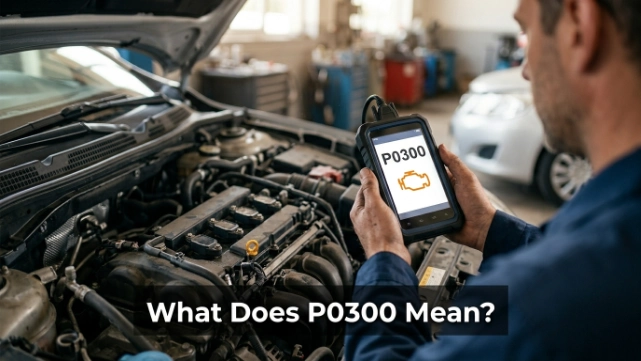
P0300 is a generic OBD2 diagnostic trouble code for “Random/Multiple Cylinder Misfire Detected.” The powertrain control module recorded irregular crankshaft acceleration that matched a misfire pattern.
A misfire happens when a cylinder fails to produce its expected power during combustion. The problem may affect one cylinder intermittently or move among several cylinders.
What each part of the code tells you
- P: The fault belongs to the powertrain system, which includes the engine and transmission.
- 0: It is a generic code shared across OBD2-compliant vehicle brands.
- 3: The fault concerns the ignition system or an engine misfire.
- 00: The computer has not isolated the misfire to one numbered cylinder.
Codes P0301 through P0308 point toward specific cylinders. For example, P0302 identifies a detected misfire on cylinder two.
P0300 can appear alone or beside cylinder-specific codes. It may also arrive with lean-mixture, sensor, fuel-pressure, or timing codes that provide stronger diagnostic clues.
Does P0300 mean the spark plugs are bad?
No. Worn spark plugs are a common possibility, but P0300 never proves they caused the misfire.
The same code can result from ignition, fuel, airflow, timing, electrical, or mechanical faults. Testing matters more than guessing.
In locksmith work, I sometimes meet customers who suspect their smart key because the engine runs poorly after starting. An immobilizer or transponder chip usually prevents authorized starting; it does not normally create a random combustion misfire after the engine runs.
Locksmith’s note: scan immobilizer or security modules separately if the engine will not start and a key warning appears. P0300 itself belongs to engine diagnosis.
What Are the Symptoms, and Can You Keep Driving?
P0300 may cause rough running, hesitation, reduced power, or a flashing check engine light. Some intermittent misfires produce no obvious symptom beyond the stored code.
Common P0300 symptoms
- Steady or flashing check engine light
- Rough or uneven idle
- Engine shaking or vibration
- Hesitation during acceleration
- Reduced engine power
- Hard starting or occasional stalling
- Popping from the intake or exhaust
- Higher fuel use
- Fuel odor near the exhaust
The exact behavior depends on when the misfire occurs. A vacuum leak may be most noticeable at idle, while a weak ignition coil may fail under acceleration.
Can you drive with code P0300?
A short, gentle trip may be possible when the light stays steady and the vehicle runs normally. You should still arrange diagnosis soon.
Do not continue driving if the check engine light flashes, power drops sharply, or the engine shakes heavily. Pull over safely and consider towing the vehicle.
Ford’s official explanation of dashboard warning lights also warns that continuous flashing can indicate an engine misfire. Your own manufacturer’s manual should take priority.
A severe misfire can send unburned fuel into the exhaust. That extra fuel may overheat and damage the catalytic converter.
- Stop immediately: The light flashes, the vehicle bucks, or you smell strong fuel.
- Drive only if necessary: The light remains steady and the engine feels normal.
- Arrange prompt service: The code returns after clearing or the symptoms worsen.
Safety note: never perform under-hood testing near moving belts, hot exhaust components, or leaking fuel.
What Causes a P0300 Code?
P0300 has no single universal cause. The best clue is usually the operating condition under which the misfire appears.
Ignition-system problems
Gasoline engines need a strong spark at the correct moment. Weak ignition parts often fail first during cold starts, heavy acceleration, or damp weather.
- Worn, fouled, or incorrectly gapped spark plugs
- Weak or failing ignition coils
- Damaged plug wires or coil boots
- Loose electrical connectors
- Corroded grounds or damaged wiring
Replacing every coil without testing can become expensive. A visual inspection and cylinder-specific data should come first.
Fuel-delivery problems
Each cylinder needs the correct amount of fuel. Both a lean mixture and excessive fuel can interfere with combustion.
- Restricted or electrically faulty fuel injectors
- Weak fuel pump or low fuel pressure
- Restricted fuel supply
- Contaminated or incorrect fuel
- Fuel-pressure regulator faults
Fuel pressure specifications vary across engines. Use service information for the exact make, model, year, and engine.
Airflow and mixture problems
Air entering after the mass airflow sensor may not be measured by the computer. That unmetered air can make several cylinders run too lean.
- Split vacuum hose
- Leaking intake manifold gasket
- Stuck-open purge valve
- Dirty or inaccurate mass airflow sensor
- Positive crankcase ventilation system leak
- Restricted exhaust or catalytic converter
Mechanical and timing problems
An engine also needs compression and correct valve timing. These faults often remain after basic ignition parts have been replaced.
- Low compression in one or more cylinders
- Burned or leaking valves
- Worn camshaft components
- Stretched timing chain or incorrect valve timing
- Head-gasket leakage
- Coolant or oil entering a combustion chamber
Software updates and manufacturer-specific defects can sometimes contribute. Check your VIN using NHTSA’s vehicle safety resources and review relevant technical service information.
Section Takeaway: P0300 describes the result—random or multiple misfires—not the failed component. Ignition, fuel, airflow, and mechanical systems must all remain on the diagnostic list.
How Do You Diagnose P0300 Correctly?
Start by preserving evidence, not clearing the code. Freeze-frame data records conditions such as engine speed, load, temperature, and fuel trim when the fault appeared.
Follow a test-based diagnostic order
- Confirm the complaint: Note whether the engine misfires when cold, hot, idling, or accelerating.
- Read every module code: Record stored, pending, and permanent codes before clearing anything.
- Review freeze-frame data: Look for patterns involving load, speed, temperature, or fuel trim.
- Inspect basic items: Check connectors, vacuum hoses, intake tubing, fluids, and visible wiring.
- Examine ignition parts: Inspect plugs, coils, wires, and boots for wear or contamination.
- Study live data: Review misfire counters, fuel trims, airflow, and relevant sensor readings.
- Test the suspected system: Use fuel-pressure, smoke, compression, or leak-down testing as needed.
- Verify the repair: Clear codes only after repairs, then repeat the conditions that triggered the fault.
A basic code reader can retrieve P0300. A scanner with live data and misfire counters gives a technician more useful direction.
What diagnostic patterns suggest
| Observed pattern | Possible direction | Useful next test |
|---|---|---|
| Misfire mainly at idle | Vacuum leak, injector, or low compression | Fuel-trim review, smoke test, or compression test |
| Misfire under acceleration | Weak ignition or insufficient fuel delivery | Ignition analysis and fuel-pressure test |
| Misfire during a cold start | Coolant intrusion, intake leak, or deposit buildup | Plug inspection, cooling-system check, or borescope inspection |
| High positive fuel trim | Lean mixture or unmetered air | Smoke test and fuel-delivery checks |
| Adjacent cylinders misfire | Shared wiring, gasket, timing, or mechanical fault | Circuit checks and cylinder sealing tests |
One memorable call involved a vehicle that already had new plugs and coils. Freeze-frame data showed the fault occurred only at warm idle, and a smoke test revealed a small intake leak.
The replacement parts had hidden the real clue. Data would have saved that driver time and money.
Technician’s note: use manufacturer service information before swapping coils or disconnecting injectors. Some vehicles need special procedures to prevent component or module damage.
Section Takeaway: Save the scan data, identify when the misfire happens, and test the system that matches the pattern. Do not use P0300 as permission to replace parts blindly.
How Do You Fix P0300, and What Can It Cost?
The correct fix addresses the tested cause. Clearing the code, disconnecting the battery, or adding a fuel treatment does not repair an active fault.
Possible P0300 repairs
- Replace worn spark plugs with the specified type
- Repair faulty coils, wires, boots, or connectors
- Repair an intake or vacuum leak
- Clean or replace a confirmed faulty injector
- Restore proper fuel pressure
- Repair damaged sensor wiring
- Correct valve timing
- Repair low-compression or cylinder-sealing problems
- Install an applicable manufacturer software update
Repair costs vary widely by vehicle, engine layout, labor rate, and diagnosis. A minor ignition or hose repair may cost a few hundred dollars, while internal engine work can reach several thousand.
- Lower-cost range: Inspection, a hose repair, or accessible ignition maintenance may fall around $100–$500.
- Middle range: Coil, injector, intake, or fuel-delivery repairs may fall around $300–$1,500.
- Major repair range: Timing, cylinder-head, or internal engine work can exceed $1,500.
These are planning ranges, not quotes. Your make, model, year, engine, region, and parts availability can change the total substantially.
A professional diagnostic charge may save money when several causes remain possible. You can locate participating facilities through the AAA Approved Auto Repair directory.
Cost note: request a written diagnosis and estimate before authorizing repairs. Ask which test confirmed the failed component.
Frequently Asked Questions
Can a bad oxygen sensor cause P0300?
It can contribute if incorrect sensor information causes a major mixture problem. However, an oxygen sensor code and P0300 together do not prove the sensor is defective.
Can a vacuum leak cause random misfires?
Yes. Unmetered air can create a lean mixture across several cylinders, especially at idle when vacuum is high.
Will changing spark plugs fix P0300?
New plugs will help only if worn, fouled, damaged, or incorrect plugs caused the misfire. Inspect the removed plugs because their condition may reveal fuel, oil, coolant, or ignition problems.
Can low fuel cause a P0300 code?
Running extremely low can reduce fuel delivery or introduce contaminants in some situations. Add the correct fuel, but diagnose the vehicle if the code or rough running remains.
Why did P0300 return after I cleared it?
Clearing a code erases stored information but does not fix the fault. The computer sets P0300 again when it detects enough new misfire events.
Is P0300 caused by the key fob or immobilizer?
Usually not. A key fob, transponder chip, or immobilizer fault more often causes a no-start or start-and-stall condition with security-related warnings.
Can P0300 fail an emissions inspection?
An active check engine light or stored emissions fault can cause an inspection failure, depending on local rules. Clearing codes shortly before inspection can also leave readiness monitors incomplete.
What Should You Do Next?
P0300 means your engine has a real combustion problem, but the code does not identify the failed part. Begin with a complete scan, saved freeze-frame data, and a careful visual inspection.
Stop driving if the warning light flashes or the engine runs severely rough. Otherwise, arrange diagnosis promptly and avoid replacing parts without test results.
Your best next step is simple: record the symptoms, save every code, and give that information to a qualified technician. Good evidence leads to a faster and more accurate repair.
