
P0430 Repair Cost: What You’ll Pay to Fix It in 2026

Quick Answer
P0430 repair cost can range from a relatively small diagnostic or exhaust repair to several thousand dollars if Bank 2 needs a catalytic converter. A useful 2026 benchmark is that complete catalytic converter replacement commonly falls around $1,000 to $4,000, according to AAA’s catalytic converter cost guide, but you should diagnose the cause before approving replacement.
What Can Determine Your P0430 Bill?
- Diagnostic testing: A shop should verify converter efficiency, oxygen-sensor data, and exhaust integrity before replacing anything.
- Exhaust leak: A leak near the converter or oxygen sensors can distort readings and may cost far less than a converter.
- Oxygen sensor: A slow, damaged, or incorrectly reporting sensor can complicate diagnosis.
- Catalytic converter: A confirmed failed converter is usually the most expensive common P0430 repair.
- Underlying engine problem: Misfires, oil burning, or fuel-control faults can damage a replacement converter if left unfixed.
Before You Pay for a Converter
- Ask the shop what test proved the Bank 2 converter is below efficiency rather than assuming the code identifies a failed part.
P0430 can be one of the more expensive OBD2 scanner codes to see because it involves the catalyst system. Still, the code itself does not automatically mean you need a new catalytic converter.
I’ve seen the same emissions code lead to very different repairs. The smart approach is to find out why Bank 2 failed its catalyst-efficiency test before spending money.
In This Guide
What Does the P0430 Code Mean?
P0430 means “Catalyst System Efficiency Below Threshold (Bank 2).” Your vehicle’s engine computer has determined that the catalyst on Bank 2 is not performing within its expected efficiency range.
Bank 2 is the side of an engine that does not contain cylinder number one. The description matters mainly on engines with two cylinder banks.
What is the catalytic converter doing?
A catalytic converter is an emissions-control device in the exhaust system. It helps change harmful exhaust pollutants into less harmful gases before they leave the tailpipe.
The engine computer usually evaluates catalyst performance by comparing signals from oxygen sensors placed before and after the converter. These sensors are often called upstream and downstream oxygen sensors.
- Upstream sensor: Measures exhaust oxygen before the catalytic converter.
- Converter: Stores and processes oxygen while treating exhaust gases.
- Downstream sensor: Helps the computer evaluate what happens after exhaust passes through the converter.
- PCM or ECM: The powertrain or engine control module compares the data and runs catalyst-monitor tests.
P0430 appears when the computer decides Bank 2 catalyst performance has fallen below its programmed threshold. That still does not identify the physical reason.
A diagnostic trouble code is a clue. It isn’t a parts-replacement instruction.
Locksmith’s diagnostic note: I treat an OBD2 code much like a smart-key fault message. It tells me which system is unhappy, but testing tells me which component caused it.
How Much Does It Cost to Fix P0430?
The P0430 repair cost depends on the confirmed cause. A minor exhaust repair or diagnostic issue can remain relatively affordable, while catalytic converter replacement can reach several thousand dollars.
As of 2026, AAA gives about $1,000 to $4,000 as a broad parts-and-labor range for catalytic converter replacement. Vehicle design, converter type, shop rates, emissions requirements, and location can move the price considerably.
| Possible P0430 Outcome | Relative Cost | What Changes the Price |
|---|---|---|
| Diagnostic testing only | Low | Shop rate and testing time |
| Minor exhaust leak repair | Low to moderate | Leak location, corrosion, welding, and pipe condition |
| Oxygen-sensor or wiring repair | Low to moderate | Sensor type, access, wiring damage, and diagnosis |
| Aftermarket catalytic converter | Moderate to high | Vehicle, emissions certification, converter design, and labor |
| OEM catalytic converter | High | Manufacturer pricing, integrated exhaust assemblies, and labor access |
| Engine repair plus converter | Potentially very high | Misfire, oil consumption, fuel-control problems, or internal damage |
Why is the price range so wide?
A catalytic converter isn’t one standardized part. Its size, location, emissions specification, precious-metal content, and integration into the exhaust assembly vary by vehicle.
Some vehicles also have more than one converter. A V6 or V8 with separate exhaust banks may use different assemblies for Bank 1 and Bank 2.
- Make and model: Luxury, performance, hybrid, truck, and specialty applications can cost more.
- Engine layout: Tight access can increase labor time.
- OEM versus aftermarket: Manufacturer parts commonly carry a higher purchase price.
- Emissions specification: The legal replacement converter must match applicable emissions requirements.
- Exhaust condition: Rusted bolts, flanges, pipes, or hardware can increase labor.
- Related damage: A bad sensor, exhaust leak, misfire, or oil-burning problem may need separate repair.
Don’t approve a converter from a generic internet price alone. Get an estimate matched to your VIN, engine, emissions specification, and test results.
Cost note: ask for separate prices for diagnosis, parts, labor, taxes, and any related exhaust work. That makes competing estimates much easier to compare.
Section Takeaway: P0430 can be inexpensive to diagnose but expensive to repair when Bank 2 truly needs a converter. Confirming the failed component is the best way to avoid paying for the wrong part.
What Causes a P0430 Code?
A worn catalytic converter is a common P0430 cause, but it isn’t the only possibility. Exhaust leaks, sensor problems, wiring faults, and engine conditions can influence catalyst-monitor results.
1. A deteriorated Bank 2 catalytic converter
The converter can lose its ability to store oxygen and treat exhaust effectively as it ages or becomes damaged. The computer may then see downstream oxygen-sensor activity that looks too similar to upstream activity.
Converters also fail early when another engine problem repeatedly overheats or contaminates them.
2. Engine misfires
A misfire can send unburned fuel and excess oxygen into the exhaust. That can create excessive heat inside the converter.
Fix the misfire first if one is present. Installing a new converter without correcting the cause can sacrifice an expensive new part.
3. Rich fuel mixture
A rich-running engine receives more fuel than needed for the available air. Injector problems, fuel-pressure faults, air-measurement errors, or control issues can contribute.
Rich operation can increase converter temperature and shorten catalyst life.
4. Oil or coolant entering the exhaust
An engine that burns significant oil can contaminate the converter. Internal coolant leakage can also create problems that shouldn’t be ignored.
A new converter won’t repair worn rings, valve-seal problems, or an internal coolant leak.
5. Exhaust leaks
A leak can introduce outside air into the exhaust stream. The resulting oxygen-sensor readings may interfere with diagnosis.
Technicians commonly inspect the Bank 2 exhaust path, joints, flanges, manifolds, and sensor locations when evaluating P0430.
6. Oxygen-sensor or electrical problems
An oxygen sensor generates information used by the engine computer. Damaged wiring, poor connectors, heater faults, contamination, or a slow sensor can complicate catalyst diagnosis.
Don’t replace an oxygen sensor merely because P0430 mentions catalyst efficiency. Its operation should be tested.
Pro tip: if other OBD2 codes are stored, diagnose related misfire, fuel-control, oxygen-sensor, and exhaust faults before treating P0430 as an isolated converter problem.
Section Takeaway: A failed converter can trigger P0430, but the converter may be the victim rather than the original cause. Check engine operation and exhaust integrity before replacing it.
How Should P0430 Be Diagnosed Before Replacing the Converter?
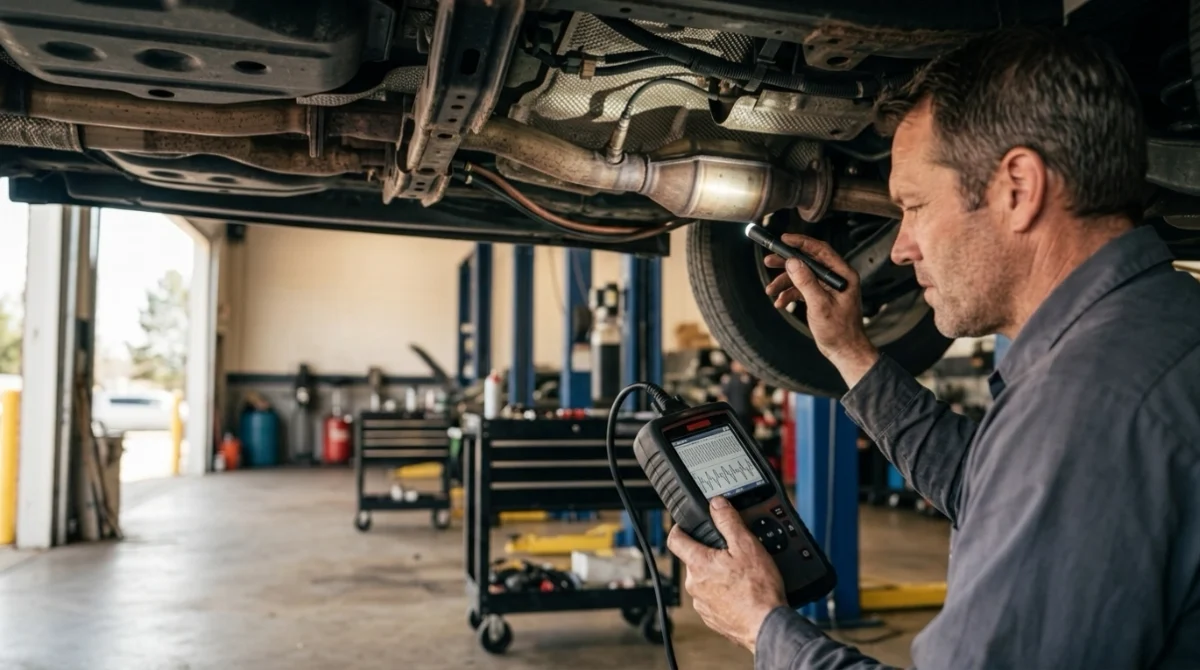
A proper P0430 diagnosis should prove that Bank 2 catalyst efficiency is low and rule out problems that can produce misleading readings. Scanning the code is only the starting point.
I would be cautious with any estimate that jumps directly from “P0430 stored” to “replace catalytic converter” without supporting test results.
A sensible diagnostic sequence
- Scan all stored codes. Look for misfire, fuel-trim, oxygen-sensor, air-fuel sensor, and related emissions faults.
- Review freeze-frame information. This shows operating conditions recorded when the code set on vehicles that support the data.
- Check for obvious exhaust leaks. Leaks upstream of or near the monitoring sensor deserve attention.
- Evaluate engine operation. Misfires, rich running, oil consumption, or other faults can damage the catalyst.
- Review live oxygen-sensor data. A technician can compare Bank 2 upstream and downstream behavior under suitable operating conditions.
- Check manufacturer information. Service bulletins, software updates, diagnostic procedures, and warranty information can change the repair path.
- Confirm the converter diagnosis. Only then should an expensive catalyst replacement be approved.
Manufacturer procedures matter here. Some vehicles require specific drive cycles, temperatures, test conditions, or scan-tool data before a catalyst can be judged accurately.
That’s one reason generic “replace the cat” troubleshooting can become expensive.
Check for recalls and manufacturer communications
Before paying for a major emissions repair, use the NHTSA VIN recall lookup. A recall or manufacturer campaign can sometimes affect diagnostics, software, or emissions-related components.
NHTSA’s database can also show manufacturer communications when searching by year, make, and model. Your dealer can check the VIN for brand-specific coverage that a generic scanner cannot show.
Locksmith’s note: VIN-specific information matters in modern vehicle electronics. I use the same mindset with immobilizers and smart keys because similar-looking components can have different software or compatibility requirements.
Can an OBD2 scanner confirm a bad catalytic converter?
A capable scanner can provide valuable evidence, but the trouble code by itself cannot prove converter failure. Live data, Mode $06 information on supported vehicles, fuel trim, related codes, and manufacturer procedures can provide more context.
Basic code readers may only show P0430 and clear it. More capable scan tools allow a technician to investigate what the engine computer observed.
Section Takeaway: Diagnosis should connect the P0430 code to measurable Bank 2 catalyst performance. Replacing an expensive converter without checking related faults can waste money and leave the code unresolved.
OEM vs Aftermarket Catalytic Converter: Which Costs Less?
An aftermarket catalytic converter usually has a lower purchase price than an OEM converter, but price isn’t the only requirement. The replacement must fit the vehicle and meet the emissions rules that apply to it.
| Factor | OEM Converter | Aftermarket Converter |
|---|---|---|
| Initial cost | Usually higher | Often lower |
| Vehicle-specific design | Designed for the manufacturer’s application | Varies by manufacturer and application |
| Emissions compliance | Must still match the vehicle specification | Must be verified for the vehicle and jurisdiction |
| Availability | Dealer or OEM parts channels | Broader aftermarket selection |
| Best choice when | You want the manufacturer-specified replacement and accept the price | A verified compliant option offers worthwhile savings |
Why shouldn’t you buy the cheapest converter online?
A converter needs more than matching pipe dimensions. Vehicle emissions certification, engine configuration, converter position, and applicable regulations all matter.
Use the VIN and vehicle emissions information when checking a replacement. Don’t rely solely on an online listing that says a part “fits” your year and model.
- Confirm the exact engine: One model may be sold with several engines.
- Identify Bank 2 correctly: Don’t assume left or right without manufacturer information.
- Verify emissions certification: Federal and stricter state requirements can affect the approved part.
- Check warranty terms: Understand both the part and installation coverage.
- Fix the root cause: A new converter can be damaged again by an unresolved engine problem.
AAA’s automotive repair information explains why catalytic converters can become expensive, including materials, vehicle design, and labor. Those factors help explain why two P0430 estimates can differ dramatically.
Cost note: ask the installer to put the exact converter brand, specification, warranty, and labor terms on the written estimate before authorizing the repair.
Can You Drive With a P0430 Code?
A vehicle with P0430 may still drive normally, but you shouldn’t ignore the code. It indicates an emissions-system problem that deserves diagnosis.
The urgency changes if other symptoms or trouble codes appear.
Get prompt help if you notice these signs
- Flashing check-engine light: This often accompanies an active misfire that can threaten the catalytic converter.
- Severe loss of power: A restricted exhaust or serious engine fault needs attention.
- Strong overheating symptoms: Stop and investigate the underlying problem rather than continuing to drive.
- Engine shaking or misfiring: Unburned fuel can create excessive catalyst temperatures.
- Multiple fuel or ignition codes: Fixing those faults may be important before evaluating P0430 again.
A stored P0430 can also prevent the vehicle from passing an emissions inspection where OBD readiness and diagnostic codes are part of testing.
Clearing the code immediately before inspection isn’t a reliable shortcut. Clearing diagnostic memory can reset readiness monitors, which then need suitable driving conditions before they complete again.
Could P0430 be covered by a recall?
It depends on the vehicle and the underlying problem. Search your VIN using NHTSA and contact the manufacturer or dealership before paying for major work.
If you believe the vehicle has a safety-related defect, NHTSA also provides a vehicle safety problem reporting service. That isn’t a substitute for mechanical diagnosis, but it provides an official reporting channel.
Section Takeaway: P0430 is not automatically an emergency, but continuing to drive with an active misfire, major power loss, or severe engine problem can turn a manageable repair into a much larger one.
P0430 Repair Cost FAQ
Does P0430 always mean the catalytic converter is bad?
No. P0430 indicates that the engine computer measured Bank 2 catalyst efficiency below its expected threshold. A deteriorated converter is one possible cause, but exhaust leaks, oxygen-sensor issues, engine misfires, fuel-control faults, and other problems should be considered before replacement.
How much is a catalytic converter for a P0430 code?
There is no single P0430 converter price. AAA gives roughly $1,000 to $4,000 as a broad catalytic converter replacement range including parts and labor, but your make, model, engine, emissions specification, converter type, region, and labor rate determine the real estimate.
Can I replace an oxygen sensor instead of the catalytic converter?
Only if testing shows the oxygen sensor or its circuit is faulty. Replacing a downstream sensor simply because P0430 appeared can waste money. The sensor data should be evaluated along with exhaust integrity, fuel control, related codes, and catalyst performance.
Can I clear P0430 with an OBD2 scanner?
You can clear the stored code with many scan tools, but clearing it doesn’t repair the cause. The code may return after the catalyst monitor runs again, and clearing codes can reset emissions readiness monitors.
Is Bank 2 on the driver or passenger side?
Bank 2 isn’t universally the driver or passenger side. It means the cylinder bank opposite Bank 1, which contains cylinder number one. Check manufacturer service information for your exact engine before ordering parts or identifying the converter.
Should I buy an aftermarket converter to lower the repair cost?
A compliant aftermarket converter can reduce the initial cost on some vehicles. Verify the exact engine, emissions certification, installation position, applicable state rules, warranty, and vehicle fit before buying rather than choosing solely by price.
What should I ask a mechanic before approving a P0430 repair?
Ask what tests confirmed the failed component, whether other codes are present, whether exhaust leaks were checked, and whether engine problems could have damaged the converter. Request a written parts-and-labor estimate tied to your VIN and emissions specification.
What Should You Do Next?
The most important thing about P0430 repair cost is that the code does not provide the repair price. It tells you where diagnosis needs to begin.
Scan all codes, inspect the Bank 2 exhaust system, review oxygen-sensor data, and correct any engine problem that could damage the catalyst. Then approve converter replacement only when the diagnosis supports it.
If a converter is confirmed bad, compare written OEM and compliant aftermarket estimates. Check VIN-specific recall or manufacturer information before spending several thousand dollars.
Don’t shop for the cheapest P0430 fix. Shop for the diagnosis that proves what actually failed.
