
P0440 Causes: What Triggers This EVAP System Code?

Quick Answer
P0440 means your vehicle’s computer detected a general problem in the evaporative emission control, or EVAP, system. Common P0440 causes include a loose or damaged fuel cap, cracked EVAP hoses, a sticking purge or vent valve, a damaged charcoal canister, wiring problems, or a faulty pressure-sensing component. Because several faults can trigger the same code, confirm the problem with an OBD2 diagnosis and EVAP inspection before replacing parts.
Most Common P0440 Causes
- Loose fuel cap: A cap that cannot seal the filler neck may allow fuel vapor to escape.
- Cracked EVAP hose: Age, heat, abrasion, or previous repairs can create an air leak.
- Faulty purge valve: A valve that sticks open or closed can prevent the system from controlling vapor correctly.
- Vent valve problem: A blocked or faulty vent valve can prevent a successful EVAP self-test.
- Canister damage: A cracked, saturated, or restricted charcoal canister can disrupt vapor storage and flow.
- Sensor or electrical fault: Pressure sensors, wiring, connectors, or control circuits can produce misleading EVAP readings.
First Thing to Check
- Inspect and properly tighten the fuel cap, then scan for related EVAP codes and freeze-frame data before buying parts.
P0440 can look intimidating when it appears on an OBD2 scanner, but it doesn’t identify one failed component. It tells you that the computer found a general fault while checking the vehicle’s EVAP system.
I’ve seen drivers replace purge valves, gas caps, and charcoal canisters in sequence when a small cracked hose was the real problem. This guide shows you how to narrow the causes down instead of guessing.
In This Guide
What Does P0440 Mean?
P0440 is a general evaporative emission control system malfunction code. It means the powertrain control module detected an EVAP problem but did not necessarily identify the exact failed part.
The EVAP system captures gasoline vapor that would otherwise escape from the fuel tank. It stores that vapor and later routes it into the engine to be burned.
What is the EVAP system?
The evaporative emission control system is a sealed network around the fuel tank and intake system. Its job is to contain fuel vapor instead of releasing it directly into the atmosphere.
Depending on the vehicle, the system can include:
- A sealed fuel cap or capless filler assembly
- Fuel-vapor hoses and hard lines
- A charcoal vapor canister
- A canister purge valve or purge solenoid
- A vent valve or vent solenoid
- A fuel tank pressure sensor
- Leak-detection hardware
- Electrical wiring and connectors
- The PCM or ECM that controls the system
Your OBD2 system runs EVAP self-tests under certain driving and temperature conditions. If the expected pressure or vacuum change does not occur, a diagnostic trouble code may be stored.
Does P0440 tell you exactly where the leak is?
No. That’s one of the most important things to understand about this code.
P0440 is broader than codes designed to describe a specific leak size, purge-flow problem, or electrical circuit fault. Treat it as a starting point for diagnosis.
Related codes can provide much better direction. Always record every stored and pending code before clearing anything.
Locksmith’s diagnostic note: An OBD2 code identifies the system that needs testing. It should never be treated as an automatic instruction to replace a particular component.
What Are the Most Common P0440 Causes?
The most common P0440 causes are faults that prevent the EVAP system from sealing, venting, purging, or measuring pressure correctly. Start with simple sealing problems before assuming an expensive component failed.
1. Loose or incorrectly installed fuel cap
A loose fuel cap is one of the easiest possibilities to check. The EVAP system cannot hold the expected pressure or vacuum if vapor escapes around the filler neck.
Look for these problems:
- A cap that was left loose after refueling
- A damaged cap seal or O-ring
- Dirt or rust around the sealing surface
- Damaged threads or locking tabs
- An incorrect replacement fuel cap
Some newer vehicles use a capless filler system. Those vehicles can still develop sealing problems around the filler mechanism.
AAA notes that a faulty fuel cap can trigger a check engine light because the EVAP system is designed to contain and recirculate gasoline vapor.
2. Cracked or disconnected EVAP hose
EVAP plumbing runs through several areas of the vehicle. Heat, vibration, road debris, and age can damage those lines.
Common hose faults include:
- Small cracks near fittings
- Split rubber elbows
- Loose quick-connect fittings
- Chafed plastic vapor lines
- Hoses left disconnected after previous work
- Lines melted near hot components
A leak can be too small to spot during a quick visual inspection. That’s why smoke testing is commonly used during EVAP diagnosis.
3. Sticking purge valve or purge solenoid
The purge valve controls when stored fuel vapor moves from the charcoal canister into the engine. It must open and close when commanded.
A sticking valve can disrupt the pressure changes the computer expects during an EVAP monitor. Depending on the vehicle, related purge-flow codes may appear alongside P0440.
Watch for:
- A purge valve stuck open
- A purge valve stuck closed
- Debris restricting the valve
- A damaged electrical connector
- Open or shorted wiring
Ford’s technical OBD documentation, for example, monitors purge-valve operation and its electrical circuit separately on supported vehicles. The exact strategy varies by manufacturer.
Pro tip: Don’t apply generic power or ground to an electronically controlled valve unless the correct service information says it’s safe. Circuit design varies between vehicles.
4. Faulty EVAP vent valve
The vent valve lets fresh air enter the EVAP system when required and helps seal the system during testing. Dirt and road contamination can affect valves mounted near the rear of the vehicle.
A valve that cannot seal may look like an EVAP leak to the computer. A valve stuck closed can create a different pressure or flow problem.
5. Damaged or saturated charcoal canister
The charcoal canister temporarily stores fuel vapor. Physical damage, contamination, or liquid gasoline entering the canister can interfere with normal operation.
Possible canister problems include:
- Cracks in the housing
- Broken hose fittings
- Restricted internal passages
- Fuel saturation
- Loose charcoal particles contaminating valves or lines
Repeatedly topping off the tank after the fuel nozzle clicks off can increase the risk of liquid fuel reaching vapor-control components. Stop filling when the nozzle shuts off normally.
6. Fuel tank pressure sensor problem
The computer may use a fuel tank pressure sensor to determine whether EVAP pressure changes match its commands. A faulty reading can therefore imitate a leak or failed control component.
The sensor itself isn’t always the problem. Wiring, terminals, power, ground, or a blocked pressure passage can also affect the signal.
7. Damaged wiring or electrical connectors
EVAP components rely on electrical circuits as well as vapor hoses. Corrosion or broken wiring can prevent a good valve or sensor from working.
Check connectors for:
- Water intrusion
- Green or white corrosion
- Bent terminals
- Pushed-back pins
- Broken connector locks
- Rodent damage
- Wiring rubbed through against the body or chassis
Section Takeaway: P0440 does not prove the gas cap, purge valve, or canister has failed. The best diagnosis checks the entire EVAP system in a logical order.
What Symptoms Can P0440 Cause?
P0440 often causes surprisingly few driving symptoms. Many vehicles continue to start, idle, and accelerate normally while the check engine light remains on.
Common signs can include:
- Check engine light: This is often the main symptom.
- Fuel odor: A significant vapor leak can sometimes produce a gasoline smell.
- Hard starting after refueling: Some purge-system failures can contribute to this symptom.
- Rough idle: A purge valve stuck open may create an unwanted intake-vacuum path on some vehicles.
- Failed emissions inspection: A stored emissions-related code or incomplete readiness monitor can prevent a passing result where OBD testing is required.
A strong gasoline smell deserves prompt attention. Do not dismiss it simply because the engine seems to run normally.
For general warning-light guidance, the National Highway Traffic Safety Administration remains a useful starting point for vehicle-safety information.
How Do You Diagnose the Cause of P0440?
Diagnose P0440 by confirming the code, checking related codes and scan data, inspecting the fuel cap and visible EVAP plumbing, then testing system sealing and component operation. Avoid clearing the code before recording useful diagnostic information.
Step 1: Scan every stored and pending code
Connect an OBD2 scanner and record P0440 plus any related codes. Freeze-frame data can show the conditions present when the fault was detected.
Pay attention to other EVAP codes because they may narrow the search to:
- Purge flow
- Vent control
- A small or large leak
- A pressure sensor
- An electrical circuit
Step 2: Check the fuel cap and filler area
Remove the cap and inspect its sealing surface. Look for cracks, hardened rubber, debris, or physical damage.
Reinstall the correct cap according to the vehicle’s instructions. Don’t assume that every aftermarket cap seals exactly like the original.
Step 3: Inspect accessible EVAP lines
Follow visible vapor lines between the engine bay, charcoal canister, and fuel-tank area where practical. Look closely around bends, connectors, brackets, and previous repair areas.
Small cracks often hide underneath hoses. Move them only when the engine is off and the area is safe to inspect.
Step 4: Use scan-tool data when available
A more capable scanner may display EVAP pressure data or allow bidirectional control of certain valves. That can help determine whether a component responds to commands.
Don’t rely on one sensor number without checking the manufacturer’s diagnostic information. Normal readings and test conditions vary by vehicle.
Step 5: Smoke-test the EVAP system
A controlled automotive smoke test is one of the most useful ways to locate an EVAP leak. Smoke introduced through the correct service point can reveal leaks too small to see normally.
Common leak locations include:
- Fuel-cap sealing surfaces
- Vapor-line connections
- Cracked hoses
- Canister seams
- Valve housings
- Fuel-pump or tank sealing areas
Safety note: Fuel-vapor systems require proper equipment and procedures. Don’t improvise with compressed air, open flames, heating tools, or unapproved homemade smoke devices around gasoline vapor.
Step 6: Test the purge and vent controls
Once the system’s plumbing looks sound, verify that the purge and vent valves operate correctly. Mechanical operation and electrical control both matter.
Manufacturer procedures may require resistance checks, command tests, pressure measurements, or specific leak-test routines. Follow service information for your exact model and year.
Official manufacturer documentation can be especially important because monitor logic differs between platforms. Ford, for example, publishes technical OBD system documentation describing how individual EVAP monitors work on covered applications.
Section Takeaway: Start with scan data and simple inspections, then move toward smoke testing and component checks. That order reduces unnecessary parts replacement.
Which P0440 Causes Should You Check First?
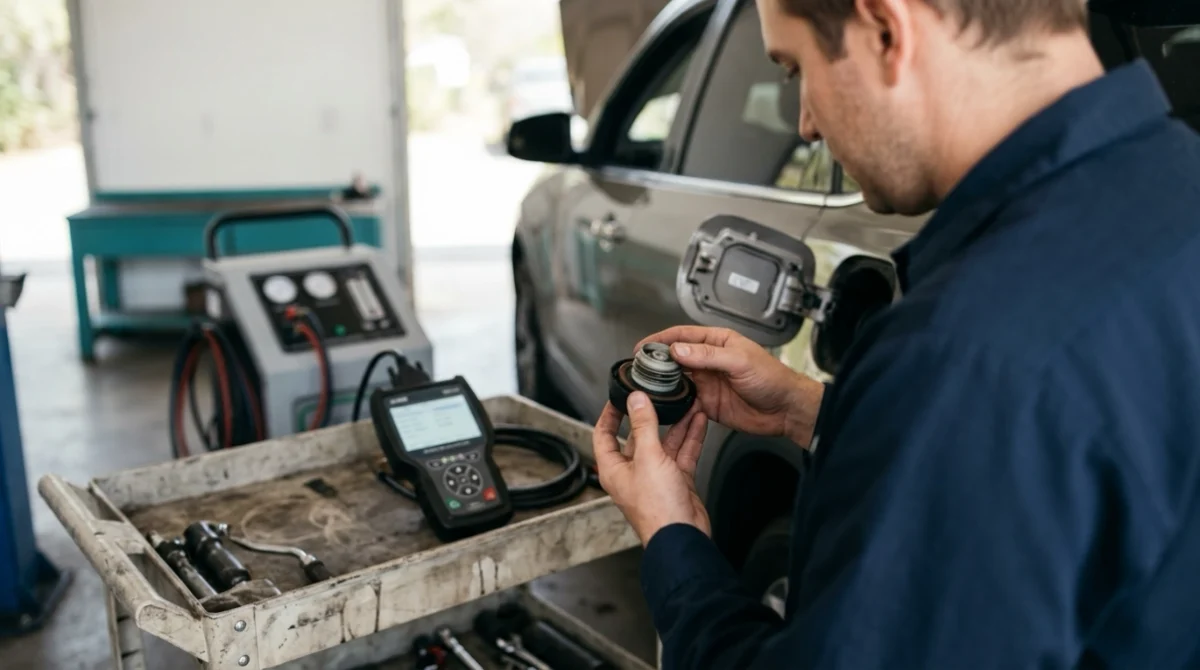
Start with faults that are common, visible, and inexpensive to verify. Move toward electrical or component-level testing only after simpler possibilities have been eliminated.
| Possible Cause | What to Look For | Useful Test | Check Priority |
|---|---|---|---|
| Fuel cap or filler seal | Loose cap, damaged seal, debris | Visual inspection and EVAP leak test | High |
| EVAP hose or line | Cracks, disconnection, chafing | Visual inspection and smoke test | High |
| Purge valve | Sticking, unwanted flow, no operation | Scan-tool command and service-manual test | Medium to high |
| Vent valve | Cannot seal, restriction, contamination | Command test and smoke test | Medium to high |
| Charcoal canister | Cracks, fuel saturation, restrictions | Visual inspection and flow/leak checks | Medium |
| Pressure sensor or circuit | Implausible data, damaged wiring | Scan data and electrical testing | Medium |
| PCM or control fault | Possible only after other faults are excluded | Manufacturer diagnostic procedure | Low |
I usually become suspicious when someone tells me several EVAP parts have already been replaced but the same code keeps returning. At that point, I want to see smoke-test results, connector condition, and scan data rather than another parts receipt.
That approach matters because manufacturers themselves caution technicians against replacing EVAP components without completing the appropriate diagnostic routine.
Can You Keep Driving With P0440?
A vehicle with P0440 may continue to drive normally, especially when the only symptom is a steady check engine light. However, the cause should still be diagnosed because the EVAP system is part of the vehicle’s emissions controls.
Get the vehicle checked sooner if you notice:
- A strong gasoline or fuel-vapor smell
- Visible fuel leakage
- Hard starting
- Severe rough running
- Loss of power
- Other warning lights or abnormal behavior
AAA advises drivers not to ignore a check engine light, especially when the vehicle is shaking, losing power, producing unusual odors, or otherwise behaving abnormally.
You can review broader check engine light guidance from AAA when deciding how urgently a warning light needs attention.
Will P0440 clear itself?
The check engine light may eventually turn off if the fault was temporary and the system later passes enough self-tests. The stored diagnostic history may remain accessible for some time.
Don’t clear the code simply to make the light disappear before diagnosis. Doing so can erase freeze-frame information and reset readiness monitors that help with troubleshooting.
How much does fixing P0440 cost?
There is no single P0440 repair price because the code does not name one failed part. A loose cap, damaged hose, valve fault, sensor problem, or tank-related leak all involve different labor and parts.
Diagnosis usually saves money when the alternative is replacing several EVAP components by trial and error. Ask for the confirmed failure and test result before authorizing major parts replacement.
Cost note: Labor rates, parts availability, system design, and diagnostic access vary by make, model, year, and region. Get a vehicle-specific estimate after the failure is identified.
P0440 Causes FAQ
What is the number one cause of P0440?
A loose or poorly sealing fuel cap is one of the first possibilities worth checking because it can prevent the EVAP system from sealing. However, P0440 can also come from hoses, valves, the charcoal canister, pressure-sensing hardware, wiring, or other EVAP components.
Can a bad gas cap cause P0440?
Yes. If the cap does not seal the filler neck correctly, the EVAP system may fail its leak or pressure test. Inspect the cap seal and filler area, but don’t assume the cap is responsible if the code returns after the seal is confirmed.
Can a bad purge valve cause P0440?
Yes, depending on the vehicle’s EVAP-monitoring strategy. A purge valve that sticks, leaks, becomes restricted, or fails electrically can prevent the system from controlling vapor and pressure as expected. Related EVAP codes may provide more specific clues.
Can P0440 be caused by a vacuum leak?
An EVAP vapor-line leak can trigger P0440 because the system may be unable to hold the expected pressure or vacuum. An unrelated engine-intake vacuum leak is not automatically the same problem, so identify exactly which circuit is leaking.
Can overfilling the gas tank cause EVAP problems?
It can contribute to EVAP trouble if liquid fuel reaches components designed mainly to handle vapor. Stop filling when the pump nozzle automatically shuts off instead of repeatedly topping off the tank.
Why did P0440 come back after I replaced the gas cap?
The gas cap may never have been the real cause. A cracked hose, leaking valve, damaged canister, sensor problem, connector fault, or another EVAP leak can produce the same general code. Scan related codes and perform a proper leak test.
Do I need a smoke test for P0440?
Not always, but a smoke test becomes valuable when the cap and obvious hoses look good and the fault keeps returning. It can expose small leaks around hoses, valves, canister seams, filler components, and tank-area seals that are difficult to find visually.
What Should You Do When P0440 Appears?
Start by treating P0440 as a diagnostic clue, not a parts list. Check the fuel cap, read every stored code, inspect EVAP hoses and connectors, and preserve freeze-frame data.
If nothing obvious appears, proper smoke testing and scan-tool diagnosis can separate a real leak from a valve, sensor, or electrical problem. That is usually faster than replacing components one at a time.
As of 2026, vehicles still use many different EVAP designs and monitoring strategies. Always verify testing procedures against reliable service information for your exact make, model, year, and engine.
The takeaway: P0440 means the EVAP system failed a general self-check. Find out why it failed before spending money on the repair.
