
What Does P0750 Mean? Shift Solenoid A Malfunction Explained

Quick Answer
P0750 means your vehicle’s computer detected a malfunction involving Shift Solenoid A in the automatic transmission. The problem may involve the solenoid itself, its wiring or connector, transmission fluid condition, the valve body, or another transmission control issue. You can also check your vehicle through the NHTSA recall lookup to see whether an open safety recall applies to your specific VIN.
Common Signs of P0750
- Check engine light: P0750 is stored when the transmission control system detects a fault.
- Harsh shifting: Gear changes may become unusually firm, delayed, or unpredictable.
- Missing shifts: The transmission may fail to engage one or more expected gears.
- Limp mode: Some vehicles limit available gears to reduce further transmission stress.
- High engine RPM: The engine may rev higher because the transmission is not reaching the expected gear.
What to Do First
- Read all stored transmission codes, inspect the transmission fluid correctly, and verify the vehicle-specific diagnostic procedure before replacing parts.
Seeing P0750 on an OBD2 scanner can sound worse than it explains. The code points you toward the automatic transmission’s shift-control system, but it does not automatically prove that the solenoid itself needs replacement.
When I approach a code like P0750, I treat the scan result as a starting point. This guide explains what the code means, what commonly causes it, how serious it can be, and what should be checked before money is spent on parts.
In This Guide
What Does the P0750 Code Mean?
P0750 is a generic OBD-II powertrain trouble code commonly defined as Shift Solenoid A Malfunction. It tells you that the transmission control system detected a problem while operating or monitoring the solenoid identified as “A.”
A shift solenoid is an electrically controlled valve that helps route automatic transmission fluid through the valve body. That hydraulic pressure helps the transmission engage the required clutches, bands, or gear combinations.
Simple definition: P0750 means the computer commanded or monitored Shift Solenoid A and detected operation outside the expected range.
The letter “A” does not identify the exact physical location across every vehicle. Manufacturers use different transmission designs, so Shift Solenoid A can perform different hydraulic functions depending on the transmission.
That distinction matters. A generic scanner gives you the basic code definition, while factory service information tells you what Solenoid A controls in your specific year, make, model, engine, and transmission.
Technician’s note: never order a shift solenoid based only on the code description. Verify the transmission type and manufacturer diagnostic information first.
What Symptoms Can P0750 Cause?
P0750 symptoms usually involve shifting, but the exact behavior depends on the transmission design and failure type. Some drivers notice a dramatic change immediately, while others first see only a warning light.
- Check engine light: The PCM or TCM stores the fault and may illuminate the malfunction indicator lamp.
- Harsh gear changes: Shifts can feel unusually firm or abrupt.
- Delayed shifting: The transmission may take longer than normal to change gears.
- Failure to shift: One or more expected gear changes may not occur correctly.
- Limp or failsafe operation: Some vehicles restrict transmission operation after detecting a serious fault.
- Higher RPM: The engine may run faster at road speed when the transmission cannot reach its normal higher gear.
- Poor acceleration: Starting in an unintended gear can make the vehicle feel sluggish.
You might also see another transmission code alongside P0750. Reading every stored, pending, and manufacturer-specific code can reveal whether the problem is isolated or affects several transmission circuits.
What Causes a P0750 Code?
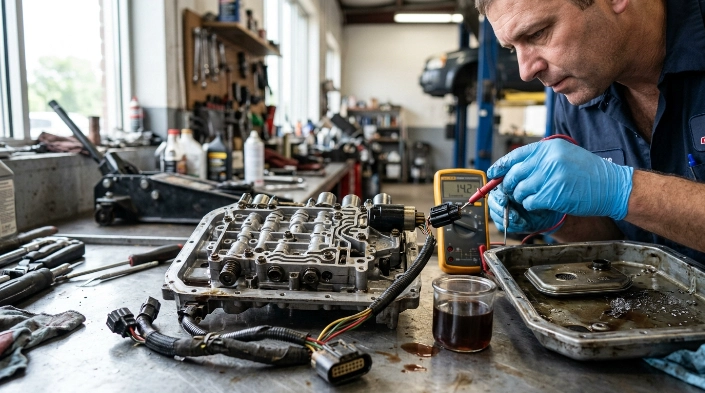
A failed solenoid is only one possible cause. Wiring, connectors, hydraulic problems, and internal transmission faults can create similar symptoms.
- Failed Shift Solenoid A: The electrical coil or mechanical valve inside the solenoid may fail.
- Damaged wiring: Open, shorted, rubbed-through, or heat-damaged wiring can interrupt solenoid control.
- Connector problems: Bent terminals, corrosion, loose connections, or fluid intrusion can affect the circuit.
- Low transmission fluid: Insufficient fluid may reduce hydraulic pressure and interfere with proper transmission operation.
- Contaminated fluid: Debris or degraded fluid can contribute to sticking valves or restricted hydraulic passages.
- Valve body problem: A sticking or worn valve can prevent the commanded hydraulic response.
- Internal transmission fault: Mechanical wear may prevent the expected gear ratio even when the solenoid operates.
- Control-module issue: PCM or TCM faults are possible, but they should not be assumed before circuit and transmission checks.
One useful clue is the number of related codes. Several solenoid-circuit codes appearing together can justify a close look at shared wiring, connectors, power, grounds, or an integrated solenoid assembly.
Pro tip: check the manufacturer’s fluid-level procedure before judging the level. Some transmissions require a specific temperature, engine state, and vehicle position.
How Serious Is P0750, and Can You Drive?
P0750 should not be ignored because it can directly affect how the transmission selects or holds gears. The safest decision depends on how the vehicle is behaving.
- Stop driving if: the transmission slips badly, loses drive, bangs into gear, overheats, or behaves unpredictably in traffic.
- Avoid unnecessary driving if: the transmission is stuck in one gear or has entered limp mode.
- Arrange diagnosis soon if: the check engine light is the only obvious symptom but P0750 keeps returning.
Continuing to operate a transmission that is slipping or shifting incorrectly can increase heat and mechanical stress. A tow can be cheaper than turning a smaller fault into broader transmission damage.
If you are in the United States, it is also worth checking your VIN for relevant campaigns through NHTSA manufacturer and recall resources. A trouble code itself does not prove that a recall applies.
Safety note: if the vehicle cannot accelerate, shift, or maintain road speed normally, avoid putting yourself in fast-moving traffic just to test it.
How Is P0750 Diagnosed?
Good P0750 diagnosis starts with evidence, not replacement parts. The goal is to determine whether the failure is electrical, hydraulic, mechanical, or related to fluid condition.
- Scan every available module. Record stored, pending, and transmission-specific codes before clearing anything.
- Review freeze-frame information. Note temperature, speed, load, and operating conditions present when the fault was stored.
- Inspect fluid correctly. Check level, condition, leaks, and obvious contamination using the manufacturer’s procedure.
- Inspect wiring and connectors. Look for damaged insulation, loose pins, corrosion, heat damage, and fluid intrusion.
- Check the circuit against specifications. Resistance, voltage, continuity, and current tests must use vehicle-specific specifications.
- Evaluate scan data. A capable scan tool may show commanded gear, input speed, output speed, solenoid status, and other transmission data.
- Test hydraulic or mechanical operation if needed. If the electrical side checks out, valve-body or internal transmission diagnosis may be necessary.
This is where a basic code reader can reach its limit. Generic scanners may read P0750, but advanced transmission diagnosis can require enhanced module access, live data, or bidirectional testing.
For drivers who do not have transmission test equipment, an AAA Approved Auto Repair facility locator is one way to search for professional repair facilities. You can also use an independent transmission specialist or the vehicle manufacturer’s dealer network.
Diagnostic note: do not use a resistance value copied from another vehicle. Solenoid specifications differ across transmission families.
How Is P0750 Different From Related Shift Solenoid Codes?
P0750 belongs to a family of Shift Solenoid A trouble codes. The neighboring codes can provide more detail about the type of malfunction detected.
| Code | General Meaning | Diagnostic Direction |
|---|---|---|
| P0750 | Shift Solenoid A Malfunction | Broad malfunction involving Solenoid A operation or control. |
| P0751 | Shift Solenoid A Performance / Stuck Off | The commanded response or hydraulic result may not match expectations. |
| P0752 | Shift Solenoid A Stuck On | The system detects behavior consistent with the solenoid remaining applied. |
| P0753 | Shift Solenoid A Electrical | Electrical circuit testing becomes especially important. |
| P0754 | Shift Solenoid A Intermittent | Look closely for intermittent wiring, connector, or component faults. |
Related codes should be interpreted together rather than individually. P0700 may also appear on some vehicles because the engine controller is being informed that the transmission controller has stored a fault.
What Repairs Can Fix P0750?
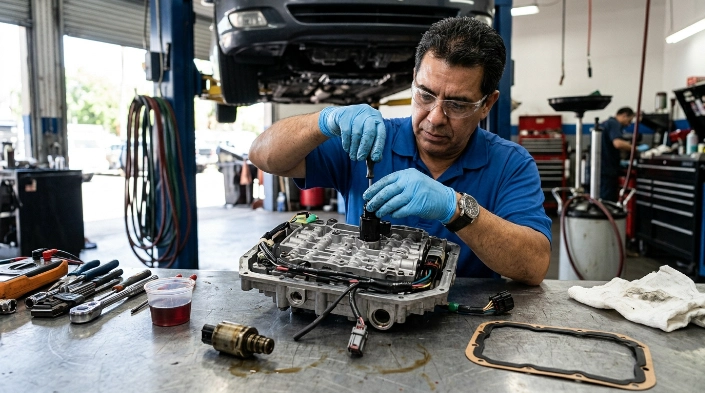
The correct repair depends on the diagnosis. Simply replacing Shift Solenoid A without testing the rest of the system can waste money and leave the code unchanged.
- Repair damaged wiring: Correct open circuits, shorts, damaged insulation, or poor connections.
- Repair a connector: Corroded or damaged terminals may require cleaning or connector repair.
- Correct fluid level: Find and repair the reason fluid became low rather than simply topping it off repeatedly.
- Service contaminated fluid: Follow the manufacturer procedure when fluid condition is part of the problem.
- Replace the affected solenoid: This is appropriate when testing confirms the component has failed.
- Repair the valve body: Hydraulic sticking, wear, or contamination may require professional valve-body service.
- Repair internal transmission damage: Mechanical failures require a different repair path from an electrical solenoid fault.
Some transmissions allow an individual solenoid to be replaced. Others use a combined solenoid pack or control assembly, so parts and labor can differ substantially between vehicles.
Repair pricing also varies by transmission design, vehicle access, labor rates, diagnostic time, and whether internal repairs are required. A vehicle-specific estimate is more useful than a generic internet price.
Repair note: confirm the exact transmission and replacement-part application using the VIN or manufacturer catalog before ordering components.
Frequently Asked Questions About P0750
Can low transmission fluid cause P0750?
Low fluid can interfere with hydraulic transmission operation and may contribute to shift-control problems. However, finding P0750 does not prove that low fluid is the cause, so the electrical circuit and vehicle-specific diagnostic information should still be checked.
Will changing transmission fluid fix P0750?
A fluid service may help if incorrect, degraded, or contaminated fluid is contributing to hydraulic problems. It will not repair an open solenoid coil, damaged wiring, a failed connector, or internal mechanical damage.
Can I clear P0750 with an OBD2 scanner?
Many OBD2 scanners can clear the code, but clearing it does not repair the cause. If the transmission control system detects the malfunction again, P0750 will usually return.
Does P0750 always mean Shift Solenoid A is bad?
No. The solenoid may be faulty, but wiring, connectors, fluid condition, valve-body problems, hydraulic faults, or internal transmission issues can produce the same general code.
Where is Shift Solenoid A located?
Its location depends on the transmission. Shift solenoids are commonly associated with the valve body inside the automatic transmission, but access and identification vary by manufacturer and transmission family.
Is P0750 an engine or transmission code?
P0750 is a powertrain diagnostic trouble code, but the fault concerns the automatic transmission shift-control system. It may be monitored by the PCM, TCM, or an integrated powertrain controller depending on the vehicle.
Final Takeaway
P0750 means the transmission control system has detected a malfunction involving Shift Solenoid A. Common diagnostic areas include the solenoid, wiring, connectors, transmission fluid, valve body, and internal transmission operation.
Do not replace the solenoid based on the code alone. Read all related codes, verify fluid condition, inspect the circuit, and use specifications for your exact vehicle and transmission.
If the transmission is slipping, stuck in gear, shifting violently, or unable to maintain normal road speed, arrange professional diagnosis before continuing to drive it.
