
P0456 Repair Cost: What You’ll Pay in 2026

Quick Answer
The typical P0456 repair cost can range from $0 for tightening a loose gas cap to several hundred dollars for an EVAP valve, hose, pump, or canister repair. A professional EVAP diagnosis or smoke test often costs about $75 to $200 before repairs, so checking simple causes first can save money. A steady check engine light caused by an EVAP fault should still be addressed, as explained in AAA’s check engine light guidance.
Typical P0456 Costs
- Loose gas cap: Often $0 if the cap only needs to be tightened or reseated.
- Replacement gas cap: Commonly around $15 to $60 for the part, with OEM options sometimes costing more.
- EVAP diagnosis: Plan on roughly $75 to $200 for professional leak testing in many U.S. shops.
- Purge or vent valve: Many repairs fall around $100 to $450 depending on the vehicle and access.
- Charcoal canister: A larger repair can reach roughly $350 to $1,000 or more on some vehicles.
Best First Move
- Read the code with an OBD2 scanner, inspect the fuel cap and visible EVAP connections, then diagnose the leak before buying expensive parts.
If your OBD2 scanner shows P0456, the good news is that the repair isn’t automatically expensive. The difficult part is finding the tiny EVAP leak that caused the code.
I’ve learned not to treat P0456 as a parts-replacement code. In this guide, I’ll show you where the money usually goes and how to avoid paying for the wrong repair.
In This Guide
What Does P0456 Mean, and Is It Safe to Drive?
P0456 means the vehicle’s computer detected a very small leak in the evaporative emissions system. The code identifies a system problem, not the exact failed part.
Definition: The EVAP, or evaporative emissions system, contains gasoline vapors instead of allowing them to escape into the atmosphere. It includes the fuel tank, vapor lines, charcoal canister, purge valve, vent valve, seals, and related controls.
Your car tests this sealed system under certain driving and operating conditions. If the computer sees pressure or vacuum changing faster than expected, it can store an EVAP leak code.
P0456 normally refers to one of the smallest leak levels the system monitors. That is why finding the fault can take longer than replacing the faulty part.
Does P0456 mean a specific part has failed?
No. This is one of the biggest mistakes I see people make when reading an OBD2 code.
A scanner tells you what condition the computer detected. It usually does not tell you which component caused that condition.
Possible leak points include:
- A loose or poorly sealing fuel cap
- A damaged fuel-cap seal
- A cracked EVAP vapor hose
- A leaking purge valve
- A leaking vent valve
- A damaged charcoal canister
- A leaking O-ring or connector seal
- A leak-detection pump problem on vehicles that use one
Manufacturer procedures show why diagnosis matters. One NHTSA-hosted Audi technical bulletin for certain vehicles lists both EVAP-system leaks and leak-detection-pump leaks as possible P0456 causes.
Can I drive with code P0456?
A vehicle with only P0456 will often drive normally. An official Audi bulletin for affected vehicles, for example, specifically notes that drivability isn’t affected.
That doesn’t mean you should ignore the light indefinitely. The vehicle has detected an emissions-system fault that still needs diagnosis.
- Steady check engine light: Schedule diagnosis soon if the vehicle otherwise runs normally.
- Flashing check engine light: Treat it as a more serious problem rather than assuming P0456 is the only fault.
- Fuel smell: Have the vehicle inspected promptly because a noticeable fuel-vapor or liquid-fuel leak needs attention.
- Poor running: Scan for additional trouble codes because P0456 alone may not explain the symptoms.
Technician’s note: Never assume every check engine light is harmless because your scanner also shows P0456. Read all stored, pending, and permanent codes before deciding how urgent the problem is.
How Much Does P0456 Cost to Repair in 2026?
A P0456 repair may cost nothing, or it may run into several hundred dollars. The final bill depends almost entirely on which part of the EVAP system is leaking.
These are planning ranges for U.S. drivers in 2026, not quotes. Labor rates, vehicle design, part quality, and local pricing can change the total significantly.
| Possible Repair | Typical Planning Range | What Affects the Price |
|---|---|---|
| Tighten or reseat fuel cap | $0 | No parts needed if the cap was simply loose |
| Replace fuel cap | About $15–$150 | OEM versus aftermarket part and shop charges |
| EVAP smoke test or diagnosis | About $75–$200 | Shop labor rate and time needed to isolate the leak |
| EVAP hose, seal, or fitting repair | About $50–$300 | Part price and location of the leak |
| Purge valve replacement | About $100–$450 | Valve cost and engine-bay access |
| Vent valve replacement | About $100–$450 | Location near the canister and corrosion |
| Leak-detection pump or module | About $200–$600 | Vehicle design, module price, and access |
| Charcoal canister replacement | About $350–$1,000+ | Vehicle-specific canister pricing and labor |
Why can the diagnosis cost more than the small part?
A tiny seal or hose can be inexpensive. Finding the exact leak may take specialized equipment and technician time.
This is why I would rather pay for one accurate smoke test than replace three EVAP components based on guesses. Random parts replacement can turn a cheap P0456 repair into an expensive one.
Why do P0456 prices vary so much between vehicles?
EVAP systems use similar ideas, but manufacturers package the parts differently. A valve that takes minutes to reach on one model may sit above a tank or behind other components on another.
Current repair-estimate data shows that variation clearly. Average purge-valve and canister replacement costs can differ by hundreds of dollars between models.
- Make and model: Part prices and EVAP layouts vary.
- Model year: Newer systems may use different leak-detection hardware.
- Labor rate: Dealer and independent-shop rates can differ.
- OEM versus aftermarket: The replacement-part choice affects cost.
- Access: Removing shields, liners, or other parts adds labor.
- Diagnosis: Some shops charge the testing fee separately.
Cost tip: Ask for an itemized estimate showing diagnosis, parts, labor, taxes, and shop fees before approving the repair.
Section Takeaway: P0456 doesn’t have one fixed repair price. Budget first for accurate diagnosis, because the actual fix may be as small as a cap seal or as costly as a canister.
What Causes a P0456 Code?
The most useful way to approach P0456 is to check simple sealing problems before expensive components. The code only tells you that the EVAP system failed a very-small-leak test.
Loose or leaking fuel cap
The fuel cap is one of the easiest checks. A damaged seal, dirt on the sealing surface, or a loose cap can prevent the fuel system from sealing correctly.
I inspect the seal before buying anything. A new cap won’t solve a cracked hose or leaking valve.
Cracked EVAP hose or connection
EVAP hoses can harden, split, rub against nearby parts, or loosen at a connector. Tiny cracks are sometimes almost invisible without testing.
Pay close attention to bends and connection points. Those areas often see more stress than the middle of a hose.
Purge valve that doesn’t seal
The purge valve controls when stored fuel vapor enters the engine. If it leaks when it should be closed, the computer may interpret the pressure change as an EVAP leak.
Don’t replace it because P0456 appears on a scanner. The valve should be tested first.
Vent valve or vent seal problem
The EVAP vent valve lets fresh air enter the system when needed. During leak testing, the system may need that vent path sealed.
A sticking valve, dirt, corrosion, or a damaged seal can cause trouble. Location near the rear or underside of some vehicles also exposes parts to road debris and moisture.
Small seal or O-ring leak
Sometimes the expensive-looking diagnosis has a surprisingly small cause. An O-ring can leak where a valve joins another EVAP component.
A NHTSA-hosted Nissan service bulletin covering certain vehicles specifically tells technicians to replace a leaking vent-control-valve O-ring rather than automatically replacing the valve.
Charcoal canister or leak-detection hardware
The charcoal canister stores fuel vapor until the engine can burn it. Cracks, damaged fittings, or internal problems can make replacement more expensive.
Some vehicles also use a dedicated pump or other hardware to test system integrity. A fault in that equipment can sometimes produce the same code as a physical leak.
Section Takeaway: P0456 can come from a cheap seal or an expensive EVAP component. Test the system before deciding which part belongs on the estimate.
How Do Shops Diagnose a P0456 Small EVAP Leak?
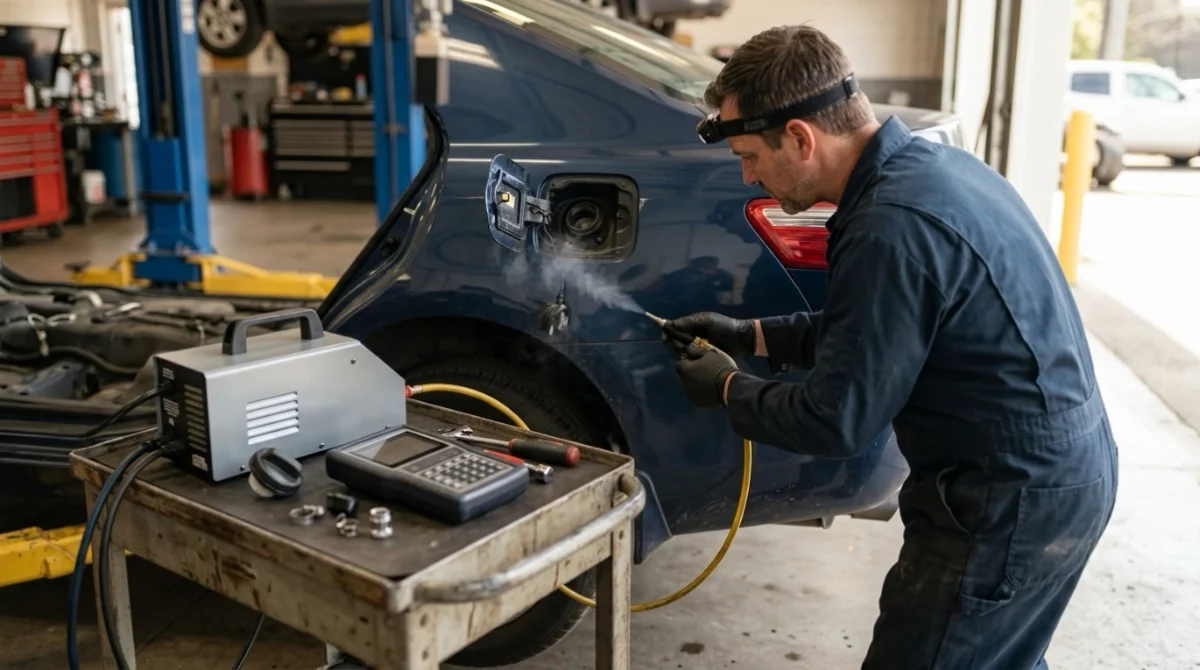
A good P0456 diagnosis starts with the code and ends with proof of the leak. A technician shouldn’t jump directly from the OBD2 scanner screen to a replacement part.
Step 1: Scan all trouble codes
I start by checking stored, pending, and related EVAP codes. A second code may change the direction of the diagnosis.
An OBD2 scanner is useful here, but it has limits. It identifies the computer’s complaint rather than physically locating a pinhole leak.
Step 2: Inspect the easy sealing points
Before setting up more involved testing, check what can be seen safely. That can uncover an obvious problem without adding diagnostic time.
- Check whether the fuel cap is present and seated correctly.
- Inspect the fuel-cap seal for cuts or deterioration.
- Look for disconnected EVAP lines.
- Check visible hoses for cracks or damage.
- Inspect accessible connectors and fittings.
Step 3: Test valves and the sealed system
The purge and vent valves may need command or sealing tests. The exact procedure depends on the make, model, year, and diagnostic equipment.
This is where vehicle-specific service information matters. I wouldn’t use one manufacturer’s test sequence on another vehicle.
Step 4: Use smoke or pressure testing when needed
A smoke machine introduces test vapor into the system so leaks can become visible. For a P0456-sized fault, this can be far more useful than staring at hoses.
Some manufacturer procedures combine pressure testing, valve control, smoke, or other leak-detection methods. Follow the service procedure designed for the exact vehicle.
Step 5: Repair and verify
After the confirmed leak is repaired, the system needs to be checked again. Clearing the code alone doesn’t prove the leak is gone.
The EVAP monitor also may not run immediately after every repair. Operating conditions such as fuel level and temperature can affect when onboard testing occurs.
Diagnostic note: Don’t assume a repair failed only because the readiness monitor hasn’t completed yet. Check manufacturer-specific monitor conditions before replacing another part.
Section Takeaway: The best P0456 diagnosis proves where the system leaks before parts are installed. That approach usually costs less than guessing.
Can You Fix P0456 Yourself and Save Money?
You can handle a few basic P0456 checks yourself, but the smallest leaks often require proper diagnostic equipment. The right DIY stopping point depends on your tools and experience.
DIY checks worth doing first
- Read and record every trouble code before clearing anything.
- Check whether the fuel cap is tightened and seated properly.
- Inspect the cap seal for obvious damage or contamination.
- Look for accessible loose, split, or disconnected EVAP hoses.
- Check whether the code appeared soon after refueling or recent repair work.
These checks cost little or nothing. They also give you useful information before visiting a repair shop.
What I would not replace blindly
Once the easy checks are done, don’t start ordering every part mentioned in a P0456 search result. That usually costs more than a proper diagnosis.
- Purge valve
- Vent valve
- Charcoal canister
- Fuel tank pressure sensor
- Leak-detection pump
Each part can fail. None should be condemned from P0456 alone.
Should you clear P0456 after tightening the gas cap?
You can clear the code with a compatible OBD2 scanner after correcting an obvious cap problem. However, clearing the light also resets diagnostic information and may reset readiness monitors.
If your vehicle is due for an emissions inspection, that matters. A recently cleared computer may show monitors as incomplete until the vehicle completes the required self-tests.
DIY safety note: EVAP work involves fuel vapor. Avoid sparks, flames, improvised pressure sources, and procedures that aren’t approved for your vehicle.
How Do You Avoid Overpaying for P0456 Repair?
The cheapest P0456 strategy isn’t automatically the cheapest part. It is paying for only the repair that testing proves you need.
Ask what test confirmed the failed part
If a shop recommends a $500 component, ask how the leak was traced to it. A clear diagnostic explanation is more valuable than a parts list based only on the code.
You don’t need to challenge the technician. You simply want to understand what evidence supports the repair.
Separate diagnosis from repair cost
Ask whether the diagnostic charge is included in the quoted repair. Some shops credit part or all of the testing fee toward the completed work, while others bill it separately.
- Diagnostic or smoke-test charge
- Replacement-part price
- Labor time
- Taxes and shop fees
- Warranty on the repair
Be careful with the cheapest replacement cap
A fuel cap needs to fit and seal correctly. An inexpensive cap that doesn’t match the vehicle can leave you with the same EVAP fault.
Verify fitment by year, make, model, and VIN when necessary. Don’t rely only on a product photo or generic description.
Check for vehicle-specific service information
P0456 diagnosis isn’t identical across every brand. Technical service information may point technicians toward known seals, valves, connections, or test procedures for certain vehicles.
That can prevent a much more expensive replacement. The Nissan O-ring example above is a good illustration.
Repair-cost tip: For an expensive EVAP quote, ask whether the shop checked applicable manufacturer service information before replacing the larger component.
P0456 Repair Cost FAQ
How much does it usually cost to fix code P0456?
A P0456 repair can cost $0 if the fuel cap only needs tightening. Professional diagnosis commonly adds roughly $75 to $200, while valve, hose, pump, or canister repairs can push the bill into several hundred dollars.
Can a bad gas cap cause P0456?
Yes. A loose, damaged, dirty, or poorly sealing fuel cap can allow the EVAP system to lose pressure or vacuum during its self-test.
Check the cap first, but don’t assume it is the cause if P0456 returns.
How much does an EVAP smoke test cost?
A professional EVAP smoke test or leak diagnosis often falls around $75 to $200 in the U.S. Pricing varies by labor rate, diagnostic procedure, and how much time the leak takes to locate.
Will P0456 go away after tightening the gas cap?
It can if the loose cap was the only cause. The check engine light may not disappear instantly because the vehicle may need to complete another EVAP monitor before confirming that the system now seals correctly.
Is P0456 expensive to repair?
Not necessarily. Some P0456 repairs involve only a cap, hose, fitting, or seal, while a leaking canister or difficult-to-access component can make the repair considerably more expensive.
Can I drive with P0456 for a week?
A vehicle with only a steady P0456 code often drives normally, but the emissions fault should still be diagnosed. If the light flashes, the engine runs poorly, or you notice a strong fuel smell, get the vehicle checked promptly.
Do I need a new purge valve for P0456?
Not based on the code alone. A purge valve can cause P0456, but so can the gas cap, hoses, seals, vent valve, canister, or leak-detection hardware.
Test the valve and system before replacing it.
Final takeaway: If you’re budgeting for P0456 repair, start with the free checks and expect to pay for diagnosis before assuming you need an expensive EVAP part. A good OBD2 scan followed by proper leak testing is usually the shortest path to an accurate repair.
Record the code, inspect the fuel cap and visible connections, and ask for a confirmed leak location before approving major parts. That simple process can save you from paying twice for the same check engine light.
