
What Does P0500 Mean? Causes, Symptoms, Diagnosis, and Fixes

Quick Answer
P0500 means your vehicle’s computer has detected a problem with the vehicle speed signal, commonly described as a Vehicle Speed Sensor “A” malfunction. The problem may come from the speed sensor, wiring, connectors, a tone or reluctor ring, or another part of the speed-sensing system. Before replacing parts, I also recommend checking your vehicle for manufacturer communications or recalls through the NHTSA recall and vehicle lookup.
Common clues I check first
- Speedometer problems: The speedometer may stop working, jump, or show an incorrect speed.
- Check engine light: Your scanner may show P0500 by itself or with related speed-sensor codes.
- Transmission changes: Some automatic transmissions may shift late, early, or harshly when speed data is missing.
- Warning lights: ABS or traction-control warnings can appear on vehicles that share speed information between modules.
- Damaged wiring: Corrosion, broken wires, loose plugs, or road debris can interrupt the sensor signal.
Best first move
- Scan all modules, inspect the speed-sensor wiring, and check live speed data before buying a replacement sensor.
I see P0500 as a diagnosis problem, not an automatic instruction to replace a sensor. An OBD2 scanner tells you where the computer noticed a fault, but it doesn’t prove which part failed.
Most of my daily work involves keys, immobilizers, and vehicle electronics. That work has taught me the same lesson repeatedly: test the signal and wiring before blaming the component.
In This Guide
What Does the P0500 Code Mean?
P0500 means the powertrain control module detected a problem with the vehicle speed signal. Many scan tools display the description as Vehicle Speed Sensor “A” Malfunction.
A vehicle speed sensor measures movement within the drivetrain or another speed-related component. The system converts that movement into an electrical signal the vehicle’s control modules can understand.
What does the vehicle speed sensor do?
The vehicle computer needs accurate speed information for more than the speedometer. Depending on the vehicle, several systems may use that information.
- Speedometer: Displays road speed to the driver.
- Automatic transmission: Uses speed information when calculating shift timing on many vehicles.
- Cruise control: Needs reliable vehicle speed information to maintain a set speed.
- ABS and traction control: Some designs share or compare wheel and vehicle speed information.
- Engine computer: May use vehicle speed when making operating decisions.
A traditional vehicle speed sensor may work with a toothed reluctor or tone ring. As the ring rotates, the sensor creates a changing signal that represents speed.
Modern vehicles can calculate road speed differently. Some use transmission output-speed information, while others receive speed data through ABS or other electronic modules.
Does P0500 always mean the speed sensor is bad?
No. This is one of the most important things I tell people when they show me a scanner result.
P0500 describes the fault the computer detected. It doesn’t identify the failed part with certainty.
- A failed sensor can trigger it.
- A broken wire can trigger it.
- A corroded connector can trigger it.
- A damaged tone ring can trigger it.
- Incorrect or missing speed data from another module can trigger it on some vehicles.
That distinction can save you from buying a good sensor to replace another good sensor.
Section Takeaway: P0500 means the expected vehicle-speed signal is missing or incorrect. Diagnose the whole speed-sensing circuit before replacing parts.
What Symptoms Can P0500 Cause?
P0500 can cause anything from a check engine light to noticeable speedometer and transmission problems. Symptoms depend heavily on how your vehicle generates and shares its speed signal.
I start by asking what changed at the same time the warning light appeared. That often points me toward the correct system faster than the code alone.
Common P0500 symptoms
- Check engine light: The warning may be your only symptom.
- Dead speedometer: The needle or digital display may stay at zero.
- Erratic speed reading: Road speed may jump or drop unexpectedly.
- Odometer problems: Distance recording can be affected on some vehicles.
- Odd shifting: An automatic transmission may shift differently when reliable road-speed information is unavailable.
- Cruise control failure: Cruise control may stop setting or cancel unexpectedly.
- ABS warning: Some vehicles may illuminate an ABS or traction-control light when related speed data is unavailable.
Don’t assume every symptom must be present. I have seen electrical faults where the driver noticed only a warning light.
I’ve also seen cases where a dead speedometer made the diagnosis much more obvious.
Check your scanner’s live data
A scanner with live-data support can be more useful than simply reading the stored code. Look for vehicle speed while the car is moving safely.
If the scanner stays at zero while the vehicle moves, you’ve confirmed that the computer isn’t receiving normal speed information. If the value jumps wildly, suspect an intermittent signal or circuit problem.
You can also use the AAA onboard diagnostics code resource when checking unfamiliar OBD2 codes.
What Causes a P0500 Code?
The most common P0500 causes involve the sensor or its electrical path. I still avoid ranking parts until I’ve inspected the specific vehicle.
Sensor design and location vary. Always use service information for your exact year, make, model, engine, and transmission.
Common causes worth checking
- Failed vehicle speed sensor: The sensor can stop producing a usable signal.
- Loose electrical connector: Vibration or previous repair work can leave a connector partly disconnected.
- Corrosion: Moisture inside a connector can increase resistance or interrupt the circuit.
- Broken wiring: Harnesses can rub against brackets, exhaust shields, or drivetrain parts.
- Damaged tone ring: Missing or damaged teeth can distort the sensor’s signal.
- Metal debris: Magnetic sensors can sometimes collect debris that interferes with signal quality.
- Related ABS or wheel-speed fault: Some newer vehicles obtain vehicle-speed information through another module.
- Calibration issue: Incorrect tire-size or drivetrain configuration can affect calculated speed on certain vehicles.
- Control-module problem: Module failures are possible, but I treat them as a later diagnosis after basic circuit checks.
One mistake I try hard to avoid is replacing the most obvious component first. Electronic fault codes often tempt people into parts swapping.
That approach gets expensive fast.
P0500 vs P0501, P0502, and P0503
The neighboring codes help describe different types of vehicle-speed signal problems. Seeing more than one can give you useful diagnostic direction.
| Code | General Meaning | What I Would Check First |
|---|---|---|
| P0500 | Vehicle Speed Sensor “A” malfunction | Sensor signal, connector, wiring, and live vehicle-speed data |
| P0501 | Vehicle Speed Sensor “A” range/performance | Incorrect or implausible speed readings |
| P0502 | Vehicle Speed Sensor “A” low input | Low signal, short, poor connection, or sensor output |
| P0503 | Vehicle Speed Sensor “A” intermittent, erratic, or high | Loose connections, damaged wiring, signal spikes, or tone-ring issues |
Technician’s note: never order a sensor from the code description alone. Verify the sensor location and system design using the VIN and correct service information.
Section Takeaway: A bad speed sensor is only one possible cause. Wiring, connectors, tone rings, calibration, and shared module data deserve attention too.
How Do You Diagnose P0500?
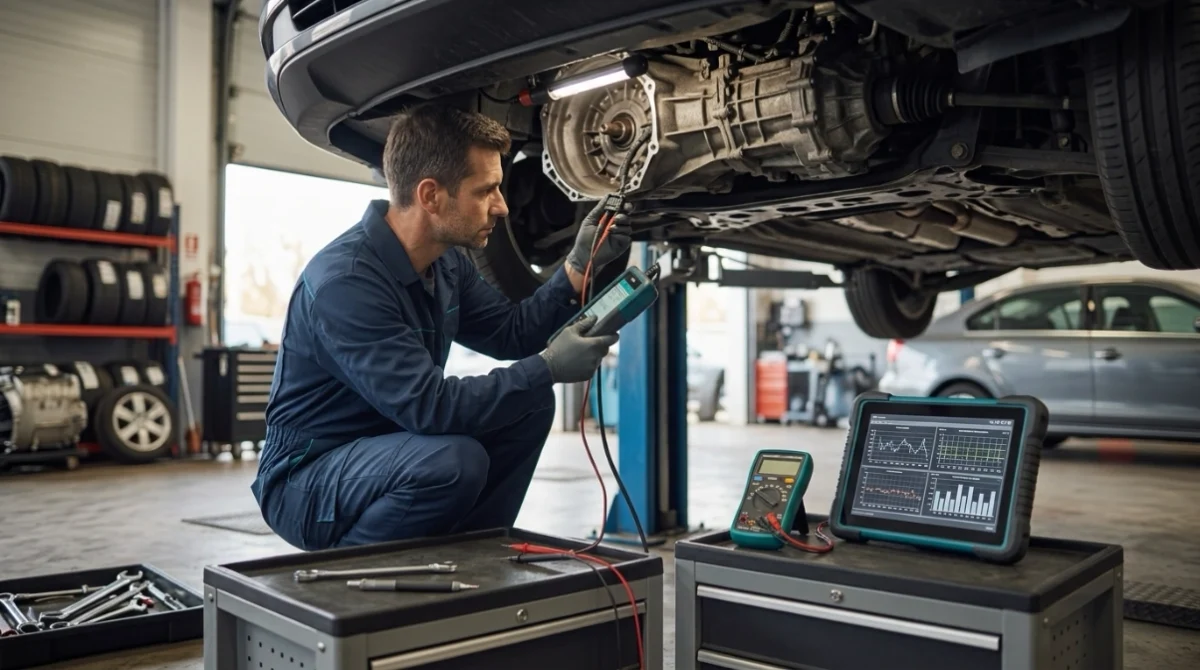
I diagnose P0500 from the easiest evidence toward the harder tests. That keeps me from tearing into a vehicle before checking simple failures.
You don’t need to replace anything just because the code returns after clearing it.
1. Scan every available module
Start by reading the engine computer and any available ABS or transmission modules. Record all codes before clearing anything.
Related wheel-speed, transmission-speed, communication, or voltage codes may completely change your diagnostic direction.
2. Look at live vehicle-speed data
Watch the scanner’s vehicle-speed parameter during a controlled test. Have another person operate the scanner if necessary.
- Normal reading: The problem may be intermittent.
- Zero reading: The computer may not be receiving a speed signal.
- Jumping reading: Inspect for an unstable sensor signal or electrical connection.
- Incorrect reading: Check sensor performance, calibration, and related speed inputs.
3. Inspect the sensor and wiring
Find the vehicle’s actual speed-sensing component using reliable service information. Don’t assume it sits on the transmission because another car used that design.
Look closely before touching anything.
- Loose plugs
- Bent connector pins
- Green or white corrosion
- Oil or water inside connectors
- Wires rubbed through against metal
- Melted insulation near exhaust parts
- Previous wiring repairs
4. Check the mechanical trigger
If your sensor reads a tone or reluctor ring, inspect that component when accessible. A good electrical sensor cannot produce a clean signal from a badly damaged trigger wheel.
Some failures appear only when the shaft or wheel rotates.
5. Test the circuit correctly
Electrical testing may involve supply voltage, ground, continuity, resistance, frequency, or waveform checks. The correct test depends on whether the vehicle uses a Hall-effect, magnetic, or network-derived speed signal.
Technician’s note: use the manufacturer’s wiring diagram before back-probing connectors. Testing the wrong circuit can damage sensitive electronics.
6. Check technical information before replacing modules
Search by VIN, year, make, and model for manufacturer communications or known problems. NHTSA’s database can display recalls, investigations, complaints, and manufacturer communications for many vehicles.
I leave PCM, ABS-module, or other controller replacement until the evidence supports it. Modules are rarely where I want to start.
Section Takeaway: Read all codes, check live speed data, inspect the wiring, and test the actual signal. P0500 diagnosis should prove the failure before parts are replaced.
Can You Drive With a P0500 Code?
You may still be able to drive with P0500, but that doesn’t mean you should ignore it. Your decision should depend on the symptoms and the systems affected.
A working speedometer matters. Transmission, cruise-control, ABS, or traction-control behavior can also be affected on some vehicles.
Stop and get help if the car behaves unpredictably
- The speedometer doesn’t work and you cannot judge road speed safely.
- The transmission shifts harshly or unpredictably.
- Multiple brake, ABS, or stability warnings appear.
- The vehicle loses power or develops additional serious symptoms.
- You notice damaged wiring near rotating or hot components.
If the only symptom is a check engine light and the car behaves normally, arrange diagnosis soon instead of assuming the problem is harmless.
The Insurance Institute for Highway Safety publishes broader research about vehicle and road safety if you want additional safety information.
How Do You Fix P0500?
The correct P0500 repair is whatever restores a valid vehicle-speed signal. There isn’t one universal repair for every car.
I match the repair to the failed test.
Possible P0500 repairs
- Reconnect or clean a connector: Useful when the fault comes from a loose or contaminated connection.
- Repair damaged wiring: Needed when the signal, power, or ground circuit is open or shorted.
- Replace the vehicle speed sensor: Appropriate after testing confirms the sensor itself has failed.
- Repair a tone or reluctor ring: Required when the sensor’s mechanical trigger is damaged.
- Repair a related wheel-speed system: Relevant on vehicles that derive road speed through ABS electronics.
- Correct vehicle configuration: Some vehicles may need proper tire-size or drivetrain calibration.
- Diagnose a control module: Consider this only after verifying inputs, wiring, power, grounds, and communication.
How much does P0500 repair cost?
There isn’t a responsible single price for fixing P0500. A connector repair and a transmission-mounted sensor replacement are different jobs.
Labor also changes by vehicle design and region. Some sensors are easy to reach, while others require more disassembly.
The most useful first expense is often proper diagnosis. Paying to confirm the failure can cost less than replacing several good parts.
Technician’s note: request a written diagnosis before approving an expensive module or transmission-related repair. The estimate should explain what testing proved the failed component.
Should you clear P0500 after the repair?
Yes, you can clear the stored code after completing the confirmed repair. Then perform an appropriate drive cycle and rescan the vehicle.
Watch live speed data again. A repair isn’t complete just because the warning light stays off for a few minutes.
Section Takeaway: Fix the cause, not the code. Confirm normal live speed data and make sure P0500 doesn’t return after the repair.
P0500 Frequently Asked Questions
Does P0500 mean my transmission is bad?
No. P0500 identifies a vehicle-speed signal problem, not automatic transmission failure. The cause may be a sensor, wiring, connector, tone ring, calibration issue, or another speed-data source. Diagnose those areas before assuming internal transmission damage.
Can a bad wheel speed sensor cause P0500?
It can on some vehicle designs. Certain vehicles calculate or distribute vehicle-speed information using ABS wheel-speed data. Check the ABS module for related codes and review the correct wiring diagram before deciding which sensor is responsible.
Can a bad vehicle speed sensor affect shifting?
Yes, on vehicles where the transmission computer uses vehicle-speed information to calculate gear changes. Missing or incorrect speed data may cause unusual shift timing or harsh shifting. The exact behavior varies by transmission and control strategy.
Can P0500 make the speedometer stop working?
Yes. A failed vehicle-speed signal can cause the speedometer to stay at zero or behave erratically on some vehicles. However, modern dashboards may receive speed information from another module, so the speedometer can sometimes work even with P0500 stored.
Will disconnecting the battery fix P0500?
No. Disconnecting the battery may erase stored information on some vehicles, but it doesn’t repair a failed sensor or circuit. If the underlying fault remains, the computer can detect it again and store P0500 after the vehicle is driven.
Can incorrect tire size trigger P0500?
Incorrect tire or drivetrain configuration can affect calculated vehicle speed on certain vehicles. It isn’t the first cause I would assume, but it’s worth checking when P0500 appears after major tire-size, gearing, or drivetrain changes.
What should I check first when P0500 appears?
Read every stored code and check live vehicle-speed data first. Then inspect the relevant sensor, wiring, and connector. This approach gives you evidence before you spend money on replacement parts.
If your scanner shows P0500, don’t panic and don’t order a sensor immediately. Use the code as the starting point for a structured diagnosis.
Confirm whether vehicle speed appears correctly on live data, inspect the circuit, and repair what the testing proves. That’s the approach I trust when troubleshooting vehicle electronics in 2026.
