
What Does P0306 Mean? Causes, Symptoms, and Fixes

Quick Answer
P0306 means your vehicle’s computer detected a misfire in cylinder 6. The code doesn’t identify the failed part, so you need to check ignition, fuel delivery, air leaks, and engine compression before replacing anything. If your check-engine light is flashing, follow AAA’s check-engine-light safety guidance and avoid continuing to drive with a severe misfire.
Common P0306 causes
- Worn spark plug: A damaged, fouled, or worn plug may fail to ignite cylinder 6 consistently.
- Weak ignition coil: A failing coil can create an intermittent or constant cylinder-specific misfire.
- Injector problem: A restricted injector or electrical fault can reduce fuel delivery to cylinder 6.
- Air leak: An intake or vacuum leak near that cylinder may create an excessively lean mixture.
- Low compression: Valve, piston, ring, head-gasket, or other mechanical problems can prevent normal combustion.
What to do first
- Save the code, freeze-frame information, and any related trouble codes before clearing the computer.
P0306 looks specific, but it still leaves an important question unanswered: why is cylinder 6 misfiring? An OBD2 scanner tells you where the computer detected the problem, not which component you should buy.
I’ve seen misfire diagnosis become expensive when parts get replaced before basic testing happens. This guide walks through the code logically, from symptoms and causes to diagnosis, repair, and driving safety.
In This Guide
What Does P0306 Mean?
P0306 means the engine control module detected a combustion misfire in cylinder 6. It’s a generic powertrain diagnostic trouble code used on many OBD2-equipped vehicles.
A misfire occurs when a cylinder doesn’t produce its expected combustion event correctly. That cylinder may produce weak power, intermittent power, or almost no useful power.
What does each part of P0306 indicate?
- P: The fault belongs to the powertrain system.
- 0: It is a generic OBD2 code rather than a manufacturer-only code.
- 3: The code falls within the ignition or misfire-related family.
- 06: Cylinder 6 is the cylinder where the misfire was detected.
The important part is that P0306 identifies the affected cylinder. It does not prove that the spark plug, coil, injector, or another specific component has failed.
You also need to verify which physical cylinder is number 6. Cylinder numbering differs between engine layouts and manufacturers.
Pro tip: use the manufacturer’s service information or owner’s documentation to confirm cylinder numbering before moving coils, plugs, or injectors.
If a four-cylinder engine appears to show P0306, double-check the scanner reading and vehicle information. A genuine cylinder 6 cannot exist in an engine with fewer than six cylinders.
What Symptoms Can P0306 Cause?

P0306 can cause anything from a check-engine light with almost normal driving to severe shaking and power loss. The symptoms depend on how often cylinder 6 fails to combust.
Intermittent misfires can disappear between trips. A constant misfire usually becomes much easier to feel.
Common P0306 symptoms
- Check-engine light: The warning may stay solid or flash during an active severe misfire.
- Rough idle: The engine may shake noticeably when stopped.
- Hesitation: Acceleration may feel uneven when you press the throttle.
- Reduced power: Losing contribution from one cylinder can make the engine feel weak.
- Poor fuel economy: Inefficient combustion may increase fuel consumption.
- Hard starting: Some engines take longer to start when the fault becomes severe.
- Fuel smell: Unburned fuel may reach the exhaust during an active misfire.
- Engine vibration: The vehicle may shake under load or at certain engine speeds.
You might also see P0300 or another cylinder-specific code alongside P0306. Multiple codes can change the diagnostic direction significantly.
That’s why I save every stored and pending code before clearing anything. Related codes often provide the clue that separates an ignition problem from a broader air or fuel issue.
What Causes a P0306 Cylinder 6 Misfire?
The most common causes involve spark, fuel delivery, air-fuel mixture, or mechanical compression. A cylinder needs all four conditions working together to produce reliable power.
Ignition problems
A worn spark plug or weak ignition coil is one of the first areas worth checking. Damaged coil boots, plug wires, or electrical connectors can create similar symptoms.
- Worn or fouled spark plug
- Cracked spark plug insulator
- Weak coil-on-plug ignition coil
- Damaged plug wire on applicable engines
- Loose or corroded ignition connector
- Damaged ignition wiring
Fuel delivery problems
Cylinder 6 also needs the correct amount of fuel. An injector that is restricted, stuck, electrically disconnected, or poorly controlled can trigger P0306.
Low system-wide fuel pressure normally affects more than one cylinder. However, an individual injector fault can remain isolated to cylinder 6.
Air leaks and mixture problems
An intake manifold gasket leak near cylinder 6 can create a localized lean mixture. Vacuum leaks may become most noticeable at idle.
Broader air-metering problems usually affect several cylinders. Check the complete code list before blaming an airflow sensor for one cylinder-specific code.
Mechanical engine problems
A cylinder can’t burn correctly when it cannot build adequate compression. Mechanical causes become more important after ignition and injector tests don’t explain the fault.
- Burned or leaking valve
- Valve-train problem
- Worn or damaged piston rings
- Piston damage
- Cylinder-wall damage
- Head-gasket leakage
- Valve-timing problem
Technician’s note: don’t order major parts from the code alone. Compression and leak-down testing can separate mechanical trouble from ignition or fuel faults.
Is P0306 Safe to Drive With?
A mild P0306 shouldn’t be ignored, and a flashing check-engine light should be treated as urgent. An active severe misfire can send unburned fuel into the exhaust and overheat the catalytic converter.
Stop driving when the engine shakes heavily, loses substantial power, smells strongly of fuel, overheats, or shows a flashing warning light. Arrange professional diagnosis or towing instead.
A steady check-engine light with normal engine operation is less urgent. Even then, diagnose the problem promptly rather than continuing normal driving for weeks.
- Flashing light: Treat the misfire as serious and reduce the risk of further damage.
- Severe shaking: Stop driving when you can do so safely.
- Major power loss: Avoid highway driving or heavy acceleration.
- Fuel odor: Shut the vehicle down and have the cause inspected.
- Steady light only: Schedule diagnosis as soon as practical.
You can also check your VIN through the NHTSA recall lookup. A manufacturer campaign or technical communication may provide useful vehicle-specific context.
For broader vehicle-safety information, the NHTSA vehicle safety resources page is another reliable starting point.
How Do You Diagnose P0306 Without Guessing?
Start with scan data, verify cylinder 6, and test the simplest likely causes before moving toward mechanical diagnosis. That approach reduces unnecessary parts replacement.
1. Scan all stored and pending codes
Don’t focus only on P0306. Save freeze-frame information showing engine speed, load, coolant temperature, and other available conditions when the code appeared.
Some scanners also expose manufacturer-supported misfire counters or Mode 6 test information. Availability varies by vehicle and scan tool.
2. Confirm cylinder 6 location
Never assume where cylinder 6 sits based on engine appearance. V6, V8, inline-six, and other layouts can use different numbering patterns.
Use reliable vehicle-specific service information. This prevents testing or replacing parts on the wrong cylinder.
3. Inspect the spark plug and ignition components
Look for worn electrodes, heavy deposits, oil contamination, damaged insulation, loose connectors, or obvious coil damage. Compare cylinder 6 parts with a normally operating cylinder.
On accessible coil-on-plug engines, a technician may move the suspected coil to another cylinder. If the misfire code follows the coil, that provides strong evidence the coil is faulty.
Pro tip: a component-swap test only works when the parts are interchangeable and the manufacturer doesn’t prohibit the procedure.
4. Evaluate the fuel injector
If spark checks pass, inspect the cylinder 6 injector and its wiring. A technician can verify electrical control and determine whether the injector delivers fuel correctly.
5. Check for intake leaks
Look for damaged vacuum lines or intake sealing problems near the affected cylinder. A professional smoke test can reveal leaks that aren’t visible during inspection.
6. Test compression when needed
If spark, fuel, and intake checks don’t explain P0306, compare cylinder compression. A leak-down test can help identify whether pressure escapes through valves, rings, or another path.
| Diagnostic finding | What it suggests | Useful next check |
|---|---|---|
| Misfire moves after coil swap | Suspect ignition coil | Confirm coil condition and connector |
| Plug is fouled or damaged | Ignition or underlying engine issue | Determine why the plug became contaminated |
| Injector isn’t operating correctly | Injector or circuit fault | Check injector control, wiring, and fuel delivery |
| Leak near cylinder 6 intake runner | Localized lean mixture | Repair leak and retest misfire data |
| Cylinder 6 compression is abnormally low | Possible mechanical problem | Perform leak-down and vehicle-specific testing |
The biggest diagnostic mistake I see is treating P0306 as a parts-ordering instruction. It’s much more useful when you treat it as the starting point for a cylinder-specific test plan.
How Do You Fix P0306 and What Might It Cost?
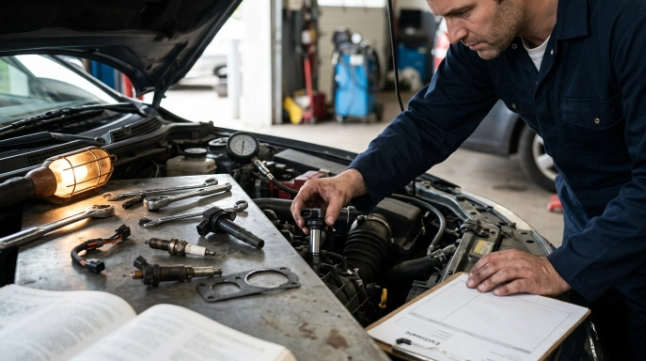
The correct P0306 repair depends entirely on what caused cylinder 6 to misfire. There is no universal P0306 replacement part.
Repairs may involve a simple ignition component or extensive internal engine work. Labor also changes dramatically depending on component access.
Common repairs for P0306
- Replace worn spark plugs when testing confirms they are due or faulty.
- Replace a failed ignition coil or damaged coil boot.
- Repair damaged ignition or injector wiring.
- Clean, service, or replace a faulty fuel injector when testing supports it.
- Repair an intake or vacuum leak.
- Correct a fuel-delivery problem.
- Repair valve-train, compression, head-gasket, or other mechanical damage.
As of 2026, typical service prices vary substantially by vehicle and location. Even the same repair can cost more when intake components must be removed for access.
For context, current national estimates place common spark-plug or ignition-coil service in the low-to-mid hundreds of dollars on many vehicles. Compression testing can also run several hundred dollars before any internal repair begins.
A major valve, cylinder-head, piston, or other internal repair can cost much more. Get a vehicle-specific written estimate after diagnosis rather than budgeting from the P0306 code alone.
Technician’s note: ask the shop what test confirmed the failed component. A diagnostic code alone isn’t proof that a coil, injector, or spark plug needs replacement.
After repair, clear the code only when appropriate and complete the required drive cycle. Then rescan for stored, pending, or returning misfire faults.
Vehicle crashworthiness and broader road-safety research are available through the Insurance Institute for Highway Safety if you want additional independent safety information.
P0306 Frequently Asked Questions
Can a bad spark plug cause P0306?
Yes. A worn, fouled, cracked, or incorrectly functioning spark plug can prevent reliable combustion in cylinder 6 and trigger P0306. Inspect the plug and compare its condition with other cylinders before assuming it is the only problem.
Can a bad ignition coil cause P0306?
Yes. On engines with individual coils, a weak cylinder 6 coil is a common possible cause. Testing the coil is better than replacing it from the code alone because plugs, injectors, wiring, and compression problems can create the same code.
Can a fuel injector cause a cylinder 6 misfire?
Yes. A restricted, electrically faulty, or poorly controlled injector can reduce fuel delivery to cylinder 6. Injector wiring and control should also be checked before replacing the injector itself.
Will P0306 clear itself?
The check-engine light may turn off after enough fault-free driving if the misfire stops. However, diagnostic information can remain stored, and the underlying problem may return if the cause was intermittent.
Can I clear P0306 with an OBD2 scanner?
Most suitable scanners can clear generic powertrain trouble codes. Clearing P0306 doesn’t repair the cause, and doing it too early can erase useful freeze-frame information needed for diagnosis.
What if P0306 comes back after replacing the coil?
Don’t keep replacing ignition parts. Check the spark plug, injector operation, wiring, intake leaks, compression, and related trouble codes to determine whether the misfire has another cause.
Does P0306 always mean cylinder 6 is damaged?
No. P0306 only means the computer detected a misfire associated with cylinder 6. Ignition, fuel, electrical, air-leak, or mechanical faults can all produce that result.
The key takeaway is simple: P0306 tells you where to investigate, not which part to replace. Save your scan data, verify cylinder numbering, and diagnose spark, fuel, air, and compression in a logical order.
If the check-engine light flashes or the engine runs severely rough, stop treating the problem as routine maintenance. Have the vehicle diagnosed before continued driving causes additional damage.
