
10 Best OBD2 Scanners with Full-System Diagnostics in 2026

A check engine light rarely tells the whole story. Modern vehicles pack a dozen or more control modules for the engine, transmission, ABS, SRS airbags, body electronics, and steering, and a fault in any one of them can trip a warning lamp or, worse, stay hidden until something fails. A scanner that reads full-system diagnostics goes past the basic OBD2 port and into these individual modules, pulling codes and live data that a generic reader simply cannot see.
That distinction matters more each model year. Vehicles built after roughly 2018 increasingly rely on CAN-FD and DoIP communication protocols, which older scan tools cannot even connect to, let alone interpret. Picking a scanner that supports these newer protocols, along with true bidirectional control (the ability to send commands to a component instead of just reading its data), separates a serious diagnostic tool from a code reader wearing a bigger screen.
Buyers should weigh update policies, vehicle coverage, and how “bidirectional” a tool truly is before comparing price tags. Some scanners marketed as offering “3000+ active tests” only support a fraction of those tests on any single vehicle, since coverage depends heavily on make, model, year, and sometimes region. We tested and cross-referenced ten of the most relevant scanners on the market to see which ones back up their claims with real diagnostic depth.
Best overall bidirectional scanner: Autel MaxiCOM MK900BT
Best for dealer-level coding: TOPDON ONE
Best value bidirectional scanner: ANCEL DS500BT
Best for maximum active test coverage: XTOOL D7W
Best compact Autel option: Autel MaxiCOM MK808S
Best battery life for shop use: TOPDON AD900 Lite
Best for app-based DIY diagnostics: Innova 5610
Best budget full-system code reader: FOXWELL NT604 Elite
Best for smartphone-paired bidirectional testing: XTOOL A30M V2.0
Best basic code reader for beginners: ANCEL AD310
Autel MaxiCOM MK900BT
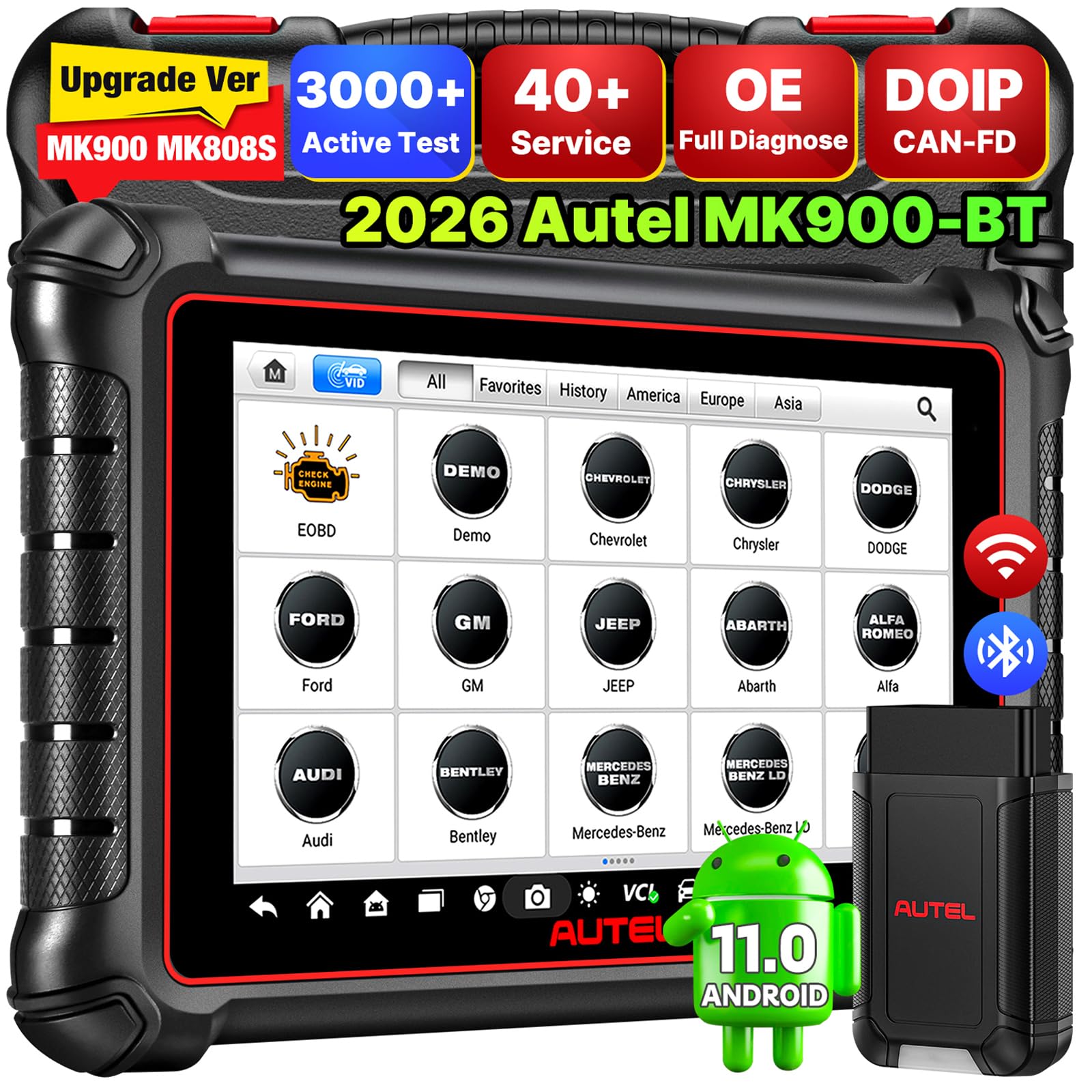
Buy this if full-system coverage, CAN-FD/DoIP support, and shop-grade hardware matter more than saving money on the initial purchase.
Pros
- CAN-FD and DoIP support newer GM, Volvo, Jaguar Land Rover, and BMW models
- Large 8-inch display with 33-foot wireless range
- Auto VIN and license-plate scanning speed up vehicle identification
Cons
- Software renewal after year one carries a real annual cost
- Battery testing and endoscope features require separate accessory purchases
- Advanced functions vary heavily by vehicle
The MK900BT sits at the top of Autel’s consumer-facing lineup, and the hardware shows it: an 8-inch display, quad-core processor, and 7700mAh battery make it feel like a professional-grade tablet rather than a code reader with delusions of grandeur. Bidirectional control extends to a genuinely wide list of active tests, including cooling fans, injectors, and window motors, though actual test availability still depends on the vehicle in the bay.
CAN-FD and DoIP support is the real headline here. These protocols matter for vehicles like 2019+ GM trucks and 2018+ Volvos, where older scan tools simply can’t establish a stable connection to certain modules. Pre- and post-scan comparison reports are useful for confirming a repair actually resolved the fault rather than just clearing a code.
TOPDON ONE
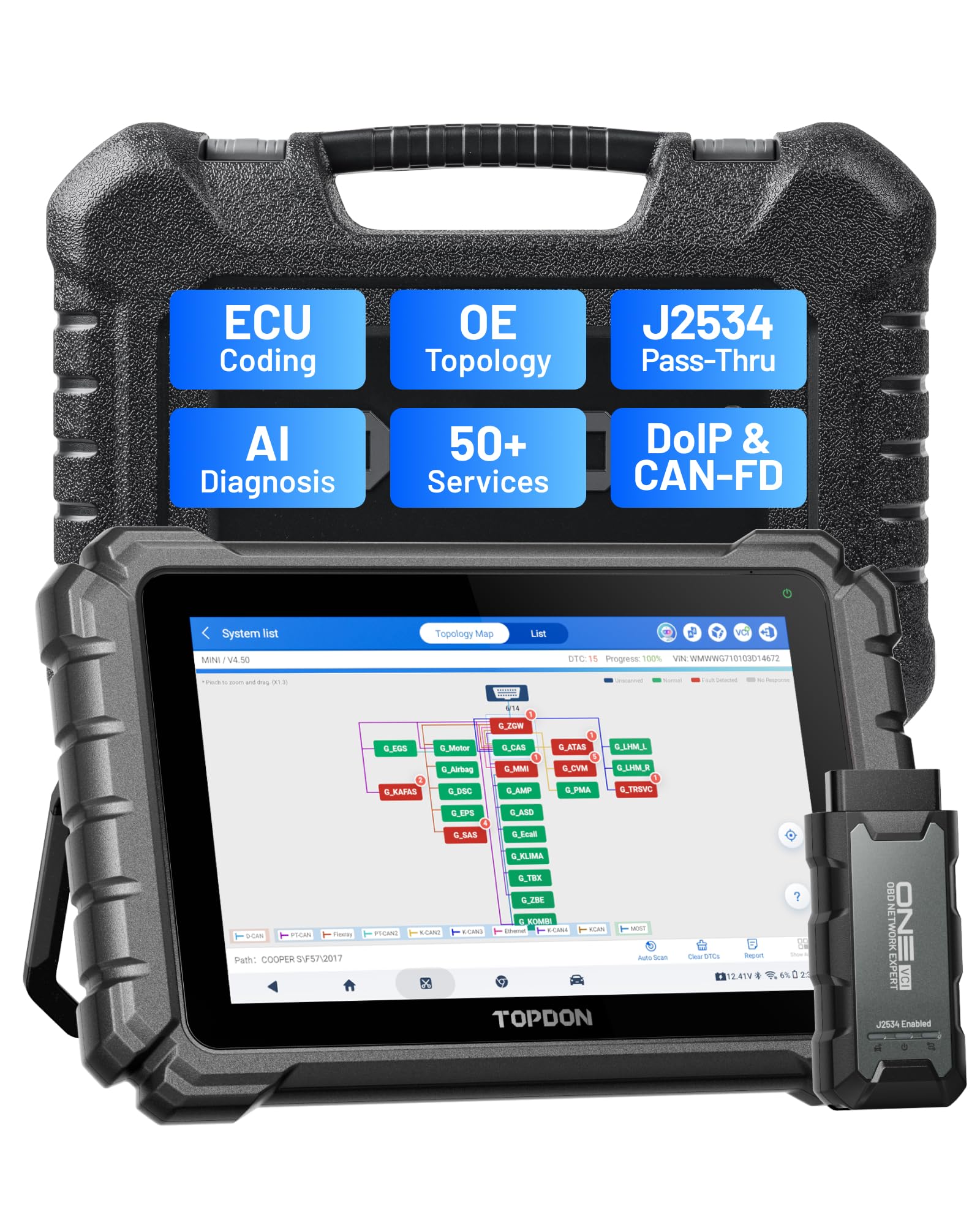
Buy this if the goal is dealer-level ECU coding and pass-thru programming, not just reading and resetting codes.
Pros
- J2534 pass-thru support enables OEM software coding sessions
- OE topology mapping visualizes the actual ECU network for pinpoint diagnosis
- ECU coding and flash support for ten major brands
Cons
- Subscription renewal after year one runs higher than most competitors
- 10.1-inch tablet and VCI add bulk compared to smaller units
- Coding features apply mainly to the ten covered brands, not universal
J2534 is a communication standard that lets a diagnostic tool act as a bridge between a laptop running OEM software (like a factory Ford or GM tool) and the vehicle’s ECUs. Few scanners in this price range support it. The TOPDON ONE does, which opens the door to dealer-level module programming without buying a manufacturer-specific system.
Topology mapping is another standout: it draws the vehicle’s actual module network so a technician can see which control units talk to which, useful for chasing communication faults across a gateway. The AI-assisted fault code lookup speeds up unfamiliar codes, though the subscription cost after the first free year is worth budgeting for before buying.
ANCEL DS500BT
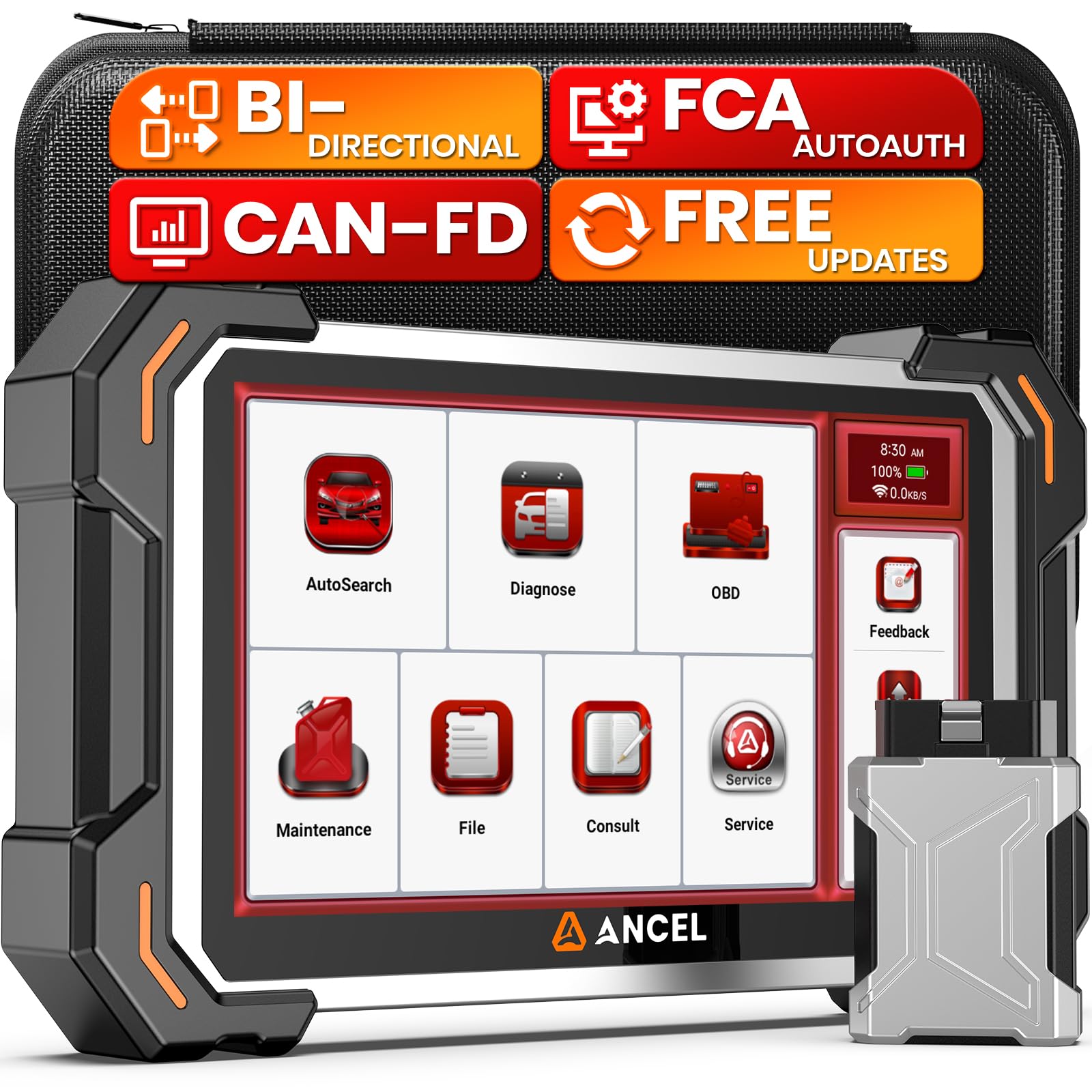
Buy this for full-system bidirectional diagnostics without a recurring software subscription.
Pros
- Lifetime free updates eliminate ongoing renewal fees
- CAN-FD support for newer vehicle networks
- Bluetooth 5.0 wireless connection with a stable range
Cons
- 7-inch screen is smaller than several competitors here
- Menu navigation takes some learning to locate specific functions quickly
- Reports of inconsistent communication with a few newer vehicle models
The DS500BT delivers active-test bidirectional control, full-system scanning, and over two dozen reset functions without the subscription structure that competitors lean on. That lifetime update policy is a meaningful cost difference for owners who plan to keep the tool for years.
Its 28+ service functions cover the resets DIYers request most: oil life, electronic parking brake, steering angle sensor calibration, and battery management resets among them. The interface isn’t as polished as pricier tools, and some owners note occasional connection hiccups on specific late-model vehicles, but the core diagnostic feature set punches well above its price point.
XTOOL D7W
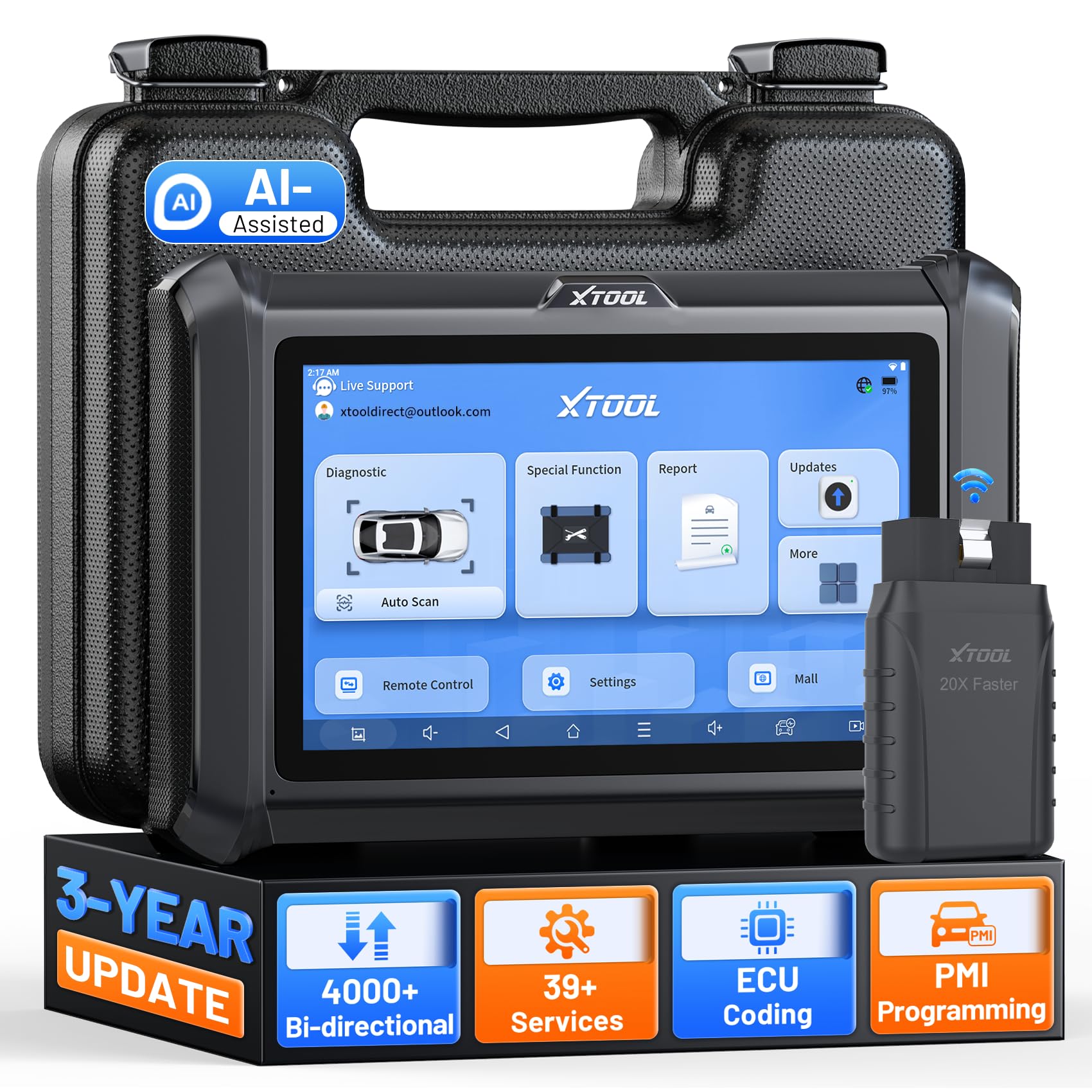
Buy this for the widest advertised active-test library and offline ECU programming through PMI.
Pros
- Claims 4,000+ active tests across a broad vehicle database
- PMI (offline module programming) works without an internet connection
- Three years of included software updates, longer than most rivals
Cons
- Wired power source rather than fully battery-independent operation
- Test counts are aggregated across the vehicle database, not per-vehicle
- Menu depth can slow down first-time users
XTOOL markets the D7W around sheer numbers, and its active-test and vehicle-coverage figures are among the highest in this roundup. Read those figures as a database total, not a guarantee for any single car; a decade-old sedan will see far fewer functions than a current-model truck.
PMI programming (Programming, Matching, Initialization) stands out because it works offline, useful for shops with unreliable internet or urgent repairs mid-shift. ECU coding for Ford, Lincoln, and Mazda modules adds real capability beyond code reading. Three years of free updates is longer than the one-year windows common elsewhere, softening the long-term cost of ownership.
Autel MaxiCOM MK808S
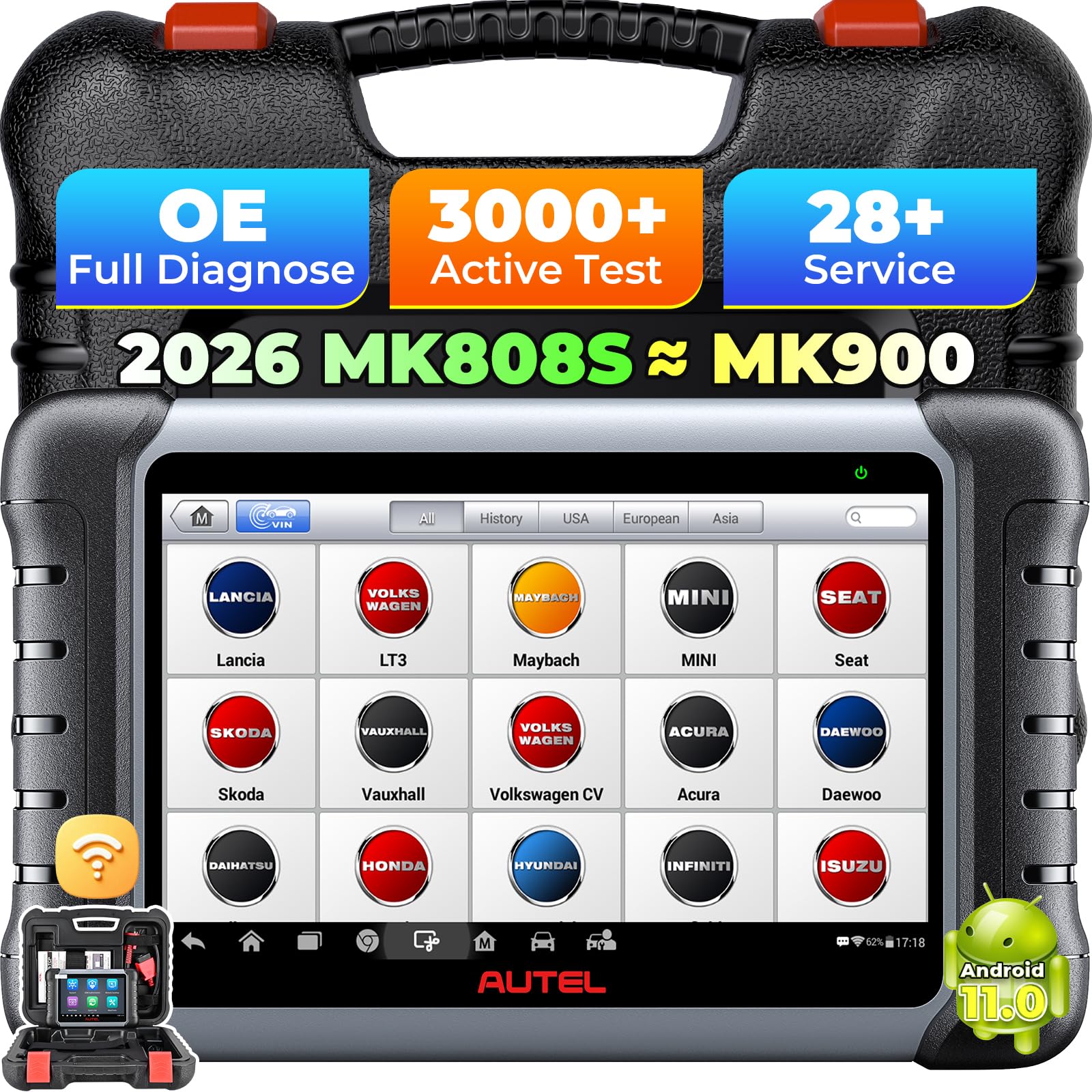
Buy this for Autel’s full-system diagnostic engine in a smaller, more affordable package than the MK900BT.
Pros
- Shares the same 3,000+ active test framework as the flagship MK900BT
- Faster RK3566 processor and Android 11 keep the interface responsive
- Covers 200+ brands with regular update cycles
Cons
- Smaller 7-inch screen compared to 8-inch flagship models
- Lacks CAN-FD/DoIP support found on the MK900BT
- Endoscope and some advanced tools require separate purchases
The MK808S is positioned as an entry point into Autel’s ecosystem, trading the MK900BT’s larger screen and newest protocol support for a lower price while keeping the same active-test architecture underneath. For owners managing a handful of vehicles from the mid-2000s through recent years, that tradeoff makes sense.
Twenty-eight service resets cover the frequent maintenance jobs (oil resets, ABS bleeding, steering angle calibration, battery registration) that used to require a dealer visit. Processing feels notably quicker than older Autel budget models thanks to the updated chipset, though buyers chasing DoIP compatibility for very recent European vehicles should look at the MK900BT instead.
TOPDON AD900 Lite

Buy this for long battery life and lifetime updates on a bidirectional scanner built for repeated daily use.
Pros
- 10,000mAh battery rated for roughly 12 hours of continuous operation
- Lifetime free software upgrades with no subscription
- DTC repair guide adds context to fault codes, not just definitions
Cons
- Only 8 reset service functions, fewer than most competitors here
- DTC repair guide currently focused on specific brands like Chrysler/Dodge/Jeep
- Some owners report inconsistent live-data accuracy on certain cylinders
Battery anxiety is a real problem with tablet-style scanners used all day in a shop, and the AD900 Lite addresses it directly with a 10,000mAh cell that outlasts a full shift. Bidirectional active tests cover the usual suspects (injectors, cooling pumps, window motors) with a stable Bluetooth 5.0 connection up to 33 feet.
Its reset menu is noticeably thinner than rivals like the DS500BT or MK900BT, limited to eight core services rather than two or three dozen. The DTC repair guide, which explains likely causes and repair steps rather than just a code definition, is a helpful touch, though its deepest coverage centers on FCA-brand vehicles for now.
Innova 5610

Buy this for a compact handheld scanner backed by U.S.-based support and a companion repair app.
Pros
- RepairSolutions2 app provides guided repair suggestions from millions of user data points
- No subscription fees for updates
- U.S.-based, English/Spanish phone support during business hours
Cons
- Bidirectional controls only work on select makes and models, not universally
- Small 3.5-inch built-in screen relies on the paired app for full detail
- Advanced systems coverage narrower than tablet-style competitors
The 5610 takes a different form factor than the tablets dominating this list: a compact handheld unit paired with a smartphone app for the deeper diagnostic view. That pairing gives it a distinct advantage for casual DIYers who want plain-language repair guidance rather than a raw list of fault codes.
Bidirectional functions like fuel pump activation or EPB retraction work well on supported vehicles, but Innova is upfront that this isn’t universal across every make. The RepairSolutions2 app, drawing on a large base of user-reported fixes, often nudges owners toward the actual failed part instead of just the triggered code. Owners of less common import models should verify compatibility before buying.
FOXWELL NT604 Elite

Buy this for affordable four-system code reading (engine, ABS, SRS, transmission) without bidirectional control.
Pros
- Reads and clears codes across four major systems out of the box
- AutoVIN quickly identifies the vehicle without manual entry
- Comes with a protective hard case rather than a flimsy pouch
Cons
- No bidirectional control or active tests
- No service reset functions like oil resets or ABS bleeding
- SRS crash/collision data cannot be cleared
The NT604 Elite is a clear-eyed budget pick for owners who want more than a check-engine-only reader without paying for bidirectional features they won’t use. It reads and clears codes on engine, ABS, SRS, and transmission systems, which covers the majority of dashboard warning lights on a typical used vehicle.
It stops short of active tests, coding, or reset procedures, so a stuck EPB or a steering angle sensor that needs recalibrating after an alignment will need a different tool. For diagnosing why a warning light came on across multiple systems, at a fraction of the cost of the bidirectional scanners above, it’s a sound choice.
XTOOL A30M V2.0

Buy this for a Bluetooth dongle-style scanner that pairs bidirectional testing with a smartphone or tablet app instead of a dedicated screen.
Pros
- Lifetime free software updates included
- Full bidirectional control paired with up to 8 live data streams graphed simultaneously
- Compatible with both iOS and Android devices
Cons
- Requires a separate phone or tablet to function, unlike standalone units
- FCA AutoAuth access must be purchased separately through Chrysler’s own site
- Reset menu (26 functions) is capable but not the deepest in this lineup
The A30M skips the built-in tablet entirely, connecting over Bluetooth 4.0 to a paired phone or iPad. That keeps the hardware cost down while still delivering full bidirectional control for active tests like fuel pump activation, injector coding, and window/sunroof operation.
Graphing up to eight live data streams at once is a genuinely useful diagnostic feature for chasing intermittent sensor faults, letting a technician correlate RPM with a suspect signal in real time. FCA AutoAuth support for newer Chrysler, Jeep, and Dodge vehicles is present, though that access requires a separate paid registration through FCA’s own portal, a detail easy to miss at checkout.
ANCEL AD310

Buy this as a no-frills, powered-by-the-car code reader for basic check-engine-light diagnosis, not full-system work.
Pros
- Extremely simple to use with no setup or charging required ** Supports all major OBD2 protocols across a wide vehicle range
- Compact and durable at a low price point
Cons
- Reads emissions-related engine codes only, no ABS, SRS, or transmission access
- No bidirectional control, active tests, or reset functions
- Small monochrome screen with basic data display
The AD310 belongs in this roundup as the baseline against which every bidirectional, full-system tool above should be measured. It plugs into the OBD2 port, draws power directly from the vehicle, and reads or clears emissions-related engine codes in seconds. Nothing more.
That simplicity is the appeal for anyone who just wants to know why the check engine light is on before a parts-store run or a repair decision. It won’t touch ABS, SRS, or transmission modules, and there’s no active testing or service reset capability at all. Treat it as a first diagnostic step, not a replacement for the full-system scanners covered elsewhere in this guide.
Buying Guide
Understand What “Full-System” Actually Means
A true full-system scanner communicates with control modules beyond the engine, typically including ABS, SRS (airbag), transmission, body control, and sometimes steering or climate modules. Basic code readers only access the powertrain module through the standard OBD2 port. Before buying, check whether a listing specifies which systems are covered; “full system” without detail sometimes still means a narrower subset than advertised.
Bidirectional Control vs. Active Tests
Bidirectional control means the scanner can send a command to a component (activate a cooling fan, cycle a window motor, trigger a relay) rather than only reading data from it. This is what separates confirming a suspected failure from just reading a fault code and guessing.
| Capability | What It Confirms | Example |
|---|---|---|
| Code reading | A fault occurred | P0301 misfire cylinder 1 |
| Live data | Current sensor values | Coolant temp reading 210°F |
| Active test | Component responds to command | Cooling fan turns on when commanded |
| Service reset | Module accepts a relearn/reset procedure | Steering angle sensor recalibrated |
CAN-FD and DoIP: Why Newer Protocols Matter
CAN-FD (Controller Area Network Flexible Data-rate) and DoIP (Diagnostics over Internet Protocol) are newer vehicle communication standards used on many models from roughly 2018 onward, especially GM, BMW, Volvo, and Jaguar Land Rover. A scanner without support for these protocols may fail to connect at all on qualifying vehicles, regardless of how many features it advertises elsewhere.
J2534 Pass-Thru and ECU Coding
J2534 is an SAE standard that lets a diagnostic tool act as a communication bridge to run genuine OEM software from a laptop. This matters for module replacement, since many new control units need to be “coded” or flashed with vehicle-specific data before they’ll function correctly. Scanners without J2534 or coding support can diagnose a failed module but can’t finish the repair on newer vehicles.
Update Policies and Long-Term Cost
Software update policies vary widely: some tools include one free year before charging an annual renewal, others advertise lifetime free updates. A tool with a lower purchase price but an expensive yearly renewal can cost more over three years than a pricier tool with lifetime updates. Confirm this before comparing prices directly.
Vehicle Compatibility Checks
No scanner supports every function on every vehicle. Manufacturers frequently note that active tests, resets, and coding availability depend on the specific make, model, year, and sometimes region. Checking a coverage list or contacting the seller with a VIN before purchase avoids disappointment after the return window closes.
Wired vs. Wireless Operation
Wireless VCI (vehicle communication interface) modules let a technician walk around the car during active tests, useful for watching a component respond in real time rather than running back to a screen tethered to the OBD2 port. Wired setups are simpler and have one less battery to manage, but limit mobility during diagnosis.
Editor’s Choice
The Autel MaxiCOM MK900BT earns the top spot for combining genuine full-system diagnostics, CAN-FD/DoIP support, and a deep bidirectional active-test library in one package. Its hardware, screen size, and update ecosystem hold up against tools costing significantly more, and Autel’s broad vehicle database means most owners will find real coverage for their cars, not just a database entry.
For technicians who need dealer-level coding and pass-thru programming, the TOPDON ONE is the strongest choice thanks to its J2534 support and OE topology mapping. Owners who want capable full-system diagnostics without a subscription should look at the ANCEL DS500BT, which delivers lifetime updates at a lower price than either flagship tool.
Buyers still deciding between a basic code reader and a full bidirectional scanner should weigh how often ABS, SRS, or transmission issues actually come up on their vehicles. That answer determines whether the investment in a full-system tool pays off.
Conclusion
Choosing among these ten scanners comes down to matching the tool’s real diagnostic depth to the repairs a reader actually performs. A DIYer chasing an intermittent check-engine light doesn’t need J2534 pass-thru coding, while a mobile technician replacing control modules for clients will find that feature essential.
Coverage claims like “3000+ active tests” or “40+ services” describe a database total, not a guarantee for any individual vehicle. Confirming compatibility with a VIN before buying, understanding whether updates are free or subscription-based, and knowing whether “bidirectional” means true component control or just data display will prevent an expensive mismatch. Match the tool to the repairs planned, not just the spec sheet.
FAQS
What does “full-system diagnostics” mean on a scan tool?
It means the scanner can communicate with control modules beyond the engine, such as ABS, SRS, transmission, and body control modules, rather than only reading powertrain codes through the basic OBD2 connection.
Is a bidirectional scan tool worth the extra cost over a basic code reader?
For anyone diagnosing components rather than just reading warning lights, yes. Bidirectional control lets a technician command a part to activate and confirm whether it responds correctly, which a basic reader cannot do.
Do all these scanners work on every car?
No. Active tests, service resets, and coding functions depend on the specific make, model, and year. Checking a coverage list or vehicle compatibility tool before purchase is worth the few extra minutes.
What is CAN-FD and why does it matter?
CAN-FD is a newer vehicle communication protocol used on many 2018-and-later vehicles, particularly from GM, BMW, Volvo, and Jaguar Land Rover. Scanners without CAN-FD support may fail to connect to certain modules on these vehicles entirely.
Do I need J2534 pass-thru support?
Only if planning to replace and code new control modules using OEM software. DIYers focused on diagnosing and resetting existing systems typically don’t need it.
Are lifetime software updates actually free forever?
Manufacturers describe “lifetime” as tied to the product’s supported lifecycle, not a legal guarantee of indefinite updates. It still generally means no recurring subscription fee compared to tools charging annual renewals.
