
P0730 Symptoms: Signs of an Incorrect Gear Ratio

Quick Answer
Common P0730 symptoms include a check engine light, transmission slipping, delayed or harsh shifts, unusually high engine RPM, poor acceleration, and reduced fuel economy. P0730 means the powertrain computer detected an incorrect transmission gear ratio, but the code does not identify the failed part by itself. Transmission slipping and delayed shifting deserve prompt diagnosis; AAA’s repair facility locator can help drivers who need professional transmission diagnosis.
P0730 symptoms to watch for
- Check engine light: The PCM or TCM may store P0730 after detecting a gear ratio that does not match its expected value.
- Transmission slipping: Engine speed may rise without a matching increase in vehicle speed.
- Delayed shifting: The transmission may hesitate before changing gears or engaging Drive.
- Harsh shifts: Gear changes may feel unusually firm, abrupt, or jerky.
- Weak acceleration: The vehicle may struggle to transfer engine power effectively to the wheels.
- Higher fuel use: Incorrect gear operation can keep engine RPM above its normal range.
What to do next
- Read all stored, pending, and related transmission codes before replacing any components.
- Avoid continued driving if the transmission slips badly, overheats, loses drive, or shifts unpredictably.
P0730 symptoms can feel alarming because they often involve the automatic transmission itself. An OBD2 scanner may show “P0730 Incorrect Gear Ratio,” but that description is only the beginning of the diagnosis.
I treat this code as evidence that the transmission is not producing the ratio the computer expects. I do not treat it as proof that the entire transmission has failed.
In This Guide
What Does P0730 Mean?
P0730 is a generic OBD2 powertrain trouble code that means Incorrect Gear Ratio. It is commonly associated with automatic transmission operation.
The transmission control system compares how fast different parts of the drivetrain are rotating. If the calculated ratio does not match the ratio expected for the commanded gear, the computer can store P0730.
Definition: A gear ratio describes the relationship between transmission input speed and output speed. P0730 appears when the vehicle detects that this relationship is outside the expected range.
The PCM, or powertrain control module, may manage both engine and transmission functions on some vehicles. Other models use a separate TCM, or transmission control module.
These modules rely on information such as input speed, output speed, throttle position, vehicle speed, and commanded gear. That is why P0730 can have electrical, hydraulic, or mechanical causes.
Does P0730 tell you which gear is bad?
No. P0730 is a general incorrect-ratio code and normally does not identify one specific gear.
Codes such as P0731, P0732, P0733, P0734, P0735, and P0736 are more specific. They identify incorrect ratios involving individual forward gears or reverse.
If several transmission codes appear together, save all of them before clearing anything. The combination can give a technician much more useful diagnostic information.
Technician’s note: Use the factory service information for your exact year, make, model, engine, and transmission before interpreting live-data values.
What Are the Most Common P0730 Symptoms?
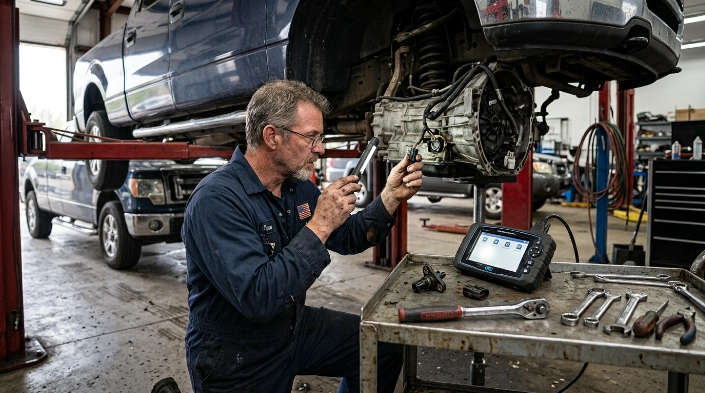
The most recognizable P0730 symptoms are transmission slipping, abnormal shifts, and a check engine light. Some vehicles have obvious drivability problems, while others show only a warning light at first.
1. Check engine light
A check engine light may be the first symptom. An OBD2 scanner can then reveal P0730 along with any related transmission codes.
Do not assume the light means the transmission needs replacement. A diagnostic trouble code identifies a condition the computer detected, not automatically the component that caused it.
2. Transmission slipping
Slipping often feels like the engine suddenly revs without a proportional increase in road speed. The vehicle may briefly feel as though the transmission has lost its grip.
AAA also describes transmission slipping as engine speed rising more than expected for the vehicle’s speed. Slipping can accompany delayed acceleration, surging, or difficulty maintaining speed.
3. Delayed or incorrect shifting
You may notice the transmission holding a gear longer than normal. It can also hesitate before an upshift or downshift.
Another possibility is delayed engagement when selecting Drive or Reverse. The exact behavior depends heavily on the transmission design and the underlying fault.
- Late shifts: Engine RPM climbs before the next gear engages.
- Harsh shifts: Gear changes feel like a jolt or sudden bump.
- Gear hunting: The transmission repeatedly changes between ratios.
- Limited shifting: The vehicle may stay in one gear as part of a protective strategy.
4. Weak acceleration or unusual RPM
A faulty ratio can prevent engine power from reaching the wheels efficiently. You might press the accelerator and hear the engine rev without getting the acceleration you expect.
Watch the tachometer if the vehicle has one. An unusual RPM flare during a shift can be an important clue.
5. Reduced fuel economy
Fuel consumption can increase if the transmission remains in an unsuitable ratio. The engine may run at higher RPM than necessary during normal driving.
This symptom alone does not prove P0730. It becomes more meaningful when paired with slipping, delayed shifts, and a stored incorrect-ratio code.
6. Transmission noise, heat, or burning odor
Some underlying transmission problems also produce whining, grinding, overheating, or a burning smell. Those signs deserve quicker attention.
AAA notes that degraded or low transmission fluid can contribute to poor shifting, unusual noises, and slipping. A fluid leak can also reduce the hydraulic pressure an automatic transmission needs.
Section Takeaway: P0730 symptoms range from a warning light to obvious slipping and harsh shifting. The more severe the drivability symptoms become, the less sense it makes to continue driving normally.
What Causes a P0730 Code?
P0730 can result from several different faults because the computer only knows that the actual ratio does not match the expected ratio. It does not automatically know why.
Common possibilities include the following:
- Low transmission fluid: Insufficient fluid can reduce hydraulic pressure and interfere with clutch or gear engagement.
- Degraded or contaminated fluid: Fluid condition can affect lubrication, cooling, and hydraulic operation.
- Shift solenoid problems: A faulty solenoid or control circuit may prevent the transmission from applying the intended hydraulic circuit.
- Speed-sensor problems: Incorrect input or output speed information can affect ratio calculations.
- Wiring or connector faults: Corrosion, damaged wiring, poor terminals, or intermittent connections can disrupt sensor or solenoid signals.
- Valve-body or hydraulic problems: Restricted passages or pressure-control faults can keep a clutch from applying correctly.
- Torque converter problems: Certain converter faults can affect expected speed relationships.
- Internal transmission wear: Worn clutches, bands, or other mechanical components may allow excessive slip.
A common mistake is replacing a speed sensor because a scanner displays an incorrect-ratio code. The sensor should be tested before replacement.
I approach P0730 the same way I approach electrical faults during broader vehicle diagnostic work: preserve the evidence first. Clearing every code before recording freeze-frame and live data can erase clues you needed.
Technician’s note: Never add transmission fluid until you confirm the correct fluid specification and level-check procedure for that vehicle. Some transmissions use temperature-dependent or sealed-system procedures.
How Is P0730 Diagnosed?
Good P0730 diagnosis starts with the scanner, but it should not end there. The goal is to determine whether the ratio error comes from bad data, hydraulic control, or internal mechanical slip.
- Scan every relevant module. Record P0730 plus any speed-sensor, solenoid, pressure, communication, or gear-specific codes.
- Save freeze-frame information. Note speed, RPM, temperature, load, and other available data captured when the fault occurred.
- Check transmission fluid correctly. Look for low level, leakage, contamination, or an abnormal burnt odor using the manufacturer’s procedure.
- Inspect accessible wiring. Check relevant connectors and harness sections for corrosion, looseness, rubbing, or fluid intrusion.
- Review live transmission data. A capable scan tool may display commanded gear, input speed, output speed, shift-solenoid status, and transmission temperature.
- Follow factory tests. Pressure testing, circuit testing, or internal inspection may be required depending on the results.
What can an OBD2 scanner tell you?
A basic scanner can confirm the trouble code. A more capable tool may access transmission-module codes and useful live data.
| Finding | What It May Suggest | Useful Next Check |
|---|---|---|
| P0730 only | General ratio mismatch | Fluid condition and live ratio data |
| P0730 plus gear-specific ratio code | Problem may be concentrated around a particular commanded ratio | Factory diagnostic procedure for that gear |
| P0730 plus speed-sensor code | Ratio calculation may be affected by an unreliable speed signal | Sensor data, wiring, connector, and circuit tests |
| RPM flare during shift | Possible clutch, hydraulic, or pressure-related slip | Fluid and manufacturer-specified hydraulic tests |
| Multiple transmission codes | A broader electrical, hydraulic, or control problem may exist | Diagnose codes together instead of replacing parts individually |
The important point is simple: scan data narrows the investigation. It does not replace mechanical testing.
Technician’s note: Advanced transmission diagnosis can require a professional scan tool, wiring information, pressure gauges, and manufacturer-specific test procedures.
Can You Drive With a P0730 Code?
You should treat P0730 as a code that needs prompt attention, especially when slipping or unpredictable shifting is present. Continued driving can create additional heat and may worsen an existing transmission problem.
A short trip may feel normal if the only symptom is a steady warning light. That does not guarantee the transmission is healthy.
Stop driving if these symptoms appear
- The transmission repeatedly slips out of gear.
- The vehicle loses forward or reverse movement.
- A transmission-temperature warning appears.
- You smell strong burning fluid.
- Shifting becomes violent or unpredictable.
- The vehicle cannot maintain speed safely in traffic.
Vehicle-specific warnings should always take priority. Check the owner’s manual because some manufacturers specifically instruct drivers to stop when particular transmission warnings appear.
You can also use the NHTSA recall lookup to check whether your VIN has an open safety recall related to the drivetrain or another vehicle system.
Safety note: If the car cannot accelerate, shift, or maintain speed predictably, arranging a tow is safer than trying to drive it to a repair shop.
How Is P0730 Fixed?

The correct P0730 repair depends on the confirmed cause. There is no single component that should automatically be replaced when this code appears.
Possible repairs can include:
- Correcting a transmission fluid level problem and repairing the source of a leak.
- Servicing degraded fluid when the manufacturer specifies that service.
- Repairing damaged wiring, connectors, grounds, or control circuits.
- Replacing a failed input or output speed sensor after testing confirms the fault.
- Repairing a confirmed shift-solenoid or valve-body problem.
- Repairing a torque converter problem when testing identifies it as the cause.
- Repairing or rebuilding internal transmission components when mechanical wear is confirmed.
Repair cost varies enormously because a wiring repair and an internal transmission rebuild are completely different jobs. Make, model, transmission design, labor rates, parts availability, and the damaged components all affect the final bill.
AAA’s information on common car problems notes that transmission slipping can come from fluid problems, worn internal components, or torque-converter faults. Its repair guidance also shows why proper diagnosis matters before approving expensive transmission work.
For professional help, the AAA Approved Auto Repair search lets drivers filter facilities that perform automatic transmission service.
Technician’s note: Ask for the diagnostic results that support an expensive repair. A P0730 code alone does not prove that a complete transmission replacement is necessary.
P0730 Symptoms FAQ
What is the main symptom of P0730?
Transmission slipping is one of the most recognizable P0730 symptoms. The engine may rev higher without a matching increase in vehicle speed, although some vehicles initially show only a check engine light or abnormal shifting.
Can low transmission fluid cause P0730?
Yes, low transmission fluid can contribute to incorrect-ratio problems because an automatic transmission relies on proper hydraulic pressure. However, the fluid should be checked using the manufacturer’s procedure before adding any, since level-check methods differ between vehicles.
Can dirty transmission fluid cause an incorrect gear ratio code?
Degraded or contaminated fluid can contribute to poor hydraulic operation and slipping. Fluid condition is therefore an important early check, but changing fluid is not a guaranteed fix for P0730 if mechanical, electrical, or control problems already exist.
Will a bad speed sensor cause P0730?
A faulty input or output speed signal can interfere with the computer’s gear-ratio calculation. A sensor-related code, erratic live data, or failed circuit test provides stronger evidence than P0730 by itself.
Can I clear P0730 with an OBD2 scanner?
A scanner may clear the stored code, but clearing it does not repair the fault. If the incorrect ratio occurs again, the code can return after the vehicle’s diagnostic system detects the condition again.
Does P0730 mean I need a new transmission?
No. P0730 can result from fluid problems, sensors, wiring, solenoids, hydraulic faults, a torque converter, or internal transmission damage. A complete replacement should only be considered after proper testing identifies serious internal failure.
Is P0730 the same as P0731?
No. P0730 is a general incorrect gear ratio code. P0731 specifically indicates an incorrect ratio associated with first gear, while related codes identify other individual gears or reverse.
The key takeaway is to diagnose P0730 before buying parts. Record every code, pay attention to the symptoms, inspect the basics, and use vehicle-specific service information before deciding what needs repair.
If your vehicle is slipping badly, overheating, or losing drive, stop treating it as a scanner-code problem and treat it as a drivability problem. A qualified transmission technician can test the system before more damage develops.
“`
