
P0135 Symptoms: What You’ll Notice Before Replacing Parts

P0135 symptoms usually start with a check engine light, poor fuel economy, rough cold starts, and higher emissions. The code points to the heated oxygen sensor heater circuit on Bank 1 Sensor 1, not always the oxygen sensor itself.
- Most common sign: check engine light.
- Most useful clue: rough cold start.
- Most common mistake: replacing parts without testing wiring.
- First action: scan the code and inspect the connector.
If your scanner shows P0135, your car is telling you the upstream oxygen sensor heater circuit is not working as expected.
That sounds technical, but the driver symptoms are simple. You’ll usually notice the problem most during the first few minutes after starting the engine.
This takes about 8 minutes to read. Start with the symptoms, then check the circuit clues before buying parts.
Key insight: P0135 is a heater circuit code. A bad oxygen sensor can cause it, but damaged wiring, corrosion, a blown fuse, or poor ground can trigger the same code.
P0135 Symptoms You Will Notice First

P0135 symptoms often feel mild because the oxygen sensor can still work after the exhaust gets hot.
The built-in heater helps Bank 1 Sensor 1 reach working temperature fast. When that heater fails, the engine control module gets delayed oxygen feedback during cold operation.
- Check engine light stays on.
- Engine runs rough after a cold start.
- Fuel economy drops.
- Exhaust smell gets stronger.
- Idle feels unstable for 1–3 minutes.
- Vehicle fails an emissions test.
- P0135 returns after clearing the code.
The check engine light is the strongest symptom. Many drivers feel no major drivability change because exhaust heat eventually warms the oxygen sensor.
That is why P0135 gets ignored. The car still drives, but fuel control and emissions control work slower during warm-up.
IMAGE SUGGESTION: Dashboard check engine light with an OBD2 scanner showing code P0135.
ALT TEXT: P0135 symptoms dashboard check engine light with OBD2 scanner code
Why Cold Starts Make P0135 Symptoms Worse
P0135 symptoms show up most during cold starts because the oxygen sensor needs heat to read exhaust oxygen correctly.
Bank 1 Sensor 1 sits before the catalytic converter. It helps the engine control module adjust the air-fuel mixture after startup.
When the heater circuit fails, the sensor warms only from exhaust heat. That delay can make the engine run rich longer than normal.
Tip: If the engine runs rough only when cold, look at the oxygen sensor heater circuit before blaming the catalytic converter.
The U.S. federal OBD rule says onboard diagnostic systems must detect emission-control malfunctions, store trouble codes, and alert drivers through the warning system. You can review the official rule here: federal onboard diagnostics requirements.
California Air Resources Board OBD II language also requires heated oxygen sensor heaters to be monitored for proper performance. See the official reference here: CARB OBD II oxygen sensor monitoring rules.
P0135 Symptoms vs Bad O2 Sensor Symptoms
P0135 does not always mean the oxygen sensor signal is bad. It means the heater circuit for the upstream oxygen sensor has a fault.
This difference matters because replacing the sensor without checking power, ground, wiring, and connectors can leave the same code active.
The table below separates driver symptoms from circuit clues.
| Symptom or clue | What it suggests | First check |
|---|---|---|
| Check engine light with P0135 | Heater circuit fault | Scan freeze-frame data |
| Rough idle only when cold | Delayed sensor warm-up | Check heater resistance |
| Fuel smell at startup | Rich warm-up operation | Check fuel trim data |
| P0135 returns after sensor replacement | Wiring, fuse, ground, or ECM driver issue | Test power and ground |
Key conclusion: A bad oxygen sensor is one possible cause, but P0135 is a circuit diagnosis first.
Scan Tool Clues That Confirm P0135
A scan tool can show whether P0135 is a current fault, pending fault, or stored history code.
Start with freeze-frame data. If the code set near startup with low coolant temperature, the heater circuit becomes the main suspect.
- P0135 stored as current or pending.
- Freeze frame shows cold engine temperature.
- Heated oxygen sensor monitor stays incomplete.
- O2 heater current test fails.
- Related codes appear, such as P0130 or P0141.
You might think clearing the code proves the issue was minor. Clearing the code only resets the monitor and erases useful data.
Drive the vehicle through a complete warm-up cycle after repairs. If P0135 returns, the fault still exists in the heater circuit path.
What Most People Get Wrong About P0135 Symptoms
Most people treat P0135 like a simple “replace the O2 sensor” code. That shortcut wastes money when the circuit has a wiring fault.
The oxygen sensor heater circuit includes the sensor heater element, connector pins, wiring harness, fuse feed, ground control, and engine control module command.
P0135 Is Not A Slow O2 Sensor Code
A slow oxygen sensor code points to sensor response. P0135 points to the heater circuit that helps the sensor warm up.
That difference changes the repair path. A signal issue needs sensor data review, while P0135 needs electrical testing first.
New Sensors Do Not Fix Bad Wiring
A new Bank 1 Sensor 1 oxygen sensor will not fix an open power wire, corroded connector, damaged ground, or blown heater fuse.
This is common near hot exhaust areas. Heat, road salt, oil leaks, and poor routing can damage the harness before the sensor fails.
One Code Does Not Mean Replace Every Sensor
P0135 identifies Bank 1 Sensor 1. That is the upstream sensor on the bank that contains cylinder 1.
Replacing downstream sensors or both sides without matching codes adds cost without solving the heater circuit fault.
Warning: Do not replace the catalytic converter for P0135 alone. This code starts with the upstream oxygen sensor heater circuit.
What To Do Based On Your Symptoms
Your next step depends on how the car behaves, not only on the code number.
Use this decision block before buying a sensor or paying for a repair.
- Check engine light only: inspect the connector and wiring first.
- Rough cold start: test heater power, ground, and resistance.
- Fuel smell or black smoke: check fuel trim and related codes.
- Failed emissions test: repair before retesting the vehicle.
- P0135 after new sensor: test fuse feed and ECM control.
- Flashing check engine light: stop driving and scan for misfire codes.
The best first physical check takes under two minutes. Look at the Bank 1 Sensor 1 connector near the exhaust and check for melted plastic, loose pins, oil contamination, or broken wires.
IMAGE SUGGESTION: Close-up of upstream oxygen sensor connector near exhaust manifold with damaged wire insulation.
ALT TEXT: P0135 symptoms oxygen sensor heater circuit damaged connector inspection
Can You Drive With P0135 Symptoms?
You can drive short distances with P0135 when the engine runs smoothly, the check engine light is steady, and there is no overheating.
Do not ignore it for weeks. The vehicle can burn extra fuel during warm-up, produce higher emissions, and fail inspection readiness checks.
Stop driving and scan again if the check engine light flashes, the engine stalls, the vehicle loses power, or you smell raw fuel. Those signs point to a more urgent fault than the heater circuit alone.
Tip: Fix P0135 before an emissions test. Clearing the code right before testing can reset readiness monitors and cause a failed inspection.
P0135 Diagnosis Checklist Before Repair
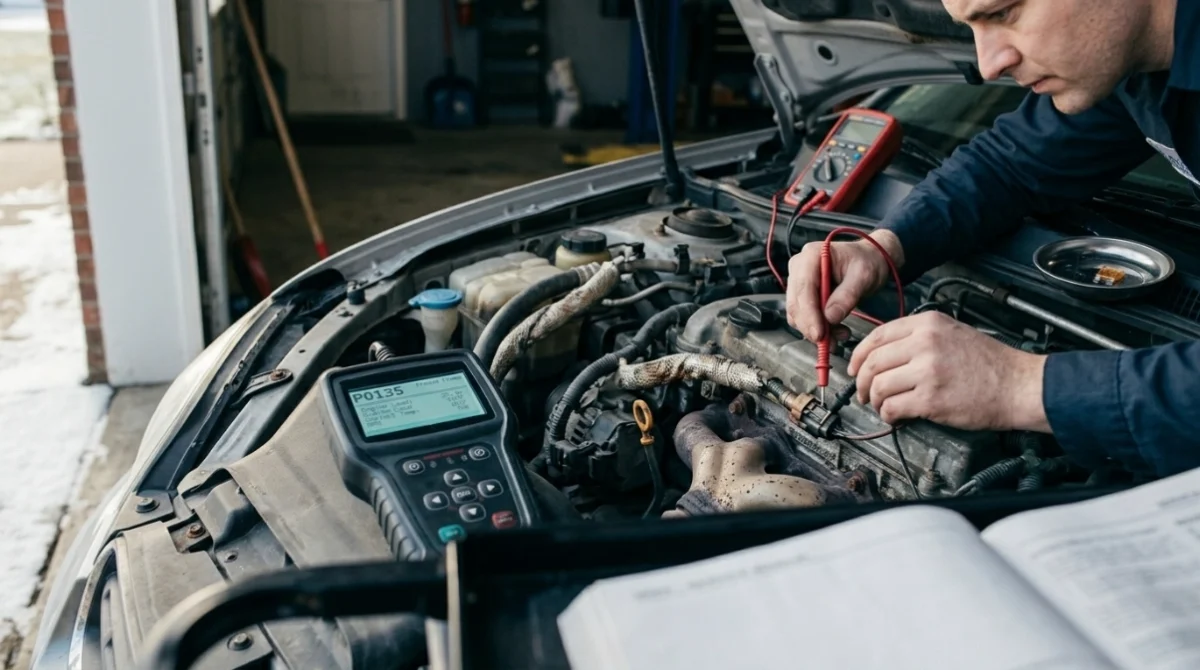
A correct P0135 diagnosis starts with proof. Test the circuit before replacing the sensor.
Follow this order to avoid repeated repairs.
- Confirm P0135 with an OBD2 scanner.
- Record freeze-frame data before clearing codes.
- Inspect Bank 1 Sensor 1 wiring and connector.
- Check the heater fuse and relay path.
- Test heater power and ground at the connector.
- Compare heater resistance with the service manual.
- Clear the code and complete a warm-up drive cycle.
A failed heater element means the upstream oxygen sensor needs replacement. Missing power, missing ground, or excessive resistance in wiring means the circuit needs repair first.
This order protects you from the most common P0135 mistake: buying a sensor when the connector or fuse caused the fault.
P0135 symptoms usually point to a heated oxygen sensor heater circuit problem, not an automatic oxygen sensor replacement.
As vehicles keep adding stricter emissions monitoring, cold-start sensor performance will matter even more.
Scan the code, save the freeze-frame data, then inspect the Bank 1 Sensor 1 connector today.
Frequently Asked Questions
Will P0135 cause a no-start problem?
P0135 alone does not usually cause a no-start problem. The heater circuit affects oxygen sensor warm-up after the engine starts. If the engine will not start, scan for battery, crankshaft sensor, fuel delivery, immobilizer, or misfire-related codes.
Is Bank 1 Sensor 1 the upstream oxygen sensor?
Yes, Bank 1 Sensor 1 is the upstream oxygen sensor before the catalytic converter on the bank with cylinder 1. Inline engines usually have one bank. V6 and V8 engines use Bank 1 and Bank 2, so location must match the engine layout.
Can a blown fuse cause P0135 symptoms?
Yes, a blown fuse can trigger P0135 when that fuse feeds the oxygen sensor heater circuit. The sensor heater needs power and ground to warm the sensor. If power is missing, a new oxygen sensor will not solve the code.
Does P0135 affect fuel economy?
P0135 can reduce fuel economy, mainly during warm-up. The oxygen sensor can take longer to provide stable feedback, so the engine control module can run a richer mixture longer than normal. The fuel loss grows with short trips and frequent cold starts.
Will P0135 fail an emissions test?
Yes, P0135 can fail an emissions test because it keeps an emission-related diagnostic code active. Clearing the code before testing can also reset readiness monitors. Repair the heater circuit, complete the drive cycle, and confirm monitors are ready before retesting.
