
How to Fix P0740: Causes, Diagnosis & Repair

Quick Answer
To fix P0740, first confirm the code and related transmission faults with an OBD2 scanner. Then check the transmission fluid correctly, inspect the torque converter clutch wiring and connectors, review TCC live data, and test the solenoid circuit to the manufacturer’s specifications before replacing parts. The correct fluid and level matter, as explained in AAA’s automatic transmission fluid guidance.
What to Check First
- Scan all codes: Save P0740, companion codes, pending faults, and freeze-frame information before clearing anything.
- Check the fluid: Verify level, condition, leaks, and the exact fluid specification required by your vehicle.
- Inspect wiring: Look for damaged insulation, corroded terminals, loose connectors, fluid intrusion, and heat damage.
- Watch TCC data: If supported, compare torque converter clutch command with slip speed and transmission speed data.
- Test before replacing: Check the solenoid and circuit using your vehicle’s wiring diagram and factory specifications.
- Confirm mechanical faults: Don’t condemn the torque converter until electrical and hydraulic causes have been ruled out.
Best Next Step
- Diagnose the failed circuit or component first, then repair that confirmed cause instead of replacing a TCC solenoid or torque converter based only on P0740.
If your OBD2 scanner has displayed P0740, don’t assume the torque converter itself has failed. The code tells you the transmission computer detected a problem involving torque converter clutch control, but several electrical, hydraulic, and mechanical faults can produce that result.
I approach P0740 as a diagnosis problem rather than a parts-replacement instruction. The checks below move from simple evidence to more involved testing so you can avoid replacing good components.
In This Guide
What Does P0740 Mean?
P0740 is a generic OBD-II powertrain diagnostic trouble code associated with a torque converter clutch circuit malfunction. The exact detection logic and repair procedure can differ by vehicle manufacturer, model, year, and transmission design.
The torque converter connects the engine to an automatic transmission through fluid. Inside it, a torque converter clutch can create a more direct connection under suitable driving conditions.
Definition: The torque converter clutch, often shortened to TCC, is an internal clutch used to reduce torque-converter slip when the transmission control system commands lockup.
The PCM or transmission control module controls that clutch through an electrical and hydraulic system. Depending on the design, that system may include a TCC solenoid, valve-body passages, wiring, connectors, transmission fluid, and the converter clutch itself.
P0740 therefore doesn’t automatically mean “replace the torque converter.” It means the control system has detected behavior it considers incorrect.
How Is P0740 Different From P0741 and P0743?
Several nearby trouble codes relate to the same system. Reading every stored and pending code can make the diagnostic direction much clearer.
| Code | General Meaning | Diagnostic Focus |
|---|---|---|
| P0740 | Torque converter clutch circuit malfunction | TCC control circuit, solenoid operation, hydraulic control, and converter response |
| P0741 | TCC performance or stuck-off condition | Whether the clutch actually applies and achieves expected lockup |
| P0743 | TCC solenoid circuit electrical fault | Wiring, connectors, solenoid circuit, power, ground, and control |
Manufacturers may use slightly different wording or additional subcodes. Always use service information for your exact vehicle when performing electrical tests.
What Symptoms Can P0740 Cause?

P0740 may cause nothing more than a check engine light, especially when the fault is intermittent. Other vehicles can show obvious transmission symptoms when the TCC cannot apply or release correctly.
- Check engine light: P0740 may be stored even when the vehicle still seems to drive normally.
- Higher cruising RPM: Engine speed may remain higher because the converter clutch isn’t locking as expected.
- Reduced fuel economy: Continued converter slip can reduce drivetrain efficiency.
- Shuddering: A clutch that applies unevenly may create vibration during lockup.
- Transmission heat: Excessive converter slip can create additional heat.
- Unusual shifting: Some vehicles may change shift strategy or enter a protective mode.
- Stalling at a stop: On some faults, a clutch that fails to release can make the engine struggle or stall as the vehicle stops.
Symptoms alone can’t identify the failed component. A shudder, for example, can have several causes beyond the TCC system.
Locksmith’s diagnostic note: transmission faults are one place where reading the full scan report matters. One code by itself rarely gives enough evidence to justify an expensive repair.
What Causes a P0740 Code?
The most common diagnostic areas include the TCC electrical circuit, solenoid control, transmission fluid, valve body, and torque converter. The priority depends on related codes and what the live data shows.
1. Damaged Wiring or a Poor Connector
A broken wire, rubbed harness, loose terminal, corrosion, or fluid-contaminated connector can interrupt the TCC control circuit. Heat around the transmission can also harden insulation over time.
This is why visual inspection comes before expensive parts. An electrical problem can make a perfectly good solenoid appear faulty.
2. Faulty Torque Converter Clutch Solenoid
The TCC solenoid helps control hydraulic pressure to the converter clutch. An electrical failure or mechanically sticking solenoid can prevent normal operation.
Don’t replace it because the code contains the words “clutch circuit.” Test the solenoid and its circuit using manufacturer specifications first.
3. Incorrect, Low, or Contaminated Transmission Fluid
Automatic transmission fluid does more than lubricate parts. It also acts as the hydraulic medium used to apply clutches and operate valves.
- Low level: A leak or incorrect fill can disturb hydraulic operation.
- Wrong fluid: Using a fluid outside the required specification can affect shift and clutch behavior.
- Overfilled fluid: Excess fluid can also cause operating problems.
- Burnt or contaminated fluid: This may point toward overheating or internal wear.
Many newer transmissions don’t have a traditional dipstick. Follow the manufacturer’s temperature and level-check procedure rather than guessing.
4. Valve Body or Hydraulic Problem
A sticking valve, restricted passage, pressure problem, or worn valve body can keep hydraulic pressure from reaching the TCC correctly. This can resemble an electrical or solenoid problem.
Hydraulic diagnosis usually needs more than a basic code reader. A transmission-capable scanner and factory test information can narrow the fault.
5. Torque Converter Clutch Failure
The clutch inside the converter can wear, overheat, or fail mechanically. That becomes more likely when the electrical circuit tests correctly but commanded lockup still doesn’t produce the expected response.
A failed converter is a major repair, so confirm the diagnosis first. Replacing one without testing the control side can leave the original problem untouched.
6. PCM, TCM, or Software Issue
Control-module faults are possible but shouldn’t be your first assumption. Some vehicles also have manufacturer software updates or technical service information for specific transmission complaints.
You can search your year, make, and model through NHTSA’s manufacturer communication resources to see whether relevant bulletins have been published.
Section Takeaway: P0740 identifies the system that needs testing, not the part you should automatically replace. Start with codes, fluid, connectors, wiring, and live data before moving toward internal transmission work.
How Do You Diagnose P0740 With an OBD2 Scanner?
Start with the information the car has already recorded. A transmission-capable scan tool is more useful than a basic reader because it may provide TCC commands, slip data, transmission speeds, and module-specific codes.
Step 1: Save the Codes and Freeze-Frame Data
Read stored, pending, and permanent codes before clearing anything. Save freeze-frame information when your scanner provides it.
Look especially for transmission speed-sensor, pressure-control, solenoid, gear-ratio, or temperature codes. Those companion faults can change the entire diagnostic path.
Step 2: Check the Transmission Fluid Correctly
Inspect the transmission for visible leakage. Then check the fluid level and condition using the exact procedure specified for your vehicle.
Don’t automatically perform a fluid flush because P0740 appeared. First determine whether fluid level, condition, or specification is part of the problem.
Step 3: Inspect the TCC Harness and Connectors
Follow the accessible transmission harness and inspect it carefully. Pay attention to areas near brackets, exhaust components, sharp edges, and connector seals.
- Loose or pushed-back connector pins
- Green or white corrosion
- Oil or water inside connectors
- Melted plastic or heat damage
- Chafed or exposed wires
- Previous repairs or splices
Step 4: Review TCC Live Data
If your scan tool supports transmission data, watch the torque converter clutch command and related speed parameters. Not every vehicle exposes the same data, so parameter names will differ.
Useful information may include engine RPM, input or turbine speed, output speed, TCC command, TCC duty cycle, and calculated converter slip. Compare what the module commands with what the drivetrain actually does.
Step 5: Test the Electrical Circuit
Use a wiring diagram for your exact make, model, year, engine, and transmission. Verify the circuit using the manufacturer’s voltage, resistance, continuity, power, ground, and control specifications.
Don’t borrow a resistance specification from another vehicle. Solenoid designs and control strategies vary.
Step 6: Confirm Hydraulic or Mechanical Operation
If wiring and electrical control test correctly, diagnosis may move into valve-body pressure, TCC apply operation, and torque converter performance. This is where transmission-specific equipment may be necessary.
Pro tip: don’t authorize a torque converter replacement until the shop can explain what testing ruled out the wiring, solenoid control, and relevant hydraulic faults.
Section Takeaway: the best P0740 diagnosis follows the evidence from the scan tool to the circuit, then from the circuit to hydraulic and mechanical operation. Skipping those stages turns diagnosis into guessing.
How Do You Fix P0740?
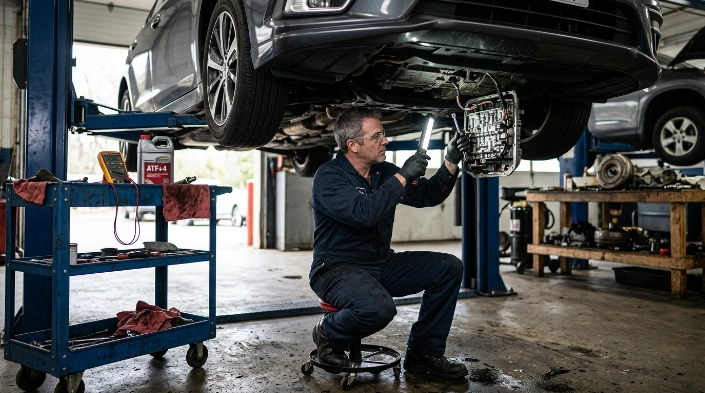
The correct P0740 fix is the repair that addresses the fault proven during diagnosis. There isn’t one universal part that fixes this code on every vehicle.
If the Wiring or Connector Is Faulty
Repair damaged wiring using an appropriate automotive repair method and correct any loose or corroded terminals. Make sure connectors are clean, locked, and protected from further heat or abrasion.
If the Transmission Fluid Is Incorrect or Low
Repair any confirmed leak and restore the correct fluid level using the manufacturer’s procedure. Use only a fluid that meets the required specification.
A fluid service won’t repair a broken wire or mechanically failed converter. Treat fluid condition as diagnostic evidence, not a guaranteed cure.
If the TCC Solenoid Has Failed
Replace the confirmed failed solenoid according to manufacturer service information. On some transmissions, individual solenoid replacement is possible.
Other designs may integrate solenoids into a larger valve-body assembly. Verify the transmission design before ordering parts.
If the Valve Body Has a Hydraulic Fault
A confirmed valve-body fault may require cleaning, repair, rebuilding, or assembly replacement depending on the design. Hydraulic pressure and contamination issues should also be addressed.
If the Torque Converter Is Faulty
A mechanically failed converter normally requires transmission removal to replace it. The surrounding transmission should also be inspected because debris, overheating, or clutch damage may affect the rest of the system.
If a Manufacturer Bulletin Applies
Check manufacturer information before making major repairs. Automakers sometimes publish model-specific diagnostic procedures, software updates, or repair instructions that differ from a generic P0740 troubleshooting path.
You can also use NHTSA’s vehicle lookup to check recalls, investigations, complaints, and manufacturer communications for your vehicle.
Pro tip: transmission repair costs can vary dramatically by vehicle and by the confirmed failure. Ask what test proved the recommended component failed before approving a major repair.
Can You Drive With a P0740 Code?
A vehicle with P0740 may still drive, but continuing normal use without diagnosis isn’t a good long-term plan. A TCC that isn’t operating correctly can create excess slip and heat under some conditions.
If the only symptom is a check engine light and the transmission otherwise behaves normally, arrange diagnosis soon. Avoid assuming the vehicle is safe for unlimited driving simply because it still moves.
Stop driving and arrange professional inspection or towing if you notice serious symptoms such as:
- Major slipping: Engine RPM rises without a matching increase in vehicle speed.
- Loss of drive: The vehicle struggles to move in Drive or Reverse.
- Severe shudder: Strong vibration occurs during acceleration or cruising.
- Overheating: A transmission-temperature warning appears or the transmission is clearly overheating.
- Burning smell: A strong burnt-fluid odor suggests excessive heat or deterioration.
- Harsh abnormal operation: Shifts become violent, unpredictable, or the vehicle enters a severe reduced-function mode.
The safest decision depends on the symptoms and your vehicle’s specific failure. Transmission problems can worsen when excessive slip or heat continues.
P0740 FAQ
Can Low Transmission Fluid Cause P0740?
Low transmission fluid can contribute to torque converter clutch and hydraulic-control problems on some vehicles. Check for leaks and verify the level using the manufacturer’s procedure before assuming the TCC solenoid or converter has failed.
Does P0740 Mean the Torque Converter Is Bad?
No. P0740 identifies a malfunction involving the torque converter clutch control system, but wiring, connectors, the TCC solenoid, fluid problems, valve-body faults, or internal mechanical issues may be responsible.
Can a Bad TCC Solenoid Cause P0740?
Yes, a failed or sticking torque converter clutch solenoid can cause P0740. However, you should test its circuit and operation before replacement because damaged wiring or hydraulic problems can create similar symptoms.
Can I Fix P0740 Myself?
You can perform basic checks such as scanning all codes, inspecting accessible wiring, checking for leaks, and reviewing fluid information. Electrical, hydraulic, valve-body, and torque converter testing may require professional tools and vehicle-specific service information.
Will Changing Transmission Fluid Fix P0740?
Not necessarily. Correcting low, incorrect, or badly degraded fluid may help when fluid condition caused the problem, but a fluid change cannot repair a damaged wire, failed solenoid, valve-body fault, or worn converter clutch.
Can I Clear P0740 With an OBD2 Scanner?
Most suitable scanners can clear the code after repairs, but clearing P0740 doesn’t fix its cause. Save the original codes and freeze-frame information first, repair the confirmed fault, then clear the code and verify that it doesn’t return.
How Do I Know the P0740 Repair Worked?
Clear the code only after the repair, then perform the manufacturer-recommended verification or drive cycle. Confirm normal shifting, stable transmission data, expected TCC operation, and no returning stored or pending transmission codes.
Final takeaway: If you’re trying to fix P0740, resist the urge to order a torque converter or TCC solenoid immediately. Start with a complete scan, verify fluid and wiring, use live data, and test the circuit to vehicle-specific specifications before moving toward major transmission repairs.
