
P0750 Causes: What Triggers Shift Solenoid A Malfunction?

Quick Answer
Common P0750 causes include a failed Shift Solenoid A, damaged wiring, a loose or corroded transmission connector, low or contaminated transmission fluid, restricted hydraulic passages, valve-body problems, and internal transmission faults. The code does not prove the solenoid itself is bad. Before buying parts, scan for related codes, check the fluid correctly, inspect the circuit, and use vehicle-specific service information. You can also check your VIN through the NHTSA recall lookup.
Most Common P0750 Causes
- Failed shift solenoid: The solenoid’s electrical coil or mechanical valve can fail or stick.
- Damaged wiring: An open, short, rubbed wire, or poor terminal connection can interrupt the control circuit.
- Low fluid: An incorrect transmission fluid level can interfere with the hydraulic pressure needed for normal shifting.
- Contaminated fluid: Debris or degraded fluid can restrict small valve-body passages or interfere with solenoid movement.
- Valve-body fault: Wear, sticking valves, or blocked passages can prevent the commanded hydraulic action.
- Internal transmission issue: Mechanical damage can sometimes create symptoms that appear alongside a solenoid-related code.
Best First Check
- Read every stored transmission code and verify fluid level, fluid condition, connectors, and wiring before replacing Shift Solenoid A.
Seeing P0750 on an OBD2 scanner often sends owners straight toward a replacement solenoid. In my experience, that can be an expensive shortcut.
P0750 points to the automatic transmission’s shift-control system, but several electrical, hydraulic, and mechanical faults can produce it. Here’s how I separate the likely causes before parts get ordered.
In This Guide
What Does the P0750 Code Mean?
P0750 is a generic OBD-II powertrain trouble code commonly described as Shift Solenoid A Malfunction. It means the transmission control system detected a problem involving the solenoid identified as “A” or its control circuit.
A shift solenoid is an electrically controlled valve inside an automatic transmission. It helps direct transmission fluid through hydraulic passages so the transmission can apply the correct clutch or gear combination.
What does Shift Solenoid A actually do?
The exact job of Solenoid A depends on the transmission design. The letter “A” does not identify one universal physical solenoid or one specific gear across every vehicle.
Some transmissions use individual solenoids. Others combine several solenoids into a pack, valve-body assembly, or integrated electronic control unit.
- PCM: The powertrain control module may manage both engine and transmission functions.
- TCM: A transmission control module may handle transmission operation separately.
- Valve body: This hydraulic control assembly directs transmission fluid through different passages.
- Shift solenoid: The electrically operated valve helps control those hydraulic routes.
This is why I never treat P0750 as a parts-ordering instruction. A generic scan tool identifies the detected fault area, not necessarily the failed component.
Technician’s note: verify the exact transmission using the VIN and vehicle-specific service information before identifying or testing Shift Solenoid A.
Section Takeaway: P0750 identifies a malfunction involving Shift Solenoid A, but it does not prove the solenoid itself has failed.
What Are the Most Common P0750 Causes?
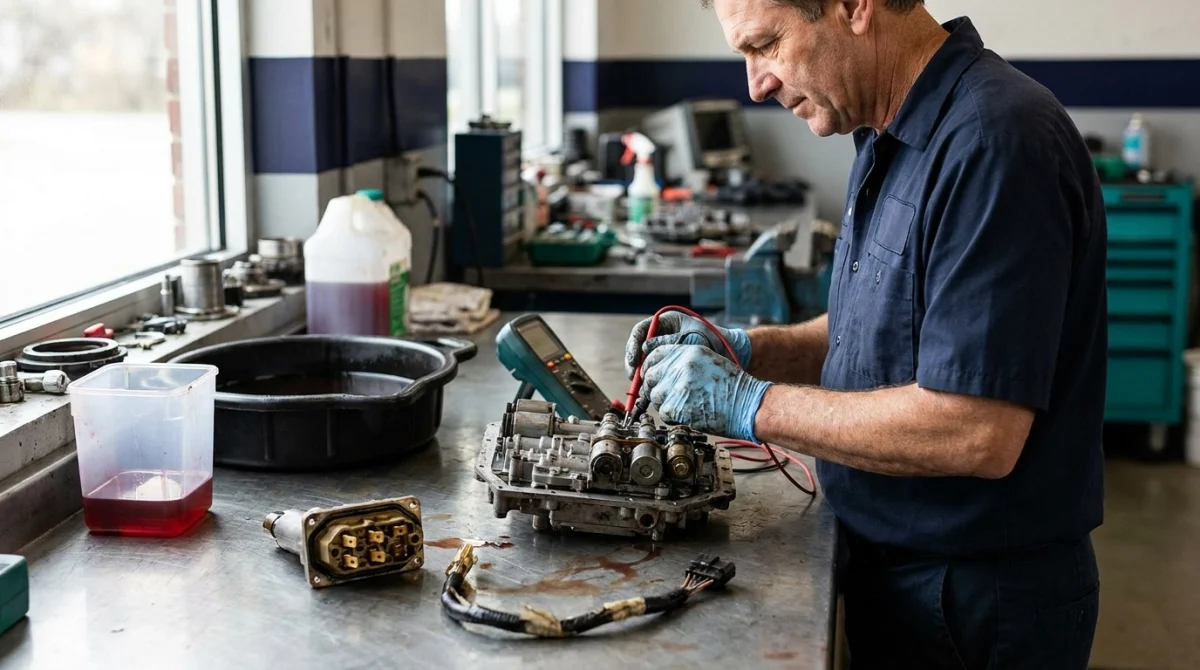
The most common P0750 causes fall into three groups: electrical faults, hydraulic problems, and internal transmission problems. Start with the simpler checks before assuming major transmission damage.
1. Failed Shift Solenoid A
The solenoid itself can fail electrically or mechanically. Its internal coil may develop an open or short, or the valve can become unable to move correctly.
Contamination can also make a mechanically sound solenoid stick. That distinction matters because an electrical test alone may not identify every hydraulic problem.
2. Damaged Wiring or a Poor Connector
Transmission wiring lives in a difficult environment. Heat, vibration, road contamination, fluid leaks, and previous repairs can all affect the harness or connectors.
- Broken or rubbed-through wiring
- Open circuits
- Shorted wiring
- Loose connector pins
- Corroded terminals
- Fluid or moisture contamination at a connector
- Damaged internal transmission harnesses
I pay extra attention when several solenoid-related codes appear together. One shared wiring or connector fault may be more likely than several solenoids failing at the same moment.
Pro tip: don’t replace a transmission solenoid until its wiring, connector condition, power, ground, and control circuit have been checked against the correct service specifications.
3. Low Transmission Fluid
Automatic transmissions depend on fluid for hydraulic operation. If the level is incorrect, the transmission may struggle to develop or maintain the pressure needed for expected shifts.
Don’t assume every vehicle uses the same checking procedure. Some transmissions have a dipstick, while others require a temperature-specific service procedure.
4. Dirty or Incorrect Transmission Fluid
Degraded fluid, debris, or the wrong fluid specification can affect transmission operation. Small hydraulic passages and valves are especially sensitive to contamination.
Your vehicle’s manufacturer should determine the correct fluid specification. For example, Toyota directs owners to vehicle-specific manuals and maintenance information rather than one universal transmission-fluid specification.
Vehicle-specific specifications can be checked through the Toyota Owners manuals section when working on an applicable Toyota.
5. Restricted Filter or Hydraulic Passage
A restricted filter or blocked hydraulic passage can reduce fluid flow. The commanded solenoid may work electrically while the expected hydraulic result never happens.
This is one reason replacing a solenoid without checking the rest of the transmission can fail to solve P0750.
6. Valve-Body Wear or Sticking
The valve body contains precisely machined hydraulic passages and valves. Wear, varnish, debris, or sticking valves can disrupt fluid routing.
A technician may need hydraulic testing or valve-body inspection when the electrical circuit tests correctly but shifting remains abnormal.
7. Internal Transmission Damage
Clutch, band, pump, seal, or other internal problems can produce abnormal hydraulic operation. These faults need a different repair path from a simple wiring problem.
Metallic debris in the pan, severe slipping, overheating, or repeated loss of gears deserves professional attention.
8. PCM or TCM Problems
A control-module problem is possible, but it should not be the first assumption. Power supplies, grounds, wiring, connectors, solenoid operation, and related codes should be verified first.
Modules may also require software updates or manufacturer-specific diagnostic procedures. Check the service information for the exact vehicle.
Section Takeaway: The leading diagnostic areas are the solenoid, wiring, connectors, fluid, valve body, and hydraulic system. Module failure should be considered only after more common faults are tested.
What Symptoms Can P0750 Cause?
P0750 symptoms depend on the transmission and the failure mode. Some vehicles show only a warning light, while others develop obvious shifting problems.
| Symptom | Possible Explanation | What to Check |
|---|---|---|
| Check engine light | The control module detected a shift-solenoid system fault. | Read all stored and pending codes. |
| Harsh shifting | Hydraulic pressure or commanded gear changes may be abnormal. | Fluid condition, solenoid operation, valve body. |
| Delayed or missing shift | The expected hydraulic circuit may not be applying correctly. | Solenoid circuit and hydraulic operation. |
| Stuck in one gear | The transmission may enter a protective operating strategy. | Transmission codes and manufacturer diagnostics. |
| High RPM at road speed | The transmission may not be reaching the expected higher gear. | Gear-command data and shift operation. |
| Slipping or poor engagement | A hydraulic or internal transmission problem may be present. | Fluid, pressure, internal condition. |
Related codes can provide useful clues. Codes such as P0751, P0752, P0753, or P0754 may appear when the control system detects more specific Shift Solenoid A performance or circuit conditions.
Don’t ignore codes for other solenoids, power supply faults, communication problems, or transmission temperature. The complete code list often tells a better story than P0750 alone.
Safety note: if the vehicle loses gears, slips badly, shifts violently, overheats, or cannot maintain normal road speed, arrange professional diagnosis rather than continuing normal driving.
How Do You Find the Real Cause of P0750?
A reliable P0750 diagnosis follows the evidence from the scanner toward the circuit and hydraulic system. Replacing the first part named in the code is not a diagnosis.
1. Scan Every Available Module
Record stored, pending, and manufacturer-specific codes before clearing anything. Freeze-frame or related operating data may also help show when the fault occurred.
2. Check for Vehicle-Specific Information
Confirm the year, make, model, engine, and transmission. Then check the manufacturer’s service information for the correct definition, circuit diagram, and diagnostic procedure.
It is also worth checking for recalls or manufacturer communications related to your vehicle. NHTSA lets owners search safety information using the vehicle’s VIN, year, make, and model.
3. Inspect the Transmission Fluid Correctly
Check fluid only with the procedure specified for your transmission. Look for an incorrect level, leaks, unusual contamination, or evidence of overheating.
Do not automatically add fluid because P0750 appeared. Overfilling can also cause transmission problems.
4. Inspect the Harness and Connectors
- Look for chafed insulation.
- Check for melted or heat-damaged wiring.
- Inspect connector locks and terminal fit.
- Look for corrosion or moisture.
- Check areas disturbed by previous repairs.
- Inspect the transmission case connector when accessible.
5. Test the Solenoid Circuit
The correct electrical tests depend on the transmission. Resistance, continuity, power, ground, and control-circuit tests must use manufacturer specifications.
Don’t copy an ohm specification or pin location from a different transmission. A value that is correct for one solenoid assembly may be completely wrong for another.
Locksmith’s note: I use the same verification mindset with transmission electronics that I use with vehicle keys. Confirm the exact vehicle and system first, then test against the correct specification.
6. Check Hydraulic and Mechanical Operation
If the electrical side passes, the diagnosis moves toward hydraulic performance. A stuck valve, restricted passage, worn valve body, or internal failure can prevent the expected shift.
This stage may require professional transmission equipment. Guessing becomes expensive quickly.
Section Takeaway: Diagnose P0750 in order—codes, vehicle identification, fluid, wiring, circuit tests, then hydraulic and mechanical checks. That approach reduces unnecessary parts replacement.
What Repairs Can Fix P0750?
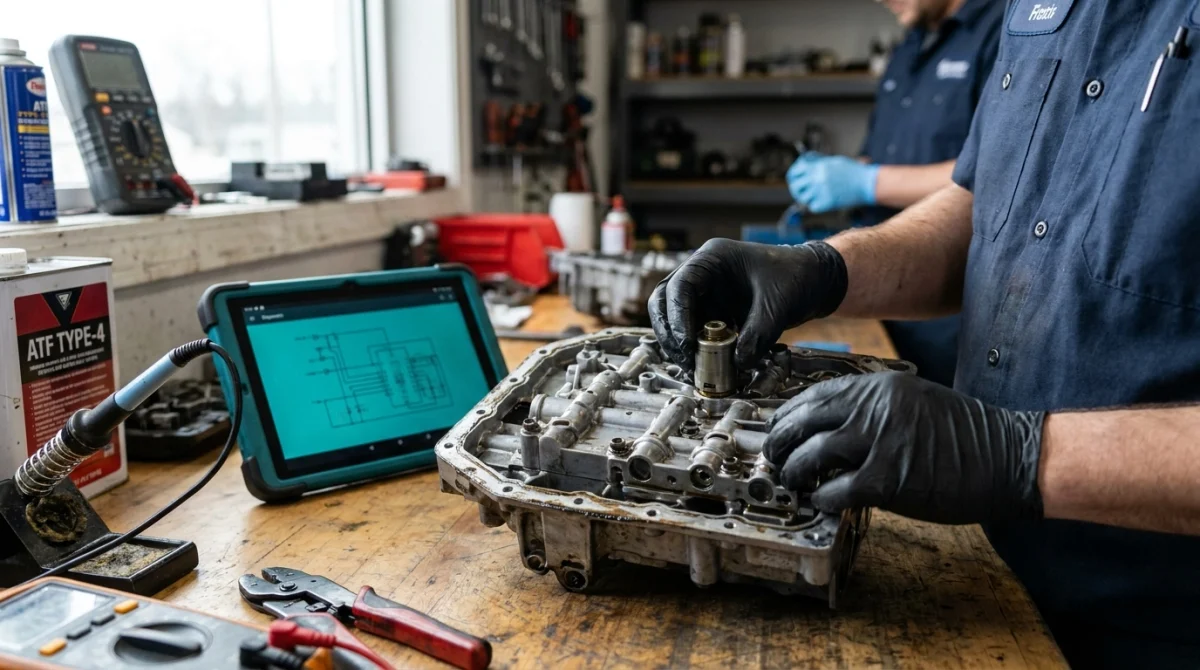
The right P0750 repair depends entirely on what testing proves. There is no single repair that applies to every vehicle carrying this code.
- Repair damaged wiring: Correct open circuits, shorts, rubbed wiring, or damaged insulation.
- Repair a connector: Address corrosion, loose terminals, broken locks, or damaged connector bodies.
- Correct fluid level: Find the reason for fluid loss instead of repeatedly topping it off.
- Use the correct fluid: Follow the vehicle manufacturer’s specified fluid type and service method.
- Replace Shift Solenoid A: Replace it when vehicle-specific testing confirms failure.
- Replace a solenoid pack: Some transmissions integrate several solenoids into one assembly.
- Repair the valve body: Hydraulic wear, sticking valves, or damaged passages may require specialist work.
- Repair internal transmission damage: Mechanical failure may require more extensive transmission service.
- Address a control-module issue: Module repair, replacement, programming, or software work should follow proper diagnosis.
Repair cost varies too much by vehicle to give one responsible figure. Access, transmission design, labor rates, diagnosis time, and whether the repair requires internal work can change the total considerably.
A wiring repair and a transmission overhaul are not comparable jobs. Get a vehicle-specific written estimate once the failed component has been confirmed.
For maintenance schedules and fluid information, use the manufacturer’s documentation when available. Toyota, for example, provides a vehicle-specific maintenance schedule for owners.
Repair note: verify replacement components against the VIN, transmission identification, and manufacturer catalog before ordering. Do not assume a solenoid listed online fits every transmission used in one vehicle model.
After the confirmed repair, clear the code with an appropriate scan tool. Then follow any required relearn or adaptation procedure and recheck the system.
A repair is not proven simply because the warning light turns off. Make sure normal shifting returns and P0750 does not immediately reset.
Section Takeaway: Fix the tested cause rather than the code description. Verify the repair with a rescan and appropriate road test.
P0750 Frequently Asked Questions
Can low transmission fluid cause P0750?
Yes, an incorrect fluid level can contribute to hydraulic transmission problems that may appear with P0750. However, low fluid does not automatically prove the cause. Check for leaks and follow the exact manufacturer procedure for checking fluid level.
Does P0750 always mean Shift Solenoid A is bad?
No. A failed solenoid is only one possible cause. Damaged wiring, connector problems, contaminated fluid, hydraulic restrictions, valve-body faults, and internal transmission problems can also be involved.
Will changing transmission fluid fix P0750?
It may help only when fluid condition or a service-related hydraulic problem is responsible. A fluid change will not repair an electrically open solenoid, damaged wiring, a failed connector, or mechanical transmission damage.
Can I keep driving with a P0750 code?
That depends on the symptoms, but transmission faults can worsen. If the vehicle slips, loses gears, shifts harshly, enters a reduced-function mode, or struggles to maintain normal speed, have it diagnosed before continuing normal driving.
Can I clear P0750 with an OBD2 scanner?
Many scanners can erase P0750, but clearing the code does not repair anything. If the transmission controller detects the same malfunction again, the code and warning light can return.
Where is Shift Solenoid A located?
The location depends on the transmission. Shift solenoids are commonly associated with the valve body inside the automatic transmission, but identification and access differ widely between manufacturers and transmission families.
How do I know whether I need a solenoid or a transmission repair?
Electrical circuit testing and vehicle-specific diagnosis separate many solenoid faults from hydraulic or mechanical problems. If the circuit tests correctly but the expected gear change still does not occur, further valve-body or internal transmission testing may be needed.
P0750 is best treated as a diagnostic starting point. Check the complete code set, identify the exact transmission, inspect the fluid and wiring, and test the circuit before buying parts.
If the transmission is slipping, stuck in gear, shifting violently, or showing signs of internal damage, get a qualified transmission technician involved early. Correct diagnosis is usually cheaper than replacing good parts.
