
Why Your Car Says the Key Fob Is Not Detected and What to Do Next

If your car says the key fob is not detected, the message usually means the vehicle cannot verify or communicate with the fob. That does not automatically mean the fob is dead. In real-world troubleshooting, the cause is often something simpler: a weak fob battery, a low vehicle battery, signal interference, or a smart key system that has lost communication.
The good news is that this problem often gives you clues. A fob that still unlocks the doors but won’t start the car points in a different direction than a car that refuses to recognize either key. The fastest fix is usually to narrow down which side of the system is failing before you buy parts.
If you’re stranded in a parking lot, the goal is not to diagnose everything perfectly. The goal is to get the car started safely, or at least figure out whether you need a battery, a re-sync, or professional help.
What the “Key Fob Not Detected” Message Usually Means
Most push-button start systems need the car and the key fob to exchange a valid signal before the engine will start. When the dashboard says the key fob is not detected, the car is telling you it can’t confirm that signal.
That warning can show up in different ways depending on the make and model. Some vehicles say “Key Not Detected,” while others use messages like “No Key Detected,” “Key Not Present,” or “Remote Not Detected.” The wording changes, but the basic issue is the same: the car is not getting a usable response from the smart key system.
A useful way to think about it is this: the car is not always rejecting the key. Sometimes it simply cannot hear it clearly enough to trust it.
Fast Checks to Try First
Before you assume the worst, try the no-tools fixes that solve a lot of these cases.
1) Move the fob to the backup reader or start area
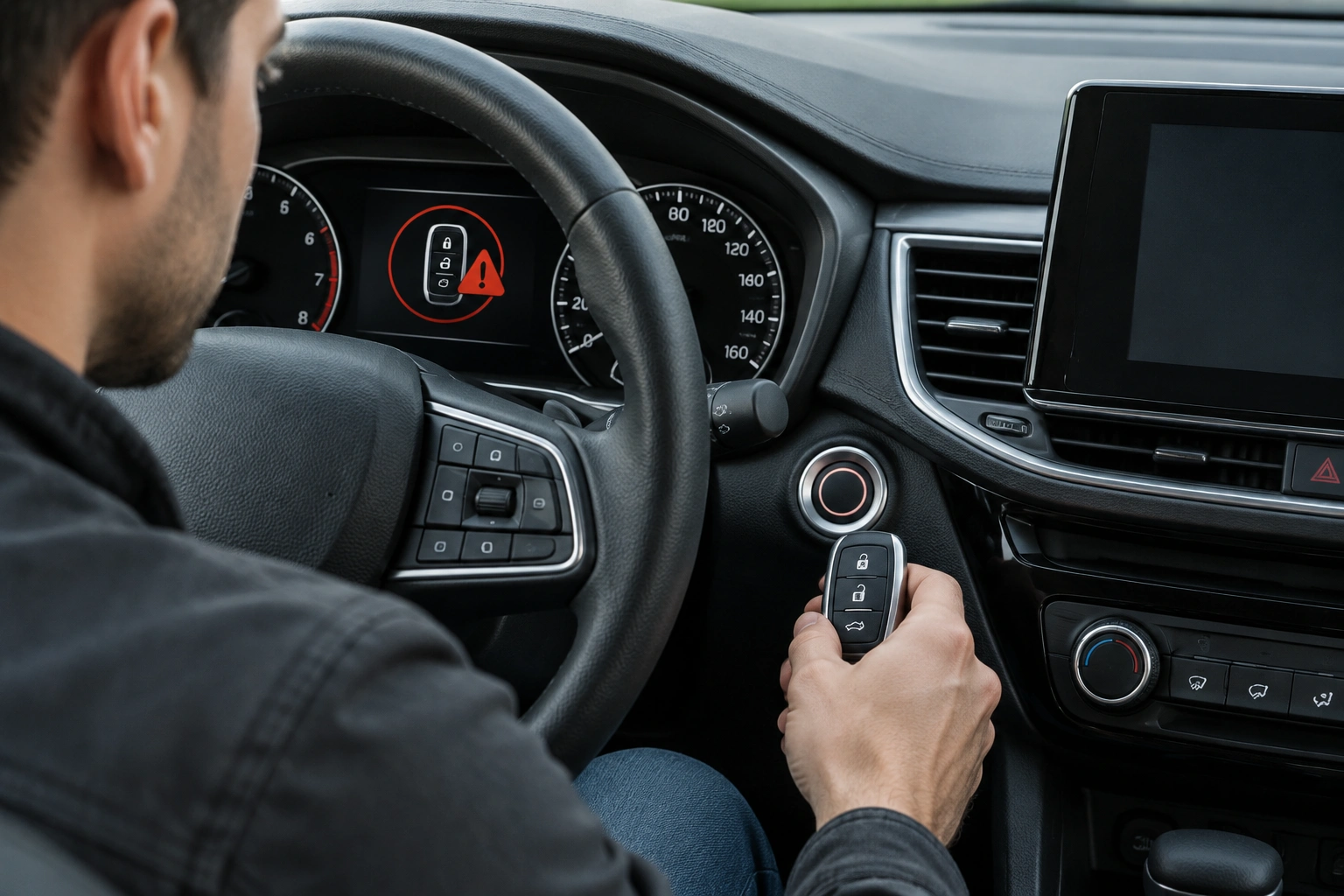
If the fob battery is weak, the signal may be too faint for normal range but still strong enough at very close distance. Sit in the driver’s seat and hold the fob right against the start button or place it in the designated backup reader/slot if your vehicle has one.
If you do not know where that backup location is, check the owner’s manual. It is often a marked pocket, slot, cupholder area, or other spot near the center console, steering column, or start button area. The point is to get the fob extremely close to the car’s emergency detection point.
This is especially useful when the fob still unlocks the doors but the car won’t start. That pattern often means the battery has enough power for short-range remote functions, but not enough for reliable starting detection.
2) Remove obvious interference
Try again after moving away from items that can interfere with the signal. Common examples include a second key fob, a phone sitting directly beside the fob, a metal wallet, or a bag full of electronics.
3) Try the spare key fob
If the spare starts the car immediately, that’s one of the clearest clues you can get. It usually points to the original fob, not the vehicle. If neither fob is detected, the problem is more likely vehicle-side.
4) Try the emergency start method
Many push-button vehicles have a backup start procedure for a weak fob battery. In plain language, it usually works like this:
- Sit in the driver’s seat with the car in Park.
- Press the brake pedal if the vehicle requires it.
- Hold the key fob directly against the start button or put it in the backup reader/slot described in the owner’s manual.
- Press the start button while keeping the fob in that position.
If the car starts this way, the fob battery is often weak rather than completely dead. This is a practical bridge solution, not a permanent repair.
Most Likely Causes, in Order
When a car says the key fob is not detected, these are the most common causes to check first.
| Likely cause | What it usually looks like | Best first test |
|---|---|---|
| Weak or dead key fob battery | Remote lock/unlock may work sometimes; start detection fails | Try the spare fob or emergency start method |
| Low vehicle battery | Slow cranking, dim lights, multiple electrical warnings | Check whether other systems are acting weak |
| Signal interference | Problem appears only in certain locations or near electronics | Move away from devices, garages, or metal objects |
| Damaged key fob | Dropped, wet, cracked, or intermittent behavior | Compare with the spare fob |
| Vehicle detection/system fault | Neither fob works, or issue keeps returning | Professional diagnosis |
A weak fob battery is the most common place to start because it’s inexpensive, easy to replace, and often the simplest explanation. But don’t stop there if the symptoms point elsewhere.
How to Tell Whether It’s the Fob or the Car
This is where a few symptom clues can save you time and money.
Signs the problem is probably the fob
- The spare key fob works normally.
- The original fob unlocks doors but won’t start the car.
- The problem is intermittent, especially after the fob was dropped.
- The fob has been exposed to moisture, which can damage internal components.
A weak battery can cause exactly this kind of partial failure. The fob may still send enough signal for some functions, but not enough for the car’s start authorization.
Signs the problem is probably the vehicle battery
- The dash lights are dim.
- The starter sounds weak or slow.
- Multiple electrical warnings appear at the same time.
- Both fobs fail to be detected.
A low vehicle battery can confuse the smart key system because the car’s electronics may not be able to power up and verify the fob properly. In that case, replacing the key fob battery won’t fix the real problem.
Signs the problem is probably the smart key system
- Neither the main fob nor the spare is detected.
- The problem persists after a fresh fob battery.
- The issue is not tied to one location or one key.
- The car behaves inconsistently even when battery voltage seems normal.
That’s the point where reprogramming, diagnosis, or module testing becomes more likely.
Step-by-Step Fixes You Can Try
Use this order to avoid guessing.
Step 1: Try the spare fob
This is the quickest diagnostic test. If the spare works, you’ve likely isolated the problem to the original fob or its battery.
Step 2: Replace the fob battery if the original fob is weak
If the fob is old, the battery is the cheapest likely fix. Many owners replace the whole key too early when a battery swap would have been enough. If your fob battery cover opens cleanly and the battery type is clearly marked, this is usually a straightforward DIY job.
If the fob still fails after a new battery, don’t keep buying batteries. That’s a sign the issue may be internal damage, reprogramming, or a vehicle-side problem.
Step 3: Try the emergency start procedure
If the battery is weak but the fob itself still works, the emergency start method may get you moving. This is a practical bridge solution, not a permanent repair.
Step 4: Check for interference and location-specific problems
If the car only detects the fob near the start button, or only inside the cabin, that often means the signal is marginal. Try a different parking location, remove electronics from the fob area, and test again.
Step 5: Re-sync only if your owner’s manual supports it
Some vehicles allow a simple re-sync or reset procedure after battery replacement. Others do not. Follow the manufacturer’s instructions exactly if your model supports this. Random button presses are more likely to waste time than solve the issue.
Intermittent Detection Problems
If the message comes and goes instead of failing all the time, that usually points to a weaker or less stable signal rather than a complete system failure.
Intermittent detection can happen when:
- the fob battery is getting weak,
- the fob has internal damage,
- the vehicle battery is borderline,
- or there is signal interference in one location but not another.
That differs from total failure, where neither the spare nor the original fob is detected anywhere. Intermittent problems are often more useful diagnostically because they can still respond to location changes, a fresh battery, or a spare fob test.
What to Do If the Fob Works Only Inside the Cabin or Very Close to the Start Button
That is an important clue. If the fob works only when it is inside the car or pressed right against the start area, the fob is often still transmitting, but not strongly enough for normal detection range.
In practice, that usually suggests one of these:
– a weak fob battery,
– a signal path problem inside the fob,
– or a vehicle-side antenna/start authorization issue.
If the spare fob works at normal range, the original fob is the stronger suspect. If both fobs only work at very close range, the vehicle-side system becomes more likely.
What to Do If the Spare Key Fob Works
If the spare starts the car and the original one doesn’t, you’ve learned something important: the vehicle is probably fine.
That usually means one of three things:
- The original fob battery is weak.
- The original fob is damaged.
- The original fob lost sync and may need reprogramming.
This is where a lot of people save money. Instead of replacing the vehicle battery or paying for a full diagnosis right away, you can focus on the one fob that’s failing.
If the spare works consistently, replace the battery in the original fob first. If that doesn’t help, the fob may need repair or replacement rather than more troubleshooting.
When the Problem Is Probably the Vehicle Battery or Electrical System
If both fobs fail, the car battery jumps higher on the list.
A weak vehicle battery can create a chain reaction. The smart key system may not wake up properly, the start button may respond strangely, and the dash may show confusing warnings. In some cases, the car may still unlock but fail to authenticate the key for starting.
If you also notice slow cranking, flickering lights, or other electronic glitches, treat the vehicle battery as a serious suspect. Avoid repeated start attempts if the battery is already weak, because you can drain it further.
If the car starts and then immediately throws several unrelated electrical warnings, that’s another hint the issue is broader than the fob.
When the Fob May Need Battery Replacement, Repair, or Reprogramming
A battery replacement is the best first move when:
- only one fob is affected,
- the battery is old or unknown,
- the fob works intermittently,
- or the fob still unlocks doors but struggles to start the car.
Repair or replacement becomes more likely when the fob has visible damage, has been dropped hard, or has been exposed to water. Internal damage can make a battery change useless.
Reprogramming is more likely when the battery is fresh, the fob appears physically intact, and the car still will not recognize it. Some vehicles can lose sync after battery changes or electrical issues, but the exact procedure is model-dependent.
If you’re also shopping for diagnostic tools or want to understand what kind of scanner can help with immobilizer-related issues, our guide to OBD2 scanners with key programming support explains where those tools fit and where they don’t.
When to Consult a Locksmith
Call a locksmith, dealer, or mechanic when basic testing doesn’t point to a simple battery issue.
A locksmith is often a strong choice when:
- the spare fob works, but the original does not,
- the fob needs reprogramming,
- you need help with a backup start procedure,
- or you want a replacement fob without going straight to the dealer.
A dealer is usually the better choice when:
- both fobs fail,
- the car needs brand-specific programming,
- the smart key system appears to have a module-level fault,
- or the vehicle requires advanced diagnostics tied to the immobilizer system.
A good rule: if the problem stays with one fob, think fob. If the problem follows the car no matter which fob you use, think vehicle.
Common Mistakes to Avoid
The biggest mistake is replacing parts before testing the spare fob. That one step can save a lot of time.
Other common missteps:
- Confusing a remote lock/unlock problem with a start-detection problem.
- Assuming a dead fob battery means the car cannot be started at all.
- Ignoring intermittent warnings until the fob fails completely.
- Replacing the fob battery repeatedly when the vehicle battery is actually weak.
- Forcing the fob slot, start button area, or steering column trim.
A careful order of checks is better than guessing. In most cases, the issue becomes much clearer once you compare the main fob, the spare, and the vehicle battery behavior side by side.
Quick Decision Guide
If you need the shortest path forward, use this:
- Only one fob fails: replace that fob battery first.
- Spare works, original doesn’t: suspect the original fob.
- Neither fob works: check the vehicle battery or the car’s detection system.
- Car starts only when the fob is held very close: weak fob battery or signal issue.
- Problem returns after battery replacement: think reprogramming or hardware damage.
That sequence is usually enough to separate a simple fix from a deeper electrical issue.
FAQ
Can I still drive if the car says the key fob is not detected?
If the car is already running, you can usually keep driving until it is turned off. The problem is more likely to show up at the next restart. If the vehicle is showing multiple electrical warnings, get the battery and system checked soon.
Will replacing the key fob battery fix it?
Often, yes — especially if only one fob is affected and the battery is old. But if the spare works and the original still fails after a battery swap, the fob may be damaged or out of sync.
Why does my spare key fob work when my main one doesn’t?
That usually means the original fob has a weak battery, internal damage, or a programming issue. It also helps rule out a vehicle-wide detection failure.
Can a dead car battery cause a key fob not detected message?
Yes. A low vehicle battery can interfere with the smart key system and create recognition problems, especially if you also notice dim lights or slow cranking.
Do I need to reprogram the key fob?
Not always. Reprogramming is more likely if a fresh battery doesn’t help and the spare works. If neither fob works, the issue may be on the vehicle side instead.
Should I replace the whole fob or just the battery?
Replace the battery first unless the fob is physically damaged or wet. A full replacement makes more sense when the fob is cracked, corroded, or still failing after a new battery and basic troubleshooting.
When should I stop troubleshooting and call for help?
If neither fob is detected, the car shows several electrical warnings, or the issue keeps coming back after a battery change, it’s time to get professional diagnosis from a locksmith, dealer, or mechanic.
Can a locksmith fix this, or do I need a dealer?
A locksmith can often help with a dead fob battery, replacement fob, or basic reprogramming. If both fobs fail or the vehicle needs immobilizer-level diagnosis, a dealer is more likely to have the right equipment.
Why does the fob work only when I’m inside the car?
That usually means the signal is weak or marginal. A weak fob battery is a common cause, but a vehicle-side antenna or start authorization issue can also be involved if the problem affects every fob.
