
Why Your Car Says “Key Fob Not Detected” but Still Starts

If your dash warns “key fob not detected” but the engine still starts, you’re usually dealing with a margin problem, not a total failure. The car is still able to recognize the fob close enough to start, but the signal is weak, inconsistent, or being interrupted.
That’s good news, because it usually means you still have time to diagnose it before you get stranded. I’ve seen this pattern many times in push-button start vehicles: the warning shows up first, the car still runs, and then the problem gets worse until one day it won’t detect the fob at all.
The trick is figuring out whether the issue is the fob, the car, or just interference.
Why a Smart Key Can Fail Detection but Still Let the Car Start
Most smart key systems use a low-power radio signal to confirm the fob is nearby. During normal operation, the car looks for that signal at a distance. But in many vehicles, there’s also a backup or emergency detection method that only works when the fob is very close to a specific area.
That’s why the warning and the start behavior can seem contradictory. The car is not saying “the fob is completely dead.” It’s saying, “I’m not reliably verifying the fob the way I should.”
A useful way to think about it: normal proximity detection can fail before the backup start check does. A weak battery, interference, or a failing internal part can make the fob “barely visible” to the car during everyday use, while still allowing the immobilizer to authorize a start when the fob is placed in the backup sensing area.
For a general overview of how modern smart key systems fit into vehicle security, NHTSA’s vehicle theft prevention resources are a solid starting point.
What the Warning Usually Means: Symptom Patterns to Note
The pattern matters more than the message itself. Before replacing anything, pay attention to when the warning appears.
Intermittent warning
If it comes and goes, the most likely causes are:
– a weak key fob battery
– signal interference
– a fob that’s starting to fail internally
Warning only in certain places
If it happens in one garage, one parking lot, or near a specific building, think radio frequency interference first. I’ve seen smart keys act up near facilities packed with wireless equipment, security systems, or heavy metal structures.
Warning gets worse over time
If you’ve gone from “once in a while” to “almost every drive,” that usually points to a battery or component that is slipping further out of range.
One fob works, the other doesn’t
That usually separates the problem quickly:
– One bad fob = likely fob battery or fob damage
– Both fobs act the same = likely vehicle-side issue
Most Likely Causes, Ranked by Probability
Here’s the order I’d check them in.
| Likely cause | What it looks like | Best first move | Temporary or permanent fix |
|---|---|---|---|
| Weak key fob battery | Warning is intermittent; fob works closer to the car | Replace the fob battery | Often permanent if battery was the issue |
| Signal interference | Problem happens in certain locations or with clutter near the fob | Move the fob away from electronics and metal | Temporary workaround |
| Damaged or aging fob | Buttons may feel inconsistent; warning persists after battery swap | Test spare fob | Usually permanent repair or replacement |
| Vehicle receiver/antenna issue | Both fobs fail the same way | Professional diagnosis | Permanent repair |
| Start button or immobilizer fault | Backup start method is unreliable or unavailable | Service inspection | Permanent repair |
A weak fob battery is commonly cited as a frequent cause of a “key not detected” warning, but it’s not the only one. In some situations, a vehicle battery that is weak enough to affect module power-up can also contribute, and some cars will show detection problems before they show obvious starting trouble.
Quick Checks Before Replacing Parts
These checks take minutes and can save you from replacing the wrong thing.
Move the fob closer
If your fob is in a purse, jacket pocket, or cupholder full of other items, take it out and hold it near the start button area. If the warning clears, you’ve learned the system is operating on a weak margin.
Remove clutter
Keys, coins, RFID tags, phone cases with magnetic accessories, and other electronics can all make troubleshooting messy. Strip the fob down to just the fob.
Try a different location
If the warning only happens in one spot, drive to another area and test again. A garage or parking structure can create more interference than an open lot.
Test the spare key
If the spare works normally, you’ve likely isolated the problem to the original fob rather than the car.
Step 1: Replace or Test the Key Fob Battery
This is the first DIY move I’d make if the battery is old or unknown.
A weak battery can sometimes power the fob just enough for emergency detection, but not enough for consistent normal operation. That’s why the car may start today and fail tomorrow.
What to expect after replacement
If the battery was the issue, you should notice:
– the warning disappears
– detection becomes more consistent
– the fob works from normal distance again
If the warning stays the same after a new battery, don’t keep throwing batteries at it. That usually means the problem has moved beyond the simple battery.
A practical decision rule
Replace the battery first if:
– the fob battery is several years old
– the warning is intermittent
– the spare fob works better than the main one
Skip ahead to vehicle-side diagnosis if:
– a fresh battery makes no difference
– both fobs behave the same way
– the fob only works when held directly against the start area
If you need a battery replacement guide for your specific fob style, the guides on ReplaceKeyFob’s battery replacement section can help you identify the right approach.
Step 2: Try the Backup Start Method
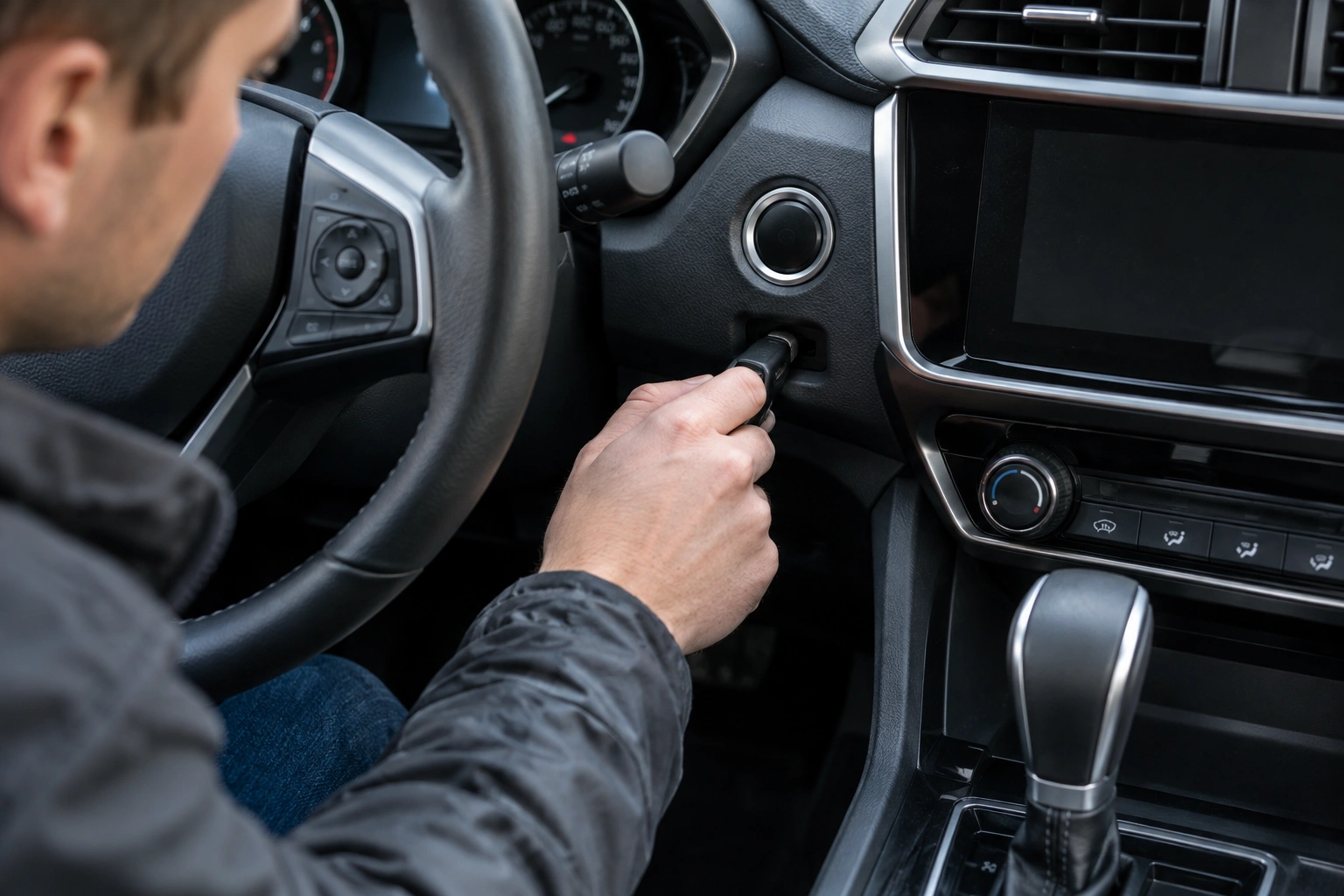
If the fob battery is too weak for normal detection, many vehicles still have a built-in emergency start procedure. Manufacturers use a backup reader area near the start button, steering column, or center console so the car can recognize the fob at very close range.
In practice, this often means:
1. Keep the fob inside the vehicle.
2. Place it in the backup start location shown in the owner’s manual.
3. Press the brake and start button normally.
Some systems use a passive induction loop or similar close-range reader to power the immobilizer chip inside the fob long enough to authorize the start. That’s why a nearly dead fob battery can still let the car run in an emergency.
This is a temporary workaround, not a fix. It’s useful when you need to get home or avoid a tow, but it should not become your long-term routine. The exact placement and procedure vary by make and model, so the owner’s manual is the authoritative source for the correct location and steps.
Step 3: Rule Out Interference and Placement Problems
This step matters more than people think.
A smart key signal is low power by design, so anything around it can matter. I’d check for:
– a phone sitting directly on the fob
– metal keychains or dense key rings
– RFID cards or transit cards in the same pocket
– the fob stored in a bag with electronics
– parking locations with heavy signal noise
One easy test: carry the fob by itself in your hand, walk to the vehicle, and try again. If the warning disappears, the problem may be environmental rather than mechanical.
That’s also why a warning that only happens in one garage is not the same as a warning that follows the fob everywhere.
Step 4: Test the Spare Key Fob to Separate Fob Problems from Car Problems
This is one of the cleanest diagnostic forks you can use.
If the spare works normally
The original fob is the likely problem. Possible causes include:
– weak battery
– worn internal contacts
– damaged circuit board
– water damage
– casing wear that affects the battery connection
If both fobs fail the same way
That shifts suspicion to the vehicle:
– receiver antenna
– wiring or connector issue
– start button fault
– immobilizer communication problem
When both fobs act up the same way, stop assuming it’s just a battery problem. At that point, the car deserves a closer look.
When the Problem Is Likely in the Car, Not the Fob
These signs point away from the fob itself:
- both key fobs trigger the same warning
- a new battery made no difference
- the car only detects the fob in a very specific spot
- the backup start method is inconsistent
- the warning appears even when the fob is held right next to the start button
A vehicle-side issue can involve the receiver antenna, wiring or connectors, or the start button circuit. As one locksmith reference notes, a faulty antenna, wiring issue, or malfunctioning start button can interfere with detection. In some cases, a weak vehicle battery can also prevent the receiver system from powering up properly.
For a general consumer-facing explanation of smart key warnings and common causes, Edmunds’ car tech advice is a helpful reference point, and it pairs well with Car and Driver’s tech coverage.
Can You Keep Driving Like This?
Short answer: maybe for now, but don’t ignore it.
If the car is still starting consistently, you can usually keep driving short-term while you troubleshoot. The risk is that intermittent detection often gets worse, and a car that starts today may refuse to recognize the fob later.
Use this rule:
– Occasional warning, spare works, battery replacement helps: continue driving cautiously and monitor it
– Frequent warning, both fobs affected, or backup start becomes necessary: get it diagnosed soon
– Car is no longer detecting the fob reliably: don’t wait until you’re stranded
When to Consult a Locksmith
If battery replacement and interference checks don’t solve it, an automotive locksmith is often a smart next stop. A good locksmith can test the fob, verify whether the signal is being transmitted, and help determine whether the issue is with the fob or the vehicle’s receiver system.
A dealer may be the better choice if:
– the vehicle needs reprogramming
– multiple modules are involved
– the start system fault is tied to a manufacturer-specific procedure
If you’re comparing DIY versus professional help, the practical trade-off is simple: a battery swap is cheap and fast, but it only helps if the battery is the real issue. Professional diagnosis costs more, but it’s the right move when the warning persists after the easy checks.
Troubleshooting Checklist
Use this in order:
- Move the fob away from your phone and metal items.
- Try the fob in a different location.
- Test the spare key fob.
- Replace the fob battery if it’s old or unknown.
- Try the vehicle’s backup start method.
- Watch whether the problem follows one fob or both.
- If both fobs fail, book a locksmith or dealer diagnosis.
That sequence gives you the fastest path from symptom to likely cause without wasting money on guesswork.
FAQ
Why does my car start if it says the key fob is not detected?
Because the car may still be detecting the fob weakly or only at very close range. The warning usually means communication is marginal, not necessarily completely gone.
Is my key fob battery dying even though the car still starts?
Very possibly. A weak battery often shows up first as an intermittent detection warning before the fob fully stops working.
Can I keep driving like this?
Usually yes for a short time if the car still starts reliably, but don’t put off diagnosis. Intermittent detection can turn into a no-start problem.
How do I start the car when the fob is not detected?
Use the manufacturer’s backup start procedure from the owner’s manual. Many vehicles have a designated spot near the start button or steering column for emergency detection.
Could the problem be with the car instead of the fob?
Yes. If both fobs fail, or a new battery doesn’t help, the issue may be in the vehicle’s receiver, antenna, wiring, or start button circuit.
When should I replace the key fob or get it reprogrammed?
If the battery and interference checks fail, the spare fob behaves differently, or the fob has been damaged, professional testing is the next step. Reprogramming or replacement becomes more likely when the fob itself is no longer transmitting properly.
What if the warning only happens sometimes?
That usually points to a weak battery, interference, or a fob that’s beginning to fail. Intermittent symptoms are often the best clue that the system is still partly working.
Should I test the spare key fob first?
Yes. The spare is one of the fastest ways to separate a fob problem from a vehicle problem.
