
Why a Key Fob Is Not Detected Intermittently: A Practical Troubleshooting Guide

If your car says the key fob is not detected intermittently, you’re dealing with a signal problem that comes and goes. That’s different from a fob that is completely dead. An intermittent issue usually means something is still working part of the time: the fob battery may be weak, the vehicle battery may be borderline, there may be RF interference nearby, or one part of the fob/vehicle system is starting to fail.
The good news is that this kind of problem often gives clues. If the car recognizes the fob only when it’s very close, only in certain places, or only after the vehicle has been running, those patterns can point you in the right direction fast.
What intermittent key fob detection usually means
A push-button start system doesn’t just “see” the fob in a simple on/off way. It has to receive a usable signal from the fob and confirm it with the vehicle’s immobilizer system. If that signal is weak, blocked, or unstable, the car may recognize the fob one moment and miss it the next.
That’s why intermittent detection often points to a marginal component rather than a total failure. A completely dead fob usually won’t unlock the doors or start the car at all. Intermittent recognition, on the other hand, often shows up as one of these patterns:
- The car starts when the fob is held close to the start button, but not from your pocket.
- Door unlock works, but push-button start fails sometimes.
- The problem happens in one location but not another.
- The warning appears more often in cold weather or after the car sits overnight.
If you want a broad overview of key fob battery replacement and remote issues, the ReplaceKeyFob battery guide collection is a useful place to compare symptoms once you’ve narrowed down the cause.
The most likely causes, in practical order
Here’s the order I’d check them in as a former tech:
-
Weak key fob battery
This is the easiest and most common first check. A weak battery can still work sometimes, especially at close range, but fail when the signal has to travel farther. -
Low vehicle battery voltage
A car battery can be weak enough to disrupt keyless entry or push-button start even if the dashboard still lights up. -
RF interference or signal blockage
Phones, chargers, metal objects, parking structures, and nearby electronics can interfere with detection. -
Damaged fob or poor battery contact
Cracked cases, loose internal contacts, or moisture exposure can make the fob unreliable. -
Vehicle-side fault
If the antenna, receiver, or immobilizer system is having trouble, the car may miss the fob even when the fob itself is fine.
Quick checks you can do in under 5 minutes
Before you open anything up, try these fast checks in this order:
1) Hold the fob at the emergency start point
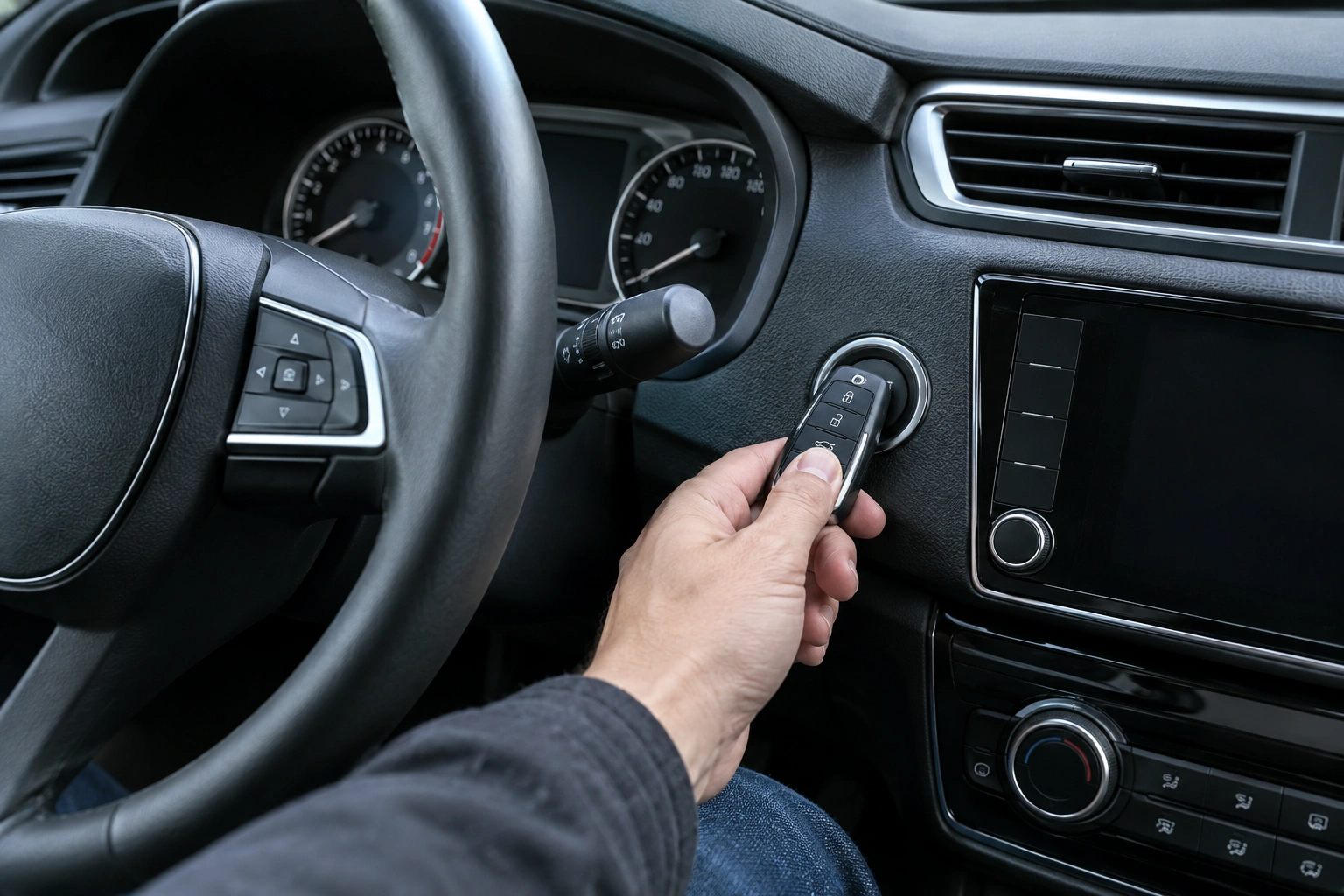
Try the vehicle’s backup start area first. On many cars, that means holding the fob directly against the start button or placing it in a designated slot or pocket near the steering column or center console. If the car starts this way, the fob is usually still transmitting enough for close-range detection, which points more toward a weak battery or weak signal than a completely dead fob.
2) Remove obvious interference
Take the fob out of a pocket with a phone, another smart key, a magnetic wallet, or a bundle of keys. Some vehicles are more sensitive than others, but crowded pockets are a common place for problems to show up. If the car works normally after you move the fob, interference or shielding is more likely than a hardware failure.
3) Try the spare fob
If the spare works normally in the same situation, the original fob is the main suspect. If both fobs act up, look harder at the vehicle battery, interference, or the car’s receiver side. If the spare only works in some places or only when held close, that also suggests a vehicle-side or signal-strength issue rather than a single bad fob.
If you need a broader overview of key fob battery replacement and remote issues, the ReplaceKeyFob battery guide collection is a useful place to compare symptoms once you’ve narrowed down the cause.
Step-by-step troubleshooting order
Use this sequence so you don’t replace parts blindly.
1) Replace the key fob battery first if it’s old
If the fob battery is several years old, or you don’t know when it was last changed, replace it first. It’s cheap, fast, and often solves an intermittent detection problem.
A weak battery can still have enough power for short-range operation, which is why people get fooled into thinking the fob is fine. If the car only detects the fob when it’s pressed close to the start button or used in the emergency start slot, that’s a strong sign the battery is borderline.
2) Inspect the battery contacts and case
Open the fob and look for:
– corrosion on the battery contacts
– a loose battery
– cracked plastic
– water spots or residue
– worn or mushy buttons
A battery that shifts around in the case can make the fob act random. Moisture damage can do the same thing, especially if the issue came on after rain, a spill, or a dropped fob.
3) Check the vehicle battery
If the car battery is weak, the fob system may be one of the first things to act strange. Watch for:
– slow engine cranking
– dim headlights
– flickering interior lights
– random electrical glitches
– warnings that appear after the car sits overnight
If those symptoms are present, the vehicle battery deserves attention before you blame the fob. Low voltage can affect keyless entry and push-button start even when the car still “has power.”
4) Test for interference
Try the car in a different place. If it works in the driveway but not in a parking garage, that’s a big clue. Metal structures, nearby transmitters, and even some electronic equipment can weaken the signal enough to cause intermittent detection.
5) Compare door unlocking and starting behavior
If the doors unlock reliably but the car sometimes refuses to start, the issue may be more than a simple battery problem. That split can point toward the transponder chip, immobilizer communication, or a vehicle-side detection fault.
How to test the key fob battery and contacts
You don’t need fancy tools to get a useful answer.
A weak fob battery often shows up like this:
– the fob works only at short range
– the car detects it after repeated attempts
– the problem gets worse in cold weather
– the spare fob works better than the main one
If you open the fob, check whether the battery is firmly seated and whether the metal contacts are clean and springy. A battery can test “okay” in a loose sense and still fail in the real world because the contact pressure is poor.
If the shell is cracked, the buttons feel inconsistent, or you see moisture damage, I’d treat the fob as suspect even if it still works sometimes. Intermittent electronics rarely improve on their own.
How to check the vehicle battery and low-voltage symptoms
A weak car battery can create a lot of confusing symptoms because the vehicle may still power up just enough to seem normal.
Look for these signs:
– the engine cranks slowly
– the dash lights dim when you start the car
– the car has been sitting overnight and acts worse in the morning
– the infotainment system reboots or glitches
– the battery is older and hasn’t been tested recently
If you’re already seeing low-voltage symptoms, test the vehicle battery before replacing the fob again. The trade-off is simple: a fob battery is cheaper and easier, but a weak vehicle battery can mimic a fob problem closely enough to waste your time.
For general vehicle safety and battery-related guidance, the NHTSA’s vehicle safety information is a reliable place to start when you’re deciding whether a broader electrical issue might be involved.
Interference, location, and weather clues
This is where a lot of intermittent problems finally make sense.
If the car works fine in your driveway but not in a parking garage, the environment may be the problem. If it fails near one office building but not another, that points toward RF interference or signal blockage. If cold mornings make the issue worse, a weak fob battery or borderline vehicle battery becomes more likely.
Temperature matters because very hot or very cold conditions can affect battery performance and electronics, especially when the fob battery is already weak. That doesn’t mean weather is the root cause every time. It often just exposes a battery that was already near the edge.
The same goes for metal objects. A phone, another key fob, a laptop bag, or even a metal-lined pocket can weaken the signal enough to matter on a marginal system.
How to start the car when the fob isn’t being detected
If you need to get moving, use the vehicle’s backup start procedure. Many push-button start cars have an emergency method that lets the system detect the transponder chip at very close range or in a designated area near the start button or steering column.
Common backup-start patterns include:
– holding the fob directly against the push-button start switch
– placing the fob in a marked slot, pocket, or tray in the center console
– touching the fob to a designated spot near the steering column or dashboard
– pressing the brake and start button while the fob is held in the emergency detection area
Because this varies by make and model, check the owner’s manual for the exact procedure. Don’t guess if you’re unsure, since some cars use a specific placement point and others use a backup slot.
If you’re stranded in an unsafe place, use the backup method first if you know it, then deal with the diagnosis later. The goal is to get the car started safely, not to prove which part failed right this second.
When re-syncing or reprogramming may help
A resync is worth trying when:
– the fob battery is fresh
– the spare fob works better than the main one
– the issue started after a battery change or electrical event
– the car seems to have lost recognition rather than losing signal strength
A resync is less likely to help when:
– the fob case is cracked
– the battery contacts are corroded
– the issue is tied to one location or one weather condition
– both fobs show the same problem
That trade-off matters. Reprogramming can solve a communication problem, but it won’t fix a damaged fob or a weak receiver. If you’re not sure whether your vehicle supports a simple resync, a locksmith or dealer can confirm the correct procedure for your exact model.
Signs the problem is the car’s receiver, antenna, or immobilizer system
If you’ve already tried a fresh fob battery, checked for interference, and tested the spare fob, the vehicle side becomes more likely.
Watch for these signs:
– both fobs behave the same way
– the problem repeats in a consistent pattern
– the car unlocks but won’t always start
– the issue seems tied to one area of the vehicle, such as the cabin or driver’s side
– the fob only seems to work in one spot inside the car, which can suggest a weak antenna or receiver zone
– the problem persists even after a known-good battery and a known-good spare fob
Antenna or receiver faults can be tricky because they may not fail completely. They can become weak or inconsistent, which looks a lot like a bad fob at first. That’s why location-specific testing is so useful.
If you want a better sense of whether your symptoms fit a vehicle-side or fob-side issue, Edmunds has useful consumer guidance on smart key and push-button start behavior in modern vehicles.
Replace the battery, replace the fob, or get professional help?
Here’s the shortest decision guide:
Replace the fob battery first if:
- the battery is old or unknown
- the fob works only at close range
- the issue is new and isolated to one fob
Replace the whole fob if:
- the shell is damaged
- the fob has water damage
- battery changes and contact cleaning don’t help
- the buttons or board are clearly failing
Test the vehicle battery if:
- the car cranks slowly
- lights dim or electronics glitch
- the problem appears after the car sits
See a locksmith or dealer if:
- both fobs fail the same way
- the problem keeps returning after battery replacement
- the car’s receiver, antenna, or immobilizer system is suspected
- you need the exact backup start or programming procedure for your vehicle
A locksmith is often the better first stop when the issue looks like a fob, battery, or simple programming problem. A dealer is usually more appropriate when the symptoms point to module diagnostics, antenna/receiver replacement, immobilizer faults, or brand-specific programming that a locksmith can’t complete. If you’re trying to choose between the two, the deciding factor is usually whether you need general fob service or deeper vehicle-module diagnosis.
When to stop troubleshooting and escalate
Stop at-home testing and get help if the problem is becoming frequent, if the car leaves you unsure whether it will start, or if you’re dealing with a vehicle battery that seems weak or unstable. Also pause if the fob is hot, swollen, corroded, or visibly damaged.
An intermittent key fob problem is annoying when it’s occasional. It becomes a real inconvenience when it starts affecting your ability to leave, return, or park safely. If the issue is recurring after the basic checks, a locksmith or dealer diagnosis is usually the fastest path to a reliable fix.
FAQs
Why does my car detect the key fob sometimes but not others?
Usually because the signal is marginal. A weak fob battery, low vehicle voltage, interference, or a failing component can make recognition inconsistent.
Is the key fob battery weak even if it still works occasionally?
Yes. That’s one of the most common signs of a weak battery. A borderline battery may work at close range or in ideal conditions, then fail when the signal has to travel farther.
Could my car battery be causing the intermittent detection?
Yes. A weak vehicle battery can cause keyless entry and push-button start problems, especially if you also notice slow cranking, dim lights, or other electrical issues.
Can my phone or other electronics interfere with the fob?
They can. A crowded pocket, nearby electronics, metal objects, or certain locations can weaken the signal enough to trigger intermittent detection.
How do I start the car if the fob isn’t being detected?
Use the vehicle’s emergency start or backup placement method described in the owner’s manual. Common methods include holding the fob against the start button or placing it in a designated slot, but the exact procedure varies by vehicle.
When should I replace the fob instead of just the battery?
Replace the whole fob if the case is cracked, the board is damaged, there’s water exposure, or a fresh battery doesn’t restore reliable operation.
Should I go to a locksmith or dealer?
If the issue looks like a battery or basic fob problem, a locksmith is often the practical first stop. If the problem points to the receiver, antenna, or immobilizer system, a dealer may be the better fit.
Can weather really affect key fob detection?
Yes. Extreme cold or heat can make a weak battery act worse, and temperature changes can expose borderline electronic problems.
Why does the door unlock but the car won’t start?
That can happen when the entry function still works but the start authorization side is weak or failing. It may point to the transponder, immobilizer communication, or a vehicle-side issue.
Will reprogramming fix it?
Sometimes, but not always. Reprogramming helps when the issue is communication or sync-related. It won’t fix damaged hardware, weak contacts, or a failing battery.
What if both fobs have the same problem?
That usually shifts suspicion toward the vehicle battery, interference, receiver/antenna, or immobilizer system rather than the individual fobs.
Is it safe to keep driving with an intermittent key fob problem?
Only if you’ve confirmed the car starts reliably for now and you understand the backup method. If the problem is getting worse or the vehicle may strand you, get it checked before you rely on it again.
Do spare fobs need updating after a repair?
Sometimes they do, depending on the repair and the vehicle. Follow the manufacturer’s procedure or ask the locksmith/dealer handling the job.
Where can I learn more about key fob battery replacement?
You can browse practical guides on ReplaceKeyFob.com for battery and remote troubleshooting, especially if your issue seems battery-related.
