
Why a Key Fob Opens the Trunk but Not the Doors: Causes and Fixes

If your key fob opens the trunk but not doors, the good news is that the problem is often narrower than it first looks. The bad news is that “partial working” can come from more than one place: the fob battery, worn buttons, lost programming, vehicle settings, or a fault in the door locking system itself.
The trunk button and the door lock/unlock buttons do not always fail together. On many vehicles, they send separate commands through separate circuits or at least separate button contacts inside the fob. That means one function can still work while another one drops out. I’ve seen owners assume the battery is fine because the trunk pops, only to find the door buttons are barely making contact anymore. I’ve also seen the opposite: the fob is healthy, but the car’s door lock system is the real issue.
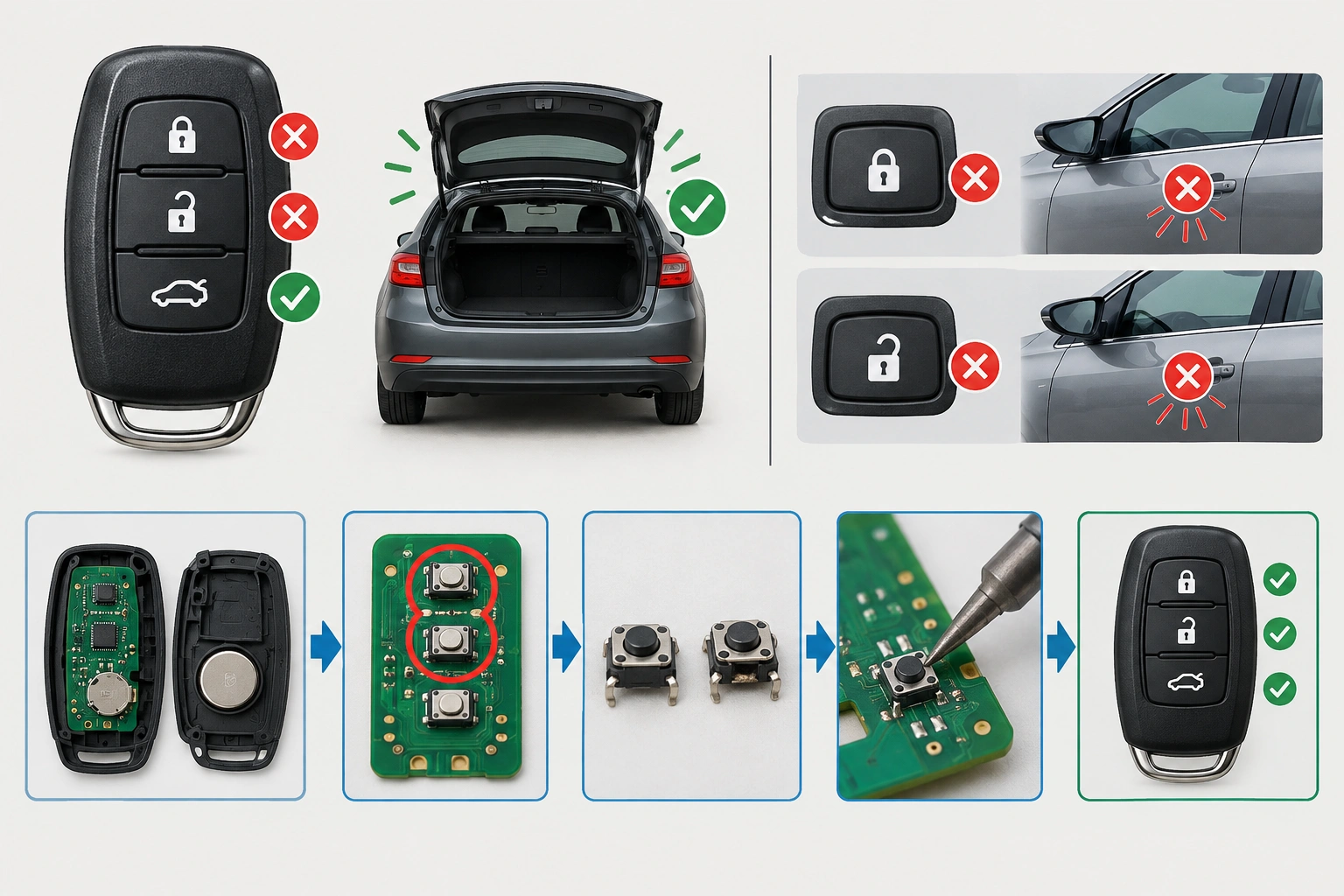
Quick Symptom Check: What Works and What Doesn’t
Before you replace anything, narrow down the pattern. That pattern tells you where to look next.
If the trunk works but all doors do not
This usually points to one of three buckets:
- the fob’s door-lock or unlock button is weak or damaged
- the fob has lost sync or programming
- the car’s central locking system is not responding to remote door commands
If only one door fails
That leans more toward the vehicle side, especially a door lock actuator, wiring issue in that door, or a mechanical lock problem. If the trunk and other doors work normally, the remote is probably not the main problem.
If the doors work sometimes but not always
Intermittent operation often suggests a weak battery, worn button contacts, or a fob that works only when pressed firmly or held at a certain angle. Distance matters too. If the fob works only when you stand close to the car, that can be a clue that signal strength is dropping.
If the trunk button is the only reliable button
That usually means the fob is not completely dead. Partial failure like this should make you suspicious of the button pad, internal contacts, or a function-specific circuit rather than the entire remote.
Most Likely Causes, in the Order I’d Check Them
I like to diagnose these from the cheapest, simplest checks to the more involved ones.
1) Weak battery or poor battery contact
A weak key fob battery can still let one function work while another becomes unreliable. That said, a working trunk button does not prove the battery is healthy. Some buttons draw differently, and some fobs are simply more forgiving on one command than another.
Also check the battery fit. If the battery is new but sitting loosely, or the contacts are bent, the fob may act inconsistent. If your car uses a coin-cell battery, make sure it is seated flat and the cover is fully snapped on.
For a broader look at battery-related remote issues, see our guide on why a key fob is not detected but the car still starts.
2) Worn buttons or damaged internal contacts
If the trunk button clicks normally but the door buttons feel mushy, sticky, or need an unusually hard press, the button pad may be worn out. In that case, the fob can still send one command while another barely registers.
A classic sign is this: the trunk opens only when you press the button in just the right spot, or the unlock button works only after a second or third attempt. That points to a physical issue inside the remote more than a vehicle-side fault.
3) Valet mode, child lock, or a trunk-disable setting
Some vehicles have a valet function or a similar security setting that changes what the remote can do. The exact behavior varies by model, so the safest check is the owner’s manual plus the in-car controls.
Use this quick checklist:
– Check the owner’s manual for “valet mode,” “trunk disable,” “child lock,” or “remote lock settings.”
– Look for a valet switch, glove-box button, menu setting, or key-fob setting that can limit remote functions.
– Confirm whether the trunk release still works from the dash, driver door switch, or interior menu.
– Check whether the child lock is active on rear doors if the symptom is limited to those doors.
– Turn the setting off using the manual’s procedure, then retest the remote.
For model-specific behavior, the owner’s manual is the safest source. If you want a general reference on vehicle security and entry systems, NHTSA’s vehicle safety resources are a solid place to start.
4) Lost programming or sync
If the fob was dropped, had a battery change, or sat unused for a long time, it may need to be resynced on some vehicles. This is more plausible when the fob seems electrically alive but the car no longer responds correctly to the door commands.
Resyncing can help when communication is the problem. It will not fix cracked solder joints, worn buttons, or a dead door actuator.
5) Door lock actuator, fuse, or central locking fault
If the remote seems fine but the doors still do not respond, the issue may be on the car side. A single failed door often means a bad actuator or wiring problem in that door. If all doors fail at once, look harder at the central locking system, a fuse, or a module issue.
One important diagnostic point: the trunk release circuit can be on a different fuse, receiver path, or control module than the door locks. So a working trunk does not rule out a door-lock fuse, receiver, or central locking fault.
That distinction matters. One bad door is a local repair. All doors failing together usually means a shared system problem.
Step-by-Step Fixes You Can Try First
These are the checks I’d do before spending money.
1) Replace the battery if it is old or unknown
If you cannot remember the last battery change, replace it first. Use the correct battery type for your fob and install it carefully. A fresh battery is not a guarantee, but it removes the easiest variable.
2) Test the buttons by feel
Press each button slowly. Compare the trunk button to the door buttons. If one feels softer, sticks, or requires a harder press, that button may be the weak link.
3) Try the fob close to the car
Stand near the driver door and try the lock and unlock buttons again. Then try from a few feet away. If it works only when you are very close, that can point to a weak battery, interference, or a borderline fob.
If you have interference concerns, our guide on why a key fob works in one place but not another covers how location can change remote behavior.
4) Check for valet mode or a trunk/lock disable setting
Look in the owner’s manual for any valet switch, glove-box button, child lock behavior, or security setting that affects remote door operation. If the car has a valet feature, disable it the way the manual recommends.
5) Use the physical key or backup entry method
If your car has a hidden key blade or another way to enter, use it so you do not lock yourself out while testing. Then see whether the doors will unlock from inside with the switch. If the inside switch works but the remote does not, that is another clue the problem is remote-side rather than mechanical.
How to Tell Whether the Problem Is the Fob or the Car
This is the fastest decision point.
The spare fob test
If you have a spare key fob, use it before anything else. A working spare is the cleanest way to separate remote trouble from vehicle trouble.
- Spare works normally: your original fob is the likely problem
- Both fobs fail the same way: the car, settings, or receiver/locking system is more suspect
That one test saves a lot of guesswork.
What the lock switches inside the car do
If the door lock switch inside the vehicle works, but the remote does not, the door hardware is probably intact. That shifts attention to the fob, programming, or remote receiver side.
If the inside switch also fails on one door, that door may have an actuator or wiring fault.
When the trunk still works but the doors do not
This is the key split:
– If the trunk works on both fobs but the doors fail on both fobs, the problem is usually on the vehicle side: receiver, central locking, fuse, module, or a settings issue.
– If the trunk works on one fob but the doors fail only on that same fob, the fob’s door-button contact or circuit is more likely to be the issue.
– If the trunk and doors both fail on one fob but a spare works, that original fob likely has a battery, contact, or internal circuit problem.
When Reprogramming or Resyncing Might Help
Reprogramming is worth considering when:
- the fob used to work and then stopped after a battery change
- both door buttons fail, but the trunk function still works intermittently
- a spare fob behaves the same way, and the car’s manual supports a resync procedure
Reprogramming is less likely to help if the buttons feel physically worn, the battery contacts are corroded, or the remote only works when pressed hard. Those signs point to hardware, not lost memory.
This is where model-specific guidance matters. Some vehicles allow owner-level resync steps; others require dealer-level programming. A general article can only go so far because the exact procedure changes by make and model.
Door Lock Actuator, Fuse, and Central Locking Problems
When the trunk still opens but the doors do not, the vehicle-side suspects depend on the pattern.
One door only
A single door that refuses to unlock is often a bad actuator or a wiring issue in that door. If the door makes a weak clicking sound, moves slowly, or works sometimes, the actuator is especially suspect.
All doors at once
When none of the doors respond, think bigger:
- central locking module
- fuse
- receiver or body control issue
- programming or security state
A fuse check is worth doing if your vehicle manual identifies one for door locks or central locking. Do not assume the trunk and doors share the same fuse. Many cars split those functions, so a trunk release can still work while a door-lock circuit is protected by a different fuse or controlled by a different module path.
Why the trunk can still work
The trunk release may be on a different command path than the door lock/unlock functions. That is why a trunk that works does not clear the fob or the car. It only proves part of the system is alive.
When the Fob Itself Is Worn or Damaged
A fob can look fine from the outside and still fail internally.
Common signs include:
- buttons that feel soft, sticky, or uneven
- a button that works only when pressed hard
- visible wear on the rubber pad
- a cracked shell or loose battery cover
- intermittent response after the fob was dropped
Inside, the contact pads or circuit board can crack or wear out. If the trunk button is the only reliable one, I would not rule out internal damage just because the remote still does something.
When to Replace the Battery, Repair the Fob, or Fix the Car
Here’s the practical decision guide I use.
Replace the battery first if:
- the battery is old or unknown
- the fob works intermittently
- button response improves when you stand close to the car
Repair or replace the fob if:
- the trunk works but the door buttons feel worn
- the battery is fresh and the problem stays the same
- a spare fob works, but the original does not
Repair the car if:
- both fobs fail the same way
- only one door has the problem
- the inside lock switch also acts up
- the doors do not respond even though the remote seems to transmit normally
That comparison matters because replacing the remote will not fix a bad actuator, and replacing actuators will not fix a worn button pad.
When to Consult a Locksmith
Call a locksmith, dealer, or mechanic when:
- you do not have a working spare fob
- the problem remains after a battery change
- the car appears to be in valet or security mode and you are not sure how to disable it
- one door is dead while the others work
- the vehicle needs programming that the owner cannot perform safely at home
A locksmith is often the best first call when the issue looks remote-related. A mechanic is usually the better fit when the car’s locks, fuse, or wiring are the likely cause. A dealer becomes more relevant when the vehicle needs model-specific programming or module work.
FAQ
Can a weak battery really let the trunk work but not the doors?
Yes, it can happen. Partial operation does not rule out the battery, especially if the fob is old or the contacts are not making solid connection.
If the trunk button works, is my fob definitely not broken?
No. The trunk function can still work even if the door buttons or internal contacts are failing.
Will replacing the battery fix this issue?
Sometimes, but not always. If the problem is worn buttons, lost programming, or a door lock fault, a new battery will not solve it.
Can I reprogram the key fob myself?
Sometimes. It depends on the vehicle. Some models allow owner-level resyncing, while others require professional programming.
Why would only one door fail?
That usually points to a door-specific problem such as an actuator, wiring, or a mechanical lock issue rather than the fob itself.
If you want to keep narrowing down remote problems, the next most helpful read is what to do when a key fob is not detected but a new battery is installed. It covers the same “partial success, partial failure” logic from a different angle.
