
Why Your Key Fob Works in One Place but Not Another: Causes and Fixes That Make Sense

If your key fob works in one location but not another, you’re not dealing with a random ghost in the car. That pattern usually points to one of three things: radio signal interference, a weak fob battery, or a problem on the vehicle side.
The good news is that this kind of issue is often diagnosable at home with a few simple comparisons. The trick is to test in the right order so you do not waste money replacing parts that are not actually bad.
Here’s the basic idea: if the fob works fine in open areas but acts up near a garage, apartment building, busy lot, or certain parking spot, the environment is a strong suspect. If the fob is getting worse everywhere, the battery moves up the list. If two different fobs fail in the same places, the car’s receiver, antenna, or smart key system deserves a closer look.
What this pattern usually means
A location-specific key fob problem is different from a dead fob. A dead fob fails everywhere. A location-based problem often comes and goes depending on where you are standing, how close the car is, and what is around you.
That distinction matters because it changes the fix. If the issue is environmental, you may only need to move a few feet or use a different parking spot. If the issue is battery-related, a simple battery replacement may restore range. If the problem follows the car no matter which fob you use, the vehicle may need diagnosis.
The most likely causes, in the order I’d check them
1) RF signal interference or signal blockage
Key fobs use radio frequency signals, and those signals can be weakened or blocked by the surroundings. Concrete, steel, dense buildings, and crowded parking structures can all make a fob act like it has a mind of its own.
This is why a fob may work in a driveway but fail in a parking garage, or unlock the car in one corner of a lot but not another. Heavy electronics and nearby radio sources can also contribute to electromagnetic interference, though the exact source is not always obvious. Weather can sometimes affect range indirectly too, but it is usually a smaller factor than physical blockage or nearby interference. In practice, the important clue is location: if the same fob behaves differently in different places, the environment is a real suspect.
A useful comparison: if you can walk 20 feet away from the problem spot and the fob suddenly works again, that points more toward interference than hardware failure.
2) A weak key fob battery
A weak battery does not always kill the fob completely. More often, it reduces range and makes the fob inconsistent. That means the fob might work when you are close to the car, work in open air, and fail in places where the signal already has to fight through obstacles.
Common weak-battery signs include reduced range, delayed response, needing to stand very close to the vehicle, and buttons that work only intermittently. Sometimes the fob still unlocks the doors but takes longer than usual, or the push-button start is less reliable even though the fob is not fully dead.
That’s why a tired battery can look like a location problem. The battery may still have enough power for a strong signal path, but not enough for a harder one.
3) Vehicle-side antenna, receiver, or smart entry issue
If the car is not consistently hearing the fob, the issue may be on the vehicle side. That can involve the receiver module, antenna, or another part of the remote keyless entry or smart key system.
This becomes more likely when both the main fob and the spare fob behave the same way in the same locations. It also becomes more likely when the problem is not just reduced range, but repeated failure to unlock or start even after you have ruled out the battery and obvious interference.
Manufacturer documentation is the best source here because the exact architecture varies by vehicle. Some cars have multiple antennas and different logic for door unlocking versus push-button start, so a fault can show up in one function before the other.
Quick comparison: interference, battery, or vehicle problem?
| Symptom | Most likely cause | What to try next |
|---|---|---|
| Works in open areas but fails in a garage, near a big building, or in one specific spot | RF signal interference or blockage | Move to a different location and test again |
| Works, but only close to the car or only sometimes | Weak fob battery | Replace the battery and retest |
| Spare fob works normally in the same spot | Main fob battery or hardware issue | Check battery fit, contacts, then consider replacement |
| Both fobs fail in the same locations | Environment or vehicle-side issue | Test in another area; if persistent, inspect the car system |
| Doors work but push-button start does not | Proximity/authentication issue or weak battery | Try the backup start method and check the battery first |
How to test it without guessing
Test in two different locations
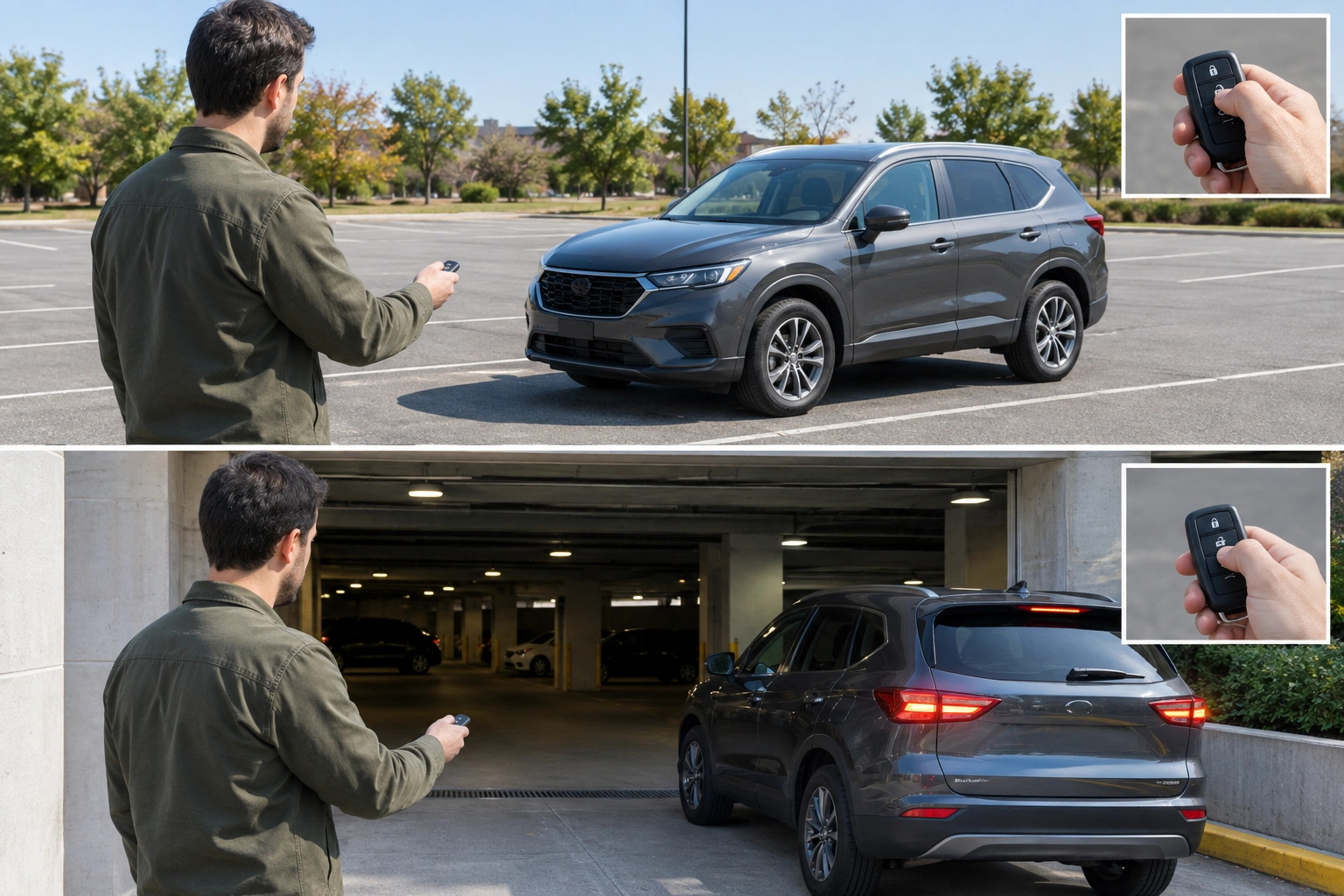
Pick one open area and one problem area. A driveway or open parking lot works well for the first test. Then try the same fob in the place where it usually fails.
If the fob works normally in the open area and fails only in the problem area, you have a strong location clue. If it is weak everywhere, the battery or fob itself moves up the list.
Check the spare fob
The spare fob is one of the best tools you already own. If the spare works in the exact same place where the main fob fails, the main fob is the likely problem. If both fobs act the same way, the car or the environment becomes more suspicious.
Replace the battery if it is old or unknown
If you do not remember the last battery change, replacement is a sensible next step. It is a low-cost test, and it removes a common weak point from the equation.
Just be careful not to treat battery replacement as a magic cure. If the fob still fails only in certain places after a new battery, the battery was probably not the only issue.
Common places where key fobs struggle
Some spots are simply harder for a key fob signal to survive:
- parking garages and parking decks
- dense urban areas with lots of metal and concrete
- near large buildings or underground structures
- crowded lots with many nearby vehicles
- areas with heavy electronics or infrastructure nearby
A key fob that works at your house but not in a parking garage is a classic example. Another common one is a fob that works on one side of an apartment complex but not near a specific entrance. In those cases, the location itself is part of the problem.
What to do if the fob fails to unlock or start the car
If the car will not respond, try the most common emergency backup steps right away.
First, look for the hidden mechanical key inside the fob. Many vehicles use it to unlock the driver’s door manually even when the electronics fail.
Second, if the car has push-button start, try the emergency start method. On many models, that means holding the fob very close to the start button, pressing the fob into a marked backup spot, or placing it in a specific area such as the center console, cupholder, or steering-column zone. The exact location varies by vehicle, but the idea is the same: the car can often read the fob at very short range even when normal detection fails.
If you are stuck and need a quick next step, the usual fallback sequence is:
1. use the hidden mechanical key to get in,
2. try the designated backup start position,
3. move the fob closer to the start button or marked sensor area,
4. replace the battery if you have not done so recently,
5. then seek professional help if the car still will not recognize the fob.
The exact method varies by make and model, so the owner’s manual is still the safest reference for the precise backup location. If you want a broader walkthrough of backup methods, see how to start a car when the key fob is not detected.
If your car says the fob is not detected but still starts sometimes, this related guide on why your car says “key fob not detected” but still starts can help you sort out the difference between detection issues and a full failure.
For a deeper battery-related comparison, this guide on what to check when a key fob is not detected with a new battery is also useful.
When the problem points to the vehicle instead of the fob
A vehicle-side issue becomes more likely when:
- both fobs fail the same way
- the failure happens in the same locations every time
- the battery is fresh and properly installed
- the fob works at close range in some situations but not others
- the problem affects unlocking, starting, or both
Some vehicles also separate door-entry behavior from ignition recognition. That means the fob may unlock the doors but not be accepted for starting, or the reverse may happen. A vehicle setting, software update, or configuration change can also matter on some models, so if your vehicle recently had an update, check whether a setting changed or a feature was disabled.
At that point, the car’s antenna or receiver module should be inspected with proper diagnostic tools. That is not a random-parts situation.
When to replace the battery, reprogram the fob, or get help
Replace the battery first if the fob range is shrinking, the operation is intermittent, or the battery is old enough that you no longer trust it.
Consider reprogramming only after you have ruled out battery weakness and obvious interference. Reprogramming can help if the fob lost sync, but it will not fix a weak signal path or a broken receiver.
Call a locksmith, dealer, or qualified mechanic if:
- both fobs fail in the same locations
- the battery is fresh and the problem continues
- the vehicle does not recognize the fob in multiple places
- the issue affects several functions, not just one button
A qualified technician can check the receiver, antenna, and related modules instead of making you guess.
A simple decision rule that keeps you from overspending
If the fob works everywhere except one or two problem spots, think environment first. If it works only when you are very close, think battery first. If the spare fob acts the same way, think vehicle-side issue or interference before buying another fob.
That order saves time and keeps the diagnosis logical.
FAQ
Why does my key fob only work in certain places?
Usually because the signal is being blocked or weakened in those locations, or because the fob battery is too weak to push through tougher conditions.
Can a parking garage really cause this?
Yes. Garages are one of the most common places for location-specific fob problems because of concrete, steel, and signal clutter.
If my spare fob works, is the car fine?
Not always, but it makes a vehicle-side issue less likely. It usually points to the main fob battery or the fob itself.
Could the car’s antenna be the problem?
Yes, especially if more than one fob fails in the same places and the battery is not the issue.
Should I replace the whole key fob right away?
Not before testing the battery and the spare fob. Replacing the whole fob too early can be an expensive guess.
For official guidance on vehicle electronics and safety-related features, NHTSA’s vehicle safety resources are a good place to start, and Edmunds’ car tech coverage can help you understand how smart key systems behave across different models. If you want a broader consumer explanation of in-car tech behavior, Car and Driver also has useful background on modern keyless systems.
