
Key Fob Replacement vs Repair: How to Choose the Right Fix

If your key fob is acting up, the fastest way to save money is to avoid guessing. In many cases, the battery, case, buttons, or battery contacts are the real problem—not the entire fob. In other cases, the circuit board is damaged and replacement is the smarter move.
Here’s the practical rule: start with the battery and contact check, then inspect the shell and buttons, and only buy a full replacement if the electronics or security components are damaged, missing, or no longer reliable.
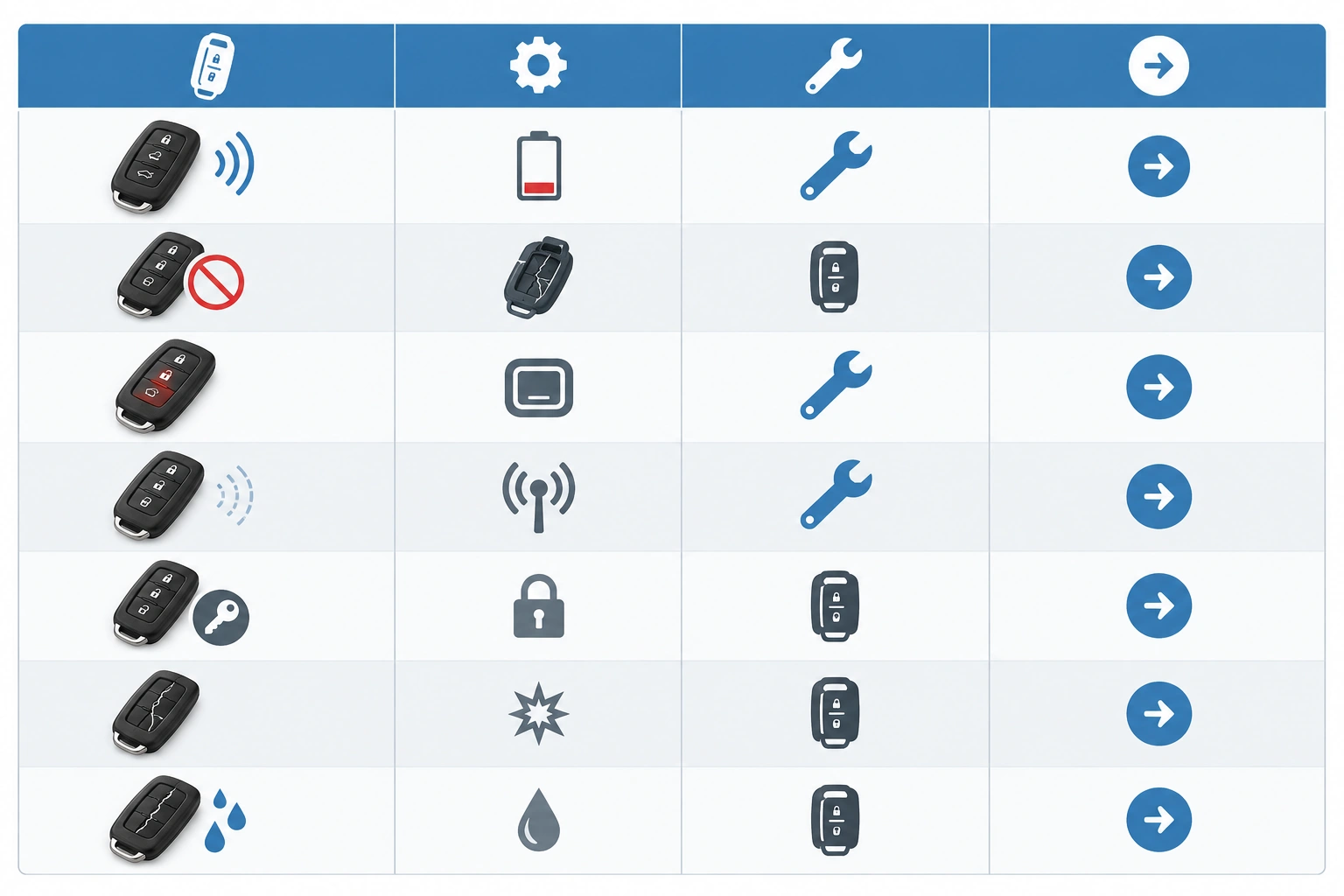
| Symptom | Most likely cause | Repairable? | Typical next step |
|---|---|---|---|
| Weak range, intermittent response | Low battery or dirty contacts | Usually yes | Replace battery, clean contacts |
| Buttons feel mushy or only work when pressed hard | Worn button pad or case | Often yes | Replace shell or button pad |
| Cracked outer shell, electronics still work | Case damage | Often yes | Swap the shell |
| Fob was dropped in water | Corrosion on circuit board | Sometimes, but often not worth it | Dry quickly, inspect for corrosion, consider replacement |
| Fob is lost or stolen | Missing security device | No | Replace and reprogram |
| No response after battery replacement | Battery issue, contact issue, or programming problem | Maybe | Check battery orientation, contacts, then reprogram if needed |
| Known-good fob still won’t work | Vehicle receiver or immobilizer issue | Not a fob repair | Diagnose the vehicle side |
If you want a deeper dive on one common branch of the problem, our guides on key fob not working after battery replacement and key fob case replacement problems can help narrow it down fast.
Quick Decision: Repair, Replace, or Start with the Battery
If the fob is still physically intact and the car sometimes responds, repair is often worth trying. If the fob is badly cracked, soaked, or missing, replacement is usually the practical path. And if the symptoms are mild—like short range or delayed locking—the battery is the first thing to check.
A simple decision rule:
- Weak or intermittent fob: try a battery first
- Cracked shell, bad buttons, loose parts: repair the housing or contacts
- Water damage, corrosion, dead board, lost fob: replace it
- New battery did nothing: look at programming or the vehicle-side system
That approach keeps you from paying for a full replacement when a few dollars in parts may solve it.
Symptoms That Point to a Battery Problem vs a Fob Problem
A dying battery usually shows up as reduced range, slow response, or a fob that works only sometimes. The indicator light may still flash, but the signal is weak. That’s different from a damaged internal board, which may cause the fob to fail completely or behave unpredictably.
A few examples help:
- If you have to stand right next to the car for it to unlock, the battery is a strong suspect.
- If one button works and another doesn’t, the button pad or contact inside the fob may be worn.
- If the fob worked yesterday and stopped after getting wet, the circuit board may already be corroding.
- If the fob does nothing even after a fresh battery, the issue may be programming, a loose contact, or a vehicle-side problem.
For context, even basic remotes may require special programming with computer software that is only accessible by a dealership, according to Kelley Blue Book’s key fob replacement guide. That matters because a “dead” fob is not always a broken fob.
Most Likely Causes, Ordered by Probability
A good diagnostic flow starts with the simplest causes first. That saves time and avoids unnecessary parts.
1. Battery or battery contacts
This is the most common first stop. A weak battery can mimic a dead fob. If the battery is installed backward, the wrong size, or not seated tightly, the fob may act dead even though the electronics are fine.
2. Worn buttons or a damaged shell
If the outer case is cracked or the button rubber is worn out, the fob may still work internally. The problem is often mechanical, not electronic.
3. Loose internal parts
A dropped fob can shift the battery, loosen the contact spring, or separate the shell enough that the circuit board doesn’t sit correctly.
4. Circuit board damage
This is where repair gets less predictable. A board can fail from impact, corrosion, or age. If the board is damaged, replacement becomes more reliable than trying to patch it.
5. Vehicle-side receiver or immobilizer issue
If a known-good fob also fails, stop blaming the fob. The car’s receiver, antenna, or immobilizer system may be the real issue.
What Can Usually Be Repaired
Some fob problems are surprisingly fixable if the electronics are still healthy.
Worn buttons
If the buttons feel soft, sticky, or only work when pressed hard, the rubber pad or contact surface may be worn. In many cases, that means a shell or button repair, not a full replacement.
Cracked case
A cracked outer shell does not automatically mean the fob is junk. If the board, battery, and transponder chip are fine, a replacement shell may restore normal use.
Loose battery contacts
Bent or loose battery terminals can interrupt power. Careful cleaning or contact adjustment may bring the fob back.
Minor internal looseness
Sometimes the fix is as simple as reseating the battery or aligning the board inside the case properly.
A useful comparison: if the fob is like a flashlight, a cracked body or loose spring is repairable; a burned-out circuit board is a different story.
When Replacement Is the Better Option
There are situations where repair is possible in theory but not practical in real life.
Water damage
Water exposure is the big one. If moisture reached the circuit board and corrosion started, the fob may fail again even after drying. I’d be especially cautious if the battery was left inside while the fob was wet.
If that’s your situation, our guide on car key fob water damage repair explains what can still be saved and what usually shouldn’t be trusted.
Severe physical damage
If the board is cracked, the battery compartment is broken apart, or the fob has been crushed, replacement is usually safer.
Lost or stolen fob
A missing fob is not a repair job. It’s a replacement-and-security job. Depending on the vehicle, you may also need to deactivate the old fob so it can’t be used.
Failed electronics
If the board or transponder chip is dead, the cost of trying to salvage it may not make sense compared with replacing the unit.
A practical note from AARP’s guidance: check and replace the batteries before buying a new one, because the device may need maintenance but not replacement. Their article also notes that a key fob may need to be reprogrammed, similar to resetting a cellphone. You can read that guidance here.
Step-by-Step Troubleshooting and Fixes
Here’s the order I’d use in the shop.
1. Replace the battery
Use the exact battery type your fob calls for. Don’t assume “close enough” will work.
2. Check the battery orientation and contacts
Make sure the battery sits firmly and the contacts aren’t bent, dirty, or corroded.
3. Test every button
If only one button fails, the problem may be isolated to the button pad or contact under that button.
4. Inspect the shell
Look for cracks, gaps, missing screws, or a loose battery door.
5. Open the fob carefully
If the case opens easily, check for a loose board, corrosion, or broken contact tabs. Don’t pry aggressively; that’s how good parts get damaged.
6. Try the spare key fob, if you have one
If the spare works normally, the problem is likely in the original fob, not the car.
7. Test the vehicle side
If both fobs fail, the issue may be the receiver, antenna, or immobilizer system rather than the remote itself.
DIY Repair vs Professional Repair
DIY repair makes sense when the fix is simple and low-risk:
- battery replacement
- shell replacement
- contact cleaning
- basic button repair
Professional help is smarter when the job involves:
- circuit board work
- transponder chip handling
- water corrosion
- programming or reprogramming
- lost or stolen fobs
The risk with DIY is not just breaking the fob further. On some vehicles, a damaged chip or bad programming attempt can turn a minor problem into a bigger one.
For many owners, the practical line is this: if the repair is limited to the case, battery, or contacts, DIY is usually reasonable; if it involves the board, immobilizer chip, or pairing the fob to the vehicle, professional help is often worth the cost.
Repair vs Replacement Cost Comparison
I’m going to keep this conservative: costs vary a lot by vehicle, fob style, and where you live. But the usual pattern is straightforward.
- Battery replacement: usually about $5 to $20 if you do it yourself, or roughly $15 to $50 installed at a shop
- Shell repair / case replacement: often about $10 to $40 for the shell, or roughly $30 to $80 with labor
- Professional repair for buttons, contacts, or minor electronics: often about $40 to $120, depending on the damage
- Locksmith replacement: commonly about $75 to $250+ for many standard fobs, with higher prices for transponder or smart-key systems
- Dealer replacement: often about $150 to $500+, and sometimes more for newer smart keys or proximity fobs
- Reprogramming: can be free to about $50 if the owner can do it, or roughly $50 to $150+ at a locksmith or dealer, depending on the vehicle and whether diagnostic access is required
The important comparison is not just the part price. Add in labor, cutting any emergency key insert, and programming. A cheap fob that still needs dealer programming can end up costing more than expected.
Dealer vs Locksmith vs Aftermarket Options
Dealer
A dealership is often the safest route for exact OEM compatibility, especially on newer or more complex vehicles. The downside is usually cost and convenience.
Locksmith
A car locksmith can often be a practical middle ground. Many can supply, cut, and program fobs for less than a dealer, depending on the vehicle.
Aftermarket fob
An aftermarket fob may save money, but compatibility matters. It can be a smart savings choice when you need a basic replacement for an older or common vehicle, the seller clearly matches your year/make/model/trim, and you are comfortable verifying return policy and programming support. OEM is usually worth the extra cost when the vehicle is newer, the fob is a proximity or smart key, the car is picky about compatibility, or you want the least guesswork.
Also, replacement fobs do not necessarily include the physical emergency key stored in the fob body. That point is worth checking before you order, and KBB calls it out in its replacement guide.
Reprogramming: When It’s Needed and When It Isn’t
Not every repair requires reprogramming. If you only replace the shell, button pad, battery, or contacts, the fob usually keeps its existing programming.
Repairs that typically preserve programming:
– battery replacement
– shell or case replacement
– button pad replacement
– contact cleaning or minor contact adjustment
Changes that often require reprogramming:
– full fob replacement
– transponder chip replacement
– some board-level repairs
– replacing a lost or stolen fob
– situations where the vehicle and fob have lost sync
Some vehicles allow owner-level programming, while others need dealer or locksmith equipment. The make, model, and year matter a lot here: an older vehicle may allow simple DIY pairing, while a newer smart-key system may require specialized tools or dealer access. If your car is one of the latter, that can affect the repair-vs-replacement decision quickly.
When the Problem May Be the Car’s Receiver or Immobilizer
This is the step many owners skip. If a known-good fob doesn’t work, the problem may not be the fob at all.
Watch for these signs:
- both fobs fail
- the car shows no response to any remote input
- the vehicle starts inconsistently even with a known-good key fob
- replacing the battery made no difference
In that case, replacing the fob again won’t solve the real issue. You’ll want a locksmith or dealer to check the receiver, antenna, or immobilizer system.
When to Consult a Locksmith
Call a locksmith when you want a practical diagnosis and the car is still worth repairing, but you don’t want dealer pricing unless necessary. A locksmith is especially useful if:
- the fob needs programming
- you need a replacement with the emergency key cut
- you’re unsure whether the problem is the fob or the vehicle
- you want a second opinion before buying a dealer fob
FAQ
Can a key fob be repaired at home?
Yes, if the problem is limited to the battery, shell, button pad, or loose contacts. Home repair is less suitable when the board is corroded, the transponder chip is damaged, or programming is required.
Does replacing the shell require reprogramming?
Usually not. Shell replacement typically preserves programming as long as the circuit board and chip are moved over correctly.
When does a key fob replacement need reprogramming?
A full replacement often does, especially if the original board or chip is not reused. Lost or stolen fobs may also need reprogramming so the old one is no longer accepted.
Is a locksmith cheaper than a dealer for key fob replacement?
Often yes, but not always. A locksmith can be a cost-effective middle ground for many vehicles, while a dealer may be necessary for certain newer or more complex systems.
Is OEM better than aftermarket?
OEM is usually the safer choice for newer vehicles or when compatibility is critical. Aftermarket can be a good value for simpler vehicles when the listing clearly matches the vehicle and programming support is available.
Bottom Line: Choose the Least Expensive Fix That Still Solves the Problem
If the fob is weak, intermittent, or acting strange, battery first. If the shell, buttons, or contacts are the issue, repair makes sense. If the board is damaged, the fob is lost, or water corrosion has spread, replacement is usually the better investment. And if a known-good fob still fails, stop spending money on the remote and check the vehicle-side system instead.
