
Key Fob Not Working After Disconnecting Your Car Battery: What to Check and How to Fix It

If your key fob stopped working after you disconnected the car battery, don’t assume the fob is dead right away. In the shop, I’d usually work this problem from the simplest causes to the more vehicle-specific ones: weak fob battery, lost sync, low vehicle voltage, or an immobilizer/start authorization issue.
One important distinction: older remote-only key fobs and newer passive-entry/push-button start systems don’t fail the same way. A remote-only fob may mainly lose lock/unlock function, while a passive-entry system can also trigger “key not detected” or no-start symptoms if the vehicle no longer recognizes the fob.
The good news is that many of these problems are fixable without replacing the whole fob. The bad news is that some vehicles recover automatically while others need a relearn or programming step. That’s why the symptom matters.
If you want the quickest path, use this order: try the spare fob first, replace a weak fob battery next, test close to the vehicle, then try a relearn/resync, and if both fobs fail, move on to dealer or locksmith help.
What the symptom is really telling you
A key fob can fail in different ways after a battery disconnect:
- Remote lock/unlock doesn’t work at all: often points to the fob battery, lost sync, range/interference, or a receiver issue on the vehicle.
- The fob still unlocks the door manually, but remote buttons do nothing: the mechanical key is fine, but the electronic side needs troubleshooting.
- Push-button start says “key not detected”: that usually shifts attention to the fob battery, passive entry system, immobilizer recognition, or a vehicle-side reset issue.
- Only one of two fobs stopped working: that usually isolates the fault to that one fob, not the car.
- All fobs quit at once: that makes a car-side problem more likely, especially if the battery was disconnected or the vehicle voltage dropped.
A manual unlock does not prove the fob electronics are working. It only proves the blade or mechanical lock cylinder still does its job.
Most likely causes after a battery disconnect
Here’s the order I’d think through it:
1) The fob battery was already weak
This is very common. A battery disconnect can make an already marginal fob seem “suddenly dead.” If the coin-cell battery was near the end of its life, the timing can look suspicious even when the disconnect only exposed the problem.
2) The fob lost sync or needs a relearn
Some vehicles are sensitive to power interruptions. After a disconnect, the car may forget the fob’s relationship with the receiver or start authorization system. In some cases, the fix is a simple resync; in others, the vehicle needs dealer-level programming.
3) The vehicle’s battery or module voltage was unstable
If the car battery was weak before, or the reconnect was messy, modules can act strangely until voltage stabilizes. Remote entry and push-button start can be affected differently.
4) The issue is on the car side, not the fob
If the fob battery is good and the spare fob behaves the same way, the receiver, lock module, or immobilizer system may be the real problem. Immobilizer or anti-theft warning lights, or a “key not detected” message on every attempt, are useful clues that the vehicle-side recognition system may need attention.
For a general overview of how key fobs can fail, the RAC’s key fob troubleshooting advice is a useful reference point. And if you want a broader look at battery-related recognition problems, see our guide on what to check when a key fob is not detected after replacing the battery.
First checks before you try reprogramming anything
Don’t jump straight into programming steps. Do these checks first.
Try the spare key fob
This is the fastest way to separate a one-fob problem from a vehicle problem.
- If the spare works: the car is probably fine, and the problem is isolated to the original fob.
- If neither fob works: the issue is more likely on the vehicle side or tied to a system reset.
That one test saves a lot of guesswork.
Replace a weak fob battery
If the battery is old, low, or unknown, replace it before you spend time on programming. A weak battery is one of the most common reasons a fob seems to fail after a disconnect.
Confirm the car battery is fully connected
After a disconnect, check that the terminals are tight and clean. A loose connection can create weird intermittent symptoms that look like a bad fob.
Test from close range
Stand right next to the driver’s door and press the lock/unlock button. A fob that only works at arm’s length or not at all may be weak, but range issues can also be caused by interference.
Move away from interference
Buildings, other electronics, and even testing from inside the house can make a good fob seem bad. Always test beside the vehicle before you blame the fob.
Check whether the car starts with the fob in the cabin
On push-button start vehicles, place the fob in the spot the owner’s manual recommends for emergency recognition. If the car starts there but not normally, the issue may be the fob battery or passive detection rather than total fob failure.
Dead fob battery vs lost programming: how to tell the difference
These two problems get mixed up all the time.
| Symptom | More likely cause | What it means |
|---|---|---|
| Buttons work only very close to the car | Weak fob battery | The fob is transmitting, but weakly |
| Buttons do nothing anywhere | Dead fob battery, damaged fob, or lost sync | The fob may not be sending a usable signal |
| Spare fob works normally | Original fob issue | The vehicle is probably not the problem |
| Both fobs fail after battery disconnect | Vehicle-side reset or receiver issue | The car may need a relearn or service |
| “Key not detected” appears on push-button start | Passive entry or immobilizer issue | Remote locking and start authorization may be failing separately |
If the fob battery is old or you don’t know when it was last replaced, I’d usually replace that battery before paying for programming. It’s cheap, quick, and it removes one big variable.
Step-by-step fixes you can try yourself
Replace the fob battery first
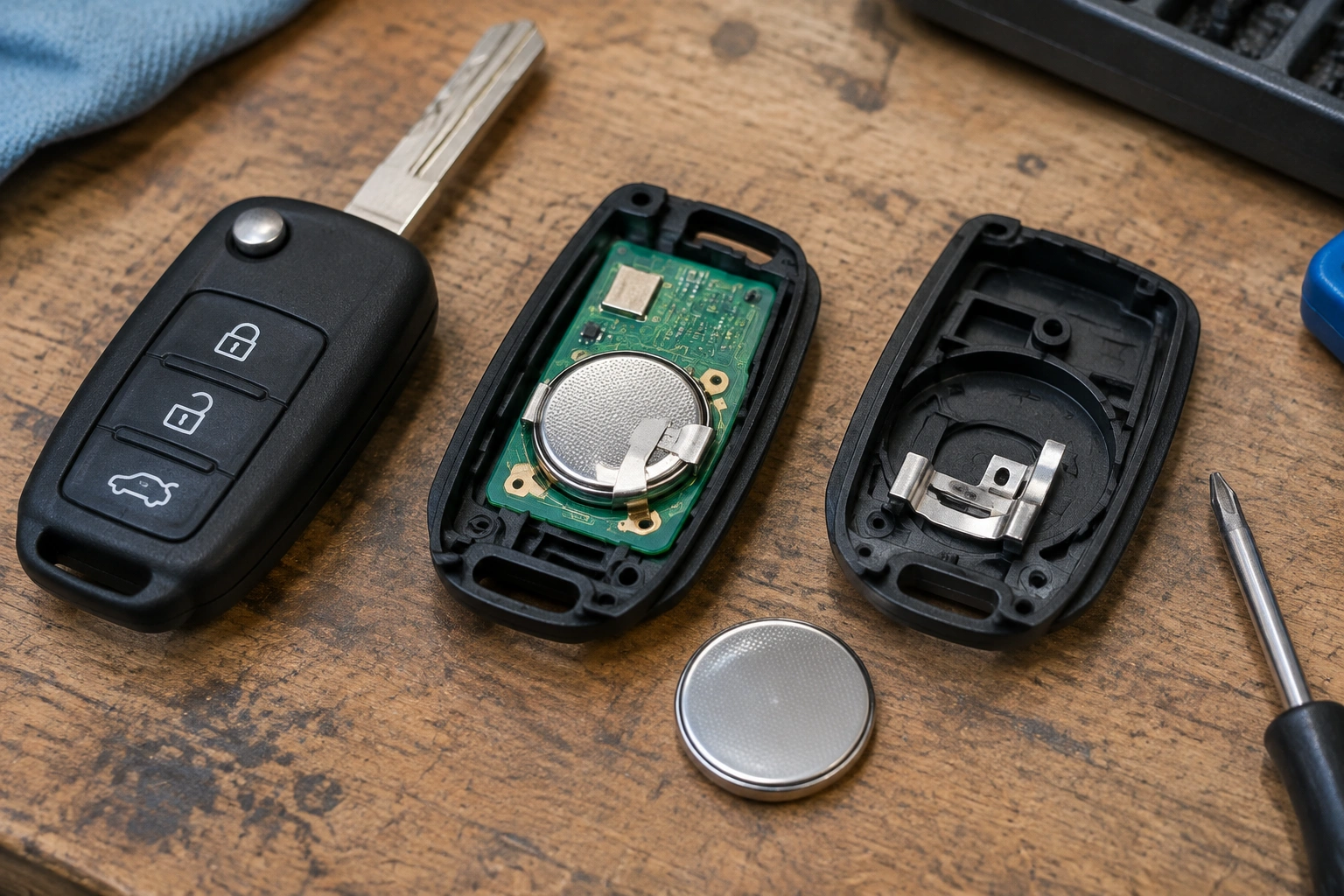
If the fob battery is weak, replacing it may restore normal operation immediately.
When you open the fob, make sure:
– the battery is the correct type
– it’s installed with the correct polarity
– the contacts are clean and seated firmly
Loose or damaged battery terminals inside the remote can stop it from working even when the battery itself is new. I’ve seen that more than once after a careless battery swap.
If the fob was dropped, stepped on, or exposed to water, that can also damage it and complicate the diagnosis.
Try a manual resync or relearn procedure
Some vehicles recover with a simple sequence after battery power is restored. The exact steps vary by make and model, so the owner’s manual is the safest place to confirm the correct procedure.
A few things matter here:
– follow the timing exactly
– keep the fob inside the vehicle if the procedure calls for it
– try the spare fob separately if you have one
If the vehicle responds after a relearn, that’s a strong sign the battery disconnect interrupted synchronization rather than damaging the fob.
Check whether the vehicle needs time to stabilize
After reconnecting the battery, some systems need a short period before all modules behave normally. If the battery was just reconnected, test again after the vehicle has been locked, unlocked, and restarted once.
What to do if remote lock works but push-button start does not
This is a classic split symptom.
If the doors lock and unlock but the car says the key is not detected, the remote portion of the fob may still be fine while the passive-entry or immobilizer function is not.
That usually means one of three things:
1. the fob battery is too weak for start authorization
2. the vehicle’s passive detection system needs a relearn
3. the immobilizer or start module needs professional programming
This is where a lot of owners waste time. They assume one working function means the whole fob is okay, but remote locking and start recognition are not always the same system.
For a related diagnostic path, our article on car key not detected after battery change walks through the start-recognition side in more detail.
What it means if only one key fob stopped working
If one fob works and the other doesn’t, the vehicle is probably not the problem.
That points to:
– a weak battery in the bad fob
– a poor battery connection inside that fob
– damaged electronics in that specific fob
– lost programming for that one fob only
If both fobs are the same age, compare them side by side. When one works normally and the other doesn’t, the diagnosis is usually straightforward: fix or replace the bad fob, not the car.
When the vehicle needs dealer or locksmith reprogramming
Some vehicles need more than a DIY reset. I’d recommend professional help if:
- both fobs stopped working after the battery disconnect
- the vehicle shows an immobilizer or anti-theft warning
- push-button start will not recognize any fob
- you’ve replaced the fob battery and tried the relearn, but nothing changed
- the owner’s manual does not list a user-level reset for your system
A dealer or automotive locksmith with the right equipment can check whether the fob is still paired and whether the vehicle’s receiver or immobilizer module needs programming.
If you already tried programming and the fob still won’t cooperate, our guide on key fob not working after reprogramming can help you narrow down what failed next.
When to replace the key fob battery or the fob itself
Replace the coin-cell battery first if:
– the fob is old
– range has been getting worse
– the buttons only work intermittently
– the car battery disconnect seems to have exposed an existing weak-battery problem
Consider replacing the whole fob if:
– the battery is new and installed correctly
– the spare fob works but the original still doesn’t
– the fob has visible damage or has been exposed to moisture
– the electronics appear dead even after a relearn
That last point matters: a fob can look fine on the outside and still have a damaged internal circuit or failed battery contacts.
How to prevent this next time
You can reduce the odds of this happening again:
- replace weak fob batteries before they become a problem
- keep a spare fob battery in the glove box
- avoid pressing the fob repeatedly when you’re far from the car
- after any battery disconnect, test both remote locking and start recognition right away
- if your vehicle has a known relearn procedure, keep it handy in the owner’s manual
A little preparation saves a lot of frustration when the car battery gets disconnected for maintenance, a jump start, or a replacement.
FAQ
Do I need to reprogram the key fob after disconnecting the car battery?
Not always. Some vehicles recover on their own, while others need a relearn or programming step. The exact answer depends on the make, model, and security system.
Will disconnecting the car battery kill the key fob battery?
No, not directly. But a weak fob battery may show its age right after a disconnect because the system is already on the edge.
Why does my key fob still unlock the door manually but not remotely?
That usually means the mechanical key is fine, but the electronic side of the fob needs attention. Check the fob battery, battery contacts, and whether the fob lost sync.
Why won’t my push-button start recognize the fob?
That often points to a weak fob battery, a passive-entry recognition issue, or an immobilizer/start system problem. Try the emergency placement method from the owner’s manual first.
What if only one key fob stopped working?
That usually means the vehicle is okay and the problem is isolated to that one fob. Battery, contacts, or internal damage are the most likely causes.
Can I fix this myself without a dealer?
Often yes, if the issue is a weak fob battery or a simple resync. If both fobs fail or the car shows an immobilizer warning, professional programming may be needed.
How do I know whether it’s the fob or the car?
Use the spare fob. If the spare works, the car is probably fine. If neither works, the vehicle side needs closer attention.
