
Car Remote Key Repair Cost: What You’ll Actually Pay and When Repair Makes Sense

If your key fob is acting up, the first question is usually simple: is this a cheap fix, or am I about to pay dealership money for a problem that could have been solved with a battery?
The short answer is that car remote key repair cost can be very low for a battery or shell issue, but it climbs quickly when the circuit board, transponder, or programming is involved. In many cases, the real savings come from identifying the failed part before paying for a full replacement. A cracked case with working electronics is a very different job from a dead smart key that needs programming.
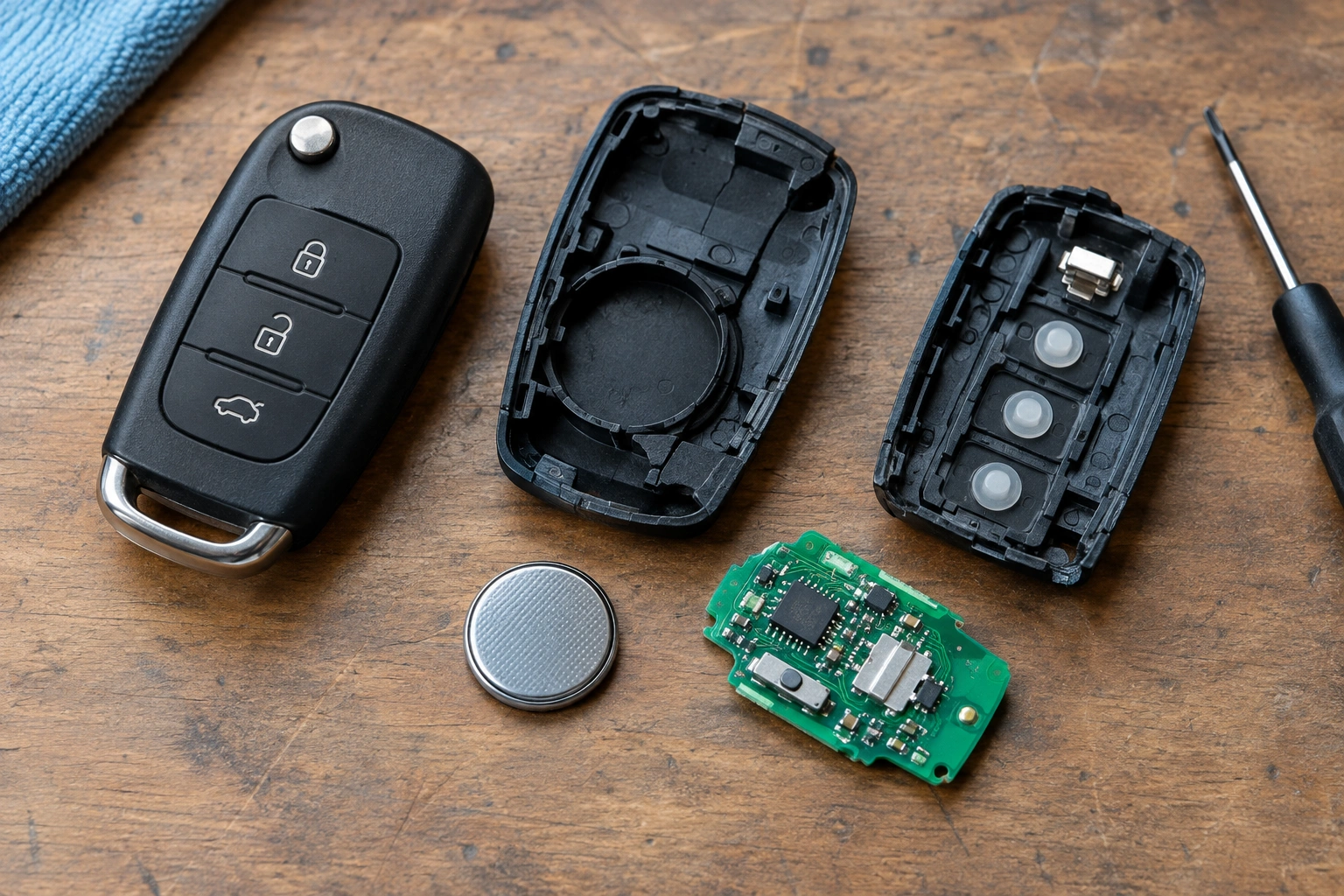
Replacement pricing gives you a useful reality check. One current pricing guide notes that replacing a key fob can run from about $50 to $600, depending on the vehicle, fob type, and where you buy it. That figure is best treated as a broad replacement range, not a repair quote: on the low end it may reflect a simple fob or remote, while the higher end often reflects more complex OEM smart keys and may include programming or dealer service. Keyless Entry Remote’s pricing guide is a useful reminder that the “cheap” option is usually the one that matches the actual failure.
For a quick comparison, here’s the practical version:
| Problem | Usual fix path | Typical cost pressure |
|---|---|---|
| Dead battery | Replace battery | Lowest |
| Cracked shell / worn buttons | Shell or button pad repair | Low to moderate |
| Loose contacts / intermittent signal | Clean, reseat, or repair contacts | Low to moderate |
| Damaged circuit board | Board repair or full replacement | Moderate to high |
| Lost or non-programmed fob | Replacement + programming | Highest |
What’s Actually Broken? Common Key Fob Symptoms
Before paying for diagnosis, match the symptom to the likely failure.
If the fob works only when you press the buttons hard, the button pad or internal contacts may be worn. If it works sometimes and fails other times, the battery may be weak, but a cracked solder joint or failing circuit board is also possible. If the lock and unlock buttons do nothing at all, check whether the issue is the fob, the vehicle battery, or the car’s receiver system.
A few examples help:
- One button works, the others don’t: likely worn button contacts or a damaged button pad.
- Buttons light up but the car does not respond: battery may be weak, or the car-side receiver may not be seeing the signal.
- Fob stopped working after being dropped: shell damage, loose battery contact, or internal board damage.
- Remote works only very close to the car: weak battery, antenna issue, or signal interference.
If the problem started suddenly, this guide on a car key remote that stopped working suddenly can help you narrow the cause before you spend money on parts.
Most Likely Causes, Ordered by Probability
In the shop, I’d usually work through the failures in this order:
1) Dead or weak battery
This is still the most common and cheapest fix. A battery can be weak enough to cause erratic operation long before it dies completely. If your fob is older and you have never changed the battery, that’s the first thing to test.
2) Worn button pad or dirty contacts
The rubber button pad can wear out, and the contact points underneath can collect dirt or oxidation. That creates the classic “works if I press it just right” complaint.
3) Cracked shell or damaged battery retention
A broken case may let the battery shift out of position. The fob can look fine from the outside and still lose contact internally.
4) Circuit board damage
Drops, moisture, and battery leakage can damage the board. At that point, repair may still be possible, but it often stops being the cheapest path.
5) Vehicle-side receiver or antenna issue
Sometimes the fob is fine and the car isn’t receiving the signal. That’s why replacing the fob without testing the car first can waste money.
For a broader diagnostic path, the article on how to diagnose a car key remote fast pairs well with this guide.
Can a Key Fob Be Repaired, or Does It Need Replacement?
A key fob is usually worth repairing when the electronics still work and the damage is limited to a battery, shell, button pad, or contact issue. If the board is intact, repair often makes more sense than buying a whole new unit.
Here’s the decision rule I use:
- Repair it if the battery, shell, buttons, or contacts are the only problems.
- Replace it if the circuit board is dead, the fob is water-damaged, or the repair cost gets close to a replacement quote.
- Check programming needs before deciding, because programming can erase the savings on a low-cost repair.
A cracked shell is a good example. If the board and transponder are fine, you may only need a replacement shell. That’s usually far cheaper than buying a complete OEM fob.
DIY Fixes That Cost the Least
If you want the lowest-cost path, work from the outside in.
Replace the battery first
This is the simplest test and often the best value. Use the correct battery type and install it with the right polarity. A battery that is inserted backward or seated poorly can create the same symptom as a bad fob.
Inspect the battery contacts
If the battery is loose, bent contacts can be the problem. Gently reseating the battery or cleaning light corrosion can restore function.
Check the shell and buttons
If the case is cracked or the buttons feel mushy, the shell may be the issue rather than the electronics. A shell swap is often cheaper than a full replacement.
Try the spare fob
If the spare works normally, the car is probably fine and the issue is isolated to the original fob.
One practical note: if the battery is swollen, leaking, or visibly damaged, don’t keep prying at it. That’s a stop-and-handle-carefully situation, not a “force it and see” situation.
Repair Cost Breakdown: Battery, Shell, Buttons, Circuit Board, and Programming
This is where quotes get confusing. A service price may include only the part, or it may include labor, testing, and programming. Ask what’s actually included.
Battery replacement
Usually the cheapest repair. DIY battery replacement is often about $5 to $20 for the battery itself, depending on the cell type. If a shop installs it, the total is often about $20 to $50 when labor is included.
Shell replacement
This is common when the electronics still work. A replacement shell is often about $10 to $40 for parts only, especially for aftermarket shells. If a shop handles the transfer, expect about $30 to $100 total depending on the vehicle and labor time.
Button pad repair
Some fobs need a new rubber pad or contact repair. Button-pad parts are often about $10 to $30, while a shop repair can land around $30 to $100 if the case has to be opened, cleaned, and reassembled.
Circuit board repair
If the board has damaged solder joints or corrosion, repair can be possible, but the labor can approach replacement pricing. Board-level repair often starts around $50 to $150 and can run higher if the damage is severe. In some cases, a full replacement is the better value.
Programming or reprogramming
Programming can change the math fast. Programming may be free on some simple DIY replacements, or it may add about $50 to $150+ at a locksmith or dealer depending on the vehicle and whether special equipment is required. If programming is needed, ask whether it is included in the quote or billed separately.
Dealer, locksmith, and DIY pricing in one place
For the full repair path, these are the usual ranges:
- DIY battery or shell repair: about $5 to $40 for parts only, or $20 to $100 if you also buy tools or small supplies
- DIY full replacement fob: often about $25 to $200+ for the part, depending on OEM vs aftermarket and vehicle compatibility
- Automotive locksmith: often about $75 to $250 for a repair or replacement service, with programming adding more if needed
- Dealer: often about $150 to $600+ for replacement and programming, especially for OEM smart keys or immobilizer-linked fobs
A helpful comparison from CARFAX is that if you already have a spare key at home, a replacement made at a local hardware store can cost less than $10 in some cases. That won’t apply to every modern fob, but it shows how much the total can swing based on the key type.
Dealer vs Locksmith vs DIY: Which Option Is Cheapest?
DIY
Usually the cheapest option when the problem is clearly battery-, shell-, or button-related. It tends to be the best value when you can avoid programming entirely. DIY is also the cheapest route for an aftermarket shell swap if the internal board is still good.
Automotive locksmith
Usually the best middle ground when the fob needs more than a battery but less than a full dealer visit. A locksmith is often the cheapest professional option for replacement plus programming, especially for standard remotes, transponder keys, and many smart keys.
Dealership
Usually the most expensive option, but it can be justified when the vehicle has a complex immobilizer system, the fob is OEM-only, or prior attempts have failed. Dealer pricing is often worth it when compatibility is the priority and you want the most predictable result.
A simple rule: if your fob is a basic remote and the problem is clearly battery or shell-related, DIY usually wins. If programming is required and you want to keep costs down, a locksmith is often the cheapest professional route. If you need OEM assurance or the vehicle is picky about smart-key matching, dealer pricing can be justified.
For broader replacement context, Edmunds and Car and Driver both offer useful consumer guidance on vehicle ownership costs and key technology trends.
When the Problem Is Not the Fob
Sometimes the fob gets blamed for a car-side problem.
Before you buy parts, check these common lookalikes:
- Weak vehicle battery: the car may not respond reliably even if the fob is fine.
- Receiver or antenna fault: the fob may transmit, but the vehicle never gets the signal.
- Immobilizer issue: the car may recognize the remote signal poorly or not at all.
- Interference or location-specific signal problems: the issue may change depending on where the car is parked.
A quick test is to try the spare fob. If both fobs fail the same way, the problem is more likely on the vehicle side than in the fob itself. If the spare works normally, focus on the original fob and stop spending money on car-side parts.
When Repair Becomes a Bad Deal
Repair stops making sense when the total cost gets too close to replacement, or when the fob fails again after a short time.
I’d lean toward replacement if:
- the board is water-damaged,
- the shell, buttons, and contacts all need work,
- programming is required anyway,
- or the vehicle uses a smart key that is expensive to revive piecemeal.
OEM fobs usually cost more, but they can be the better long-term value when compatibility matters. Aftermarket fobs can save money, but only if they’re confirmed to work with your specific vehicle and programming method.
If you only need one working remote and your spare is still functional, repair the weaker fob first. If both are aging, it may be smarter to replace one now and keep the other as a backup.
Quick Decision Guide: Repair, Replace the Shell, or Buy a New Fob
Use this simple rule of thumb:
- Repair the fob if the battery, buttons, or contacts are the only issues and the board still works.
- Replace the shell if the electronics work but the case is cracked, worn, or the buttons are mushy.
- Buy a new fob if the board is dead, the fob was water-damaged, programming is expensive, or the repair quote is close to replacement.
If you are still deciding, compare the total cost, not just the part price. A cheap shell can still become expensive once labor and programming are added.
How to Avoid Overpaying for Diagnosis or Service
Ask these questions before authorizing the job:
- Is the quote for the battery, shell, repair, or full replacement?
- Does it include programming?
- Is the fob OEM or aftermarket?
- Is compatibility guaranteed for my exact year, make, and model?
- Is diagnosis credited toward the repair if I proceed?
That last question matters. A cheap diagnosis fee can be worth it if it keeps you from buying the wrong part. A vague quote that leaves out programming is how a “cheap” fix becomes an expensive one.
When to Consult a Locksmith
Call a locksmith when the fob is tied to transponder or immobilizer functions, when you’ve lost the spare, or when the repair involves more than a battery or shell. A locksmith is also the right move if you want a cost check before committing to a dealer quote.
If you’re on the fence, bring the working fob, the broken fob, and your vehicle information. That makes it easier to compare repair versus replacement without guessing.
FAQ
How much does it usually cost to repair a car remote key fob?
It depends on what failed. A battery or shell issue is usually far cheaper than board damage or programming-related work. In practical terms, a simple DIY fix may cost under $20, a basic shop repair may land around $30 to $100, and a replacement with programming can cost $75 to $600+ depending on the vehicle and fob type.
Is it cheaper to repair a key fob or replace it?
Repair is cheaper when the electronics still work and only the battery, shell, buttons, or contacts are damaged. Replacement makes more sense when the board is damaged, the fob is water-damaged, or programming costs erase the savings.
Do I need programming after a repair?
Not always. Battery swaps and shell replacements may not require programming, but some vehicles do need resyncing after service. If the fob is being replaced or the internal electronics were changed, programming is much more likely.
Can I fix a broken key fob myself?
Yes, sometimes. Battery replacement, shell swaps, and basic contact cleaning are common DIY jobs. If the fob is part of the immobilizer system or has board damage, professional help is the safer route.
Why does my fob still not work after a new battery?
The battery may not be the real problem. Worn button contacts, a cracked shell, internal board damage, or a car-side receiver issue can all create the same symptom.
When should I stop repairing and just replace it?
If the repair quote is close to the replacement price, if the board is damaged, or if the fob has already failed more than once, replacement is usually the better value.
Should I keep a spare key fob?
Yes. A spare can save time, reduce towing risk, and make diagnosis easier when one fob fails. It also gives you a backup while you decide whether the damaged fob is worth repairing.
