
Can a Dead Key Fob Be Repaired? A Practical Guide for Car Owners

A dead key fob is often repairable, but not always in the same way.
If the problem is a weak battery, dirty or loose contacts, worn buttons, a cracked shell, or a need to resync the fob, the fix can be straightforward. If the circuit board, transponder, or internal electronics are damaged, replacement is usually the smarter move. In other words, the real question is not just “can a dead key fob be repaired?” It is “what failed inside the fob, and is that failure worth fixing?”
The fastest way to avoid wasting money is to diagnose the problem in order: battery first, then contacts and buttons, then programming or resyncing, and only after that consider deeper internal damage.
Quick decision path: battery replacement first, then check contacts/buttons, then try resync or programming, and finally repair or replace the fob if the hardware is damaged.
If you want a related diagnosis, this guide on whether a weak car battery can affect your key fob can help separate vehicle-side problems from fob-side problems.
Quick Answer: Repairable or Replaceable?
A key fob is usually worth repairing when the failure is limited to parts you can see or replace: the coin battery, the case, the button pad, or the battery contacts. A fob that still has a healthy circuit board often comes back to life after one of those fixes.
Replacement makes more sense when the damage reaches the electronics. That includes a cracked circuit board, a failed transponder, severe corrosion, or water damage that has already spread across the board. At that point, repair may cost nearly as much as a replacement without offering the same reliability.
A useful rule: if the fix only involves the shell, battery, or contacts, repair is usually sensible. If the fob needs electronic board work, replacement often wins on time and confidence.
How to Tell Whether the Problem Is the Battery or the Fob
The battery is the most common failure point, so it should be the first thing you test.
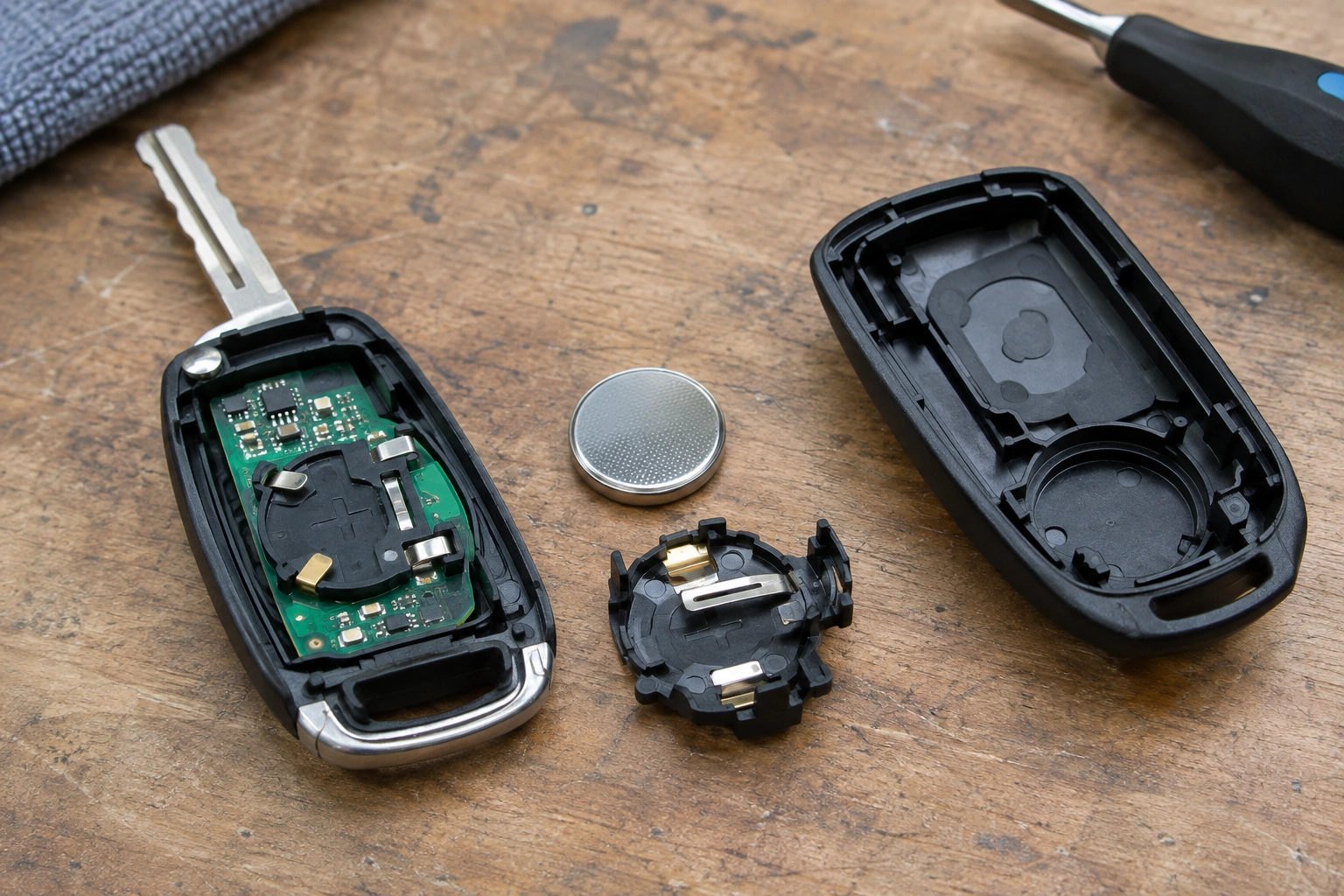
A dead or weak battery usually shows up in predictable ways:
- The fob works only when you stand very close to the car.
- The lock and unlock buttons respond intermittently.
- One button works while another does not.
- The fob stopped working gradually instead of all at once.
- The car still recognizes the fob sometimes, but not reliably.
Those signs point to battery weakness, loose contacts, or worn button pads more than total electronic failure.
A complete fob failure looks different. The car does not respond at all, the spare fob still works normally, and replacing the battery does nothing. If the fob has been dropped hard, soaked, or crushed, internal damage becomes more likely.
A simple at-home test sequence can help narrow it down fast:
- Try the spare fob first. If the spare works normally, the car is probably fine and the issue is isolated to the original fob.
- Try the problem fob at close range. On some vehicles, a weak fob may still work only when it is very near the vehicle or the start area.
- Replace the battery. If the fob comes back to life, the battery was likely the issue.
- If it still fails, test for resync or programming needs. A fresh battery with no response often means the fob needs to be recognized again or checked for hardware damage.
The spare fob is one of the best diagnostic tools you already have. If the spare works and the main one does not, the vehicle is probably fine and the problem is isolated to the original fob.
The Most Likely Causes, in the Right Order
When a fob stops working, it helps to think in terms of probability, not worst-case scenarios.
1. Dead or weak battery
This is the most common cause. Coin-cell batteries lose strength over time, and many fobs start acting flaky before they stop completely. AAA notes that battery replacement is often a common maintenance step for modern key fobs, and the task can sometimes be quick. That is why battery replacement is the first move, not the last.
2. Loose or dirty battery contacts
Even with a new battery, the fob will fail if the metal contacts do not press firmly against the battery. A drop, a bent tab, or light corrosion can interrupt power.
3. Worn buttons or button membrane
If one button works only when pressed hard, the rubber membrane or the contact pad beneath it may be wearing out. That is a repairable problem if the rest of the fob is healthy.
4. Cracked shell or broken case
A cracked case can keep the battery from sitting correctly or allow the internal parts to shift. Sometimes the electronics still work fine once the shell is replaced.
5. Moisture or corrosion
Water exposure can cause anything from minor contact oxidation to full board damage. The outcome depends on how fast the fob was opened, dried, and cleaned.
6. Programming or resync issue
Sometimes the fob has power, but the car no longer recognizes it correctly. That points to a sync or programming issue rather than a dead battery.
7. Circuit board or transponder failure
If the internal electronics are damaged, repair becomes less practical. At that stage, replacement is often the more reliable choice.
Step-by-Step Fixes You Can Try at Home
The safest approach is to work from cheapest to most expensive.
1. Replace the battery first
Open the fob carefully and note how the battery sits before removing it. Many fobs use a small coin-cell battery, but the exact type depends on the vehicle and fob design, so check the owner’s manual or the battery already inside the fob.
If the battery is visibly weak, corroded, or old, replace it with the correct type and polarity. A battery swap is usually quick and low-risk when the case is intact.
After installing the new battery, test the lock, unlock, and panic buttons before snapping everything back together fully. That tells you whether the battery was the real issue.
2. Check the battery contacts
Look for bent metal tabs, white or green corrosion, or contact points that no longer press against the battery. If the contacts are only slightly out of shape, they may be gently adjusted back into position. If they are heavily corroded, the fob may need deeper repair or replacement.
3. Inspect the button membrane
Press each button and feel for a normal click. A mushy, sticky, or uneven button usually means the membrane or contact pad is worn. A shell replacement or internal button repair may solve that without replacing the whole fob.
4. Dry and clean minor moisture damage
If the fob got damp but was not submerged for long, remove the battery immediately and let the case dry fully. Light corrosion around the battery area may be cleaned carefully, but if the board is visibly damaged or the corrosion has spread, the odds of a lasting repair drop fast.
5. Reassemble and test after each step
Do not change three things at once. Replace the battery, test it, and only then move on. That way you know what actually fixed the problem.
When the Key Fob Needs Reprogramming or Resyncing
A fresh battery does not always solve the problem. If the fob powers up but the car still will not unlock, start, or detect it, the issue may be recognition rather than power.
That is more likely when:
- the battery was recently replaced,
- the fob worked before battery removal,
- the spare fob still works,
- the car lights or locks respond inconsistently,
- the fob seems alive but the vehicle ignores it.
Some vehicles can resync a fob through a sequence in the cabin, while others require professional programming. The owner’s manual is the best place to confirm what your specific car allows. On some push-button start systems, holding the fob near the start/stop button or placing it in a designated backup slot can let the vehicle detect it even when the battery is weak, but that is vehicle-specific rather than universal.
If the fob still fails after a new battery, the next step is usually:
- Try the manufacturer’s resync procedure if your owner’s manual lists one.
- Test the fob at the vehicle’s backup recognition point if your car has one.
- If the car still will not recognize it, contact an automotive locksmith or dealer for programming.
That distinction matters: a simple resync is something you may be able to do yourself, but if the vehicle needs a security relearn or key registration, a locksmith or dealer is often the right next step.
Repairable Damage vs. When the Fob Is Beyond Repair
Some damage is worth fixing. Some is not.
Usually repairable
- cracked outer shell
- worn buttons
- loose battery contacts
- light corrosion near the battery compartment
- broken key ring loop
- battery replacement only
These problems are often cheaper to fix because the core electronics still work.
Usually not worth repairing
- damaged circuit board
- failed transponder
- heavy water intrusion
- corrosion across the board
- repeated programming failure after a battery swap
- a fob that has been crushed or split in a way that damaged the electronics
The practical question is not whether a technician can “do something” with the fob. It is whether the result will be dependable enough to trust every day. If the electronics have been compromised, a replacement often saves time and frustration.
Repair vs. Replacement: What Makes the Most Sense?
Here is the decision framework I use with customers:
- Battery only: repair it.
- Shell, buttons, or contacts: repair it if the board is intact.
- Recognition issue after battery replacement: try resyncing or programming.
- Water damage or board damage: compare repair cost with replacement.
- Multiple failures at once: replacement is usually the better value.
A simple rule of thumb: if the repair is limited to low-cost parts and a few minutes of labor, it is usually worth trying. If the repair starts approaching the cost of a replacement fob plus programming, replacement is usually the smarter buy.
Replacement becomes more attractive when the fob is older, the shell is falling apart, and the electronics are already questionable. Repair makes more sense when the problem is isolated and the fob still has a solid circuit board.
If you are deciding between fixing and replacing, a working spare fob is valuable. If the spare is healthy and the main fob is the only issue, you can be more aggressive about repair because you are not stranded.
DIY Repair vs. Locksmith vs. Dealer
DIY
DIY is best for battery swaps, shell replacement, and visual inspection. It is the lowest-cost route and often all you need. The trade-off is that you are limited to simple mechanical fixes.
Automotive locksmith
A locksmith is often the middle ground. This is the right choice when the fob needs diagnosis, resyncing, programming, shell replacement, or a replacement fob that must be matched to the vehicle. Locksmiths can be especially helpful when the car still starts but the remote side is failing.
Dealer
A dealer is often the most expensive option, but sometimes it is the most direct one for brand-specific programming or systems with tighter security requirements. If the vehicle needs a specialized procedure or the fob is tied closely to the immobilizer system, dealer service may be the cleanest path.
If you want a broader look at vehicle-side symptoms, this article on how to tell if a bad car battery is causing key fob problems can help you avoid replacing the wrong part.
Cost Expectations: What Usually Costs Less
Exact prices vary by vehicle and location, so it is better to think in tiers.
- Battery replacement: usually the cheapest fix.
- Shell or button repair: more than a battery, less than a full replacement.
- Locksmith diagnosis/programming: mid-range, often less than dealer service.
- Dealer programming or replacement: usually the highest-cost option.
- Full replacement fob: often the most expensive if programming is included.
RAC notes that a new car key fob can cost from about £250 to well over £1000 in the UK in some cases, which is a good reminder that full replacement can get expensive quickly. In the U.S., the same principle applies even though exact pricing varies widely by make and model.
The best value is usually the least invasive fix that restores reliable daily use. If a battery and shell repair solve the issue, that is a much better outcome than paying for a full replacement too early.
What to Do If the Spare Fob Works but the Main One Does Not
A working spare tells you a lot.
First, it rules out the car as the main problem. Second, it narrows the issue to the original fob, its battery, its contacts, its shell, or its programming.
Use the spare to compare behavior:
- If the spare works at normal distance, the main fob likely has a battery or internal issue.
- If both fobs act strangely, the car may have a vehicle-side problem.
- If the main fob works only after a battery change, the fix was probably simple.
- If the main fob still fails after a fresh battery, the next step is resyncing or professional diagnosis.
That one comparison can save you from replacing parts you do not need.
When to Call an Automotive Locksmith
Call a locksmith when the fob still will not work after a battery replacement, when the shell or buttons are damaged enough to affect use, or when the vehicle needs programming that you cannot do yourself. A locksmith is also the right call if the fob was exposed to water and you want a realistic answer about whether repair is still worth trying.
If the circuit board is visibly damaged, the transponder is suspected to be bad, or the fob keeps failing after every DIY step, stop troubleshooting and get it checked professionally. At that point, the goal is not to keep guessing. It is to get a clear answer on repair versus replacement.
Bottom Line
So, can a dead key fob be repaired? Often, yes — if the problem is the battery, contacts, buttons, shell, or a simple resync issue. If the electronics inside the fob are damaged, replacement is usually the better investment.
The smartest path is simple: test the battery first, inspect the contacts, compare it with the spare, and only then move on to programming or replacement. That sequence gives you the best chance of fixing the problem without paying for more than you need.
FAQ
Can a dead key fob be reprogrammed?
Sometimes. If the fob still has a healthy battery and the issue is only that the car no longer recognizes it, resyncing or reprogramming may solve the problem. If the internal electronics are damaged, reprogramming usually will not help.
Can a dead key fob be repaired, or should it be replaced?
If the issue is the battery, contacts, buttons, or shell, repair is often the best first step. If the board, transponder, or water-damaged electronics are the problem, replacement is usually more practical.
What should I do first if my key fob stops working?
Try the spare fob, test the fob at close range, replace the battery, and then check whether the car needs a resync or programming step.
Do I need a dealer to fix a key fob?
Not always. A locksmith can often handle battery-related issues, shell repair, resyncing, and many programming jobs. Dealer service is more likely to be needed for brand-specific security systems or specialized programming.
Why does my key fob work only sometimes?
Intermittent operation usually points to a weak battery, loose contacts, worn buttons, or early internal failure. It is a warning sign that the fob should be checked before it fails completely.
Can water-damaged key fobs be saved?
Sometimes, if the damage is minor and the battery is removed quickly. If corrosion has spread to the circuit board, the odds of a reliable repair drop and replacement may be the better option.
How do I know if the problem is the fob or the car?
Use the spare fob. If the spare works normally, the car is probably fine and the original fob is the likely problem. If both fobs fail in the same way, the issue may be vehicle-side.
Is it worth repairing an old key fob?
It depends on the damage and the cost of parts. If the fix is simple and inexpensive, repair is usually worth it. If programming and electronic repair are both needed, replacement may be the better value.
