
Can a Weak Car Battery Affect Your Key Fob? What Drivers Should Check First

If your key fob suddenly starts acting up, a weak car battery can absolutely be part of the problem. Low vehicle voltage can interfere with remote locking, smart key detection, and push-button start behavior even when the fob battery itself is still fine.
That does not mean every key fob issue is caused by the car battery. Sometimes the fob battery is dead, the contacts inside the fob are loose, or the vehicle’s receiver has a fault. But if you also notice dim lights, slow cranking, or other electrical weirdness, the car battery moves to the top of the suspect list.
Here’s the practical way to think about it:
– Weak car battery = the vehicle may not power its electronics reliably.
– Dead key fob battery = the remote itself may stop sending a strong signal.
Those two problems can look similar from the driver’s seat, which is why people often replace the wrong battery first.
First-step checklist: what to test first and why
Use this order to avoid guessing:
- Test the car battery first if you see slow cranking, dim lights, flickering electronics, or a key-not-detected warning.
-
Why: those are vehicle-wide voltage clues, not just fob symptoms.
-
Test the key fob battery next if the car seems normal but the remote range is weak or button response is inconsistent.
-
Why: a weak fob battery usually shows up as a range or signal issue.
-
Try the spare fob if the first two checks don’t settle it.
-
Why: if the spare works, the original fob is the likely problem.
-
Check vehicle-side components last if both fobs fail the same way.
- Why: that points more toward a fuse, receiver, transceiver, or body control module issue.
Quick answer: yes, a weak car battery can affect key fob performance
A key fob depends on the vehicle’s electronic systems to receive and respond to the signal. If system voltage drops, the car may become less reliable at recognizing the fob, unlocking the doors, or allowing a push-button start.
That’s especially common when the battery is getting old and the car shows other symptoms at the same time. For example, you might press unlock and get no response one moment, then the doors work fine the next. Or the vehicle may say the key is not detected until you hold the fob closer to the start button.
If you want a broader reference point for battery-related warning signs, the NHTSA is a good place to check general vehicle safety guidance, and Consumer Reports has also noted that a key fob constantly communicates with the car but usually does not drain a healthy car battery on its own.
How to tell whether the problem is the car battery or the key fob battery
The fastest way to separate the two is to look at the whole vehicle, not just the remote.
| Symptom | More likely car battery | More likely key fob battery |
|---|---|---|
| Slow engine cranking | Yes | No |
| Dim headlights or interior lights | Yes | No |
| Multiple electrical glitches | Yes | No |
| Key fob works only close to the car | Sometimes | Yes |
| Fob buttons work sometimes, not always | Sometimes | Yes |
| “Key not detected” or smart key warning | Yes, if paired with low voltage symptoms | Yes, if the fob battery is weak |
| Car unlocks but won’t start with push-button ignition | Yes | Yes |
A weak vehicle battery usually shows up as a broader electrical issue. A weak fob battery usually shows up as a range issue or inconsistent button response while the rest of the car behaves normally.
One useful clue: if the fob only works when you stand right next to the door, that can point to a dying fob battery. If the fob suddenly became unreliable at the same time the car started cranking slowly, the car battery is a stronger suspect.
Most likely causes, in the order I’d check them
When I was turning wrenches, this was the order that saved people the most time:
1. Weak car battery or low vehicle voltage
If the car has dim lights, slow cranking, or random electrical issues, test the car battery first. A jump start may temporarily restore normal fob behavior, which can be a clue that the vehicle battery or charging system is involved.
2. Dead or weak key fob battery
If the car battery seems healthy and the issue is mostly poor range or delayed button response, replace the coin-cell battery in the fob. A weak fob battery often gives early warning signs before it quits completely.
3. Spare key fob test
If the spare works normally, the problem is probably in the original fob, not the car. If both fobs act the same, the issue is more likely vehicle-side.
4. Fuse, receiver/transceiver, or body control module
If the battery checks out and both fobs still fail, the car may have a problem with the receiver, a related fuse, or the body control module that handles remote entry functions.
That order matters because it keeps you from replacing a good fob battery when the real issue is a weak car battery.
A simple troubleshooting sequence that makes sense at home
Here’s the sequence I’d use before spending money on parts:
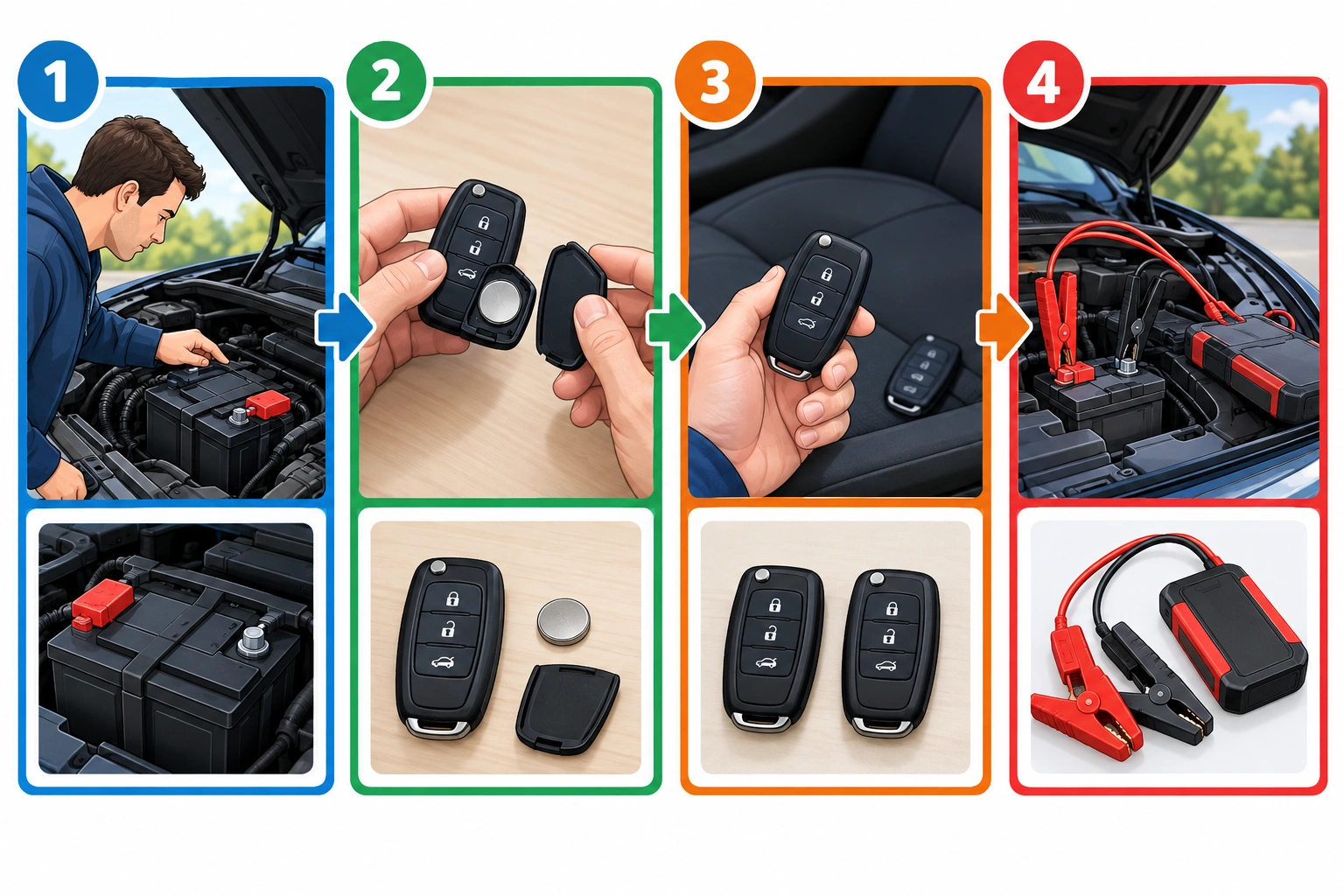
1. Check for battery symptoms in the car
Look for slow cranking, dim headlights, flickering interior lights, or warning lights that appeared around the same time the fob started acting up. If you see those, the vehicle battery deserves immediate attention.
2. Try a jump start
If the car starts normally after a jump, test the fob again. If remote locking and smart key functions seem to improve, that suggests the vehicle battery or charging system may be part of the problem.
3. Replace the key fob battery if the vehicle battery seems fine
If the car starts strongly and the electrical system seems normal, a fresh fob battery is the next logical move. Many remotes use a coin-cell battery, and a weak one often causes short range or inconsistent response.
4. Use the mechanical key if needed
If the remote is unreliable, use the hidden mechanical key to get into the car. On many vehicles, the fob also has an emergency start method even if the battery inside the fob is weak.
5. Test the spare fob
This is one of the quickest ways to separate a fob problem from a vehicle problem. If the spare works perfectly, the original fob is the likely issue. If both fail, keep looking at the car.
For a related walkthrough on emergency starting and dead-fob symptoms, see our guide on what to do when the key fob battery is dead.
Why low voltage can make a smart key system act strange
Traditional remote entry and smart key systems do not always fail the same way.
With a basic remote, low voltage may show up as weaker range or delayed unlocking. With a smart key system, the vehicle may struggle to detect the fob at all, especially if the battery is already borderline. Some vehicles may still unlock or start through backup methods, but only if you hold the fob near the start button or place it in a designated spot.
That’s why one driver may still be able to start the car with the fob in the cabin, while another cannot unlock the doors reliably from the driveway. The system may be partially working, but not consistently enough to feel normal.
A weak car battery can also create confusing behavior after the car has sat overnight. The car may unlock once, then refuse the next time, or the dash may show a no-detection message even though the fob battery is new. In that case, the issue is often not the fob alone.
What changes after a jump start or battery replacement
If a jump start restores normal fob behavior, that suggests the vehicle battery voltage was likely part of the problem. Once the car has proper power again, the receiver and body control module may start recognizing the fob normally.
A battery replacement may fix the issue in a similar way if the old battery was weak or failing, but it is not guaranteed to solve every key fob problem. In many cases, you do not need to reprogram the key fob after replacing the car battery. Most vehicles keep working normally, although some may lose clock or preset settings, and a few may need a reset or relearn procedure depending on the model.
If you want a comparison point for a car-side issue after battery work, our article on why a key fob won’t lock the car after a battery change explains the difference between a battery issue and a sync problem.
When the car starts but the key fob still acts up
This is the less obvious case, and it matters.
If the engine starts fine but the remote buttons still behave unpredictably, the car battery may not be the only issue anymore. You could be dealing with:
– a weak fob battery,
– dirty or damaged battery contacts in the fob,
– a receiver problem,
– a fuse issue,
– or a body control module fault.
A good example is a vehicle that starts normally every morning but only unlocks when you stand close to the door. That can point to a weak fob battery. But if the car also randomly refuses to detect the fob for push-button start, even with a new fob battery, the issue may be on the vehicle side.
That’s why I like the spare-fob test. It gives you a clean comparison without guessing.
When to stop troubleshooting and call for help
If you’ve already checked the car battery, tried a jump start, replaced the fob battery, and tested a spare fob, it’s time to stop swapping parts blindly.
A professional should look at the vehicle if:
– the car repeatedly needs jump starts,
– the dash keeps showing a key not detected message,
– both fobs fail the same way,
– the remote works only intermittently after battery checks,
– or the car has other electrical problems that suggest a fuse, receiver, or body control module issue.
If the vehicle is getting harder to start, don’t keep driving it and hoping the problem goes away. A weak battery can turn into a no-start at the worst possible time.
For more general battery and vehicle reliability guidance, Edmunds has useful owner-focused maintenance information, and Car and Driver also covers battery-related starting issues in practical terms.
FAQ
Can a weak car battery cause key fob problems?
Yes. Low vehicle voltage can affect remote locking, smart key detection, and push-button start behavior, especially if the car is also showing other electrical symptoms.
Should I test the car battery or key fob battery first?
Test the car battery first if the car has slow cranking, dim lights, or other electrical issues. Test the fob battery first if the car seems normal but the remote range is weak.
Do I need to reprogram the key fob after replacing the car battery?
Usually no. Most vehicles do not require key fob reprogramming after a car battery change, but some may need a reset or relearn depending on the model.
Why does my smart key work only when I hold it near the start button?
That can happen when the fob battery is weak or when the vehicle battery voltage is low. Some vehicles also have a backup start location or method for this situation.
Bottom line
Yes, a weak car battery can affect a key fob. In fact, when the fob starts acting strange at the same time the car shows slow cranking, dim lights, or other electrical symptoms, the vehicle battery is often the first thing to check.
The smartest troubleshooting order is simple:
1. look for signs of low vehicle voltage,
2. try a jump start,
3. test the fob battery,
4. try the spare fob,
5. then move on to the receiver, fuse, or body control module if needed.
That approach saves time, avoids unnecessary parts replacement, and gets you to the real fix faster.
