
Key Fob Receiver Problem Symptoms: How to Tell When the Car Is the Issue

If your key fob suddenly works only sometimes, only at very close range, or not at all, the problem may not be the fob battery. In many cases, the clues point to the vehicle side: the receiver, antenna module, fuse, wiring, or smart key system.
The fastest way to think about it is this: a dead fob battery usually weakens one remote. A receiver problem often affects the car’s ability to hear any fob consistently. That difference matters, because it tells you whether to replace the remote or inspect the vehicle.
Quick Answer: What Receiver Problems Usually Feel Like
A bad key fob receiver usually shows up as one of these patterns:
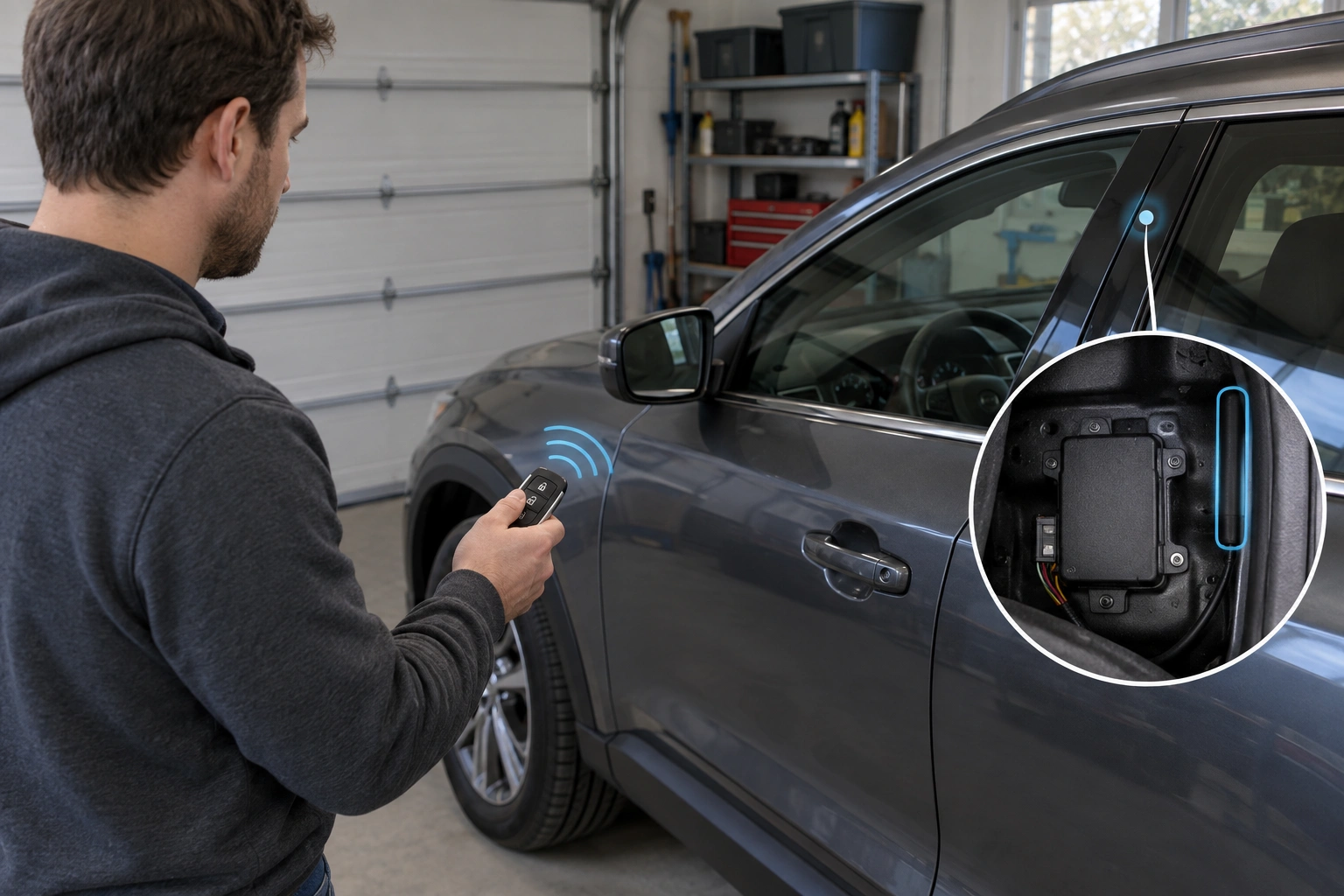
- The fob works only when you stand very close to the car.
- Lock and unlock become intermittent, even with a fresh battery.
- Push-button start sometimes recognizes the fob and sometimes does not.
- Both your main fob and spare fob fail in the same way.
- The car works in one spot but not another, especially near sources of interference.
Those symptoms do not prove the receiver is bad, but they do shift suspicion away from the fob itself. Many modern vehicles use radio-frequency communication between the fob and the car, so signal loss, interference, damaged antennas, or module faults can all look similar. Standard Auto Part’s overview of keyless entry issues is a good example of why range and interference matter in diagnosis.
Common Symptoms of a Failing Key Fob Receiver or Antenna Module
1) The fob only works right next to the car
If you have to stand at the driver door or even touch the handle before the car responds, that is a strong clue that reception is weak. Range can vary a lot by vehicle design, antenna placement, and local interference, so this is not a universal rule. But when range is consistently poor across different conditions, the issue may be the receiver, the antenna, or a wiring problem reducing signal pickup.
This symptom is especially useful because it separates “no signal at all” from “weak signal.” A weak fob battery can also reduce range, but if a spare fob behaves the same way, the vehicle side becomes much more likely.
2) Lock and unlock work only sometimes
Intermittent operation is one of the most frustrating patterns because it creates doubt. The key clue is consistency: if the same button works, fails, then works again without any obvious change, the car may be missing the signal rather than the fob failing cleanly.
That can happen when the receiver is weak, an antenna connection is loose, or the signal is being interrupted by nearby electronics or metal structures. Busy parking garages and dense urban areas can make this worse.
3) Push-button start does not always recognize the fob
In smart key systems, the car has to detect the fob inside or near the cabin before it allows starting. If the dash says it cannot detect the key, or if you have to move the fob around the cabin to get it recognized, that may point to a receiver or antenna issue. It can also point to reprogramming problems in some vehicles, especially after battery disconnects or module replacement.
A common clue here is this pattern: remote lock/unlock fails, but push-button start still works sometimes, or the reverse happens. That often means one detection path is weaker than the other. For a quick check, try this mini-list:
– Test lock/unlock from the normal standing position.
– Try the push-button start with the fob in the cabin.
– Move the fob to the manufacturer’s backup detection spot if the car has one.
– Compare the result with the spare fob in the same location.
4) One function works, another does not
A receiver-side fault does not always kill every function equally. You may still get occasional start recognition but lose lock/unlock range, or vice versa. That uneven behavior suggests the vehicle is receiving some signals but not all of them reliably.
5) Both fobs fail the same way
This is one of the most useful decision points. If the original fob and a spare fob both act up in the same vehicle, the odds move away from a single bad remote and toward the car’s receiver path, fuse, antenna, or body control module.
What the Symptoms Mean: Receiver Problem vs Battery, Fob, Programming, or Fuse
| Symptom pattern | More likely cause | Why it points there |
|---|---|---|
| One fob fails, spare works normally | Bad fob battery, damaged fob, or worn buttons | The car is responding to one remote, so the vehicle side is probably alive |
| Both fobs fail the same way | Receiver, antenna, fuse, wiring, or BCM issue | A shared vehicle-side problem affects every fob |
| Works only at very close range | Weak fob battery, receiver sensitivity issue, antenna issue, or interference | Range loss can come from either side, but repeated poor range is a clue |
| Push-button start fails, but lock/unlock may still work | Smart key recognition or programming issue | The start system may use a different detection path than remote locking |
| Nothing works after battery replacement | Fob damage, fuse, receiver, or programming problem | A new battery does not rule out vehicle-side faults |
| Fails only in one location | Interference or environmental signal blockage | Physical barriers and electronics can block RF communication |
| Reprogramming fails repeatedly | Faulty fob or vehicle-side receiver issue | If programming cannot complete, either end of the link may be the problem |
A dead fob battery is still the easiest thing to rule out first, because it is cheap and common. But battery replacement is only a clue, not proof. If the battery is fresh and the symptoms remain, the diagnosis has to move deeper.
A faulty fob usually behaves like one bad remote, not every remote. If the spare works normally, the issue is probably in the original fob. If neither works, the car is more suspect.
Programming problems can look similar to a receiver issue, especially on push-to-start vehicles. Some systems may stop recognizing a fob after certain power interruptions or module work. If the programming process keeps failing, that can mean either the fob or the receiver path is faulty.
A blown fuse can mimic a bad receiver because the receiver may lose power entirely. That is why fuse checks belong early in the process, not after you have already bought parts.
Plain-English takeaway: if both fobs fail the same way, or the car’s response changes by location, the vehicle side becomes the stronger suspect. If only one remote acts up while the spare works normally, the fob itself is more likely. Intermittent range by itself is not enough to prove a bad receiver, but repeated poor range across different spots is a useful clue.
Most Likely Causes, Ranked by Probability
The exact order depends on the vehicle, but a practical troubleshooting sequence usually looks like this:
-
Weak or dead fob battery
Cheapest and easiest to rule out. -
Signal interference or physical blockage
Parking structures, other electronics, and metal barriers can reduce range. -
Bad or damaged fob
Especially if one remote is affected and the spare works. -
Blown fuse or poor power supply to the receiver
A receiver with no power cannot do its job. -
Antenna module or antenna connection problem
Weak reception often comes from the pickup side, not the fob. -
Wiring fault or connector corrosion
Intermittent symptoms often come from loose or damaged connections. -
Body control module or smart key module issue
Less common, but possible when multiple related functions fail.
Step-by-Step Troubleshooting to Confirm a Receiver Problem
1) Test the spare fob first
If you have a spare, use it exactly where the problem happened. Do not test it in a different location and assume the result means much. You want the same conditions.
- If the spare works normally, the original fob is the likely problem.
- If the spare fails the same way, look at the vehicle side.
This one test saves a lot of guesswork.
2) Try the car in a different location
If the fob fails in a garage but works in an open driveway, interference may be the real issue. RF signals can be blocked or distorted by buildings, nearby electronics, and even some parking environments. A location-based failure is not the same thing as a dead receiver.
3) Replace the fob battery only if the symptoms fit
A weak battery usually shows up as reduced range and sometimes delayed response, but some vehicles can behave more erratically than that, especially if the battery is very low. If the battery is old, swollen, corroded, or unknown, replacing it is still a reasonable first step. Just do not stop there if the spare fob has the same problem.
4) Check the relevant fuse
Use the owner’s manual or fuse chart for the keyless entry, smart key, BCM, or body electronics circuit. If the fuse is blown, replacing it may restore the system immediately. If the new fuse blows again, there is a deeper electrical fault that needs diagnosis.
5) Watch for pattern changes after battery replacement
If the fob improves only briefly, or only one function returns, that suggests the fob may not be the only issue. A weak receiver, antenna, or wiring fault can still leave you with partial operation.
6) Scan for fault codes if the vehicle supports it
A diagnostic scan tool can help identify communication faults in the smart key system, BCM, or related modules. This is especially useful when the car starts acting like the fob is invisible even though the fob battery is fine. For many vehicles, this is the point where diagnosis becomes more efficient with professional equipment.
When the Problem Is Probably the Antenna, Fuse, Wiring, or BCM Instead
A receiver symptom does not always mean the receiver itself has failed. The nearby parts can create the same result.
Antenna or antenna module
If the fob works on one side of the car but not another, or only near a certain door, the antenna path is worth checking. Vehicles often use multiple antennas for smart key detection, so one weak antenna can create strange, location-specific behavior. For example, a bad door-handle antenna may let the car start normally inside the cabin but stop responding to remote unlock at that door.
Fuse
If the system went dead suddenly and neither fob works afterward, a fuse is a strong suspect. This is one of the most overlooked causes because the symptom feels like a major module failure.
Wiring or connector
Intermittent behavior, especially after rain, vibration, or recent repairs, can point to a loose connector or damaged wire. That kind of fault often comes and goes, which makes it easy to misread as a bad fob. A broken wire near a door jamb, for instance, may make one antenna or handle work only when the door is moved a certain way.
BCM or smart key module
If several electrical features act up together, the body control module or smart key module may be involved. That is more likely when the vehicle also shows warning messages, communication faults, or repeated programming issues.
Can You Fix It at Home, or Do You Need Reprogramming or Replacement?
Some diagnosis is very DIY-friendly. Some is not.
Reasonable at-home steps
- Test the spare fob.
- Replace the fob battery if it is weak or unknown.
- Try the car in a different location.
- Check the fuse related to keyless entry or smart key operation.
Those steps are low-risk and often enough to identify the problem category.
When reprogramming makes sense
If the car no longer recognizes the fob after battery loss, module work, or a system reset, reprogramming may solve it. This is more likely when the fob still seems physically fine but the vehicle treats it as unknown.
When replacement becomes more likely
If the receiver or antenna module has power, the fuse is good, the spare fob fails, and scan data points to a hardware fault, replacement may be the practical fix. The important trade-off is this: replacing parts blindly is expensive and can miss the real cause if the issue is actually wiring or programming.
When a locksmith, dealer, or specialist is the better choice
A qualified automotive locksmith can often help with fob testing, battery replacement, many programming jobs, and some receiver-related diagnosis, but that depends on the vehicle make/model and the locksmith’s diagnostic equipment. Dealer-level coding is more likely when the car needs brand-specific module programming, security access, or factory scan functions. If the issue involves wiring, a mechanic or electrical specialist may be the best fit.
When to Call an Automotive Locksmith
Call a locksmith, dealer, or qualified mechanic when:
- Both fobs fail and basic checks do not help.
- The car shows smart key or BCM fault codes.
- Reprogramming fails repeatedly.
- You suspect antenna, wiring, or module failure.
- The vehicle is intermittently failing to recognize the fob and you need a reliable fix before you get stranded.
A locksmith is often a good first call when the problem may be fob-related, programming-related, or a receiver recognition issue, but only if they have the right tools for your vehicle. A dealer may be better when the vehicle needs brand-specific module coding or factory-level diagnostics. A mechanic is often the best fit when the likely fault is wiring, fuse-related, or tied to the vehicle’s electrical system rather than the remote itself.
If you want a deeper breakdown of the diagnosis path, see our guides on how to know if a key fob receiver is bad and key fob immobilizer problem symptoms.
Bottom Line
The clearest key fob receiver problem symptoms are reduced range, intermittent response, and failure across more than one fob. If the spare remote behaves the same way, the car side deserves attention before you buy another fob. Start with the battery, fuse, and location-based interference, then move to programming, antenna, wiring, or module diagnosis if the problem persists.
