
Lost Car Key Finder: How to Locate a Missing Fob or Key Fast

Find it fast
- Check your spare key.
- See whether the fob is dead or just unresponsive.
- Use a tracker app if one is attached.
- Search the last place you used the key.
- Then check the car, home entry area, and nearby bags or pockets.
If your car key is missing, don’t assume the worst yet. In many cases, the key is nearby, the fob battery is dead, or the key was left in the car rather than truly lost.
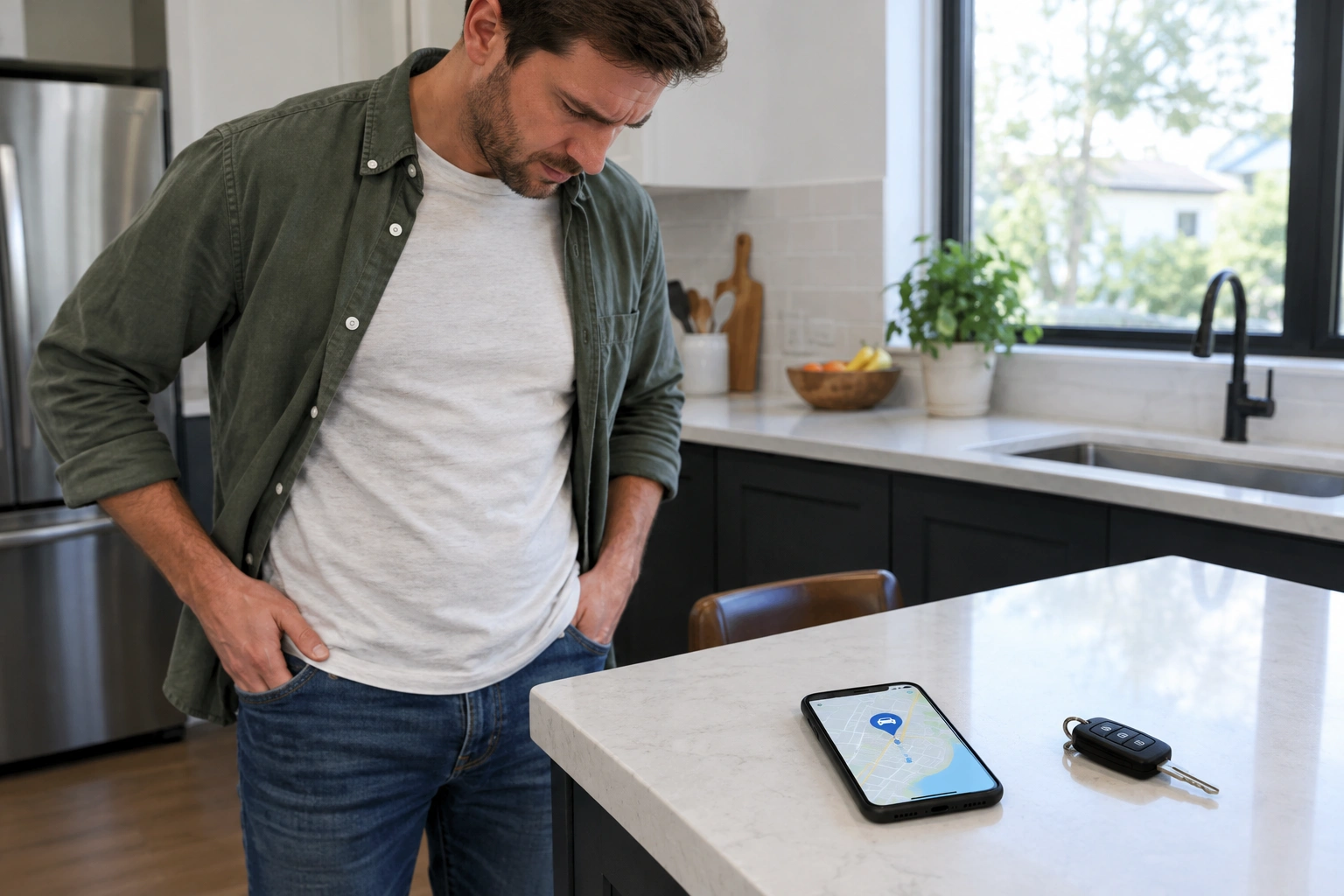
The fastest path is simple: check whether you have a spare, check whether the fob still responds, and then search the most likely places in a strict order. If you already use a Bluetooth tracker, use it now. If you don’t, skip to the high-probability search spots and retrace the last place you remember using the key.
A lost car key finder only helps if it was already attached and still powered. If not, your best tool is a disciplined search, not random guessing.
Quick Answer: Start Here if Your Car Key Is Missing
Use this triage order:
-
Try the spare key first.
If the spare works, you’ve confirmed the vehicle itself is fine and the issue is the missing key, not the car. -
Check whether the fob is dead, not lost.
A dead battery can make a key feel “missing” because the car won’t unlock or start normally. -
Use your tracker app if one is attached.
If the tag supports sound alerts or separation alerts, that may save you a lot of searching. -
Search the nearest likely places before moving farther away.
Pockets, bags, couch cushions, laundry, and the car interior beat a full-house panic search. -
If the key still isn’t found, decide whether to replace it.
If this is your only key, it’s usually time to contact a locksmith or dealership rather than search indefinitely.
That order matters because it separates a simple battery issue from an actual lost-key problem. The fix is very different in each case.
First, Identify the Symptom: Lost Key, Dead Fob, Locked-In Key, or Vehicle Access Problem
A missing key is not always a lost key. Four situations get mixed up all the time:
1) The key is truly lost
You don’t know where it is, and it isn’t responding because you can’t even find it. In that case, the goal is location first, replacement second.
2) The key fob is dead
The key may be right in front of you, but the battery is flat or the fob is damaged. The car won’t react, so it feels like the key disappeared. This often shows up when the fob is in a pocket, bag, or drawer and you only notice the problem when the car doesn’t unlock.
3) The key is in the car or trunk
The fob gets set down inside the cabin, falls between seats, or ends up in the trunk with groceries. If the car won’t respond, that doesn’t automatically mean the key is gone.
4) The vehicle access system is the problem
Sometimes the key is present, but the car still won’t open or recognize it because the vehicle battery is dead, the remote access system is malfunctioning, or the locking system is acting up. In that case, the key may not be the issue at all.
A quick way to sort this out is to ask: Did the key disappear, or did the car stop recognizing it? That answer points you in the right direction.
Most Likely Places to Find a Lost Car Key, in Order
Search in the order below. It’s faster than bouncing around the house.
1) Pockets and bags
Check the exact clothes you wore last. Then check every bag you carried: backpack, purse, laptop bag, gym bag, coat pockets, and even the inside zipper pockets.
This sounds obvious, but keys often move with clothing. A jacket tossed over a chair can hide a fob for hours.
2) The last surface where you set something down
Look at counters, tables, the bathroom sink area, nightstands, kitchen islands, and the spot near the front door. Keys are often placed down “just for a second” and never moved again.
3) Couch cushions, chair creases, and furniture gaps
Use your hands, not just your eyes. Slide fingers between cushions, under throw blankets, and along the edge where the seat meets the armrest.
If your key is dark-colored, it can disappear into upholstery very easily.
4) Laundry baskets, washer, and dryer
This can be a dead end. Keys get left in pants pockets, then fall into laundry or get trapped in a machine. If the key has electronic parts, don’t keep running a wash cycle while you search.
5) The car interior
Check the driver seat, passenger seat, center console, floor mats, under seats, and the door pockets. If the car was recently used, look there before expanding the search to the whole house.
6) The places you visited last
If the key isn’t at home, think through your last stop: store checkout, office desk, restaurant booth, gas station counter, gym locker room, or driveway.
The most likely loss points are where you handled the key while distracted. That’s where a retrace usually pays off.
Retrace the Last Time You Used the Key
When people are stressed, they search the whole house and skip the last known location. That wastes time.
Instead, run the last-use check:
- Where were you when the car was last unlocked?
- Did you carry groceries, a child, a bag, or work items?
- Did you switch jackets or pants after arriving home?
- Did you sit down anywhere right after parking?
- Did you open the trunk or rear hatch?
A practical example: if you got home carrying groceries and the key disappeared afterward, the key is more likely in the kitchen, entryway, or a grocery bag than in the bedroom.
If you remember a specific stop, search the route in reverse. Check your pockets, then the car, then the last place outside the car. That sequence is usually more efficient than a broad search.
How to Use a Bluetooth Tracker or Key Finder
A tracker helps only if it was already attached to the key. That may seem obvious, but it is the key limitation.
Different products use different systems. Some trackers support sound alerts or separation alerts, and some rely on a phone ecosystem or a crowdsourced network. Those features can help, but the exact result depends on the product and the phone platform.
Here’s how to use one effectively:
Step 1: Open the app
Open the tracker app on your phone and select the missing key or tag.
Step 2: Trigger the sound
Use the sound or ring feature first. If the key is nearby, this is the fastest way to narrow the search.
Step 3: Check the last known area
Go to the last place the app shows or the last place you remember using the key. Search that area first.
Step 4: Expand outward
If you don’t hear it, move outward in a small radius from that spot. Check nearby rooms, bags, furniture, and the car interior before moving to the rest of the house.
Step 5: Confirm whether the tracker was ever attached
If the tracker was never on the key in the first place, it cannot help with recovery. In that case, stop relying on the app and switch to a manual search and retracing steps.
If the tracker battery is dead
Then the tracker can’t help. In that case, you’re back to manual search and retracing steps.
The trade-off is straightforward: trackers are fast when they’re already attached and powered, but they do nothing if they were never installed or have no battery left.
What to Do If the Key Fob Battery Is Dead
A dead battery can look like a lost key problem, especially if the car won’t unlock or start normally.
Before you call the key “lost,” check these clues:
- The fob is physically in your hand, pocket, or bag.
- Buttons stopped working suddenly.
- The car responds only inconsistently.
- The key opens the door mechanically, but remote functions fail.
If that’s the situation, the key may still be with you. The issue is power, not location.
That distinction matters because replacing a battery is simpler than replacing a whole key. If the key is present but dead, you may only need a battery change or a closer look at the fob itself if it was damaged.
If you have a spare key, use it to confirm the car and immobilizer system are still fine. A working spare tells you the vehicle isn’t the problem.
If the key is present but the car still won’t open
That can point to a vehicle-side issue instead of a key problem. On push-button start vehicles, a weak or dead vehicle battery, a malfunctioning remote access system, or a lock issue can keep the car from responding even when the fob is nearby. If the mechanical blade key is available, use it to confirm whether the door itself can be opened manually.
How to Check Whether the Key Is in the Car or Trunk
If the car won’t respond, don’t rule out an internal lockout too early.
Check these spots:
- Driver seat and passenger seat cracks
- Center console
- Cup holders
- Door pockets
- Under the seats
- Floor mats
- Trunk or rear cargo area
- Jacket or bag left in the car
If you have a push-button start vehicle, the car may still detect the key if it’s inside the cabin, even if the battery is weak. If it doesn’t, that still doesn’t prove the key is outside the car.
A useful test is to stand near each door and try the usual unlock method. If one door behaves differently, the key may be closer than you think. Also check whether the trunk release behaves normally, because keys often end up where groceries or luggage were loaded.
If the key is inside the car but the car still won’t open, you may be dealing with a dead vehicle battery or a remote access malfunction rather than a lost key. In that case, roadside assistance may help with access or towing, but not necessarily with replacement.
Comparison: Dead Fob vs Lost Key vs Tracker Search
| Situation | Fastest move | Likelihood of success | Main trade-off |
|---|---|---|---|
| Dead key fob battery | Test with spare or replace battery | High if the key is present | Cheap fix, but only if the key isn’t actually missing |
| Lost key at home | Search pockets, bags, furniture, laundry, car interior | High if searched in order | Time spent searching may save replacement cost |
| Tracker attached and powered | Open app, trigger sound, check last known area, expand outward | High when within tracker limits | Only works if tracker was installed and still has power |
| Key lost outside the home | Retrace last stop and route | Moderate | Can take time, but may find the key without replacement |
| No key found, no spare | Call locksmith or dealership | High for getting back on the road | Replacement may require proof of ownership and programming |
| Roadside assistance | Use for access or tow help | Moderate | Helpful for lockouts, not always full replacement |
This table is the decision point. If the key is probably nearby, keep searching. If it’s truly gone and you have no spare, stop burning time and move to replacement.
If You Still Can’t Find It: Keep Searching or Replace It?
Use this rule:
- Keep searching if the key was last used at home, the fob may be dead, or you have a tracker attached.
- Move to replacement if you’ve searched the likely spots, retraced the last stop, and still have no sign of it.
- Escalate immediately if you lost your only key or suspect it was stolen.
A useful cutoff is about five to ten minutes of focused searching on the highest-probability spots. After that, if nothing turns up, widen the search once and then decide whether replacement is the better next step.
A lot of people search too long because they hope the key will turn up in one more pocket. That’s reasonable for a few minutes. It’s not efficient for hours.
If the vehicle is usable with a spare, you can buy more time. If not, replacement becomes the practical next step.
Replacement Options: Locksmith vs Dealership vs Roadside Assistance
This is where speed and vehicle type matter.
Automotive locksmith
A locksmith is often the faster practical option for many lost-key situations, especially when you need mobile help and the vehicle can be serviced on-site. They may be able to cut and program a replacement, depending on the vehicle and key type. For many drivers, this is the most convenient path when the key is lost and the car needs to be usable again soon.
Dealership
A dealership may be necessary for certain vehicles, especially when the key type, security system, or programming procedure is more specialized. If the vehicle uses dealer-specific programming or a restricted key system, the dealership is more likely to be required. The trade-off is usually less convenience. You may need to tow the car or bring documents and wait for parts or programming.
Roadside assistance
Roadside help is useful if you’re locked out or stranded, and some plans can help with access or towing. But roadside assistance does not always solve the full replacement problem. It’s best seen as a bridge to the next step, not always the final fix.
If you want a deeper comparison of replacement paths, this guide on how to replace a lost car key without the original breaks down the common options more fully.
What to Do If You Lost Your Only Car Key
This is the highest-stakes version of the problem.
First, stop assuming a spare exists somewhere. If you truly have no backup, the goal is to regain access and get a replacement made as efficiently as possible.
Have these ready:
- Vehicle identification
- Proof of ownership
- Your ID
- The car’s location
- Any details about the key type, if you know them
A locksmith or dealership may need those documents before they can help. If the car is somewhere unsafe or the key might be inside it, you may also need towing or access assistance.
If you want a step-by-step recovery path for this scenario, see what to do next after losing a car key fob.
When the Key May Be Stolen, Not Just Lost
If the key disappeared in a public place, was taken from a bag, or went missing after a break-in, treat it as a security issue.
That changes the response because the missing key may still work on the vehicle. In that case, replacement alone may not be enough. You may need to ask whether the lost key should be deactivated during the replacement process, depending on the vehicle and system.
Signs it may be stolen rather than misplaced:
- The key vanished from a secure area
- Your bag or pocket was accessed
- The key disappeared after a theft or break-in
- Someone else may know where the vehicle is parked
If theft is possible, act faster. Don’t leave the car exposed longer than necessary.
When to Call an Automotive Locksmith
Call a locksmith right away if:
- You lost your only key
- The key is locked in the car or trunk and you can’t access it safely
- You need a replacement that may require programming
- The car is stuck and you need mobile help instead of a tow
- You suspect the key was stolen and need the situation handled carefully
For many drivers, a locksmith is a practical middle ground between doing nothing and going straight to the dealership, but the best choice depends on the vehicle and the key system.
FAQ
Can a dead key fob still be found?
Yes. A dead battery stops the remote function, but it doesn’t make the key vanish. If the fob is physically nearby, search the normal hiding places first.
Do key finders work for car keys?
They can, if a compatible tracker was already attached. Some products offer sound alerts, separation alerts, or app-based location features, but results depend on the model and phone ecosystem.
What if I only lost the key outside the house?
Retrace the last stop and the route back home. Check the place where you paid, sat down, or handled bags. That’s often faster than a full-house search.
Should I call the dealership or a locksmith first?
If you need speed and the vehicle allows it, a locksmith is often the faster call. If the vehicle needs dealer-specific programming, the dealership may be necessary.
Can a traditional car key be tracked?
Traditional keys with no electronic components cannot be tracked. In that case, manual search and retracing steps are your only real recovery tools.
What if the key is in the trunk?
Check the trunk release, rear cargo area, and anything you loaded last. If the key is inside and inaccessible, you may need professional help to regain access.
If I find the key later, should I still replace it?
If it was only misplaced, maybe not. If it may have been stolen or exposed, ask a professional whether reprogramming or deactivation is wise for your vehicle.
The key takeaway: don’t treat every missing fob the same way. A dead battery, a locked-in key, a vehicle access problem, and a genuinely lost key each call for a different response. The faster you identify which one you’re dealing with, the faster you get back in the car.
